 Add to Chrome
 Add to Firefox
 Add to Edge
Selective Prior Synchronization via SYNC Loss
Feb 11, 2026
Prediction under uncertainty is a critical requirement for the deep neural network to succeed responsibly. This paper focuses on selective prediction, which allows DNNs to make informed decisions about when to predict or abstain based on the uncertainty level of their predictions. Current methods are either ad-hoc such as SelectiveNet, focusing on how to modify the network architecture or objective function, or post-hoc such as softmax response, achieving selective prediction through analyzing the model's probabilistic outputs. We observe that post-hoc methods implicitly generate uncertainty information, termed the selective prior, which has traditionally been used only during inference. We argue that the selective prior provided by the selection mechanism is equally vital during the training stage. Therefore, we propose the SYNC loss which introduces a novel integration of ad-hoc and post-hoc method. Specifically, our approach incorporates the softmax response into the training process of SelectiveNet, enhancing its selective prediction capabilities by examining the selective prior. Evaluated across various datasets, including CIFAR-100, ImageNet-100, and Stanford Cars, our method not only enhances the model's generalization capabilities but also surpasses previous works in selective prediction performance, and sets new benchmarks for state-of-the-art performance.

Recognize Any Surgical Object: Unleashing the Power of Weakly-Supervised Data
Jan 25, 2025
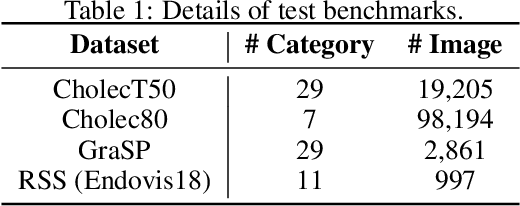

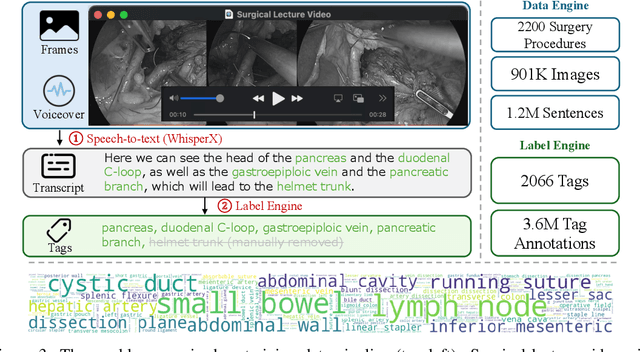
We present RASO, a foundation model designed to Recognize Any Surgical Object, offering robust open-set recognition capabilities across a broad range of surgical procedures and object classes, in both surgical images and videos. RASO leverages a novel weakly-supervised learning framework that generates tag-image-text pairs automatically from large-scale unannotated surgical lecture videos, significantly reducing the need for manual annotations. Our scalable data generation pipeline gatherers to 2,200 surgical procedures and produces 3.6 million tag annotations across 2,066 unique surgical tags. Our experiments show that RASO achieves improvements of 2.9 mAP, 4.5 mAP, 10.6 mAP, and 7.2 mAP on four standard surgical benchmarks respectively in zero-shot settings, and surpasses state-of-the-art models in supervised surgical action recognition tasks. We will open-source our code, model, and dataset to facilitate further research.
Client Contribution Normalization for Enhanced Federated Learning
Nov 10, 2024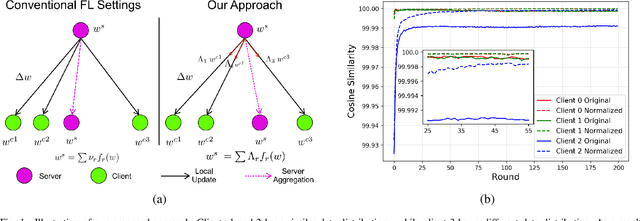
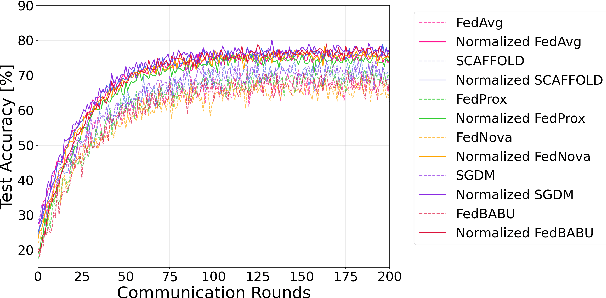
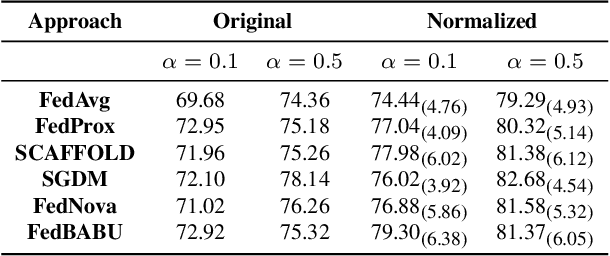
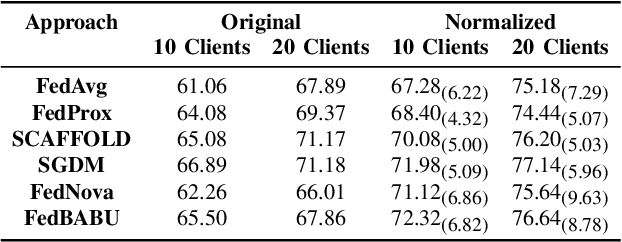
Mobile devices, including smartphones and laptops, generate decentralized and heterogeneous data, presenting significant challenges for traditional centralized machine learning models due to substantial communication costs and privacy risks. Federated Learning (FL) offers a promising alternative by enabling collaborative training of a global model across decentralized devices without data sharing. However, FL faces challenges due to statistical heterogeneity among clients, where non-independent and identically distributed (non-IID) data impedes model convergence and performance. This paper focuses on data-dependent heterogeneity in FL and proposes a novel approach leveraging mean latent representations extracted from locally trained models. The proposed method normalizes client contributions based on these representations, allowing the central server to estimate and adjust for heterogeneity during aggregation. This normalization enhances the global model's generalization and mitigates the limitations of conventional federated averaging methods. The main contributions include introducing a normalization scheme using mean latent representations to handle statistical heterogeneity in FL, demonstrating the seamless integration with existing FL algorithms to improve performance in non-IID settings, and validating the approach through extensive experiments on diverse datasets. Results show significant improvements in model accuracy and consistency across skewed distributions. Our experiments with six FL schemes: FedAvg, FedProx, FedBABU, FedNova, SCAFFOLD, and SGDM highlight the robustness of our approach. This research advances FL by providing a practical and computationally efficient solution for statistical heterogeneity, contributing to the development of more reliable and generalized machine learning models.
Distilling Calibrated Student from an Uncalibrated Teacher
Feb 22, 2023Knowledge distillation is a common technique for improving the performance of a shallow student network by transferring information from a teacher network, which in general, is comparatively large and deep. These teacher networks are pre-trained and often uncalibrated, as no calibration technique is applied to the teacher model while training. Calibration of a network measures the probability of correctness for any of its predictions, which is critical in high-risk domains. In this paper, we study how to obtain a calibrated student from an uncalibrated teacher. Our approach relies on the fusion of the data-augmentation techniques, including but not limited to cutout, mixup, and CutMix, with knowledge distillation. We extend our approach beyond traditional knowledge distillation and find it suitable for Relational Knowledge Distillation and Contrastive Representation Distillation as well. The novelty of the work is that it provides a framework to distill a calibrated student from an uncalibrated teacher model without compromising the accuracy of the distilled student. We perform extensive experiments to validate our approach on various datasets, including CIFAR-10, CIFAR-100, CINIC-10 and TinyImageNet, and obtained calibrated student models. We also observe robust performance of our approach while evaluating it on corrupted CIFAR-100C data.