 Add to Chrome
 Add to Firefox
 Add to Edge
GSRM: Generative Speech Reward Model for Speech RLHF
Feb 14, 2026
Recent advances in speech language models, such as GPT-4o Voice Mode and Gemini Live, have demonstrated promising speech generation capabilities. Nevertheless, the aesthetic naturalness of the synthesized audio still lags behind that of human speech. Enhancing generation quality requires a reliable evaluator of speech naturalness. However, existing naturalness evaluators typically regress raw audio to scalar scores, offering limited interpretability of the evaluation and moreover fail to generalize to speech across different taxonomies. Inspired by recent advances in generative reward modeling, we propose the Generative Speech Reward Model (GSRM), a reasoning-centric reward model tailored for speech. The GSRM is trained to decompose speech naturalness evaluation into an interpretable acoustic feature extraction stage followed by feature-grounded chain-of-thought reasoning, enabling explainable judgments. To achieve this, we curated a large-scale human feedback dataset comprising 31k expert ratings and an out-of-domain benchmark of real-world user-assistant speech interactions. Experiments show that GSRM substantially outperforms existing speech naturalness predictors, achieving model-human correlation of naturalness score prediction that approaches human inter-rater consistency. We further show how GSRM can improve the naturalness of speech LLM generations by serving as an effective verifier for online RLHF.

VowelPrompt: Hearing Speech Emotions from Text via Vowel-level Prosodic Augmentation
Feb 06, 2026Emotion recognition in speech presents a complex multimodal challenge, requiring comprehension of both linguistic content and vocal expressivity, particularly prosodic features such as fundamental frequency, intensity, and temporal dynamics. Although large language models (LLMs) have shown promise in reasoning over textual transcriptions for emotion recognition, they typically neglect fine-grained prosodic information, limiting their effectiveness and interpretability. In this work, we propose VowelPrompt, a linguistically grounded framework that augments LLM-based emotion recognition with interpretable, fine-grained vowel-level prosodic cues. Drawing on phonetic evidence that vowels serve as primary carriers of affective prosody, VowelPrompt extracts pitch-, energy-, and duration-based descriptors from time-aligned vowel segments, and converts these features into natural language descriptions for better interpretability. Such a design enables LLMs to jointly reason over lexical semantics and fine-grained prosodic variation. Moreover, we adopt a two-stage adaptation procedure comprising supervised fine-tuning (SFT) followed by Reinforcement Learning with Verifiable Reward (RLVR), implemented via Group Relative Policy Optimization (GRPO), to enhance reasoning capability, enforce structured output adherence, and improve generalization across domains and speaker variations. Extensive evaluations across diverse benchmark datasets demonstrate that VowelPrompt consistently outperforms state-of-the-art emotion recognition methods under zero-shot, fine-tuned, cross-domain, and cross-linguistic conditions, while enabling the generation of interpretable explanations that are jointly grounded in contextual semantics and fine-grained prosodic structure.
The Llama 4 Herd: Architecture, Training, Evaluation, and Deployment Notes
Jan 15, 2026This document consolidates publicly reported technical details about Metas Llama 4 model family. It summarizes (i) released variants (Scout and Maverick) and the broader herd context including the previewed Behemoth teacher model, (ii) architectural characteristics beyond a high-level MoE description covering routed/shared-expert structure, early-fusion multimodality, and long-context design elements reported for Scout (iRoPE and length generalization strategies), (iii) training disclosures spanning pre-training, mid-training for long-context extension, and post-training methodology (lightweight SFT, online RL, and lightweight DPO) as described in release materials, (iv) developer-reported benchmark results for both base and instruction-tuned checkpoints, and (v) practical deployment constraints observed across major serving environments, including provider-specific context limits and quantization packaging. The manuscript also summarizes licensing obligations relevant to redistribution and derivative naming, and reviews publicly described safeguards and evaluation practices. The goal is to provide a compact technical reference for researchers and practitioners who need precise, source-backed facts about Llama 4.
Non-Monotonic Attention-based Read/Write Policy Learning for Simultaneous Translation
Mar 28, 2025Simultaneous or streaming machine translation generates translation while reading the input stream. These systems face a quality/latency trade-off, aiming to achieve high translation quality similar to non-streaming models with minimal latency. We propose an approach that efficiently manages this trade-off. By enhancing a pretrained non-streaming model, which was trained with a seq2seq mechanism and represents the upper bound in quality, we convert it into a streaming model by utilizing the alignment between source and target tokens. This alignment is used to learn a read/write decision boundary for reliable translation generation with minimal input. During training, the model learns the decision boundary through a read/write policy module, employing supervised learning on the alignment points (pseudo labels). The read/write policy module, a small binary classification unit, can control the quality/latency trade-off during inference. Experimental results show that our model outperforms several strong baselines and narrows the gap with the non-streaming baseline model.
Transcribing and Translating, Fast and Slow: Joint Speech Translation and Recognition
Dec 19, 2024We propose the joint speech translation and recognition (JSTAR) model that leverages the fast-slow cascaded encoder architecture for simultaneous end-to-end automatic speech recognition (ASR) and speech translation (ST). The model is transducer-based and uses a multi-objective training strategy that optimizes both ASR and ST objectives simultaneously. This allows JSTAR to produce high-quality streaming ASR and ST results. We apply JSTAR in a bilingual conversational speech setting with smart-glasses, where the model is also trained to distinguish speech from different directions corresponding to the wearer and a conversational partner. Different model pre-training strategies are studied to further improve results, including training of a transducer-based streaming machine translation (MT) model for the first time and applying it for parameter initialization of JSTAR. We demonstrate superior performances of JSTAR compared to a strong cascaded ST model in both BLEU scores and latency.
Textless Streaming Speech-to-Speech Translation using Semantic Speech Tokens
Oct 04, 2024


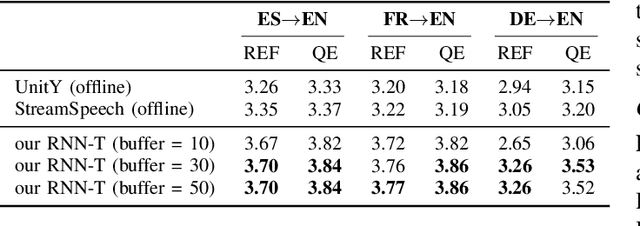
Cascaded speech-to-speech translation systems often suffer from the error accumulation problem and high latency, which is a result of cascaded modules whose inference delays accumulate. In this paper, we propose a transducer-based speech translation model that outputs discrete speech tokens in a low-latency streaming fashion. This approach eliminates the need for generating text output first, followed by machine translation (MT) and text-to-speech (TTS) systems. The produced speech tokens can be directly used to generate a speech signal with low latency by utilizing an acoustic language model (LM) to obtain acoustic tokens and an audio codec model to retrieve the waveform. Experimental results show that the proposed method outperforms other existing approaches and achieves state-of-the-art results for streaming translation in terms of BLEU, average latency, and BLASER 2.0 scores for multiple language pairs using the CVSS-C dataset as a benchmark.
AGADIR: Towards Array-Geometry Agnostic Directional Speech Recognition
Jan 18, 2024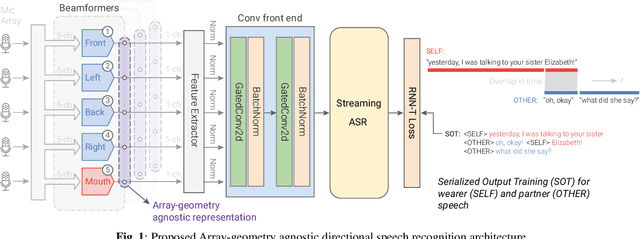
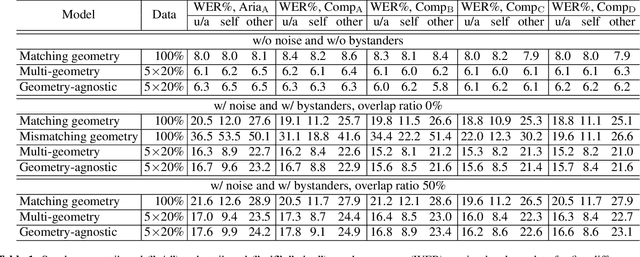
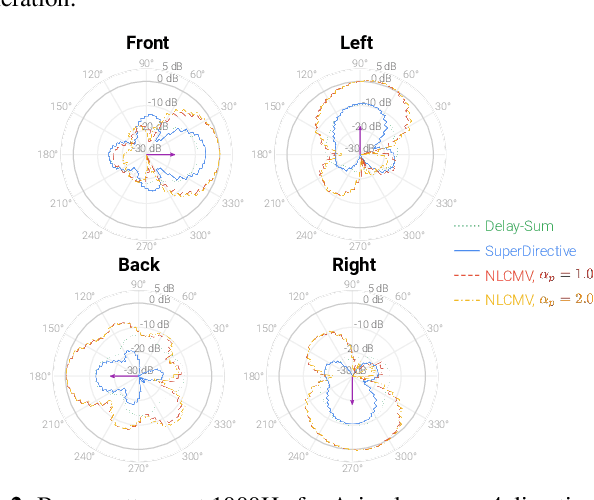

Wearable devices like smart glasses are approaching the compute capability to seamlessly generate real-time closed captions for live conversations. We build on our recently introduced directional Automatic Speech Recognition (ASR) for smart glasses that have microphone arrays, which fuses multi-channel ASR with serialized output training, for wearer/conversation-partner disambiguation as well as suppression of cross-talk speech from non-target directions and noise. When ASR work is part of a broader system-development process, one may be faced with changes to microphone geometries as system development progresses. This paper aims to make multi-channel ASR insensitive to limited variations of microphone-array geometry. We show that a model trained on multiple similar geometries is largely agnostic and generalizes well to new geometries, as long as they are not too different. Furthermore, training the model this way improves accuracy for seen geometries by 15 to 28\% relative. Lastly, we refine the beamforming by a novel Non-Linearly Constrained Minimum Variance criterion.
SynthVSR: Scaling Up Visual Speech Recognition With Synthetic Supervision
Apr 03, 2023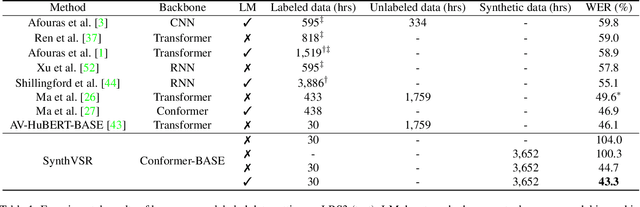

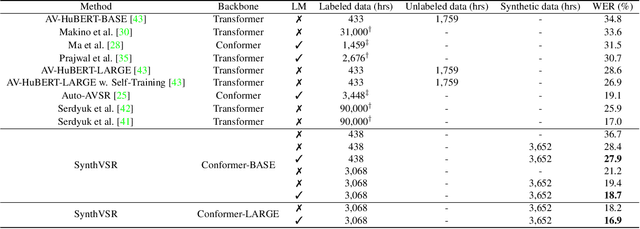
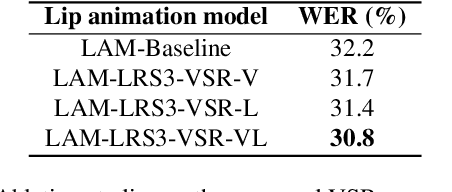
Recently reported state-of-the-art results in visual speech recognition (VSR) often rely on increasingly large amounts of video data, while the publicly available transcribed video datasets are limited in size. In this paper, for the first time, we study the potential of leveraging synthetic visual data for VSR. Our method, termed SynthVSR, substantially improves the performance of VSR systems with synthetic lip movements. The key idea behind SynthVSR is to leverage a speech-driven lip animation model that generates lip movements conditioned on the input speech. The speech-driven lip animation model is trained on an unlabeled audio-visual dataset and could be further optimized towards a pre-trained VSR model when labeled videos are available. As plenty of transcribed acoustic data and face images are available, we are able to generate large-scale synthetic data using the proposed lip animation model for semi-supervised VSR training. We evaluate the performance of our approach on the largest public VSR benchmark - Lip Reading Sentences 3 (LRS3). SynthVSR achieves a WER of 43.3% with only 30 hours of real labeled data, outperforming off-the-shelf approaches using thousands of hours of video. The WER is further reduced to 27.9% when using all 438 hours of labeled data from LRS3, which is on par with the state-of-the-art self-supervised AV-HuBERT method. Furthermore, when combined with large-scale pseudo-labeled audio-visual data SynthVSR yields a new state-of-the-art VSR WER of 16.9% using publicly available data only, surpassing the recent state-of-the-art approaches trained with 29 times more non-public machine-transcribed video data (90,000 hours). Finally, we perform extensive ablation studies to understand the effect of each component in our proposed method.