 Add to Chrome
 Add to Firefox
 Add to Edge
A Control System, a Dataset, and a Recipe for Making Frozen LLM Agents Learn a Domain
Jul 28, 2026
Production LLM agents are increasingly assembled from a frozen model wrapped in a harness: a prompt template, a tool set, a memory/retrieval layer, a planning strategy, and a verification policy. Two 2026 systems, Meta-Harness (Lee et al., 2026) and HyperAgents (Meta AI, 2026), show that this harness can itself be optimized or even self-rewritten by an agentic proposer -- at the cost of either an expensive code-search loop or unconstrained self-modifying code, neither of which is auditable or usable with a fully black-box model API. We take a narrower, more constrained position: treat the harness as a small, fixed, human-legible action space and learn a policy over it online with classic sample-efficient reinforcement learning (an $ε$-greedy contextual bandit and REINFORCE), scored against a multi-objective reward (task success, verifier score, policy compliance, cost, latency, and an unsupported-claim penalty). We instantiate this control system with DSPy (Khattab et al., 2024) as both the context assembler and the source of the strongest non-adaptive baseline (a DSPy BootstrapFewShot static prompt), and evaluate it across three verifiable task domains -- tool-use workflows, code generation (HumanEval), and multi-hop retrieval QA (HotpotQA) -- and two model providers (a local Ollama model and AWS Bedrock). We release the harness-control-system code, the cross-domain verifiable task suite, the full trajectory/reward-decomposition logs from training, and a provider-agnostic deployment recipe for applying this to a new organization's domain and verification setup.

Context Assembly as the Controlled Variable: A Control-Theoretic View of Harness Policies for Frozen LLM Agents
Jul 28, 2026A growing body of 2026 work applies control theory to LLM agents: Lyapunov-certified stability for tool-mediated controllers (Prinos et al., "Stable Agentic Control", 2026), sample-complexity bounds for sparse policies over massive discrete tool universes (Majumdar, "Sparse Agentic Control", 2026), and regulatory-control decompositions of multi-agent systems into auditable feedback loops (Nogueira and Skogestad, 2026). We do not claim to introduce control theory to LLM agents -- that ship has sailed. Our narrower claim is about what the controlled variable is. Prior work controls tool selection, inter-agent message routing, or the agent's raw action stream. We instead treat context assembly itself -- which prompt template, which few-shot demonstrations, how much retrieved context, how many planning/verification passes -- as the controlled variable, learned online by a contextual bandit or REINFORCE policy sitting outside a frozen model. This paper develops the formal decomposition (inner frozen policy $π_θ$, outer context policy $π_φ$), gives a stability argument for the online controller in the sense used by Zhang et al. (2026) (non-decreasing expected reward under bounded policy change), and reports an uncertainty-calibration analysis of the controller's own confidence against realized task outcomes. The applied counterpart to this paper instantiates the same controller across three domains and two model providers and releases the dataset, trajectory logs, and a deployment recipe; here we focus on the formal framing and the stability/uncertainty evidence a control-theoretic claim requires.
VowelPrompt: Hearing Speech Emotions from Text via Vowel-level Prosodic Augmentation
Feb 06, 2026Emotion recognition in speech presents a complex multimodal challenge, requiring comprehension of both linguistic content and vocal expressivity, particularly prosodic features such as fundamental frequency, intensity, and temporal dynamics. Although large language models (LLMs) have shown promise in reasoning over textual transcriptions for emotion recognition, they typically neglect fine-grained prosodic information, limiting their effectiveness and interpretability. In this work, we propose VowelPrompt, a linguistically grounded framework that augments LLM-based emotion recognition with interpretable, fine-grained vowel-level prosodic cues. Drawing on phonetic evidence that vowels serve as primary carriers of affective prosody, VowelPrompt extracts pitch-, energy-, and duration-based descriptors from time-aligned vowel segments, and converts these features into natural language descriptions for better interpretability. Such a design enables LLMs to jointly reason over lexical semantics and fine-grained prosodic variation. Moreover, we adopt a two-stage adaptation procedure comprising supervised fine-tuning (SFT) followed by Reinforcement Learning with Verifiable Reward (RLVR), implemented via Group Relative Policy Optimization (GRPO), to enhance reasoning capability, enforce structured output adherence, and improve generalization across domains and speaker variations. Extensive evaluations across diverse benchmark datasets demonstrate that VowelPrompt consistently outperforms state-of-the-art emotion recognition methods under zero-shot, fine-tuned, cross-domain, and cross-linguistic conditions, while enabling the generation of interpretable explanations that are jointly grounded in contextual semantics and fine-grained prosodic structure.
LLaMA based Punctuation Restoration With Forward Pass Only Decoding
Aug 09, 2024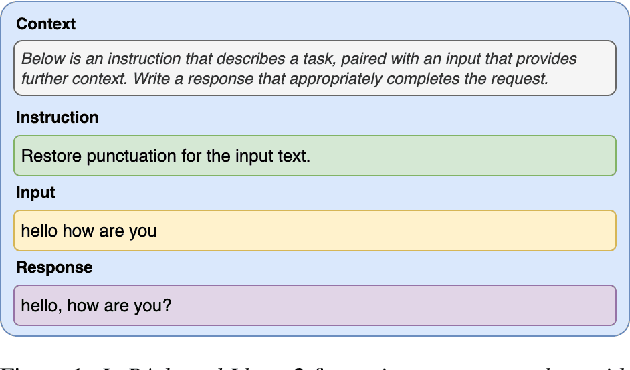
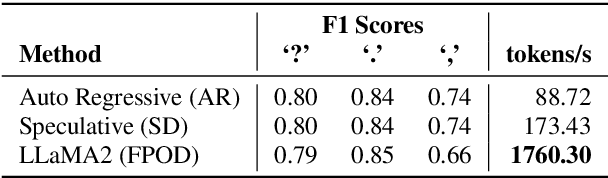
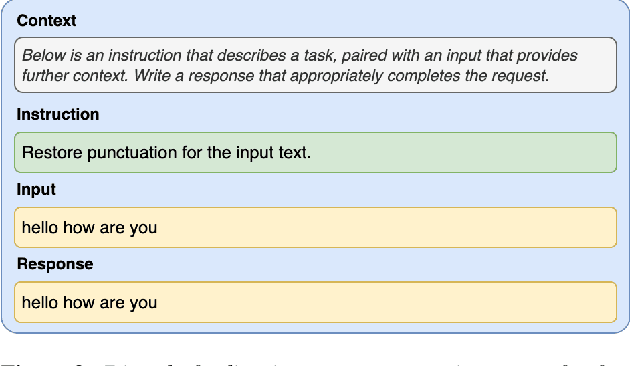
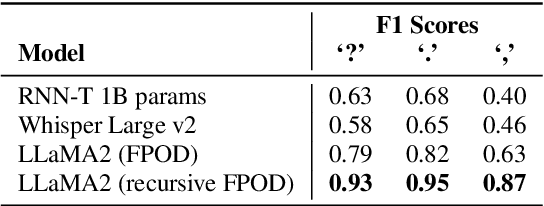
This paper introduces two advancements in the field of Large Language Model Annotation with a focus on punctuation restoration tasks. Our first contribution is the application of LLaMA for punctuation restoration, which demonstrates superior performance compared to the established benchmark. Despite its impressive quality, LLaMA faces challenges regarding inference speed and hallucinations. To address this, our second contribution presents Forward Pass Only Decoding (FPOD), a novel decoding approach for annotation tasks. This innovative method results in a substantial 19.8x improvement in inference speed, effectively addressing a critical bottleneck and enhancing the practical utility of LLaMA for large-scale data annotation tasks without hallucinations. The combination of these contributions not only solidifies LLaMA as a powerful tool for punctuation restoration but also highlights FPOD as a crucial strategy for overcoming speed constraints.
Towards scalable efficient on-device ASR with transfer learning
Jul 23, 2024
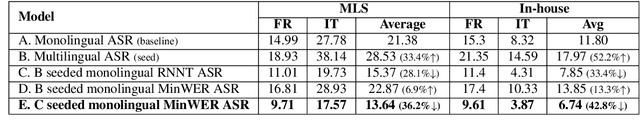


Multilingual pretraining for transfer learning significantly boosts the robustness of low-resource monolingual ASR models. This study systematically investigates three main aspects: (a) the impact of transfer learning on model performance during initial training or fine-tuning, (b) the influence of transfer learning across dataset domains and languages, and (c) the effect on rare-word recognition compared to non-rare words. Our finding suggests that RNNT-loss pretraining, followed by monolingual fine-tuning with Minimum Word Error Rate (MinWER) loss, consistently reduces Word Error Rates (WER) across languages like Italian and French. WER Reductions (WERR) reach 36.2% and 42.8% compared to monolingual baselines for MLS and in-house datasets. Out-of-domain pretraining leads to 28% higher WERR than in-domain pretraining. Both rare and non-rare words benefit, with rare words showing greater improvements with out-of-domain pretraining, and non-rare words with in-domain pretraining.
Generative AI for Software Metadata: Overview of the Information Retrieval in Software Engineering Track at FIRE 2023
Oct 27, 2023The Information Retrieval in Software Engineering (IRSE) track aims to develop solutions for automated evaluation of code comments in a machine learning framework based on human and large language model generated labels. In this track, there is a binary classification task to classify comments as useful and not useful. The dataset consists of 9048 code comments and surrounding code snippet pairs extracted from open source github C based projects and an additional dataset generated individually by teams using large language models. Overall 56 experiments have been submitted by 17 teams from various universities and software companies. The submissions have been evaluated quantitatively using the F1-Score and qualitatively based on the type of features developed, the supervised learning model used and their corresponding hyper-parameters. The labels generated from large language models increase the bias in the prediction model but lead to less over-fitted results.
Recovering from Privacy-Preserving Masking with Large Language Models
Sep 23, 2023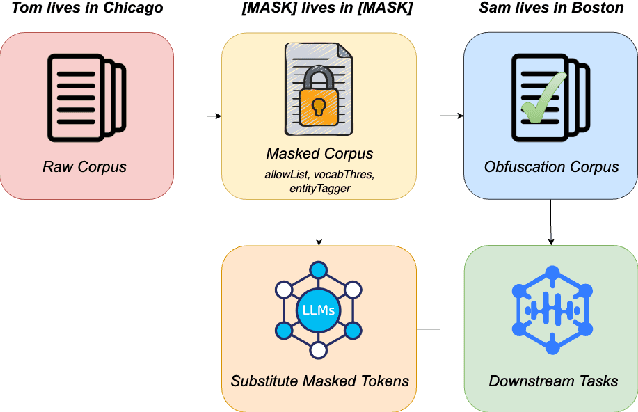
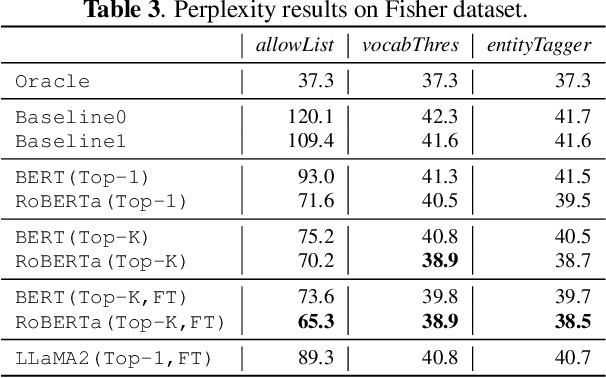
Model adaptation is crucial to handle the discrepancy between proxy training data and actual users data received. To effectively perform adaptation, textual data of users is typically stored on servers or their local devices, where downstream natural language processing (NLP) models can be directly trained using such in-domain data. However, this might raise privacy and security concerns due to the extra risks of exposing user information to adversaries. Replacing identifying information in textual data with a generic marker has been recently explored. In this work, we leverage large language models (LLMs) to suggest substitutes of masked tokens and have their effectiveness evaluated on downstream language modeling tasks. Specifically, we propose multiple pre-trained and fine-tuned LLM-based approaches and perform empirical studies on various datasets for the comparison of these methods. Experimental results show that models trained on the obfuscation corpora are able to achieve comparable performance with the ones trained on the original data without privacy-preserving token masking.
Language Agnostic Data-Driven Inverse Text Normalization
Jan 24, 2023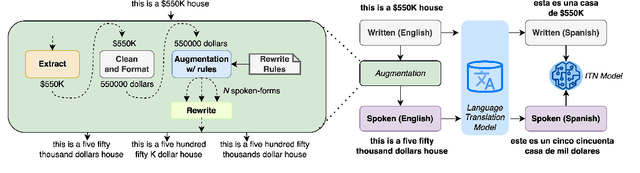
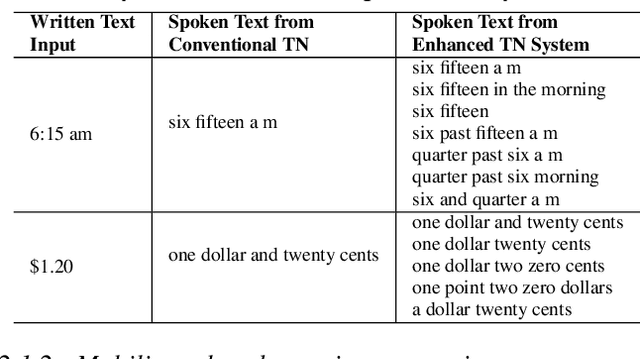
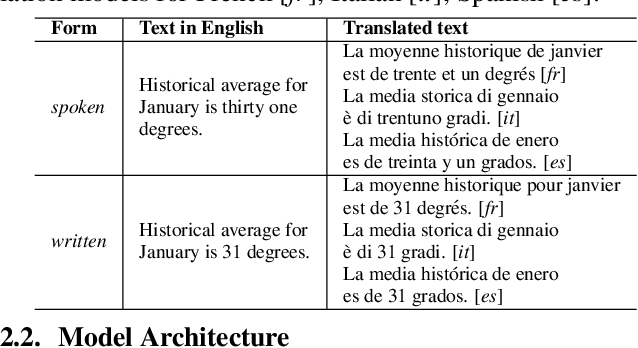
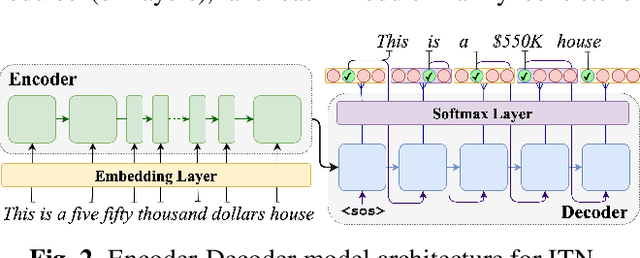
With the emergence of automatic speech recognition (ASR) models, converting the spoken form text (from ASR) to the written form is in urgent need. This inverse text normalization (ITN) problem attracts the attention of researchers from various fields. Recently, several works show that data-driven ITN methods can output high-quality written form text. Due to the scarcity of labeled spoken-written datasets, the studies on non-English data-driven ITN are quite limited. In this work, we propose a language-agnostic data-driven ITN framework to fill this gap. Specifically, we leverage the data augmentation in conjunction with neural machine translated data for low resource languages. Moreover, we design an evaluation method for language agnostic ITN model when only English data is available. Our empirical evaluation shows this language agnostic modeling approach is effective for low resource languages while preserving the performance for high resource languages.
Improving Data Driven Inverse Text Normalization using Data Augmentation
Jul 20, 2022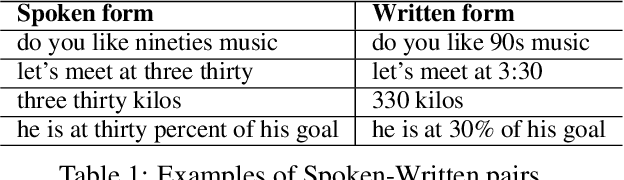
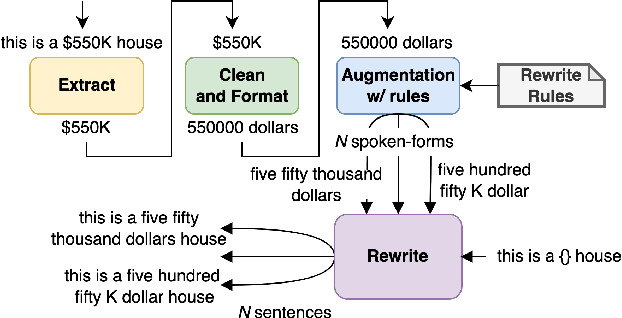

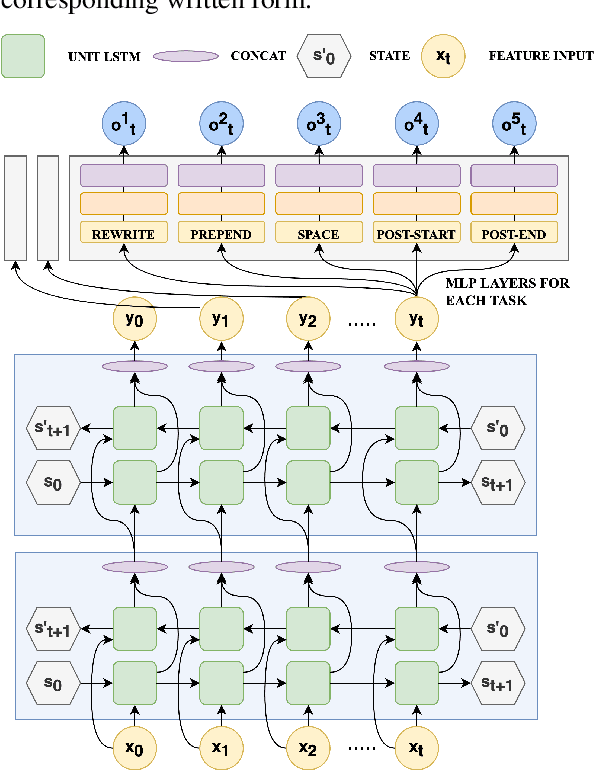
Inverse text normalization (ITN) is used to convert the spoken form output of an automatic speech recognition (ASR) system to a written form. Traditional handcrafted ITN rules can be complex to transcribe and maintain. Meanwhile neural modeling approaches require quality large-scale spoken-written pair examples in the same or similar domain as the ASR system (in-domain data), to train. Both these approaches require costly and complex annotations. In this paper, we present a data augmentation technique that effectively generates rich spoken-written numeric pairs from out-of-domain textual data with minimal human annotation. We empirically demonstrate that ITN model trained using our data augmentation technique consistently outperform ITN model trained using only in-domain data across all numeric surfaces like cardinal, currency, and fraction, by an overall accuracy of 14.44%.
Database Workload Characterization with Query Plan Encoders
May 26, 2021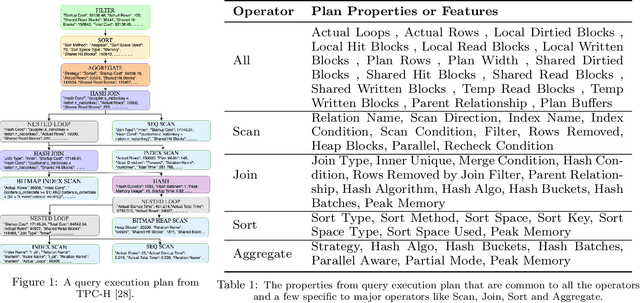
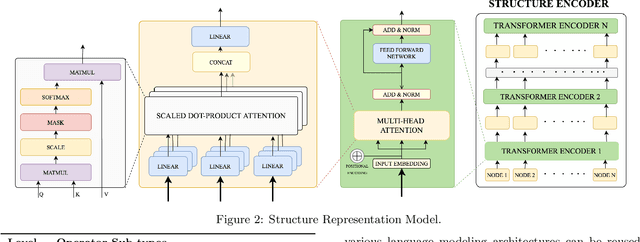
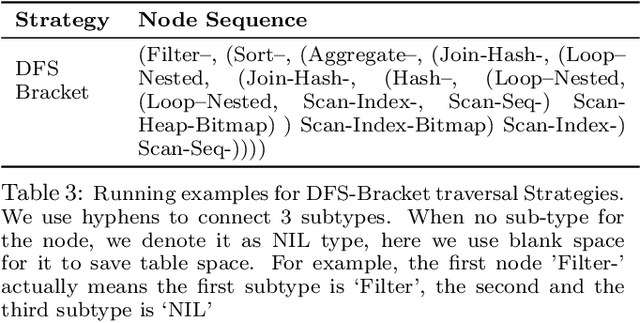
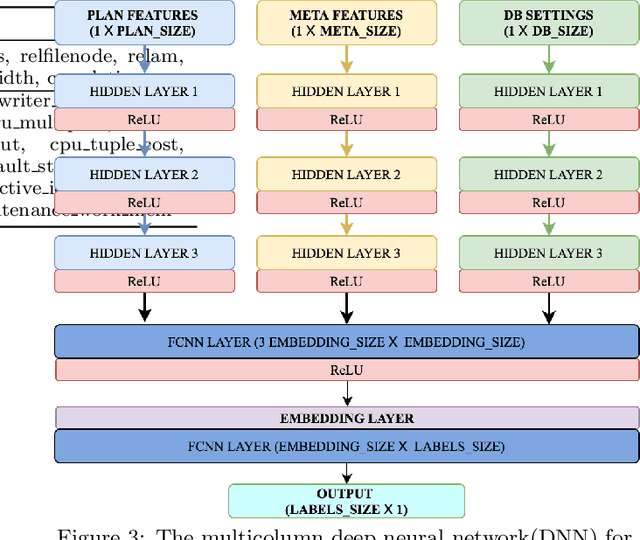
Smart databases are adopting artificial intelligence (AI) technologies to achieve {\em instance optimality}, and in the future, databases will come with prepackaged AI models within their core components. The reason is that every database runs on different workloads, demands specific resources, and settings to achieve optimal performance. It prompts the necessity to understand workloads running in the system along with their features comprehensively, which we dub as workload characterization. To address this workload characterization problem, we propose our query plan encoders that learn essential features and their correlations from query plans. Our pretrained encoders capture the {\em structural} and the {\em computational performance} of queries independently. We show that our pretrained encoders are adaptable to workloads that expedite the transfer learning process. We performed independent assessments of structural encoder and performance encoders with multiple downstream tasks. For the overall evaluation of our query plan encoders, we architect two downstream tasks (i) query latency prediction and (ii) query classification. These tasks show the importance of feature-based workload characterization. We also performed extensive experiments on individual encoders to verify the effectiveness of representation learning and domain adaptability.