 Add to Chrome
 Add to Firefox
 Add to Edge
VowelPrompt: Hearing Speech Emotions from Text via Vowel-level Prosodic Augmentation
Feb 06, 2026
Emotion recognition in speech presents a complex multimodal challenge, requiring comprehension of both linguistic content and vocal expressivity, particularly prosodic features such as fundamental frequency, intensity, and temporal dynamics. Although large language models (LLMs) have shown promise in reasoning over textual transcriptions for emotion recognition, they typically neglect fine-grained prosodic information, limiting their effectiveness and interpretability. In this work, we propose VowelPrompt, a linguistically grounded framework that augments LLM-based emotion recognition with interpretable, fine-grained vowel-level prosodic cues. Drawing on phonetic evidence that vowels serve as primary carriers of affective prosody, VowelPrompt extracts pitch-, energy-, and duration-based descriptors from time-aligned vowel segments, and converts these features into natural language descriptions for better interpretability. Such a design enables LLMs to jointly reason over lexical semantics and fine-grained prosodic variation. Moreover, we adopt a two-stage adaptation procedure comprising supervised fine-tuning (SFT) followed by Reinforcement Learning with Verifiable Reward (RLVR), implemented via Group Relative Policy Optimization (GRPO), to enhance reasoning capability, enforce structured output adherence, and improve generalization across domains and speaker variations. Extensive evaluations across diverse benchmark datasets demonstrate that VowelPrompt consistently outperforms state-of-the-art emotion recognition methods under zero-shot, fine-tuned, cross-domain, and cross-linguistic conditions, while enabling the generation of interpretable explanations that are jointly grounded in contextual semantics and fine-grained prosodic structure.

The Llama 4 Herd: Architecture, Training, Evaluation, and Deployment Notes
Jan 15, 2026This document consolidates publicly reported technical details about Metas Llama 4 model family. It summarizes (i) released variants (Scout and Maverick) and the broader herd context including the previewed Behemoth teacher model, (ii) architectural characteristics beyond a high-level MoE description covering routed/shared-expert structure, early-fusion multimodality, and long-context design elements reported for Scout (iRoPE and length generalization strategies), (iii) training disclosures spanning pre-training, mid-training for long-context extension, and post-training methodology (lightweight SFT, online RL, and lightweight DPO) as described in release materials, (iv) developer-reported benchmark results for both base and instruction-tuned checkpoints, and (v) practical deployment constraints observed across major serving environments, including provider-specific context limits and quantization packaging. The manuscript also summarizes licensing obligations relevant to redistribution and derivative naming, and reviews publicly described safeguards and evaluation practices. The goal is to provide a compact technical reference for researchers and practitioners who need precise, source-backed facts about Llama 4.
Towards scalable efficient on-device ASR with transfer learning
Jul 23, 2024
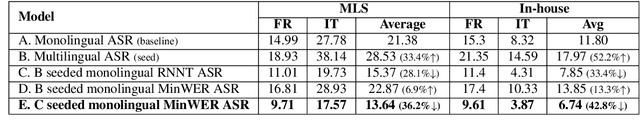


Multilingual pretraining for transfer learning significantly boosts the robustness of low-resource monolingual ASR models. This study systematically investigates three main aspects: (a) the impact of transfer learning on model performance during initial training or fine-tuning, (b) the influence of transfer learning across dataset domains and languages, and (c) the effect on rare-word recognition compared to non-rare words. Our finding suggests that RNNT-loss pretraining, followed by monolingual fine-tuning with Minimum Word Error Rate (MinWER) loss, consistently reduces Word Error Rates (WER) across languages like Italian and French. WER Reductions (WERR) reach 36.2% and 42.8% compared to monolingual baselines for MLS and in-house datasets. Out-of-domain pretraining leads to 28% higher WERR than in-domain pretraining. Both rare and non-rare words benefit, with rare words showing greater improvements with out-of-domain pretraining, and non-rare words with in-domain pretraining.