 Add to Chrome
 Add to Firefox
 Add to Edge
Towards An Efficient LLM Training Paradigm for CTR Prediction
Mar 02, 2025
Large Language Models (LLMs) have demonstrated tremendous potential as the next-generation ranking-based recommendation system. Many recent works have shown that LLMs can significantly outperform conventional click-through-rate (CTR) prediction approaches. Despite such promising results, the computational inefficiency inherent in the current training paradigm makes it particularly challenging to train LLMs for ranking-based recommendation tasks on large datasets. To train LLMs for CTR prediction, most existing studies adopt the prevalent ''sliding-window'' paradigm. Given a sequence of $m$ user interactions, a unique training prompt is constructed for each interaction by designating it as the prediction target along with its preceding $n$ interactions serving as context. In turn, the sliding-window paradigm results in an overall complexity of $O(mn^2)$ that scales linearly with the length of user interactions. Consequently, a direct adoption to train LLMs with such strategy can result in prohibitively high training costs as the length of interactions grows. To alleviate the computational inefficiency, we propose a novel training paradigm, namely Dynamic Target Isolation (DTI), that structurally parallelizes the training of $k$ (where $k >> 1$) target interactions. Furthermore, we identify two major bottlenecks - hidden-state leakage and positional bias overfitting - that limit DTI to only scale up to a small value of $k$ (e.g., 5) then propose a computationally light solution to effectively tackle each. Through extensive experiments on three widely adopted public CTR datasets, we empirically show that DTI reduces training time by an average of $\textbf{92%}$ (e.g., from $70.5$ hrs to $5.31$ hrs), without compromising CTR prediction performance.

Model Adaptation: Unsupervised Domain Adaptation without Source Data
Feb 26, 2025In this paper, we investigate a challenging unsupervised domain adaptation setting -- unsupervised model adaptation. We aim to explore how to rely only on unlabeled target data to improve performance of an existing source prediction model on the target domain, since labeled source data may not be available in some real-world scenarios due to data privacy issues. For this purpose, we propose a new framework, which is referred to as collaborative class conditional generative adversarial net to bypass the dependence on the source data. Specifically, the prediction model is to be improved through generated target-style data, which provides more accurate guidance for the generator. As a result, the generator and the prediction model can collaborate with each other without source data. Furthermore, due to the lack of supervision from source data, we propose a weight constraint that encourages similarity to the source model. A clustering-based regularization is also introduced to produce more discriminative features in the target domain. Compared to conventional domain adaptation methods, our model achieves superior performance on multiple adaptation tasks with only unlabeled target data, which verifies its effectiveness in this challenging setting.
* accepted by CVPR2020
AeroReformer: Aerial Referring Transformer for UAV-based Referring Image Segmentation
Feb 23, 2025As a novel and challenging task, referring segmentation combines computer vision and natural language processing to localize and segment objects based on textual descriptions. While referring image segmentation (RIS) has been extensively studied in natural images, little attention has been given to aerial imagery, particularly from unmanned aerial vehicles (UAVs). The unique challenges of UAV imagery, including complex spatial scales, occlusions, and varying object orientations, render existing RIS approaches ineffective. A key limitation has been the lack of UAV-specific datasets, as manually annotating pixel-level masks and generating textual descriptions is labour-intensive and time-consuming. To address this gap, we design an automatic labelling pipeline that leverages pre-existing UAV segmentation datasets and Multimodal Large Language Models (MLLM) for generating textual descriptions. Furthermore, we propose Aerial Referring Transformer (AeroReformer), a novel framework for UAV referring image segmentation (UAV-RIS), featuring a Vision-Language Cross-Attention Module (VLCAM) for effective cross-modal understanding and a Rotation-Aware Multi-Scale Fusion (RAMSF) decoder to enhance segmentation accuracy in aerial scenes. Extensive experiments on two newly developed datasets demonstrate the superiority of AeroReformer over existing methods, establishing a new benchmark for UAV-RIS. The datasets and code will be publicly available at: https://github.com/lironui/AeroReformer.
Be a Multitude to Itself: A Prompt Evolution Framework for Red Teaming
Feb 22, 2025Large Language Models (LLMs) have gained increasing attention for their remarkable capacity, alongside concerns about safety arising from their potential to produce harmful content. Red teaming aims to find prompts that could elicit harmful responses from LLMs, and is essential to discover and mitigate safety risks before real-world deployment. However, manual red teaming is both time-consuming and expensive, rendering it unscalable. In this paper, we propose RTPE, a scalable evolution framework to evolve red teaming prompts across both breadth and depth dimensions, facilitating the automatic generation of numerous high-quality and diverse red teaming prompts. Specifically, in-breadth evolving employs a novel enhanced in-context learning method to create a multitude of quality prompts, whereas in-depth evolving applies customized transformation operations to enhance both content and form of prompts, thereby increasing diversity. Extensive experiments demonstrate that RTPE surpasses existing representative automatic red teaming methods on both attack success rate and diversity. In addition, based on 4,800 red teaming prompts created by RTPE, we further provide a systematic analysis of 8 representative LLMs across 8 sensitive topics.
How Far are LLMs from Being Our Digital Twins? A Benchmark for Persona-Based Behavior Chain Simulation
Feb 20, 2025Recently, LLMs have garnered increasing attention across academic disciplines for their potential as human digital twins, virtual proxies designed to replicate individuals and autonomously perform tasks such as decision-making, problem-solving, and reasoning on their behalf. However, current evaluations of LLMs primarily emphasize dialogue simulation while overlooking human behavior simulation, which is crucial for digital twins. To address this gap, we introduce BehaviorChain, the first benchmark for evaluating LLMs' ability to simulate continuous human behavior. BehaviorChain comprises diverse, high-quality, persona-based behavior chains, totaling 15,846 distinct behaviors across 1,001 unique personas, each with detailed history and profile metadata. For evaluation, we integrate persona metadata into LLMs and employ them to iteratively infer contextually appropriate behaviors within dynamic scenarios provided by BehaviorChain. Comprehensive evaluation results demonstrated that even state-of-the-art models struggle with accurately simulating continuous human behavior.
SuperGPQA: Scaling LLM Evaluation across 285 Graduate Disciplines
Feb 20, 2025Large language models (LLMs) have demonstrated remarkable proficiency in mainstream academic disciplines such as mathematics, physics, and computer science. However, human knowledge encompasses over 200 specialized disciplines, far exceeding the scope of existing benchmarks. The capabilities of LLMs in many of these specialized fields-particularly in light industry, agriculture, and service-oriented disciplines-remain inadequately evaluated. To address this gap, we present SuperGPQA, a comprehensive benchmark that evaluates graduate-level knowledge and reasoning capabilities across 285 disciplines. Our benchmark employs a novel Human-LLM collaborative filtering mechanism to eliminate trivial or ambiguous questions through iterative refinement based on both LLM responses and expert feedback. Our experimental results reveal significant room for improvement in the performance of current state-of-the-art LLMs across diverse knowledge domains (e.g., the reasoning-focused model DeepSeek-R1 achieved the highest accuracy of 61.82% on SuperGPQA), highlighting the considerable gap between current model capabilities and artificial general intelligence. Additionally, we present comprehensive insights from our management of a large-scale annotation process, involving over 80 expert annotators and an interactive Human-LLM collaborative system, offering valuable methodological guidance for future research initiatives of comparable scope.
Refining Sentence Embedding Model through Ranking Sentences Generation with Large Language Models
Feb 19, 2025Sentence embedding is essential for many NLP tasks, with contrastive learning methods achieving strong performance using annotated datasets like NLI. Yet, the reliance on manual labels limits scalability. Recent studies leverage large language models (LLMs) to generate sentence pairs, reducing annotation dependency. However, they overlook ranking information crucial for fine-grained semantic distinctions. To tackle this challenge, we propose a method for controlling the generation direction of LLMs in the latent space. Unlike unconstrained generation, the controlled approach ensures meaningful semantic divergence. Then, we refine exist sentence embedding model by integrating ranking information and semantic information. Experiments on multiple benchmarks demonstrate that our method achieves new SOTA performance with a modest cost in ranking sentence synthesis.
FedP$^2$EFT: Federated Learning to Personalize Parameter Efficient Fine-Tuning for Multilingual LLMs
Feb 05, 2025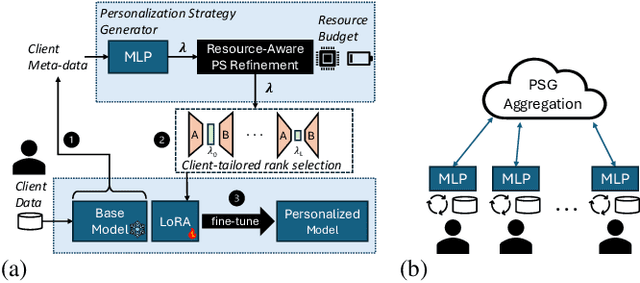
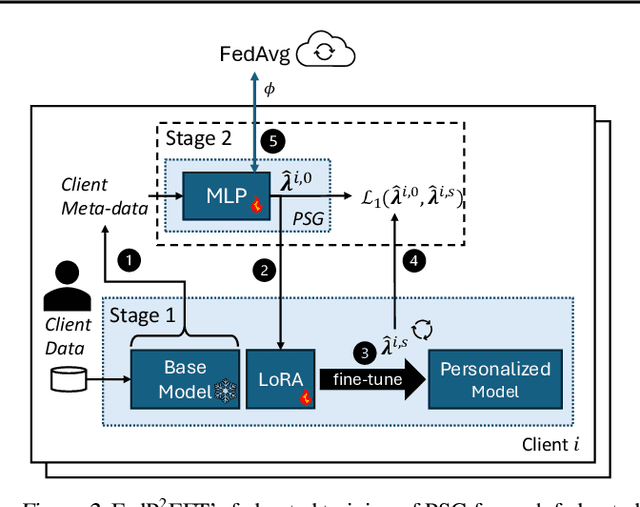
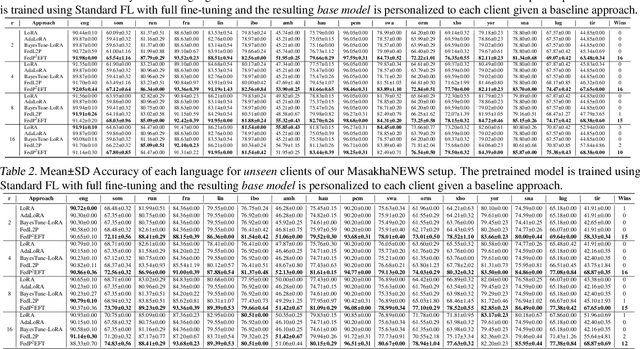
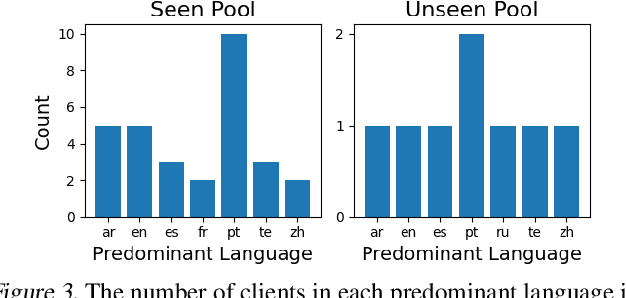
Federated learning (FL) has enabled the training of multilingual large language models (LLMs) on diverse and decentralized multilingual data, especially on low-resource languages. To improve client-specific performance, personalization via the use of parameter-efficient fine-tuning (PEFT) modules such as LoRA is common. This involves a personalization strategy (PS), such as the design of the PEFT adapter structures (e.g., in which layers to add LoRAs and what ranks) and choice of hyperparameters (e.g., learning rates) for fine-tuning. Instead of manual PS configuration, we propose FedP$^2$EFT, a federated learning-to-personalize method for multilingual LLMs in cross-device FL settings. Unlike most existing PEFT structure selection methods, which are prone to overfitting low-data regimes, FedP$^2$EFT collaboratively learns the optimal personalized PEFT structure for each client via Bayesian sparse rank selection. Evaluations on both simulated and real-world multilingual FL benchmarks demonstrate that FedP$^2$EFT largely outperforms existing personalized fine-tuning methods, while complementing a range of existing FL methods.
Personalized Interpolation: An Efficient Method to Tame Flexible Optimization Window Estimation
Jan 23, 2025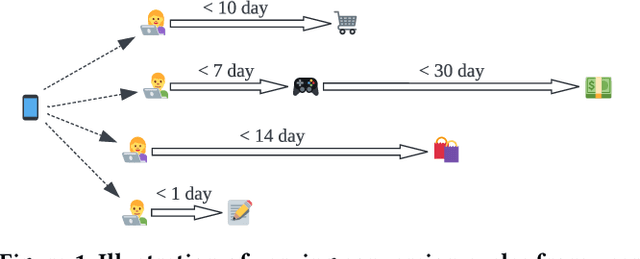
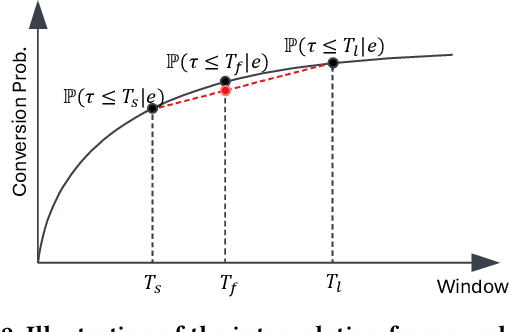
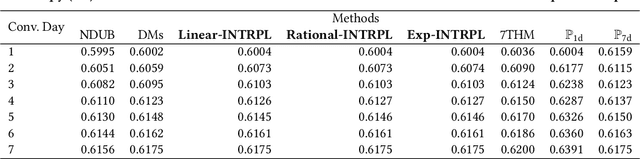
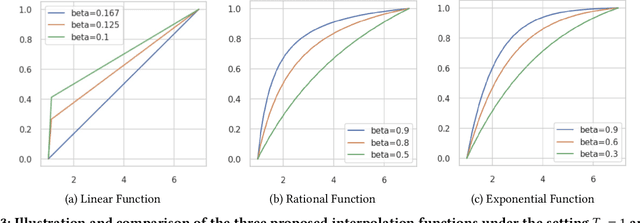
In the realm of online advertising, optimizing conversions is crucial for delivering relevant products to users and enhancing business outcomes. Predicting conversion events is challenging due to variable delays between user interactions, such as impressions or clicks, and the actual conversions. These delays differ significantly across various advertisers and products, necessitating distinct optimization time windows for targeted conversions. To address this, we introduce a novel approach named the \textit{Personalized Interpolation} method, which innovatively builds upon existing fixed conversion window models to estimate flexible conversion windows. This method allows for the accurate estimation of conversions across a variety of delay ranges, thus meeting the diverse needs of advertisers without increasing system complexity. To validate the efficacy of our proposed method, we conducted comprehensive experiments using ads conversion model. Our experiments demonstrate that this method not only achieves high prediction accuracy but also does so more efficiently than other existing solutions. This validation underscores the potential of our Personalized Interpolation method to significantly enhance conversion optimization in real-world online advertising systems, promising improved targeting and effectiveness in advertising strategies.
Temporal Preference Optimization for Long-Form Video Understanding
Jan 23, 2025


Despite significant advancements in video large multimodal models (video-LMMs), achieving effective temporal grounding in long-form videos remains a challenge for existing models. To address this limitation, we propose Temporal Preference Optimization (TPO), a novel post-training framework designed to enhance the temporal grounding capabilities of video-LMMs through preference learning. TPO adopts a self-training approach that enables models to differentiate between well-grounded and less accurate temporal responses by leveraging curated preference datasets at two granularities: localized temporal grounding, which focuses on specific video segments, and comprehensive temporal grounding, which captures extended temporal dependencies across entire video sequences. By optimizing on these preference datasets, TPO significantly enhances temporal understanding while reducing reliance on manually annotated data. Extensive experiments on three long-form video understanding benchmarks--LongVideoBench, MLVU, and Video-MME--demonstrate the effectiveness of TPO across two state-of-the-art video-LMMs. Notably, LLaVA-Video-TPO establishes itself as the leading 7B model on the Video-MME benchmark, underscoring the potential of TPO as a scalable and efficient solution for advancing temporal reasoning in long-form video understanding. Project page: https://ruili33.github.io/tpo_website.