 Add to Chrome
 Add to Firefox
 Add to Edge
WhiFlash: Accelerating Speculative Decoding with Token-Level Cross-Paradigm Routing
Jun 05, 2026
The autoregressive nature of large language models (LLMs) remains a significant bottleneck for inference, particularly in complex agentic workloads. While speculative decoding (SD) accelerates inference, current approaches rely on static drafting paradigms, utilising either autoregressive drafting models for reasoning or diffusion-based parallel drafting models for structured outputs. We empirically find that drafting accuracy fluctuates dramatically within a single sequence, leaving significant performance unrealised by static paradigms and coarse-grained routing. To address this volatility, we introduce WhiFlash, the first cross-paradigm SD method that unifies autoregressive and diffusion-based parallel drafting under a single token-level controller. WhiFlash adopts a fine-grained routing mechanism that employs either a lightweight entropy-based or a learned neural policy, both parametrised to provide a tunable balance between expected token gain and latency. To make high-frequency switching computationally viable, we introduce novel cache-management optimisations, Lazy Catch-up and KV-only Prefill, reducing switching overhead to below 7% of per-round latency. By capitalising on the complementary strengths of fundamentally distinct drafting architectures, WhiFlash achieves significantly higher acceptance lengths, yielding category-specific throughput gains of up to 69.6% over the state-of-the-art autoregressive EAGLE-3 and 37.3% over the diffusion-based DFlash.

A-THENA: Early Intrusion Detection for IoT with Time-Aware Hybrid Encoding and Network-Specific Augmentation
Apr 23, 2026The proliferation of Internet of Things (IoT) devices has significantly expanded attack surfaces, making IoT ecosystems particularly susceptible to sophisticated cyber threats. To address this challenge, this work introduces A-THENA, a lightweight early intrusion detection system (EIDS) that significantly extends preliminary findings on time-aware encodings. A-THENA employs an advanced Transformer-based architecture augmented with a generalized Time-Aware Hybrid Encoding (THE), integrating packet timestamps to effectively capture temporal dynamics essential for accurate and early threat detection. The proposed system further employs a Network-Specific Augmentation (NA) pipeline, which enhances model robustness and generalization. We evaluate A-THENA on three benchmark IoT intrusion detection datasets-CICIoT23-WEB, MQTT-IoT-IDS2020, and IoTID20-where it consistently achieves strong performance. Averaged across all three datasets, it improves accuracy by 6.88 percentage points over the best-performing traditional positional encoding, 3.69 points over the strongest feature-based model, 6.17 points over the leading time-aware alternatives, and 5.11 points over related models, while achieving near-zero false alarms and false negatives. To assess real-world feasibility, we deploy A-THENA on the Raspberry Pi Zero 2 W, demonstrating its ability to perform real-time intrusion detection with minimal latency and memory usage. These results establish A-THENA as an agile, practical, and highly effective solution for securing IoT networks.
Speculative Decoding with a Speculative Vocabulary
Feb 14, 2026Speculative decoding has rapidly emerged as a leading approach for accelerating language model (LM) inference, as it offers substantial speedups while yielding identical outputs. This relies upon a small draft model, tasked with predicting the outputs of the target model. State-of-the-art speculative decoding methods use a draft model consisting of a single decoder layer and output embedding matrix, with the latter dominating drafting time for the latest LMs. Recent work has sought to address this output distribution bottleneck by reducing the vocabulary of the draft model. Although this can improve throughput, it compromises speculation effectiveness when the target token is out-of-vocabulary. In this paper, we argue for vocabulary speculation as an alternative to a reduced vocabulary. We propose SpecVocab, an efficient and effective method that selects a vocabulary subset per decoding step. Across a variety of tasks, we demonstrate that SpecVocab can achieve a higher acceptance length than state-of-the-art speculative decoding approach, EAGLE-3. Notably, this yields up to an 8.1% increase in average throughput over EAGLE-3.
HierarchicalPrune: Position-Aware Compression for Large-Scale Diffusion Models
Aug 06, 2025State-of-the-art text-to-image diffusion models (DMs) achieve remarkable quality, yet their massive parameter scale (8-11B) poses significant challenges for inferences on resource-constrained devices. In this paper, we present HierarchicalPrune, a novel compression framework grounded in a key observation: DM blocks exhibit distinct functional hierarchies, where early blocks establish semantic structures while later blocks handle texture refinements. HierarchicalPrune synergistically combines three techniques: (1) Hierarchical Position Pruning, which identifies and removes less essential later blocks based on position hierarchy; (2) Positional Weight Preservation, which systematically protects early model portions that are essential for semantic structural integrity; and (3) Sensitivity-Guided Distillation, which adjusts knowledge-transfer intensity based on our discovery of block-wise sensitivity variations. As a result, our framework brings billion-scale diffusion models into a range more suitable for on-device inference, while preserving the quality of the output images. Specifically, when combined with INT4 weight quantisation, HierarchicalPrune achieves 77.5-80.4% memory footprint reduction (e.g., from 15.8 GB to 3.2 GB) and 27.9-38.0% latency reduction, measured on server and consumer grade GPUs, with the minimum drop of 2.6% in GenEval score and 7% in HPSv2 score compared to the original model. Last but not least, our comprehensive user study with 85 participants demonstrates that HierarchicalPrune maintains perceptual quality comparable to the original model while significantly outperforming prior works.
FedP$^2$EFT: Federated Learning to Personalize Parameter Efficient Fine-Tuning for Multilingual LLMs
Feb 05, 2025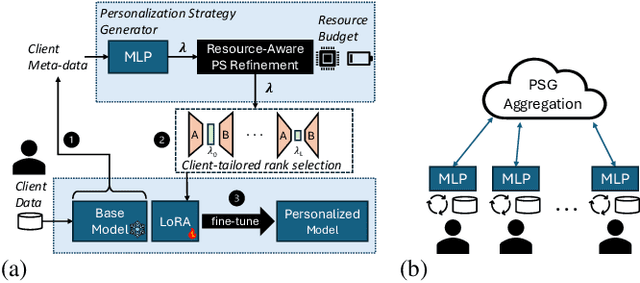
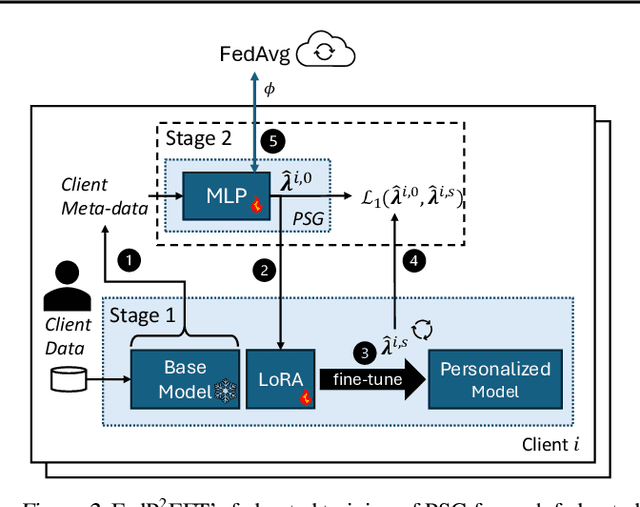
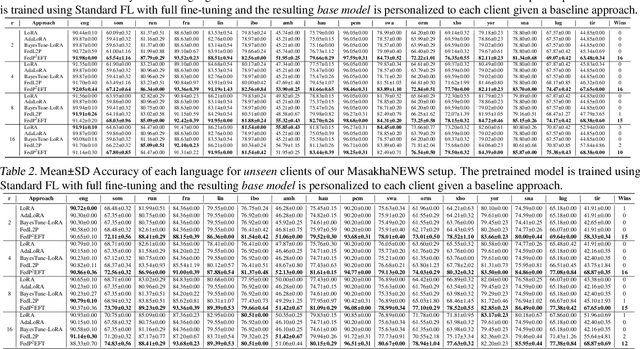
Federated learning (FL) has enabled the training of multilingual large language models (LLMs) on diverse and decentralized multilingual data, especially on low-resource languages. To improve client-specific performance, personalization via the use of parameter-efficient fine-tuning (PEFT) modules such as LoRA is common. This involves a personalization strategy (PS), such as the design of the PEFT adapter structures (e.g., in which layers to add LoRAs and what ranks) and choice of hyperparameters (e.g., learning rates) for fine-tuning. Instead of manual PS configuration, we propose FedP$^2$EFT, a federated learning-to-personalize method for multilingual LLMs in cross-device FL settings. Unlike most existing PEFT structure selection methods, which are prone to overfitting low-data regimes, FedP$^2$EFT collaboratively learns the optimal personalized PEFT structure for each client via Bayesian sparse rank selection. Evaluations on both simulated and real-world multilingual FL benchmarks demonstrate that FedP$^2$EFT largely outperforms existing personalized fine-tuning methods, while complementing a range of existing FL methods.
MultiTASC++: A Continuously Adaptive Scheduler for Edge-Based Multi-Device Cascade Inference
Dec 05, 2024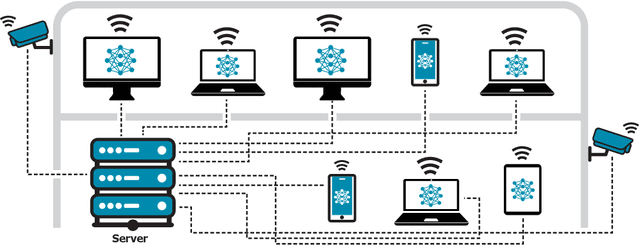
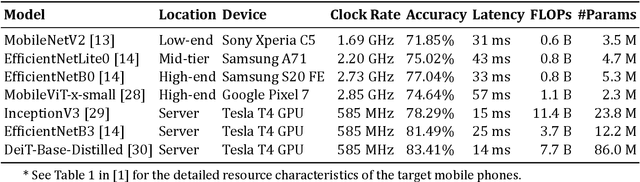
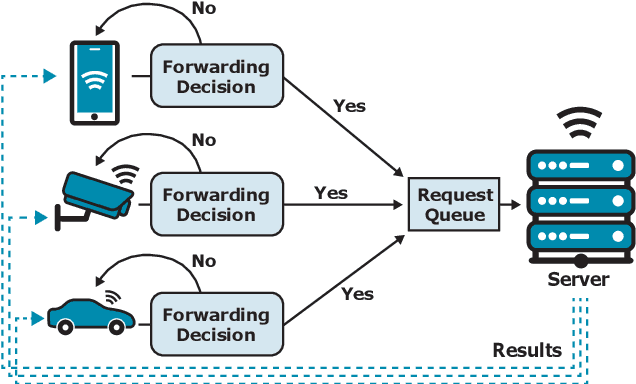
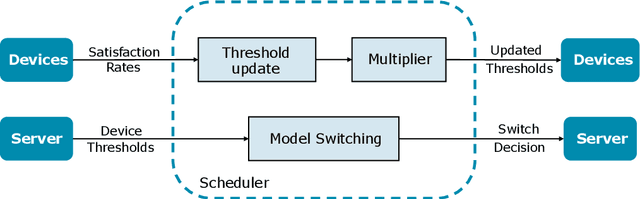
Cascade systems, consisting of a lightweight model processing all samples and a heavier, high-accuracy model refining challenging samples, have become a widely-adopted distributed inference approach to achieving high accuracy and maintaining a low computational burden for mobile and IoT devices. As intelligent indoor environments, like smart homes, continue to expand, a new scenario emerges, the multi-device cascade. In this setting, multiple diverse devices simultaneously utilize a shared heavy model hosted on a server, often situated within or close to the consumer environment. This work introduces MultiTASC++, a continuously adaptive multi-tenancy-aware scheduler that dynamically controls the forwarding decision functions of devices to optimize system throughput while maintaining high accuracy and low latency. Through extensive experimentation in diverse device environments and with varying server-side models, we demonstrate the scheduler's efficacy in consistently maintaining a targeted satisfaction rate while providing the highest available accuracy across different device tiers and workloads of up to 100 devices. This demonstrates its scalability and efficiency in addressing the unique challenges of collaborative DNN inference in dynamic and diverse IoT environments.
Progressive Mixed-Precision Decoding for Efficient LLM Inference
Oct 17, 2024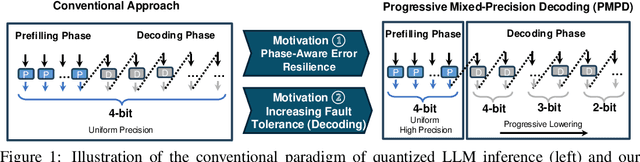
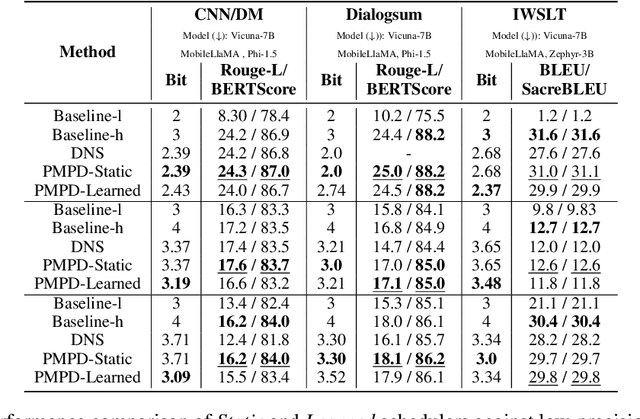

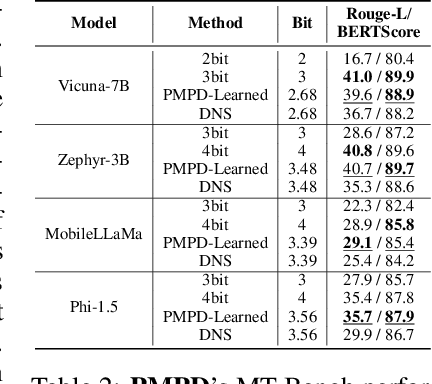
In spite of the great potential of large language models (LLMs) across various tasks, their deployment on resource-constrained devices remains challenging due to their excessive computational and memory demands. Quantization has emerged as an effective solution by storing weights in reduced precision. However, utilizing low precisions (i.e.~2/3-bit) to substantially alleviate the memory-boundedness of LLM decoding, still suffers from prohibitive performance drop. In this work, we argue that existing approaches fail to explore the diversity in computational patterns, redundancy, and sensitivity to approximations of the different phases of LLM inference, resorting to a uniform quantization policy throughout. Instead, we propose a novel phase-aware method that selectively allocates precision during different phases of LLM inference, achieving both strong context extraction during prefill and efficient memory bandwidth utilization during decoding. To further address the memory-boundedness of the decoding phase, we introduce Progressive Mixed-Precision Decoding (PMPD), a technique that enables the gradual lowering of precision deeper in the generated sequence, together with a spectrum of precision-switching schedulers that dynamically drive the precision-lowering decisions in either task-adaptive or prompt-adaptive manner. Extensive evaluation across diverse language tasks shows that when targeting Nvidia GPUs, PMPD achieves 1.4$-$12.2$\times$ speedup in matrix-vector multiplications over fp16 models, while when targeting an LLM-optimized NPU, our approach delivers a throughput gain of 3.8$-$8.0$\times$ over fp16 models and up to 1.54$\times$ over uniform quantization approaches while preserving the output quality.
CARIn: Constraint-Aware and Responsive Inference on Heterogeneous Devices for Single- and Multi-DNN Workloads
Sep 02, 2024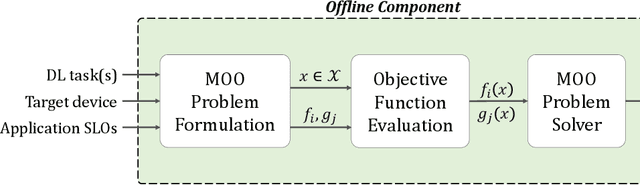
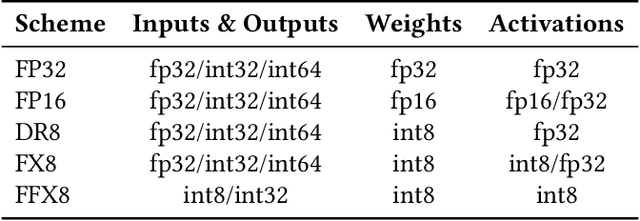
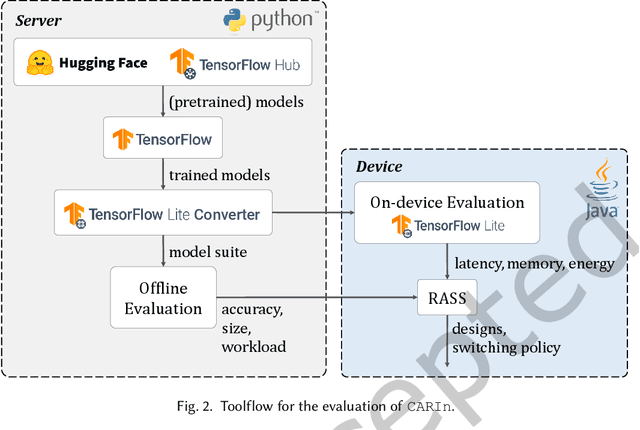
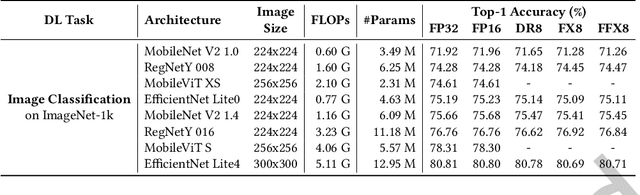
The relentless expansion of deep learning applications in recent years has prompted a pivotal shift toward on-device execution, driven by the urgent need for real-time processing, heightened privacy concerns, and reduced latency across diverse domains. This article addresses the challenges inherent in optimising the execution of deep neural networks (DNNs) on mobile devices, with a focus on device heterogeneity, multi-DNN execution, and dynamic runtime adaptation. We introduce CARIn, a novel framework designed for the optimised deployment of both single- and multi-DNN applications under user-defined service-level objectives. Leveraging an expressive multi-objective optimisation framework and a runtime-aware sorting and search algorithm (RASS) as the MOO solver, CARIn facilitates efficient adaptation to dynamic conditions while addressing resource contention issues associated with multi-DNN execution. Notably, RASS generates a set of configurations, anticipating subsequent runtime adaptation, ensuring rapid, low-overhead adjustments in response to environmental fluctuations. Extensive evaluation across diverse tasks, including text classification, scene recognition, and face analysis, showcases the versatility of CARIn across various model architectures, such as Convolutional Neural Networks and Transformers, and realistic use cases. We observe a substantial enhancement in the fair treatment of the problem's objectives, reaching 1.92x when compared to single-model designs and up to 10.69x in contrast to the state-of-the-art OODIn framework. Additionally, we achieve a significant gain of up to 4.06x over hardware-unaware designs in multi-DNN applications. Finally, our framework sustains its performance while effectively eliminating the time overhead associated with identifying the optimal design in response to environmental challenges.
Hardware-Aware Parallel Prompt Decoding for Memory-Efficient Acceleration of LLM Inference
May 28, 2024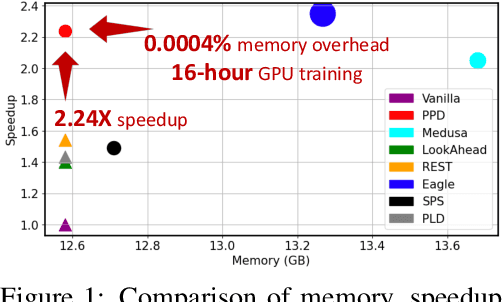
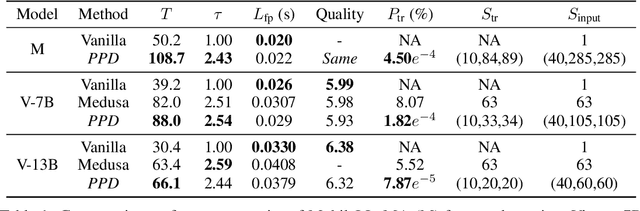
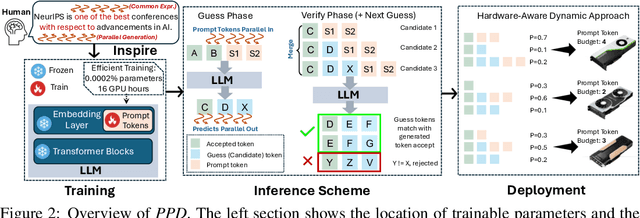
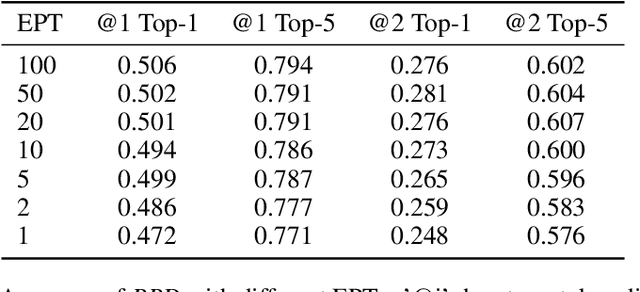
The auto-regressive decoding of Large Language Models (LLMs) results in significant overheads in their hardware performance. While recent research has investigated various speculative decoding techniques for multi-token generation, these efforts have primarily focused on improving processing speed such as throughput. Crucially, they often neglect other metrics essential for real-life deployments, such as memory consumption and training cost. To overcome these limitations, we propose a novel parallel prompt decoding that requires only $0.0002$% trainable parameters, enabling efficient training on a single A100-40GB GPU in just 16 hours. Inspired by the human natural language generation process, $PPD$ approximates outputs generated at future timesteps in parallel by using multiple prompt tokens. This approach partially recovers the missing conditional dependency information necessary for multi-token generation, resulting in up to a 28% higher acceptance rate for long-range predictions. Furthermore, we present a hardware-aware dynamic sparse tree technique that adaptively optimizes this decoding scheme to fully leverage the computational capacities on different GPUs. Through extensive experiments across LLMs ranging from MobileLlama to Vicuna-13B on a wide range of benchmarks, our approach demonstrates up to 2.49$\times$ speedup and maintains a minimal runtime memory overhead of just $0.0004$%. More importantly, our parallel prompt decoding can serve as an orthogonal optimization for synergistic integration with existing speculative decoding, showing up to $1.22\times$ further speed improvement. Our code is available at https://github.com/hmarkc/parallel-prompt-decoding.
LifeLearner: Hardware-Aware Meta Continual Learning System for Embedded Computing Platforms
Nov 19, 2023Continual Learning (CL) allows applications such as user personalization and household robots to learn on the fly and adapt to context. This is an important feature when context, actions, and users change. However, enabling CL on resource-constrained embedded systems is challenging due to the limited labeled data, memory, and computing capacity. In this paper, we propose LifeLearner, a hardware-aware meta continual learning system that drastically optimizes system resources (lower memory, latency, energy consumption) while ensuring high accuracy. Specifically, we (1) exploit meta-learning and rehearsal strategies to explicitly cope with data scarcity issues and ensure high accuracy, (2) effectively combine lossless and lossy compression to significantly reduce the resource requirements of CL and rehearsal samples, and (3) developed hardware-aware system on embedded and IoT platforms considering the hardware characteristics. As a result, LifeLearner achieves near-optimal CL performance, falling short by only 2.8% on accuracy compared to an Oracle baseline. With respect to the state-of-the-art (SOTA) Meta CL method, LifeLearner drastically reduces the memory footprint (by 178.7x), end-to-end latency by 80.8-94.2%, and energy consumption by 80.9-94.2%. In addition, we successfully deployed LifeLearner on two edge devices and a microcontroller unit, thereby enabling efficient CL on resource-constrained platforms where it would be impractical to run SOTA methods and the far-reaching deployment of adaptable CL in a ubiquitous manner. Code is available at https://github.com/theyoungkwon/LifeLearner.