 Add to Chrome
 Add to Firefox
 Add to Edge
Outage Analysis of Backscatter-Based Ambient IoT Device Classes with Energy Buffering
Jul 18, 2026
This paper presents an analytical framework for evaluating the outage probability of ambient Internet of Things (A-IoT) device classes communicating directly with a base station. Device 1 is a passive backscatter device with minimal storage, while Device 2 is equipped with a supercapacitor that enables energy buffering and optional amplification. The proposed framework jointly accounts for carrier-detection sensitivity, energy harvesting constraints, supercapacitor energy dynamics, and an energy-aware amplification policy, while the energy evolution of buffered devices is modeled using a discrete-time Markov chain (DTMC). The results highlight the interplay between energy availability and communication reliability. Device 2 achieves superior performance in energy-rich regimes due to buffering and amplification gains, whereas Device 1 becomes more robust in energy-constrained regimes, particularly at larger distances or under high payload requirements. These findings highlight that the optimal device choice depends critically on the operating regime and application demands.

Ambient IoT Backscatter Devices as Passive Anchors for NLOS Cellular Positioning: Fundamental Limits
Jul 03, 2026Ambient Internet-of-Things backscatter devices at known locations can act as low-cost passive anchors by creating geometrically anchored reflected paths in cellular networks. Unlike reconfigurable intelligent surfaces, practical backscatter devices are independently controlled and lack a common phase reference; their modulation signatures may be known, but their reflection gains and residual phases are generally uncalibrated. We study how much localization information survives this incomplete per-device calibration in uplink non-line-of-sight (NLOS) positioning, where the direct NLOS path and the backscatter-assisted paths share an unknown scatterer. Treating the common channel gain, the relative backscatter response, and the residual device phases as nuisance parameters, we derive closed-form equivalent Fisher information matrices for calibrated, partially calibrated, and fully uncalibrated operation. The analysis shows that unknown device phases remove carrier-phase information from the backscatter-assisted paths, whereas joint uncertainty in the common gain and relative response leaves the direct NLOS path with only bandwidth-dependent delay information. The resulting position-domain bounds show that device count alone is insufficient: the passive anchors must also observe the common scatterer from sufficiently diverse directions. For joint single-snapshot identification of the user equipment and scatterer, at least two devices in two dimensions and three in three dimensions are necessary. The results identify deployment implications for Ambient Internet-of-Things positioning and show which calibration losses also apply to separable subpanel-based reconfigurable-surface architectures.
Self-Calibrated Indoor Tracking from Backscatter Fiducials under NLOS Transmitter Illumination
Jun 15, 2026This paper studies indoor tracking from wall-mounted backscatter fiducials in corridor segments outside direct transmitter illumination. In the measured setup, the transmitter-to-fiducial links are NLOS, whereas the fiducial-to-receiver links along the corridor are largely LOS. The main challenge is that the effective fiducial response is deployment-dependent, so a fixed calibrated link budget is not reliable. We therefore use a grid-based penalized-likelihood tracker that profiles the receiver path, a fitted log-distance slope parameter, and fiducial-specific offsets directly from received powers. The resulting paths can then be reused as surrogate calibration coordinates for residual-map correction, while the same correction with measured calibration coordinates is reported only as a reference. On a short four-fiducial corridor segment, the profiled dual-band tracker gives a 0.52 m median error without measured calibration coordinates, and surrogate residual correction improves this to 0.46 m. With measured calibration coordinates, the same correction and a RADAR-style fingerprint reference both reach 0.31 m. The main remaining limitation is therefore the quality of the surrogate calibration paths rather than the structured observation model itself.
Backscatter Assisted Indoor NLOS Positioning
Jun 15, 2026Passive backscatter devices (BDs) can enable indoor non-line-of-sight (NLOS) positioning by serving as virtual anchors whose Doppler-separated signatures are observable in standard channel estimates. This paper studies continuous user-equipment (UE) tracking in corridor environments using a noncoherent power-domain formulation that avoids BD phase synchronization and remains robust to residual carrier offsets and strong multipath. The BD-dependent measurements are modeled by a log-distance law with unknown BD-specific offsets, which allows passive asynchronous devices to be used as anchors without transmit-power calibration. Based on this model, we develop a corridor-constrained maximum a posteriori (MAP) tracker with motion regularization and Huber-robust estimation. In ray-tracing-inspired simulations, the method achieves median positioning errors of 0.23--0.27 m with 90th-percentile errors below 0.45 m. In office-corridor measurements with four passive BDs at 866 MHz, it attains an aggregated median error of 0.505 m and outperforms a simple weighted-average baseline. The results show that passive asynchronous BDs can provide practical sub-meter indoor NLOS tracking while remaining compatible with existing channel-estimation pipelines and energy-autonomous BD deployments.
Dual-Hop Joint Visible Light and Backscatter Communication Relaying under Finite Blocklength
Feb 25, 2026This paper investigates a dual-hop joint visible light communication (VLC) and backscatter communication (BC) relaying framework under the finite blocklength (FBL) constraint, aiming at energy-neutral Ambient Internet of Things (A-IoT) deployments. In the proposed system, indoor LED access points are used to simultaneously provide illumination and transmit information over light to a backscatter device (BD), which harvests optical energy and backscatters the received messages to user equipments (UEs) equipped with radio frequency (RF) front ends. This forwarding of the information from VLC to RF channels is implemented without the need for carrier synthesizers and power amplifiers at the IoT node. By modeling the end-to-end communication link with short-packet IoT traffic and realistic levels of interference between adjacent VLC coverage areas, we analyze the outage performance and achievable data rate of the proposed system. Simulation results demonstrate that key factors, such as placement and orientation of the BD, as well as the selected code rate of the system affect reliability and data rate that can be achieved for communication purposes. The insights gained from this study pave the way for ambient power-enabled IoT solutions and future hybrid VLC/RF network designs.
Joint Visible Light and Backscatter Communications for Proximity-Based Indoor Asset Tracking Enabled by Energy-Neutral Devices
Oct 31, 2025In next-generation wireless systems, providing location-based mobile computing services for energy-neutral devices has become a crucial objective for the provision of sustainable Internet of Things (IoT). Visible light positioning (VLP) has gained great research attention as a complementary method to radio frequency (RF) solutions since it can leverage ubiquitous lighting infrastructure. However, conventional VLP receivers often rely on photodetectors or cameras that are power-hungry, complex, and expensive. To address this challenge, we propose a hybrid indoor asset tracking system that integrates visible light communication (VLC) and backscatter communication (BC) within a simultaneous lightwave information and power transfer (SLIPT) framework. We design a low-complexity and energy-neutral IoT node, namely backscatter device (BD) which harvests energy from light-emitting diode (LED) access points, and then modulates and reflects ambient RF carriers to indicate its location within particular VLC cells. We present a multi-cell VLC deployment with frequency division multiplexing (FDM) method that mitigates interference among LED access points by assigning them distinct frequency pairs based on a four-color map scheduling principle. We develop a lightweight particle filter (PF) tracking algorithm at an edge RF reader, where the fusion of proximity reports and the received backscatter signal strength are employed to track the BD. Experimental results show that this approach achieves the positioning error of 0.318 m at 50th percentile and 0.634 m at 90th percentile, while avoiding the use of complex photodetectors and active RF synthesizing components at the energy-neutral IoT node. By demonstrating robust performance in multiple indoor trajectories, the proposed solution enables scalable, cost-effective, and energy-neutral indoor tracking for pervasive and edge-assisted IoT applications.
Ambient Backscatter Communication in LTE Uplink Sounding Reference Signal
Jan 19, 2025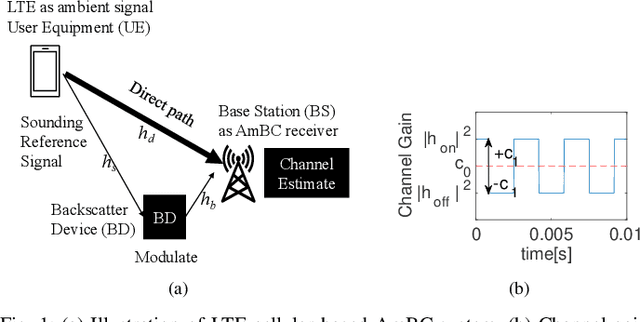
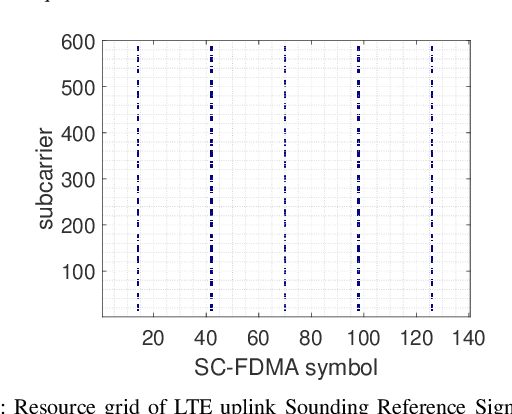
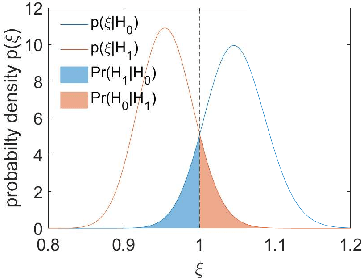
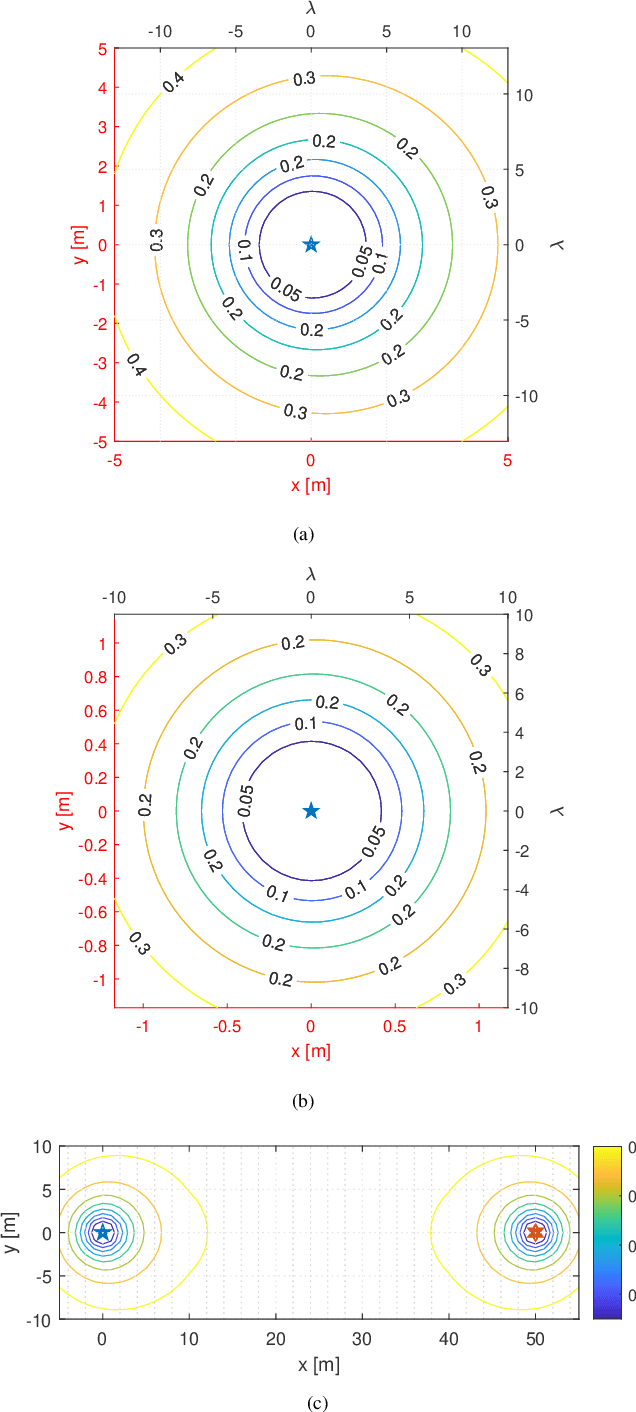
Ambient Internet of Things (AIoT), recently standardized by the 3rd Generation Partnership Project (3GPP), demands a low-power wide-area communication solution that operates several orders of magnitude below the power requirements of existing 3GPP specifications. Ambient backscatter communication (AmBC) is considered as a competitive potential technique by harvesting energy from the ambient RF signal. This paper considers a symbiotic AmBC into Long Term Evolution (LTE) cellular system uplink. Leveraging by LTE uplink channel estimation ability, AIoT conveys its own message to Base Station (BS) by modulating backscatter path. We explore the detector design, analyze the error performance of the proposed scheme, provide exact expression and its Guassian approximation for the error probability. We corroborate the receiver error performance by Monte Carlo simulation. Analysis of communication range reveals AmBC achieves a reasonable BER of order of magnitude $10^{-2}$ within four times wavelength reading distance. In addition, a AmBC prototype in LTE uplink confirms the its feasibility. The over-the-air experiment results validate theoretical analysis. Hence, the proposed AmBC approach enables AIoT deployment with minimal changes to the LTE system.
Thin Film Reconfigurable Intelligent Surface for Harmonic Beam Steering
Jun 10, 2024This letter explores the development and implementation of a novel thin film 1-by-4 reconfigurable intelligent surface (RIS) designed for future communication and sensing scenarios. Utilizing cost-effective inkjet printing methods and additive manufacturing, our approach significantly simplifies the RIS construction process and reduces production costs. The RIS, fabricated on a flexible and lightweight polyethylene terephthalate (PET) substrate, integrates antennas, switching circuitry, and a microcontroller unit (MCU). This setup enables individual and simultaneous control of each RIS element, manipulating the captured carrier signal by steering its dominant harmonics toward multiple desired directions. Measurement results of the beam steering show the manufactured RIS has the potential to enable RIS-aided communication and sensing applications.
Generative AI for Immersive Communication: The Next Frontier in Internet-of-Senses Through 6G
Apr 02, 2024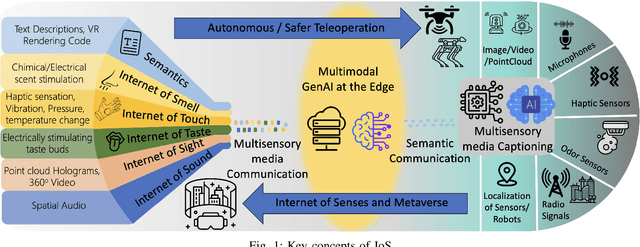
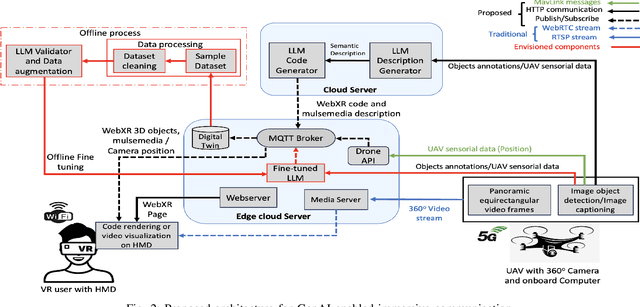
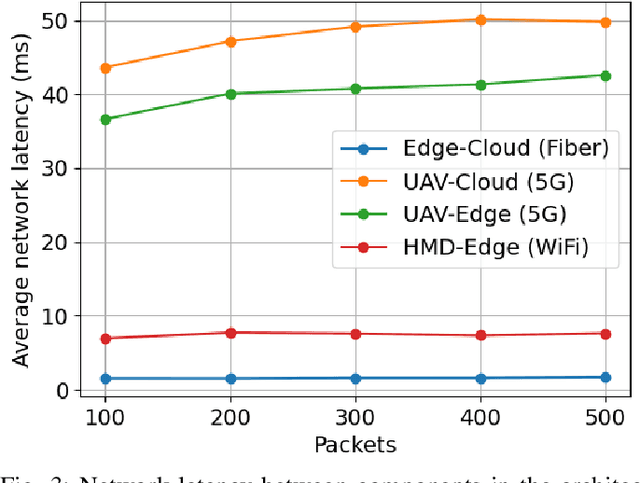
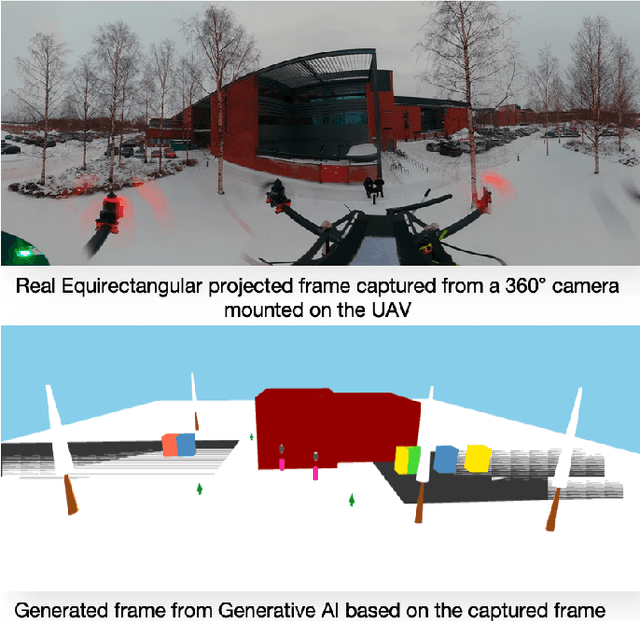
Over the past two decades, the Internet-of-Things (IoT) has been a transformative concept, and as we approach 2030, a new paradigm known as the Internet of Senses (IoS) is emerging. Unlike conventional Virtual Reality (VR), IoS seeks to provide multi-sensory experiences, acknowledging that in our physical reality, our perception extends far beyond just sight and sound; it encompasses a range of senses. This article explores existing technologies driving immersive multi-sensory media, delving into their capabilities and potential applications. This exploration includes a comparative analysis between conventional immersive media streaming and a proposed use case that leverages semantic communication empowered by generative Artificial Intelligence (AI). The focal point of this analysis is the substantial reduction in bandwidth consumption by 99.93% in the proposed scheme. Through this comparison, we aim to underscore the practical applications of generative AI for immersive media while addressing the challenges and outlining future trajectories.
Zero-energy Devices for 6G: Technical Enablers at a Glance
Feb 14, 2024Low-cost, resource-constrained, maintenance-free, and energy-harvesting (EH) Internet of Things (IoT) devices, referred to as zero-energy devices (ZEDs), are rapidly attracting attention from industry and academia due to their myriad of applications. To date, such devices remain primarily unsupported by modern IoT connectivity solutions due to their intrinsic fabrication, hardware, deployment, and operation limitations, while lacking clarity on their key technical enablers and prospects. Herein, we address this by discussing the main characteristics and enabling technologies of ZEDs within the next generation of mobile networks, specifically focusing on unconventional EH sources, multi-source EH, power management, energy storage solutions, manufacturing material and practices, backscattering, and low-complexity receivers. Moreover, we highlight the need for lightweight and energy-aware computing, communication, and scheduling protocols, while discussing potential approaches related to TinyML, duty cycling, and infrastructure enablers like radio frequency wireless power transfer and wake-up protocols. Challenging aspects and open research directions are identified and discussed in all the cases. Finally, we showcase an experimental ZED proof-of-concept related to ambient cellular backscattering.