 Add to Chrome
 Add to Firefox
 Add to Edge
Load Balancing in Non-Terrestrial Networks Using Free Space Optical Inter-satellite Links
Mar 13, 2026
Non-terrestrial networks (NTNs) increasingly rely on non-geostationary (NGSO) constellations that combine radio frequency (RF) feeder links (FLs) with free space optical (FSO) inter-satellite links (ISLs). Downlink performance in such systems is often constrained by uneven satellite-gateway visibility, data traffic congestion, and rain-induced FL attenuation, leaving the downlink capacity of some satellites underutilized while others become bottlenecks. To prevent such non-uniform load distribution, this paper presents a fairness-driven load balancing strategy that treats the satellite constellation in space as an anycast multi-commodity flow problem. Then, by solving an equivalent linear programming optimization problem, the proposed algorithm dynamically selects the most convenient ground station (GS) to serve each satellite and, when needed, offloads data traffic to adjacent satellites through FSO ISLs. Using a realistic MEO satellite constellation with 1550 nm FSO ISLs and Ka-band feeder links, the method stabilizes the reverse link data service, maintaining the average data rate but notably improving the worst-case throughput. Our proposed algorithm enhances the minimum downlink data rate by more than 25% in the presence of rain and by over 10% under no-rain conditions. These results demonstrate that the use of an ISL-assisted load-balancing scheme mitigates FL bottlenecks and enhances fairness across the satellite constellation, offering a scalable basis for resource allocation in future NTN systems.

Dual-Hop Joint Visible Light and Backscatter Communication Relaying under Finite Blocklength
Feb 25, 2026This paper investigates a dual-hop joint visible light communication (VLC) and backscatter communication (BC) relaying framework under the finite blocklength (FBL) constraint, aiming at energy-neutral Ambient Internet of Things (A-IoT) deployments. In the proposed system, indoor LED access points are used to simultaneously provide illumination and transmit information over light to a backscatter device (BD), which harvests optical energy and backscatters the received messages to user equipments (UEs) equipped with radio frequency (RF) front ends. This forwarding of the information from VLC to RF channels is implemented without the need for carrier synthesizers and power amplifiers at the IoT node. By modeling the end-to-end communication link with short-packet IoT traffic and realistic levels of interference between adjacent VLC coverage areas, we analyze the outage performance and achievable data rate of the proposed system. Simulation results demonstrate that key factors, such as placement and orientation of the BD, as well as the selected code rate of the system affect reliability and data rate that can be achieved for communication purposes. The insights gained from this study pave the way for ambient power-enabled IoT solutions and future hybrid VLC/RF network designs.
Symbol Rate Maximization in Rolling-Shutter OCC: Design and Implementation Considerations
Feb 09, 2026Optical Camera Communication (OCC) systems can take advantage of the row-by-row scanning process of rolling-shutter cameras to capture the fast variations of light intensity coming from Visible Light Communication (VLC) LED-based transmitters. In order to study the maximum data rate that is feasible in such kind of OCC systems, this paper presents its equivalent digital communication system model in which the rolling-shutter camera is modeled as a rectangular matched-filter whose time width is equal to the exposure time of the camera, followed by a sampling process at the pixel row sweep rate of the camera. Based on the proposed rolling-shutter camera model, the maximum symbol rate that such OCC systems can support is experimentally demonstrated, and the impact of imperfect time synchronization between the VLC transmitter and the rolling-shutter OCC receiver is characterized in the form of Inter-Symbol Interference (ISI). The equivalent three-tap channel model that results from this process is experimentally validated and the generated ISI is compensated with the use of linear equalization in reception. Simulation and experimental results show a strong correlation between them, demonstrating that the proposed approach can be used to make the OCC system work at the Nyquist sampling rate, which is equivalent to the pixel row sweep rate of the rolling-shutter camera used in reception.
Joint Visible Light and Backscatter Communications for Proximity-Based Indoor Asset Tracking Enabled by Energy-Neutral Devices
Oct 31, 2025In next-generation wireless systems, providing location-based mobile computing services for energy-neutral devices has become a crucial objective for the provision of sustainable Internet of Things (IoT). Visible light positioning (VLP) has gained great research attention as a complementary method to radio frequency (RF) solutions since it can leverage ubiquitous lighting infrastructure. However, conventional VLP receivers often rely on photodetectors or cameras that are power-hungry, complex, and expensive. To address this challenge, we propose a hybrid indoor asset tracking system that integrates visible light communication (VLC) and backscatter communication (BC) within a simultaneous lightwave information and power transfer (SLIPT) framework. We design a low-complexity and energy-neutral IoT node, namely backscatter device (BD) which harvests energy from light-emitting diode (LED) access points, and then modulates and reflects ambient RF carriers to indicate its location within particular VLC cells. We present a multi-cell VLC deployment with frequency division multiplexing (FDM) method that mitigates interference among LED access points by assigning them distinct frequency pairs based on a four-color map scheduling principle. We develop a lightweight particle filter (PF) tracking algorithm at an edge RF reader, where the fusion of proximity reports and the received backscatter signal strength are employed to track the BD. Experimental results show that this approach achieves the positioning error of 0.318 m at 50th percentile and 0.634 m at 90th percentile, while avoiding the use of complex photodetectors and active RF synthesizing components at the energy-neutral IoT node. By demonstrating robust performance in multiple indoor trajectories, the proposed solution enables scalable, cost-effective, and energy-neutral indoor tracking for pervasive and edge-assisted IoT applications.
Resource Allocation in a Quantum Key Distribution Network with LEO and GEO trusted-repeaters
Jul 15, 2021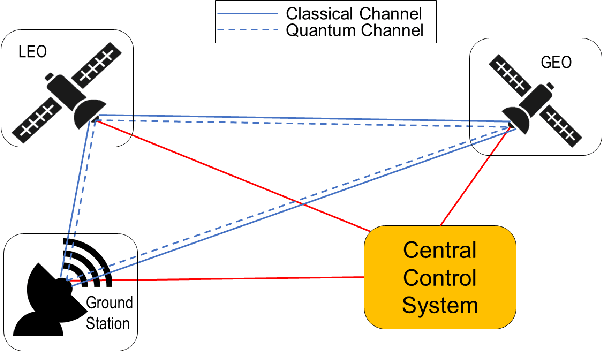
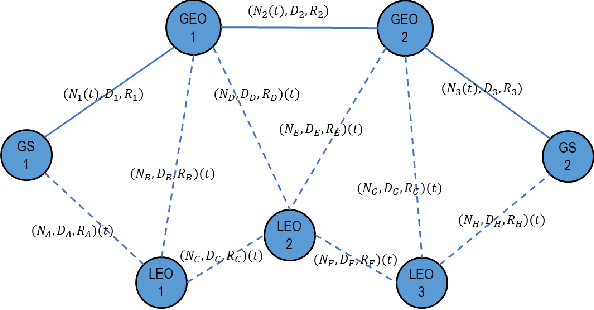
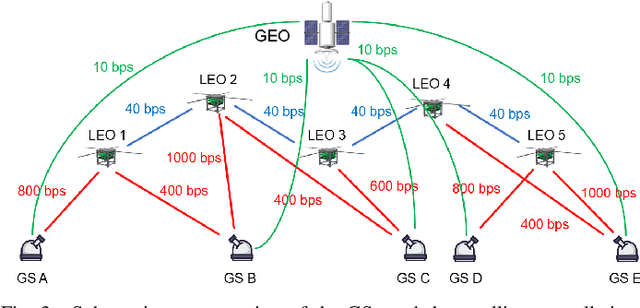
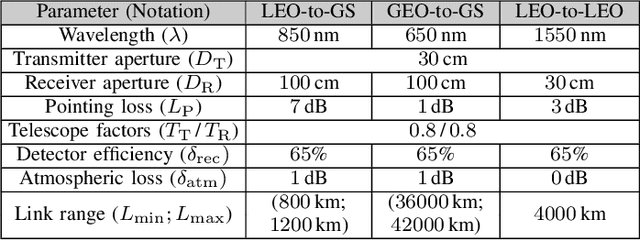
Quantum Key Distribution~(QKD) is a technology that enables the exchange of private encryption keys between two legitimate parties, using protocols that involve quantum mechanics principles. The rate at which secret keys can be exchanged depends on the attenuation that is experienced. Therefore, it is more convenient to replace many terrestrial fiber segments (and repeaters) by just few optical satellite links that would enable flexible global coverage. Then, the satellite nodes can take the role of trusted-relays, forwarding the secret keys from source to destination. However, since the rate at which secret keys can be generated in each quantum link is limited, it is very important to select the intermediate satellite nodes to inter-connect ground stations efficiently. This paper studies the most convenient allocation of resources in a QKD network that combines complementary connectivity services of GEO and LEO satellites. The aim of the centralized routing algorithm is to select the most convenient trusted-relays to forward the secret keys between pairs of ground stations, verifying the constraints that satellite-to-ground and inter-satellite quantum channels have.
Visible light communication-based monitoring for indoor environments using unsupervised learning
Jan 20, 2021Visible Light Communication~(VLC) systems provide not only illumination and data communication, but also indoor monitoring services if the effect that different events create on the received optical signal is properly tracked. For this purpose, the Channel State Information that a VLC receiver computes to equalize the subcarriers of the OFDM signal can be also reused to train an Unsupervised Learning classifier. This way, different clusters can be created on the collected CSI data, which could be then mapped into relevant events to-be-monitored in the indoor environments, such as the presence of a new object in a given position or the change of the position of a given object. When compared to supervised learning algorithms, the proposed approach does not need to add tags in the training data, simplifying notably the implementation of the machine learning classifier. The practical validation the monitoring approach was done with the aid of a software-defined VLC link based on OFDM, in which a copy of the intensity modulated signal coming from a Phosphor-converted LED was captured by a pair of Photodetectors~(PDs). The performance evaluation of the experimental VLC-based monitoring demo achieved a positioning accuracy in the few-centimeter-range, without the necessity of deploying a large number of sensors and/or adding a VLC-enabled sensor on the object to-be-tracked.