 Add to Chrome
 Add to Firefox
 Add to Edge
Outage Analysis of Backscatter-Based Ambient IoT Device Classes with Energy Buffering
Jul 18, 2026
This paper presents an analytical framework for evaluating the outage probability of ambient Internet of Things (A-IoT) device classes communicating directly with a base station. Device 1 is a passive backscatter device with minimal storage, while Device 2 is equipped with a supercapacitor that enables energy buffering and optional amplification. The proposed framework jointly accounts for carrier-detection sensitivity, energy harvesting constraints, supercapacitor energy dynamics, and an energy-aware amplification policy, while the energy evolution of buffered devices is modeled using a discrete-time Markov chain (DTMC). The results highlight the interplay between energy availability and communication reliability. Device 2 achieves superior performance in energy-rich regimes due to buffering and amplification gains, whereas Device 1 becomes more robust in energy-constrained regimes, particularly at larger distances or under high payload requirements. These findings highlight that the optimal device choice depends critically on the operating regime and application demands.

Continuous Fluid Antenna Sampling for Channel Estimation in Cell-Free Massive MIMO
Feb 18, 2026In this letter, we develop a continuous fluid antenna (FA) framework for uplink channel estimation in cell-free massive multiple-input and multiple-output (CF-mMIMO) systems. By modeling the wireless channel as a spatially correlated Gaussian random field, channel estimation is formulated as a Gaussian process (GP) regression problem with motion-constrained spatial sampling. Closed-form expressions for the linear minimum mean squared error (LMMSE) estimator and the corresponding estimation error are derived. A fundamental comparison with discrete port-based architectures is established under identical position constraints, showing that continuous FA sampling achieves equal or lower estimation error for any finite pilot budget, with strict improvement for non-degenerate spatial correlation models. Numerical results validate the analysis and show the performance gains of continuous FA sampling over discrete baselines.
Enhanced Connectivity in Ambient Backscatter Communications via Fluid Antenna Readers
Feb 18, 2026Ambient backscatter communication (AmBC) enables ultra-low-power connectivity by allowing passive backscatter devices (BDs) to convey information through reflection of ambient signals. However, the cascaded AmBC channel suffers from severe double path loss and multiplicative fading, while accurate channel state information (CSI) acquisition is highly challenging due to the weak backscattered signal and the resource-limited nature of BDs. To address these challenges, this paper considers an AmBC system in which the reader is equipped with a pixel-based fluid antenna system (FAS). By dynamically selecting one antenna position from a dense set of pixels within a compact aperture, the FAS-enabled reader exploits spatial diversity through measurement-driven port selection, without requiring explicit CSI acquisition or multiple RF chains. The intrinsic rate-energy tradeoff at the BD is also incorporated by jointly optimizing the backscatter modulation coefficient under an energy harvesting (EH) neutrality constraint. To efficiently solve this problem, a particle swarm optimization (PSO)-based framework is developed to jointly determine the FAS port selection and modulation coefficient on an optimize-then-average (OTA) basis. Simulation results show that the proposed scheme significantly improves the achievable rate compared with conventional single-antenna readers, with gains preserved under imperfect observations, stringent EH constraints, and different pixel spacings.
FIRES: Fluid Integrated Reflecting and Emitting Surfaces
May 19, 2025This letter introduces the concept of fluid integrated reflecting and emitting surface (FIRES), which constitutes a new paradigm seamlessly integrating the flexibility of fluid-antenna systems (FASs) with the dual functionality of simultaneous transmitting and reflecting reconfigurable intelligent surfaces (STAR-RISs). The potential of the proposed metasurface structure is studied though an FIRES-enabled multicast system based on the energy splitting protocol. In this model, the FIRES is divided into non-overlapping subareas, each functioning as a 'fluid' element capable of concurrent reflection and transmission and changing its position of radiation within the subarea. In particular, we formulate an optimization problem for the design of the triple tunable features of the surface unit elements, which is solved via a tailored particle swarm optimization approach. Our results showcase that the proposed FIRES architecture significantly outperforms its conventional STAR-RIS counterpart.
UAV-Relay Assisted RSMA Fluid Antenna System: Outage Probability Analysis
Mar 20, 2025This letter studies the impact of fluid antenna system (FAS) technology on the performance of unmanned aerial vehicle (UAV)-assisted multiuser communication networks. Specifically, we consider a scenario where a fixed-position antenna (FPA) base station (BS) serves K FAS-equipped users with the assistance of a UAV acting as an aerial relay. The BS employs rate-splitting multiple access (RSMA), while the UAV operates in half-duplex (HD) mode using the decode-and-forward (DF) strategy. For this system, we derive a compact analytical expression for the outage probability (OP) and its asymptotic behavior in the high signal-to-noise ratio (SNR) regime, leveraging the multivariate t-distribution. Our results show how deploying FAS at ground users (GUs) in UAV-aided communications improves overall system performance compared to using FPA GUs.
Phase-mismatched STAR-RIS with FAS-assisted RSMA Users
Mar 12, 2025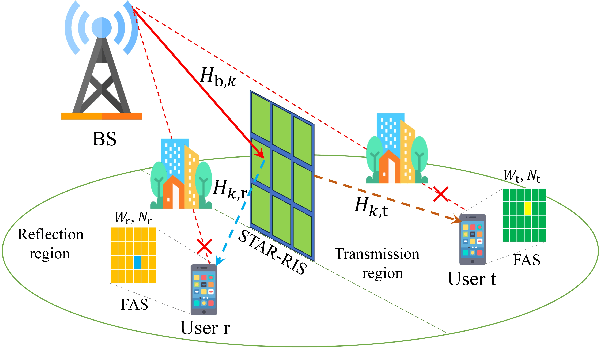
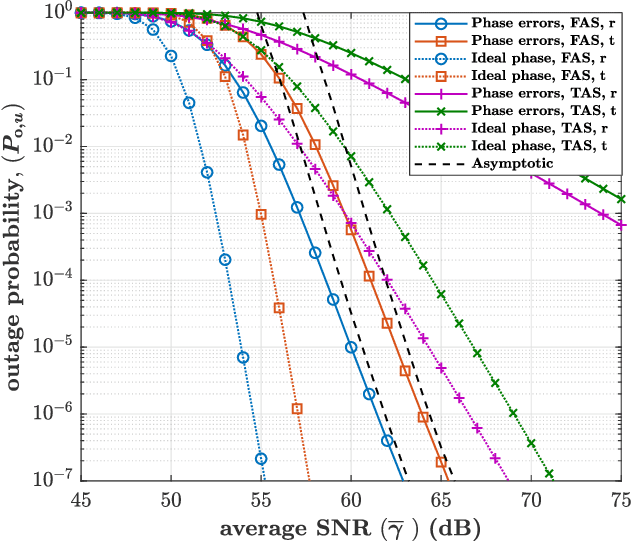
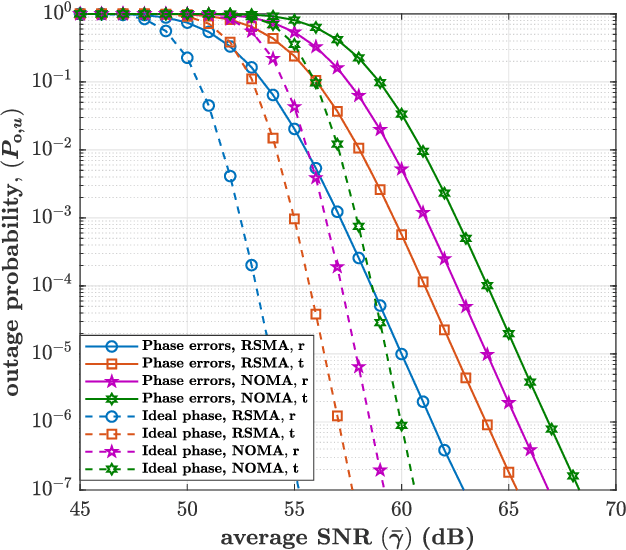
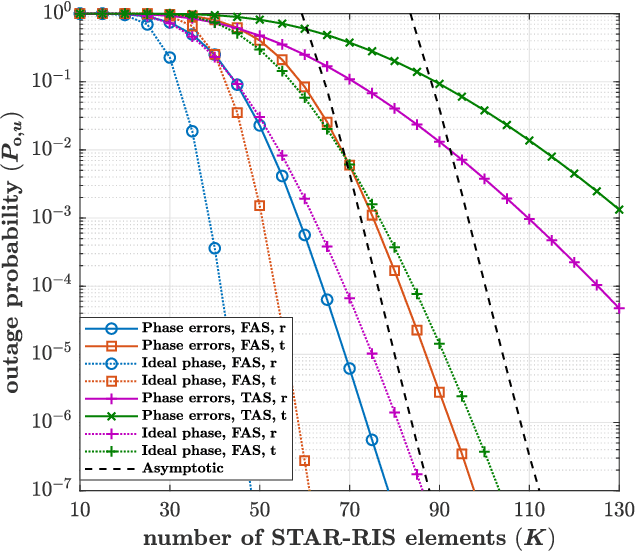
This paper considers communication between a base station (BS) to two users, each from one side of a simultaneously transmitting-reflecting reconfigurable intelligent surface (STAR-RIS) in the absence of a direct link. Rate-splitting multiple access (RSMA) strategy is employed and the STAR-RIS is subjected to phase errors. The users are equipped with a planar fluid antenna system (FAS) with position reconfigurability for spatial diversity. First, we derive the distribution of the equivalent channel gain at the FAS-equipped users, characterized by a t-distribution. We then obtain analytical expressions for the outage probability (OP) and average capacity (AC), with the latter obtained via a heuristic approach. Our findings highlight the potential of FAS to mitigate phase imperfections in STAR-RIS-assisted communications, significantly enhancing system performance compared to traditional antenna systems (TAS). Also, we quantify the impact of practical phase errors on system efficiency, emphasizing the importance of robust strategies for next-generation wireless networks.
On Performance of FAS-aided Covert Communications
Feb 27, 2025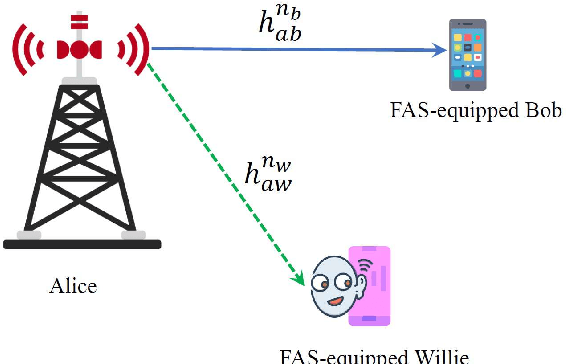
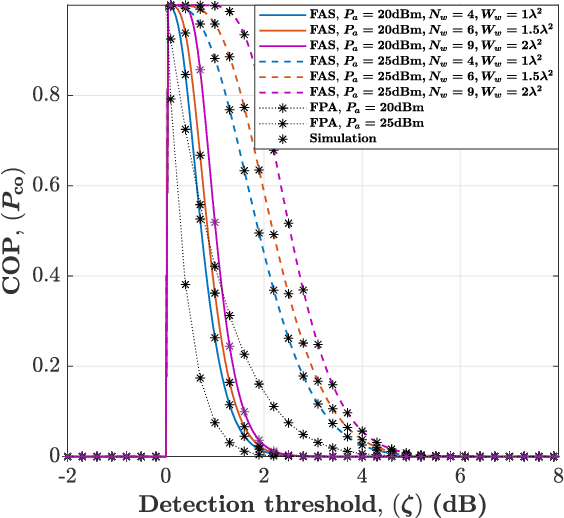
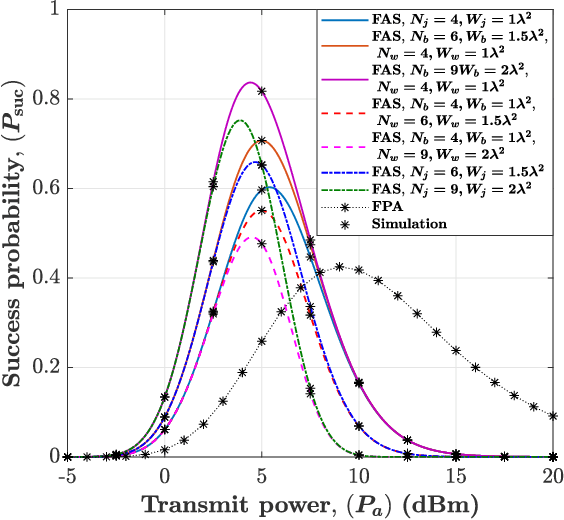
This paper investigates the impact of deploying the fluid antenna system (FAS) on the performance of covert communications. In particular, we focus on a scenario where a transmitter seeks to covertly communicate with a receiver, while a warden attempts to detect the transmission. Both the receiver and the warden are assumed to utilize planar FAS. We derive compact analytical expressions for the covertness outage probability (COP), defined as the complement of the sum of false alarm (FA) and missed detection (MD) probabilities. By determining the optimal detection threshold that maximizes the COP, we characterize the success probability for the legitimate transmission, highlighting the trade-off between covertness and transmission success. Our numerical results confirm that while deploying FAS at the warden enhances its detection ability compared to fixed-position antennas (FPAs), equipping the receiver with FAS rather than FPAs significantly improves reception quality, leading to more reliable transmission.
Physical Layer Security in FAS-aided Wireless Powered NOMA Systems
Jan 15, 2025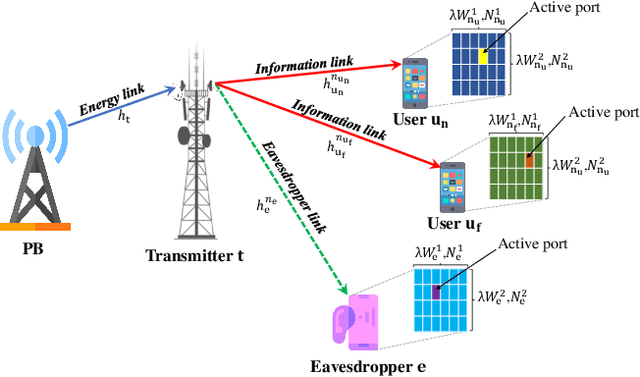
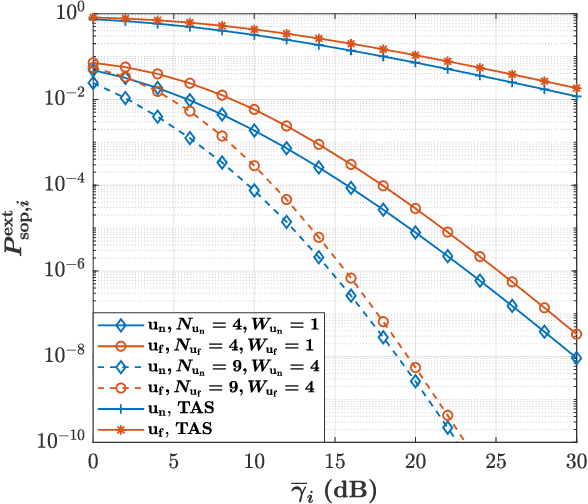
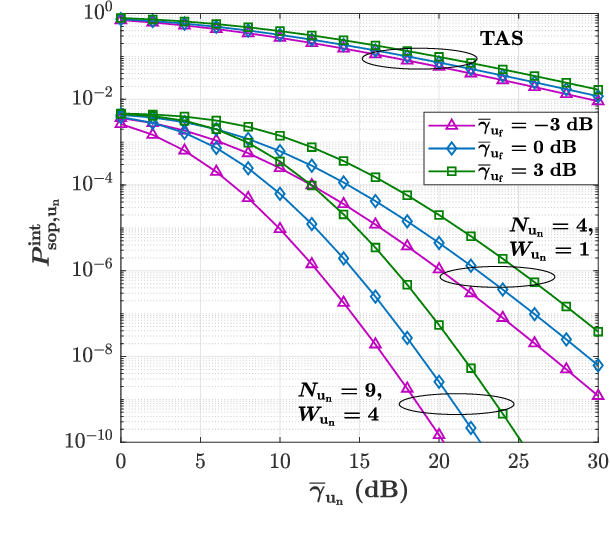
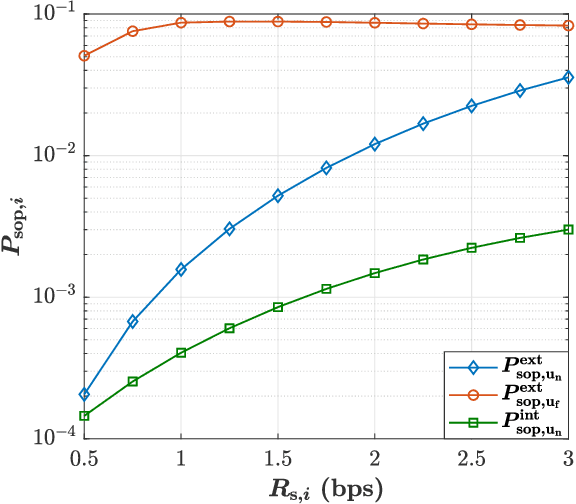
The rapid evolution of communication technologies and the emergence of sixth-generation (6G) networks have introduced unprecedented opportunities for ultra-reliable, low-latency, and energy-efficient communication. However, the integration of advanced technologies like non-orthogonal multiple access (NOMA) and wireless powered communication networks (WPCNs) brings significant challenges, particularly in terms of energy constraints and security vulnerabilities. Traditional antenna systems and orthogonal multiple access schemes struggle to meet the increasing demands for performance and security in such environments. To address this gap, this paper investigates the impact of emerging fluid antenna systems (FAS) on the performance of physical layer security (PLS) in WPCNs. Specifically, we consider a scenario in which a transmitter, powered by a power beacon via an energy link, transmits confidential messages to legitimate FAS-aided users over information links while an external eavesdropper attempts to decode the transmitted signals. Additionally, users leverage the NOMA scheme, where the far user may also act as an internal eavesdropper. For the proposed model, we first derive the distributions of the equivalent channels at each node and subsequently obtain compact expressions for the secrecy outage probability (SOP) and average secrecy capacity (ASC), using the Gaussian quadrature methods. Our results reveal that incorporating the FAS for NOMA users, instead of the TAS, enhances the performance of the proposed secure WPCN.
RIS-Aided Backscattering Tag-to-Tag Networks: Performance Analysis
Aug 29, 2024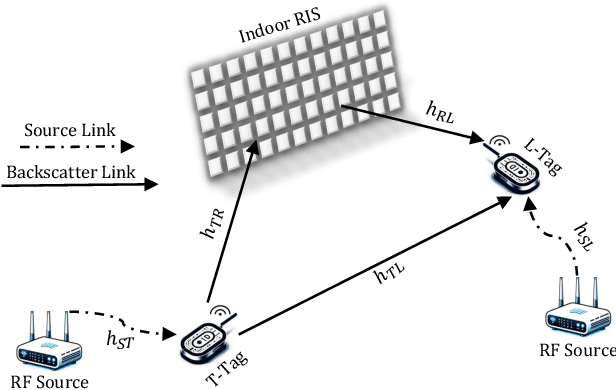
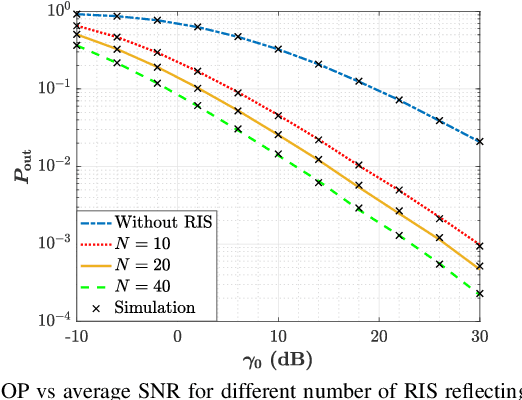
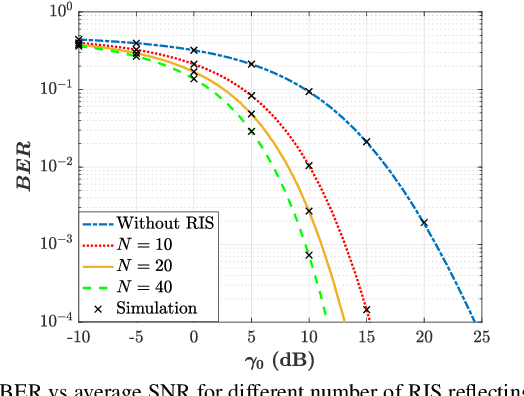
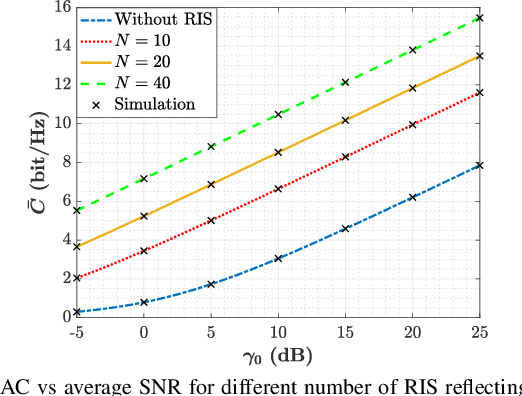
Backscattering tag-to-tag networks (BTTNs) represent a passive radio frequency identification (RFID) system that enables direct communication between tags within an external radio frequency (RF) field. However, low spectral efficiency and short-range communication capabilities, along with the ultra-low power nature of the tags, create significant challenges for reliable and practical applications of BTTNs. To address these challenges, this paper introduces integrating an indoor reconfigurable intelligent surface (RIS) into BTTN and studying RIS's impact on the system's performance. To that end, we first derive compact analytical expressions of the probability density function (PDF) and cumulative distribution function (CDF) for the received signal-to-noise ratio (SNR) at the receiver tag by exploiting the moment matching technique. Then, based on the derived PDF and CDF, we further derive analytical expressions of outage probability (OP), bit error rate (BER), and average capacity (AC) rate. Eventually, the Monte Carlo simulation is used to validate the accuracy of the analytical results, revealing that utilizing RIS can greatly improve the performance of BTTNs in terms of AC, BER, OP, and coverage region relative to traditional BTTNs setups that do not incorporate RIS.
On Performance of FAS-aided Wireless Powered NOMA Communication Systems
May 19, 2024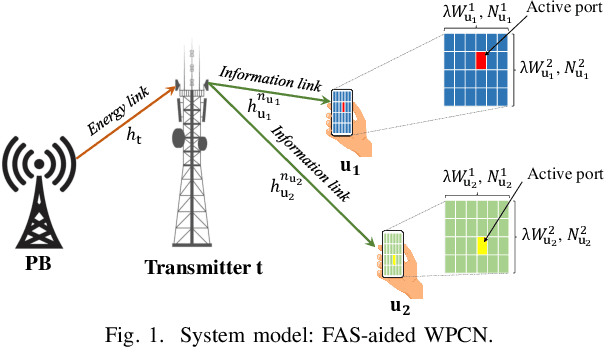
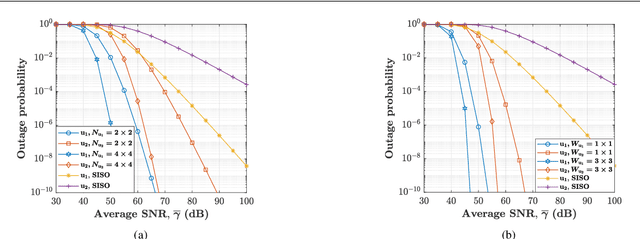
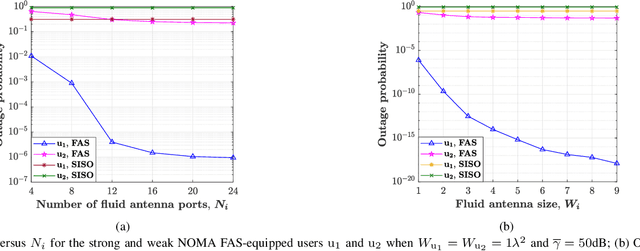
This paper studies the performance of a wireless powered communication network (WPCN) under the non-orthogonal multiple access (NOMA) scheme, where users take advantage of an emerging fluid antenna system (FAS). More precisely, we consider a scenario where a transmitter is powered by a remote power beacon (PB) to send information to the planar NOMA FAS-equipped users through Rayleigh fading channels. After introducing the distribution of the equivalent channel coefficients to the users, we derive compact analytical expressions for the outage probability (OP) in order to evaluate the system performance. Additionally, we present asymptotic OP in the high signal-to-noise ratio (SNR) regime. Eventually, results reveal that deploying the FAS with only one activated port in NOMA users can significantly enhance the WPCN performance compared with using traditional antenna systems (TAS).