 Add to Chrome
 Add to Firefox
 Add to Edge
Extrapolative Weight Averaging Reveals Correctness-Efficiency Frontiers in Code RL
May 27, 2026
Linear interpolation between fine-tuned checkpoints has been shown to trace the Pareto front between competing objectives, but whether extrapolative weight averaging can extend such frontiers to new checkpoints useful at inference time, without additional RL training, remains unclear. We study this question in RL for competitive programming, where hidden unit tests under time and memory limits enforce both functional correctness and computational efficiency. Starting from a shared initialization, we train checkpoints under nested unit-test coverage: low-coverage rewards require passing smaller-input tests, while high-coverage rewards require passing progressively larger tests up to the full suite. This sweep reveals the emergence of a correctness-efficiency frontier: on hard problems, higher-coverage reward reduces optimization failures but increases correctness failures, leaving solve rate nearly unchanged. Interpolation between low- and high-coverage checkpoints recovers this frontier, while extrapolation extends it beyond the trained endpoints. Both the frontier and its extrapolative continuation appear across three inference settings, pure reasoning, tool use, and agentic coding, and across two model scales, 32B and 7B. At the problem level, moving along the frontier changes which problems are solved, making extrapolated checkpoints complementary policies in inference-time scaling. Ensembles with extrapolative weight averaging broaden coverage and improve pass@250 on LCB/hard by 3.3% over the best single checkpoint at matched sample budget. These results show that nested unit-test coverage in code RL induces a frontier that extrapolative weight averaging can navigate, extend, and exploit.

Efficient RL Training for LLMs with Experience Replay
Apr 09, 2026While Experience Replay - the practice of storing rollouts and reusing them multiple times during training - is a foundational technique in general RL, it remains largely unexplored in LLM post-training due to the prevailing belief that fresh, on-policy data is essential for high performance. In this work, we challenge this assumption. We present a systematic study of replay buffers for LLM post-training, formalizing the optimal design as a trade-off between staleness-induced variance, sample diversity and the high computational cost of generation. We show that strict on-policy sampling is suboptimal when generation is expensive. Empirically, we show that a well-designed replay buffer can drastically reduce inference compute without degrading - and in some cases even improving - final model performance, while preserving policy entropy.
A Deep Dive into Scaling RL for Code Generation with Synthetic Data and Curricula
Mar 25, 2026Reinforcement learning (RL) has emerged as a powerful paradigm for improving large language models beyond supervised fine-tuning, yet sustaining performance gains at scale remains an open challenge, as data diversity and structure, rather than volume alone, become the limiting factor. We address this by introducing a scalable multi-turn synthetic data generation pipeline in which a teacher model iteratively refines problems based on in-context student performance summaries, producing structured difficulty progressions without any teacher fine-tuning. Compared to single-turn generation, this multi-turn approach substantially improves the yield of valid synthetic problems and naturally produces stepping stones, i.e. easier and harder variants of the same core task, that support curriculum-based training. We systematically study how task difficulty, curriculum scheduling, and environment diversity interact during RL training across the Llama3.1-8B Instruct and Qwen3-8B Base model families, with additional scaling experiments on Qwen2.5-32B. Our results show that synthetic augmentation consistently improves in-domain code and in most cases out-of-domain math performance, and we provide empirical insights into how curriculum design and data diversity jointly shape RL training dynamics.
What Does It Take to Be a Good AI Research Agent? Studying the Role of Ideation Diversity
Nov 19, 2025AI research agents offer the promise to accelerate scientific progress by automating the design, implementation, and training of machine learning models. However, the field is still in its infancy, and the key factors driving the success or failure of agent trajectories are not fully understood. We examine the role that ideation diversity plays in agent performance. First, we analyse agent trajectories on MLE-bench, a well-known benchmark to evaluate AI research agents, across different models and agent scaffolds. Our analysis reveals that different models and agent scaffolds yield varying degrees of ideation diversity, and that higher-performing agents tend to have increased ideation diversity. Further, we run a controlled experiment where we modify the degree of ideation diversity, demonstrating that higher ideation diversity results in stronger performance. Finally, we strengthen our results by examining additional evaluation metrics beyond the standard medal-based scoring of MLE-bench, showing that our findings still hold across other agent performance metrics.
RL-finetuning LLMs from on- and off-policy data with a single algorithm
Mar 25, 2025We introduce a novel reinforcement learning algorithm (AGRO, for Any-Generation Reward Optimization) for fine-tuning large-language models. AGRO leverages the concept of generation consistency, which states that the optimal policy satisfies the notion of consistency across any possible generation of the model. We derive algorithms that find optimal solutions via the sample-based policy gradient and provide theoretical guarantees on their convergence. Our experiments demonstrate the effectiveness of AGRO in both on-policy and off-policy settings, showing improved performance on the mathematical reasoning dataset over baseline algorithms.
The KoLMogorov Test: Compression by Code Generation
Mar 18, 2025Compression is at the heart of intelligence. A theoretically optimal way to compress any sequence of data is to find the shortest program that outputs that sequence and then halts. However, such 'Kolmogorov compression' is uncomputable, and code generating LLMs struggle to approximate this theoretical ideal, as it requires reasoning, planning and search capabilities beyond those of current models. In this work, we introduce the KoLMogorov-Test (KT), a compression-as-intelligence test for code generating LLMs. In KT a model is presented with a sequence of data at inference time, and asked to generate the shortest program that produces the sequence. We identify several benefits of KT for both evaluation and training: an essentially infinite number of problem instances of varying difficulty is readily available, strong baselines already exist, the evaluation metric (compression) cannot be gamed, and pretraining data contamination is highly unlikely. To evaluate current models, we use audio, text, and DNA data, as well as sequences produced by random synthetic programs. Current flagship models perform poorly - both GPT4-o and Llama-3.1-405B struggle on our natural and synthetic sequences. On our synthetic distribution, we are able to train code generation models with lower compression rates than previous approaches. Moreover, we show that gains on synthetic data generalize poorly to real data, suggesting that new innovations are necessary for additional gains on KT.
Soft Policy Optimization: Online Off-Policy RL for Sequence Models
Mar 07, 2025
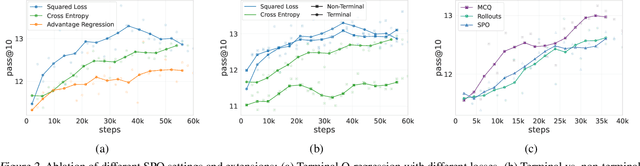
RL-based post-training of language models is almost exclusively done using on-policy methods such as PPO. These methods cannot learn from arbitrary sequences such as those produced earlier in training, in earlier runs, by human experts or other policies, or by decoding and exploration methods. This results in severe sample inefficiency and exploration difficulties, as well as a potential loss of diversity in the policy responses. Moreover, asynchronous PPO implementations require frequent and costly model transfers, and typically use value models which require a large amount of memory. In this paper we introduce Soft Policy Optimization (SPO), a simple, scalable and principled Soft RL method for sequence model policies that can learn from arbitrary online and offline trajectories and does not require a separate value model. In experiments on code contests, we shows that SPO outperforms PPO on pass@10, is significantly faster and more memory efficient, is able to benefit from off-policy data, enjoys improved stability, and learns more diverse (i.e. soft) policies.
Does equivariance matter at scale?
Oct 30, 2024Given large data sets and sufficient compute, is it beneficial to design neural architectures for the structure and symmetries of each problem? Or is it more efficient to learn them from data? We study empirically how equivariant and non-equivariant networks scale with compute and training samples. Focusing on a benchmark problem of rigid-body interactions and on general-purpose transformer architectures, we perform a series of experiments, varying the model size, training steps, and dataset size. We find evidence for three conclusions. First, equivariance improves data efficiency, but training non-equivariant models with data augmentation can close this gap given sufficient epochs. Second, scaling with compute follows a power law, with equivariant models outperforming non-equivariant ones at each tested compute budget. Finally, the optimal allocation of a compute budget onto model size and training duration differs between equivariant and non-equivariant models.
What Makes Large Language Models Reason in (Multi-Turn) Code Generation?
Oct 10, 2024


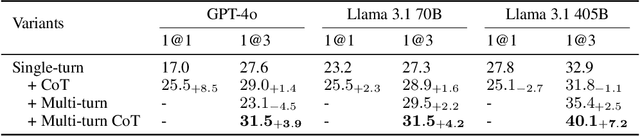
Prompting techniques such as chain-of-thought have established themselves as a popular vehicle for improving the outputs of large language models (LLMs). For code generation, however, their exact mechanics and efficacy are under-explored. We thus investigate the effects of a wide range of prompting strategies with a focus on automatic re-prompting over multiple turns and computational requirements. After systematically decomposing reasoning, instruction, and execution feedback prompts, we conduct an extensive grid search on the competitive programming benchmarks CodeContests and TACO for multiple LLM families and sizes (Llama 3.0 and 3.1, 8B, 70B, 405B, and GPT-4o). Our study reveals strategies that consistently improve performance across all models with small and large sampling budgets. We then show how finetuning with such an optimal configuration allows models to internalize the induced reasoning process and obtain improvements in performance and scalability for multi-turn code generation.
RLEF: Grounding Code LLMs in Execution Feedback with Reinforcement Learning
Oct 02, 2024


Large language models (LLMs) deployed as agents solve user-specified tasks over multiple steps while keeping the required manual engagement to a minimum. Crucially, such LLMs need to ground their generations in any feedback obtained to reliably achieve desired outcomes. We propose an end-to-end reinforcement learning method for teaching models to leverage execution feedback in the realm of code synthesis, where state-of-the-art LLMs struggle to improve code iteratively compared to independent sampling. We benchmark on competitive programming tasks, where we achieve new start-of-the art results with both small (8B parameters) and large (70B) models while reducing the amount of samples required by an order of magnitude. Our analysis of inference-time behavior demonstrates that our method produces LLMs that effectively leverage automatic feedback over multiple steps.