 Add to Chrome
 Add to Firefox
 Add to Edge
RanLayNet: A Dataset for Document Layout Detection used for Domain Adaptation and Generalization
Apr 15, 2024
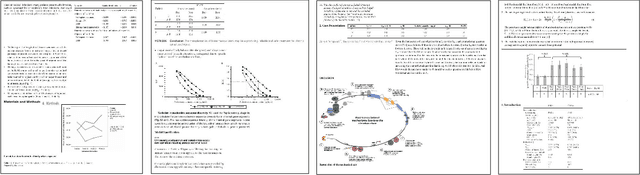


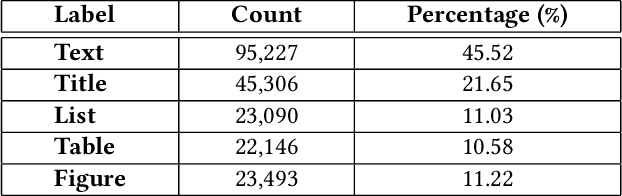
Large ground-truth datasets and recent advances in deep learning techniques have been useful for layout detection. However, because of the restricted layout diversity of these datasets, training on them requires a sizable number of annotated instances, which is both expensive and time-consuming. As a result, differences between the source and target domains may significantly impact how well these models function. To solve this problem, domain adaptation approaches have been developed that use a small quantity of labeled data to adjust the model to the target domain. In this research, we introduced a synthetic document dataset called RanLayNet, enriched with automatically assigned labels denoting spatial positions, ranges, and types of layout elements. The primary aim of this endeavor is to develop a versatile dataset capable of training models with robustness and adaptability to diverse document formats. Through empirical experimentation, we demonstrate that a deep layout identification model trained on our dataset exhibits enhanced performance compared to a model trained solely on actual documents. Moreover, we conduct a comparative analysis by fine-tuning inference models using both PubLayNet and IIIT-AR-13K datasets on the Doclaynet dataset. Our findings emphasize that models enriched with our dataset are optimal for tasks such as achieving 0.398 and 0.588 mAP95 score in the scientific document domain for the TABLE class.

Isometric Neural Machine Translation using Phoneme Count Ratio Reward-based Reinforcement Learning
Mar 20, 2024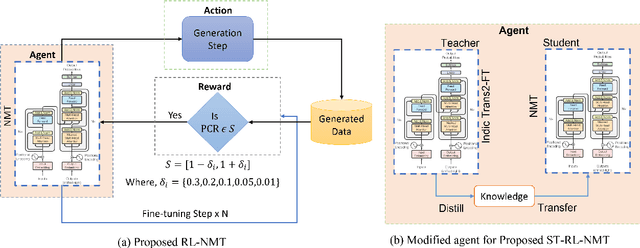
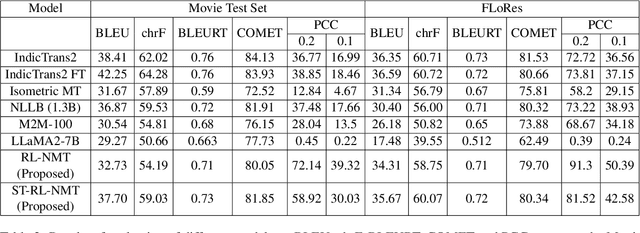
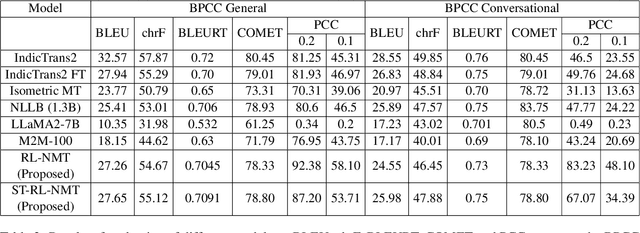
Traditional Automatic Video Dubbing (AVD) pipeline consists of three key modules, namely, Automatic Speech Recognition (ASR), Neural Machine Translation (NMT), and Text-to-Speech (TTS). Within AVD pipelines, isometric-NMT algorithms are employed to regulate the length of the synthesized output text. This is done to guarantee synchronization with respect to the alignment of video and audio subsequent to the dubbing process. Previous approaches have focused on aligning the number of characters and words in the source and target language texts of Machine Translation models. However, our approach aims to align the number of phonemes instead, as they are closely associated with speech duration. In this paper, we present the development of an isometric NMT system using Reinforcement Learning (RL), with a focus on optimizing the alignment of phoneme counts in the source and target language sentence pairs. To evaluate our models, we propose the Phoneme Count Compliance (PCC) score, which is a measure of length compliance. Our approach demonstrates a substantial improvement of approximately 36% in the PCC score compared to the state-of-the-art models when applied to English-Hindi language pairs. Moreover, we propose a student-teacher architecture within the framework of our RL approach to maintain a trade-off between the phoneme count and translation quality.
Multilingual Coreference Resolution in Low-resource South Asian Languages
Feb 21, 2024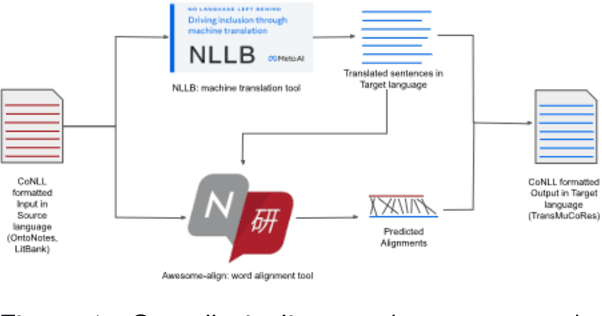
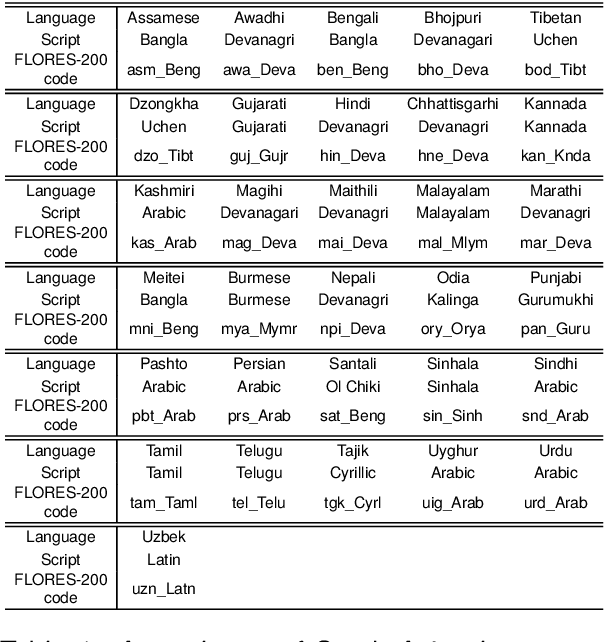
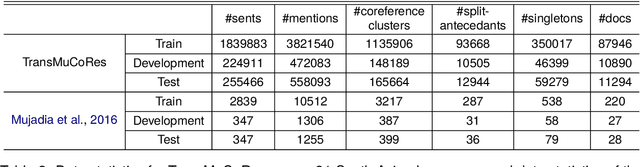
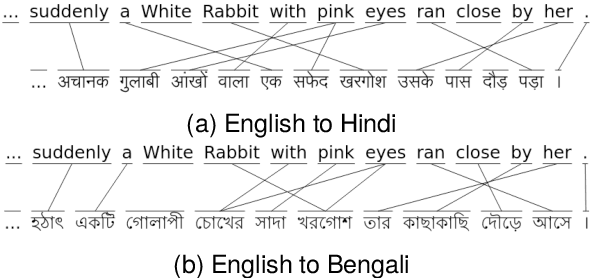
Coreference resolution involves the task of identifying text spans within a discourse that pertain to the same real-world entity. While this task has been extensively explored in the English language, there has been a notable scarcity of publicly accessible resources and models for coreference resolution in South Asian languages. We introduce a Translated dataset for Multilingual Coreference Resolution (TransMuCoRes) in 31 South Asian languages using off-the-shelf tools for translation and word-alignment. Nearly all of the predicted translations successfully pass a sanity check, and 75% of English references align with their predicted translations. Using multilingual encoders, two off-the-shelf coreference resolution models were trained on a concatenation of TransMuCoRes and a Hindi coreference resolution dataset with manual annotations. The best performing model achieved a score of 64 and 68 for LEA F1 and CoNLL F1, respectively, on our test-split of Hindi golden set. This study is the first to evaluate an end-to-end coreference resolution model on a Hindi golden set. Furthermore, this work underscores the limitations of current coreference evaluation metrics when applied to datasets with split antecedents, advocating for the development of more suitable evaluation metrics.
Behavior Optimized Image Generation
Nov 18, 2023


The last few years have witnessed great success on image generation, which has crossed the acceptance thresholds of aesthetics, making it directly applicable to personal and commercial applications. However, images, especially in marketing and advertising applications, are often created as a means to an end as opposed to just aesthetic concerns. The goal can be increasing sales, getting more clicks, likes, or image sales (in the case of stock businesses). Therefore, the generated images need to perform well on these key performance indicators (KPIs), in addition to being aesthetically good. In this paper, we make the first endeavor to answer the question of "How can one infuse the knowledge of the end-goal within the image generation process itself to create not just better-looking images but also "better-performing'' images?''. We propose BoigLLM, an LLM that understands both image content and user behavior. BoigLLM knows how an image should look to get a certain required KPI. We show that BoigLLM outperforms 13x larger models such as GPT-3.5 and GPT-4 in this task, demonstrating that while these state-of-the-art models can understand images, they lack information on how these images perform in the real world. To generate actual pixels of behavior-conditioned images, we train a diffusion-based model (BoigSD) to align with a proposed BoigLLM-defined reward. We show the performance of the overall pipeline on two datasets covering two different behaviors: a stock dataset with the number of forward actions as the KPI and a dataset containing tweets with the total likes as the KPI, denoted as BoigBench. To advance research in the direction of utility-driven image generation and understanding, we release BoigBench, a benchmark dataset containing 168 million enterprise tweets with their media, brand account names, time of post, and total likes.
Exploring Graph Neural Networks for Indian Legal Judgment Prediction
Oct 19, 2023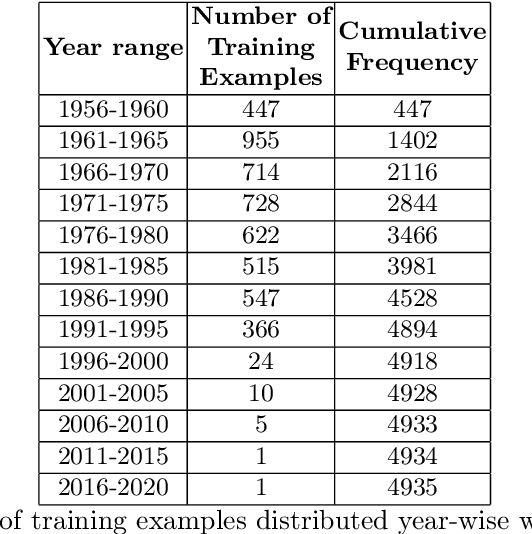
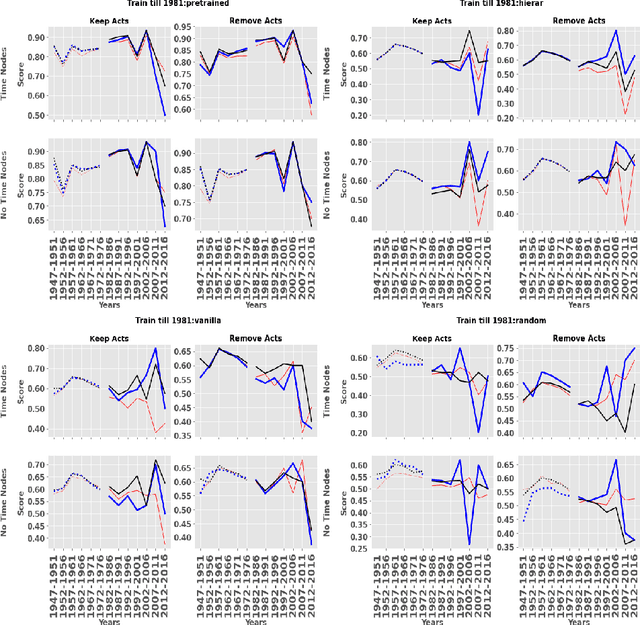
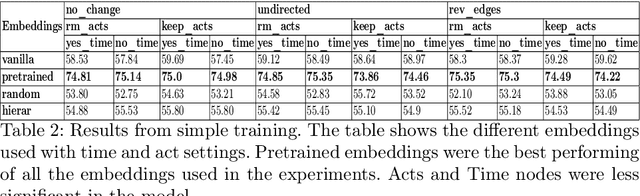
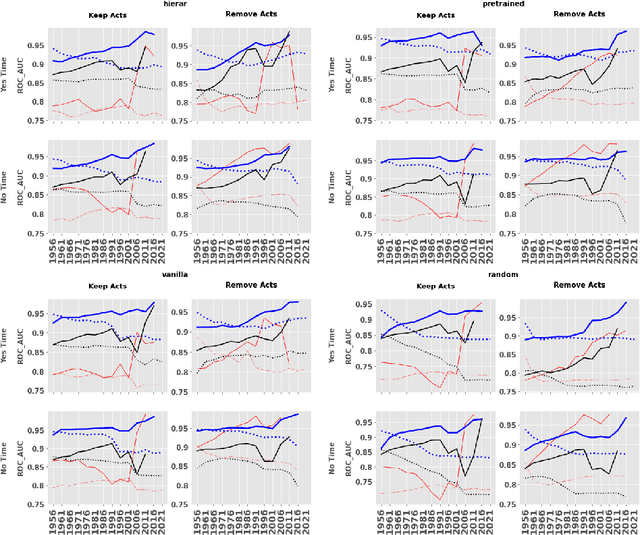
The burdensome impact of a skewed judges-to-cases ratio on the judicial system manifests in an overwhelming backlog of pending cases alongside an ongoing influx of new ones. To tackle this issue and expedite the judicial process, the proposition of an automated system capable of suggesting case outcomes based on factual evidence and precedent from past cases gains significance. This research paper centres on developing a graph neural network-based model to address the Legal Judgment Prediction (LJP) problem, recognizing the intrinsic graph structure of judicial cases and making it a binary node classification problem. We explored various embeddings as model features, while nodes such as time nodes and judicial acts were added and pruned to evaluate the model's performance. The study is done while considering the ethical dimension of fairness in these predictions, considering gender and name biases. A link prediction task is also conducted to assess the model's proficiency in anticipating connections between two specified nodes. By harnessing the capabilities of graph neural networks and incorporating fairness analyses, this research aims to contribute insights towards streamlining the adjudication process, enhancing judicial efficiency, and fostering a more equitable legal landscape, ultimately alleviating the strain imposed by mounting case backlogs. Our best-performing model with XLNet pre-trained embeddings as its features gives the macro F1 score of 75% for the LJP task. For link prediction, the same set of features is the best performing giving ROC of more than 80%
Partial Rank Similarity Minimization Method for Quality MOS Prediction of Unseen Speech Synthesis Systems in Zero-Shot and Semi-supervised setting
Oct 08, 2023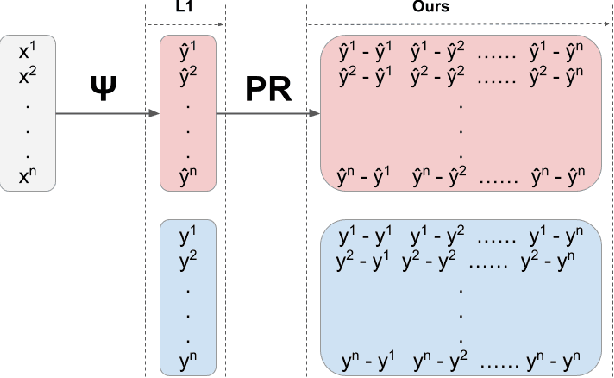

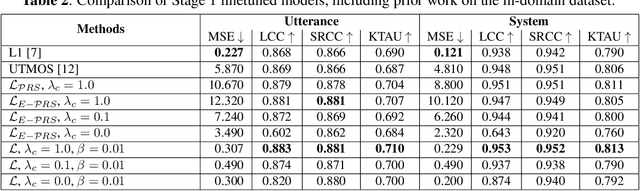
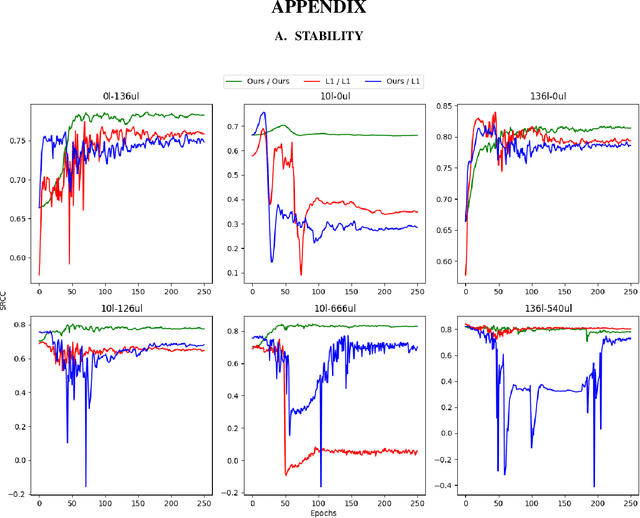
This paper introduces a novel objective function for quality mean opinion score (MOS) prediction of unseen speech synthesis systems. The proposed function measures the similarity of relative positions of predicted MOS values, in a mini-batch, rather than the actual MOS values. That is the partial rank similarity is measured (PRS) rather than the individual MOS values as with the L1 loss. Our experiments on out-of-domain speech synthesis systems demonstrate that the PRS outperforms L1 loss in zero-shot and semi-supervised settings, exhibiting stronger correlation with ground truth. These findings highlight the importance of considering rank order, as done by PRS, when training MOS prediction models. We also argue that mean squared error and linear correlation coefficient metrics may be unreliable for evaluating MOS prediction models. In conclusion, PRS-trained models provide a robust framework for evaluating speech quality and offer insights for developing high-quality speech synthesis systems. Code and models are available at github.com/nii-yamagishilab/partial_rank_similarity/
Large Content And Behavior Models To Understand, Simulate, And Optimize Content And Behavior
Sep 08, 2023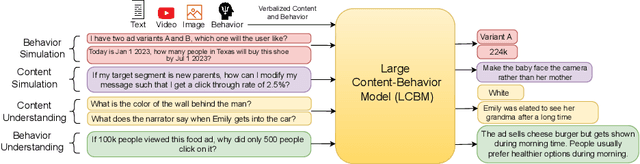
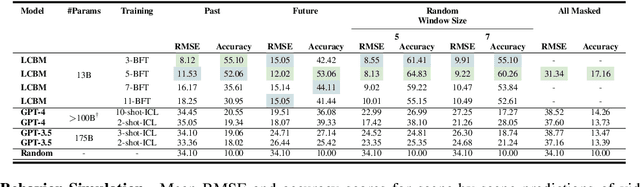
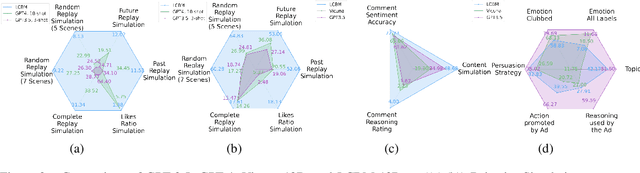
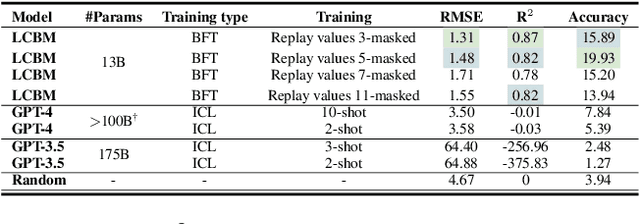
Shannon, in his seminal paper introducing information theory, divided the communication into three levels: technical, semantic, and effectivenss. While the technical level is concerned with accurate reconstruction of transmitted symbols, the semantic and effectiveness levels deal with the inferred meaning and its effect on the receiver. Thanks to telecommunications, the first level problem has produced great advances like the internet. Large Language Models (LLMs) make some progress towards the second goal, but the third level still remains largely untouched. The third problem deals with predicting and optimizing communication for desired receiver behavior. LLMs, while showing wide generalization capabilities across a wide range of tasks, are unable to solve for this. One reason for the underperformance could be a lack of "behavior tokens" in LLMs' training corpora. Behavior tokens define receiver behavior over a communication, such as shares, likes, clicks, purchases, retweets, etc. While preprocessing data for LLM training, behavior tokens are often removed from the corpora as noise. Therefore, in this paper, we make some initial progress towards reintroducing behavior tokens in LLM training. The trained models, other than showing similar performance to LLMs on content understanding tasks, show generalization capabilities on behavior simulation, content simulation, behavior understanding, and behavior domain adaptation. Using a wide range of tasks on two corpora, we show results on all these capabilities. We call these models Large Content and Behavior Models (LCBMs). Further, to spur more research on LCBMs, we release our new Content Behavior Corpus (CBC), a repository containing communicator, message, and corresponding receiver behavior.
Long-Term Memorability On Advertisements
Sep 01, 2023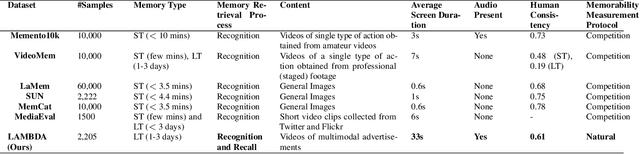
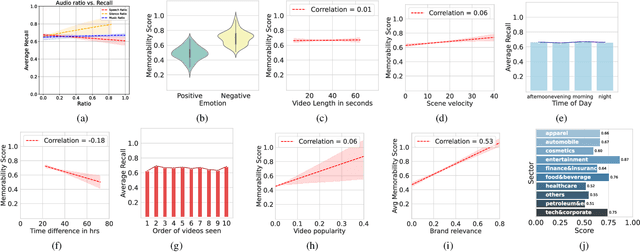
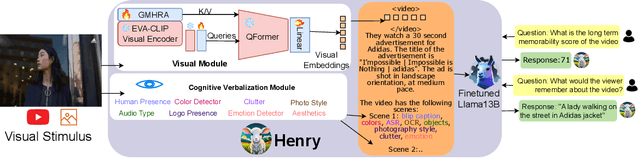

Marketers spend billions of dollars on advertisements but to what end? At the purchase time, if customers cannot recognize a brand for which they saw an ad, the money spent on the ad is essentially wasted. Despite its importance in marketing, until now, there has been no study on the memorability of ads in the ML literature. Most studies have been conducted on short-term recall (<5 mins) on specific content types like object and action videos. On the other hand, the advertising industry only cares about long-term memorability (a few hours or longer), and advertisements are almost always highly multimodal, depicting a story through its different modalities (text, images, and videos). With this motivation, we conduct the first large scale memorability study consisting of 1203 participants and 2205 ads covering 276 brands. Running statistical tests over different participant subpopulations and ad-types, we find many interesting insights into what makes an ad memorable - both content and human factors. For example, we find that brands which use commercials with fast moving scenes are more memorable than those with slower scenes (p=8e-10) and that people who use ad-blockers remember lower number of ads than those who don't (p=5e-3). Further, with the motivation of simulating the memorability of marketing materials for a particular audience, ultimately helping create one, we present a novel model, Sharingan, trained to leverage real-world knowledge of LLMs and visual knowledge of visual encoders to predict the memorability of a content. We test our model on all the prominent memorability datasets in literature (both images and videos) and achieve state of the art across all of them. We conduct extensive ablation studies across memory types, modality, brand, and architectural choices to find insights into what drives memory.
A Video Is Worth 4096 Tokens: Verbalize Story Videos To Understand Them In Zero Shot
May 23, 2023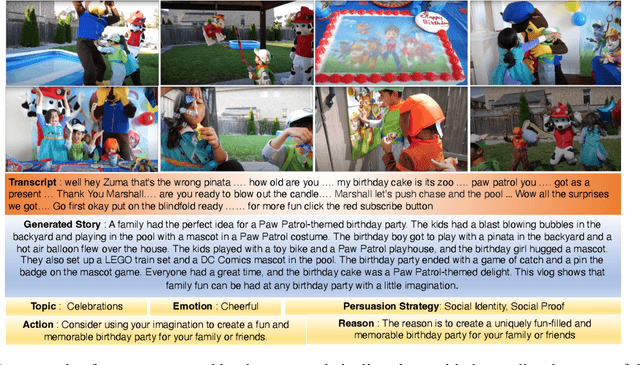
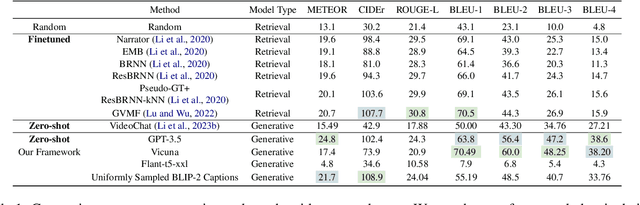
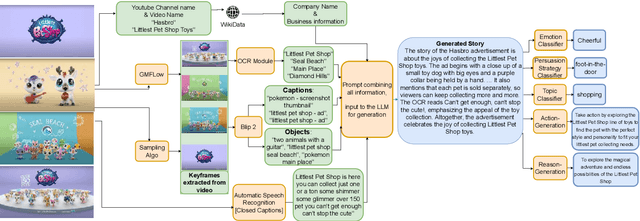
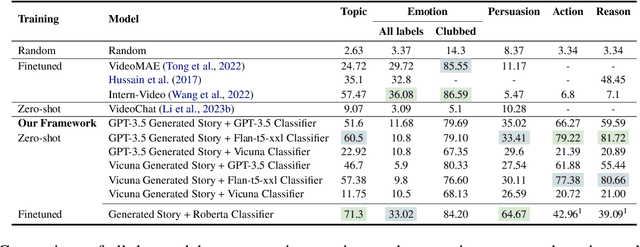
Multimedia content, such as advertisements and story videos, exhibit a rich blend of creativity and multiple modalities. They incorporate elements like text, visuals, audio, and storytelling techniques, employing devices like emotions, symbolism, and slogans to convey meaning. While previous research in multimedia understanding has focused mainly on videos with specific actions like cooking, there is a dearth of large annotated training datasets, hindering the development of supervised learning models with satisfactory performance for real-world applications. However, the rise of large language models (LLMs) has witnessed remarkable zero-shot performance in various natural language processing (NLP) tasks, such as emotion classification, question-answering, and topic classification. To bridge this performance gap in multimedia understanding, we propose verbalizing story videos to generate their descriptions in natural language and then performing video-understanding tasks on the generated story as opposed to the original video. Through extensive experiments on five video-understanding tasks, we demonstrate that our method, despite being zero-shot, achieves significantly better results than supervised baselines for video understanding. Further, alleviating a lack of story understanding benchmarks, we publicly release the first dataset on a crucial task in computational social science, persuasion strategy identification.
CiteCaseLAW: Citation Worthiness Detection in Caselaw for Legal Assistive Writing
May 03, 2023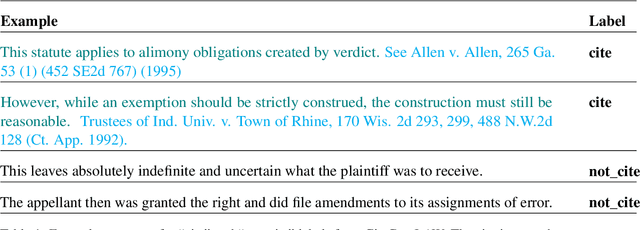
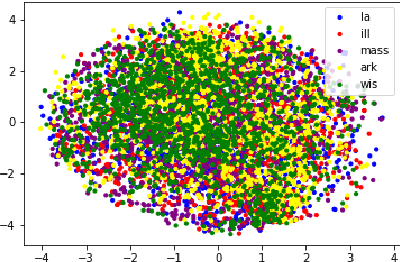
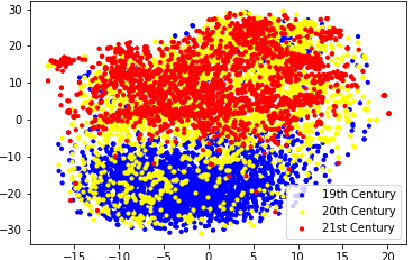
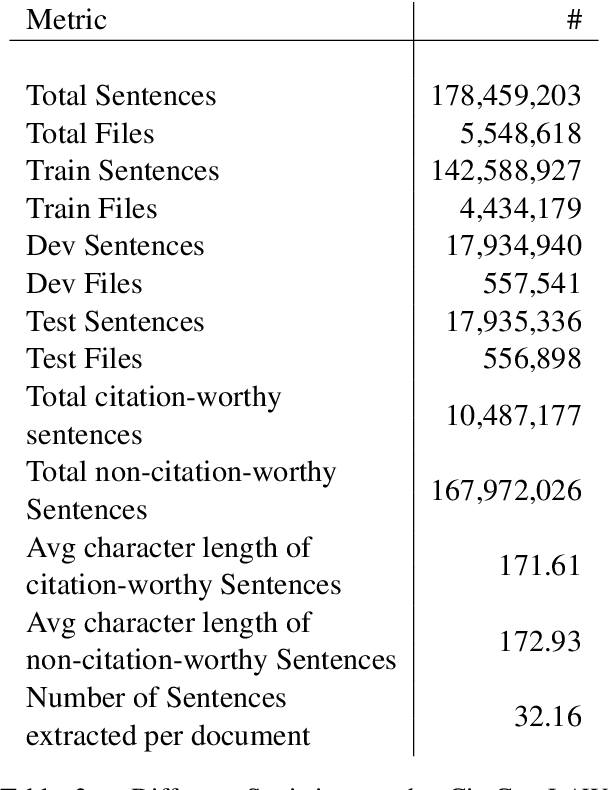
In legal document writing, one of the key elements is properly citing the case laws and other sources to substantiate claims and arguments. Understanding the legal domain and identifying appropriate citation context or cite-worthy sentences are challenging tasks that demand expensive manual annotation. The presence of jargon, language semantics, and high domain specificity makes legal language complex, making any associated legal task hard for automation. The current work focuses on the problem of citation-worthiness identification. It is designed as the initial step in today's citation recommendation systems to lighten the burden of extracting an adequate set of citation contexts. To accomplish this, we introduce a labeled dataset of 178M sentences for citation-worthiness detection in the legal domain from the Caselaw Access Project (CAP). The performance of various deep learning models was examined on this novel dataset. The domain-specific pre-trained model tends to outperform other models, with an 88% F1-score for the citation-worthiness detection task.