 Add to Chrome
 Add to Firefox
 Add to Edge
Graph-Based Bayesian Optimization for Quantum Circuit Architecture Search with Uncertainty Calibrated Surrogates
Dec 10, 2025
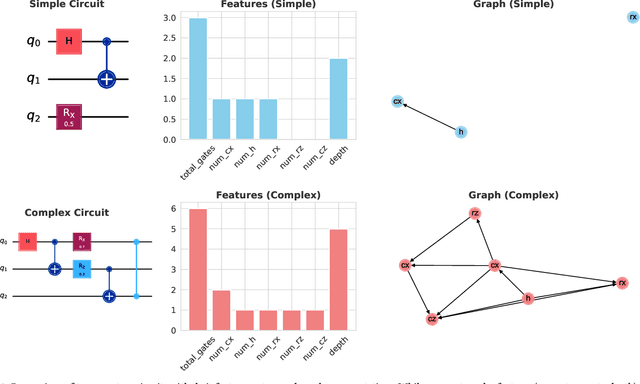
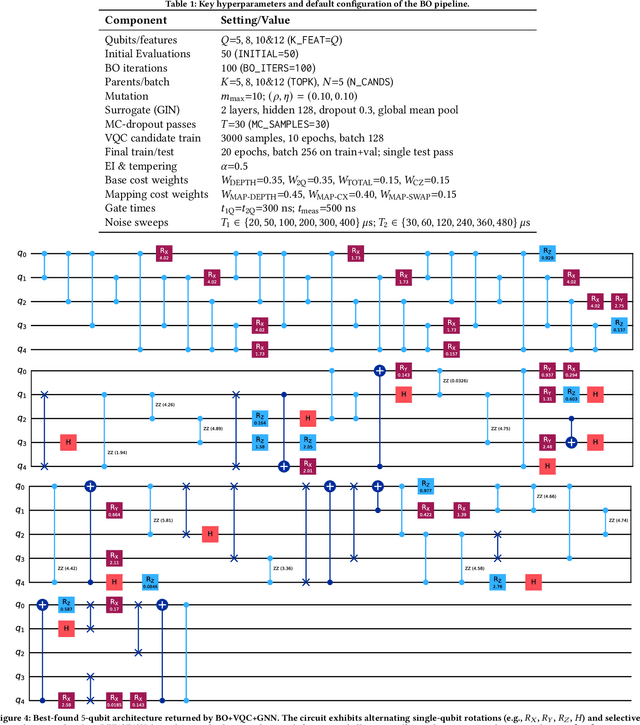
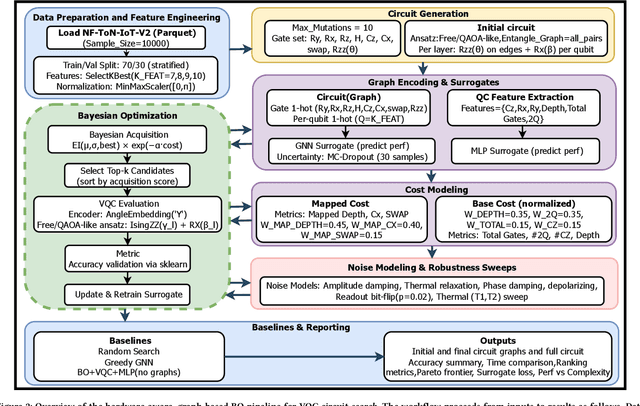
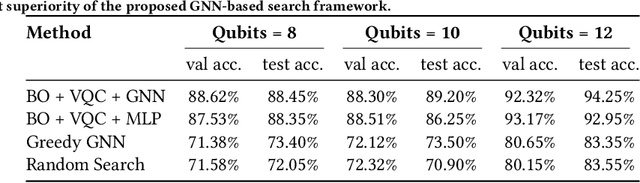
Quantum circuit design is a key bottleneck for practical quantum machine learning on complex, real-world data. We present an automated framework that discovers and refines variational quantum circuits (VQCs) using graph-based Bayesian optimization with a graph neural network (GNN) surrogate. Circuits are represented as graphs and mutated and selected via an expected improvement acquisition function informed by surrogate uncertainty with Monte Carlo dropout. Candidate circuits are evaluated with a hybrid quantum-classical variational classifier on the next generation firewall telemetry and network internet of things (NF-ToN-IoT-V2) cybersecurity dataset, after feature selection and scaling for quantum embedding. We benchmark our pipeline against an MLP-based surrogate, random search, and greedy GNN selection. The GNN-guided optimizer consistently finds circuits with lower complexity and competitive or superior classification accuracy compared to all baselines. Robustness is assessed via a noise study across standard quantum noise channels, including amplitude damping, phase damping, thermal relaxation, depolarizing, and readout bit flip noise. The implementation is fully reproducible, with time benchmarking and export of best found circuits, providing a scalable and interpretable route to automated quantum circuit discovery.

HQNN-FSP: A Hybrid Classical-Quantum Neural Network for Regression-Based Financial Stock Market Prediction
Mar 19, 2025Financial time-series forecasting remains a challenging task due to complex temporal dependencies and market fluctuations. This study explores the potential of hybrid quantum-classical approaches to assist in financial trend prediction by leveraging quantum resources for improved feature representation and learning. A custom Quantum Neural Network (QNN) regressor is introduced, designed with a novel ansatz tailored for financial applications. Two hybrid optimization strategies are proposed: (1) a sequential approach where classical recurrent models (RNN/LSTM) extract temporal dependencies before quantum processing, and (2) a joint learning framework that optimizes classical and quantum parameters simultaneously. Systematic evaluation using TimeSeriesSplit, k-fold cross-validation, and predictive error analysis highlights the ability of these hybrid models to integrate quantum computing into financial forecasting workflows. The findings demonstrate how quantum-assisted learning can contribute to financial modeling, offering insights into the practical role of quantum resources in time-series analysis.
RanLayNet: A Dataset for Document Layout Detection used for Domain Adaptation and Generalization
Apr 15, 2024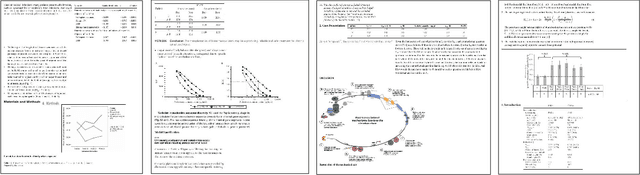


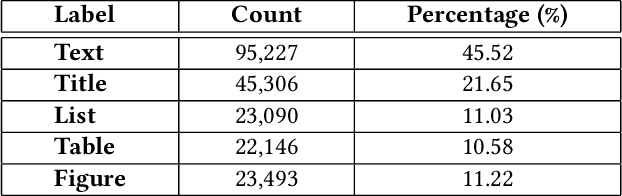
Large ground-truth datasets and recent advances in deep learning techniques have been useful for layout detection. However, because of the restricted layout diversity of these datasets, training on them requires a sizable number of annotated instances, which is both expensive and time-consuming. As a result, differences between the source and target domains may significantly impact how well these models function. To solve this problem, domain adaptation approaches have been developed that use a small quantity of labeled data to adjust the model to the target domain. In this research, we introduced a synthetic document dataset called RanLayNet, enriched with automatically assigned labels denoting spatial positions, ranges, and types of layout elements. The primary aim of this endeavor is to develop a versatile dataset capable of training models with robustness and adaptability to diverse document formats. Through empirical experimentation, we demonstrate that a deep layout identification model trained on our dataset exhibits enhanced performance compared to a model trained solely on actual documents. Moreover, we conduct a comparative analysis by fine-tuning inference models using both PubLayNet and IIIT-AR-13K datasets on the Doclaynet dataset. Our findings emphasize that models enriched with our dataset are optimal for tasks such as achieving 0.398 and 0.588 mAP95 score in the scientific document domain for the TABLE class.