 Add to Chrome
 Add to Firefox
 Add to Edge
CipherSight: Robust Website Fingerprinting via Record-Resource Semantic Supervision under Distribution Shifts
Aug 14, 2026
HTTPS website fingerprinting (WF) aims to identify visited websites from metadata observable in encrypted traffic. However, real-world deployments introduce a significant out-of-distribution (OOD) problem caused by temporal and geographic changes, while previously unseen websites are common in open-world scenarios. Existing methods primarily learn from raw TCP packet sequences and struggle to capture stable and generalizable website representations, resulting in performance degradation under practical conditions. We propose CipherSight, a TLS-record-based hierarchical framework for robust HTTPS WF. Unlike existing approaches that rely on TCP packet sequences and are sensitive to transport-layer artifacts, CipherSight learns website representations from TLS records by jointly encoding multiple record-level attributes. It introduces a hierarchical architecture that captures both intra-flow dependencies among TLS records and inter-flow interactions across concurrent flows, enabling the model to exploit structural patterns in HTTPS traffic. Besides, to learn robust representations, CipherSight employs a masked record modeling (MRM) task to capture contextual traffic semantics and leverages fine-grained record-resource annotations as privileged supervision through structure-aware objectives and semantic distillation. Experiments show that CipherSight achieves 95.41% accuracy across more than 2,000 website classes in the closed-world setting and maintains over 90% accuracy under both temporal and geographic drift, consistently outperforming all evaluated baselines.

MIDS: Detecting Stealthy Masquerade and Tampering Attacks on CAN Bus via Bidirectional Mamba
Jun 17, 2026The Controller Area Network (CAN) protocol is the primary communication standard for Electronic Control Units (ECUs) in modern vehicles, but its lack of encryption and authentication exposes it to a range of security threats. Existing intrusion detection systems are largely tuned to fabrication-style attacks (DoS, fuzzing, ID spoofing realised by frame injection), in which detection signals such as per-ID inter-arrival statistics are readily available. We instead address the harder \emph{masquerade} setting~\cite{b37}, in which an internal adversary substitutes a legitimate frame in-situ at its original transmission slot, preserving traffic periodicity and rendering traffic-statistic defences ineffective. We propose the Mamba Intrusion Detection System (MIDS), an innovative dual-stream framework that processes CAN identifiers and payloads in parallel and reconstructs their joint temporal semantics through bidirectional selective state-space modelling. To evaluate MIDS, we collected over 100 million CAN frames from a physical Tesla Model 3 across three driving regimes and synthesised 54 masquerade attack variants spanning ID-only, data-only, and combined modifications. MIDS attains an F1 of 96.94\% on this dataset, exceeding the strongest reproducible baseline by more than 8 percentage points, while sustaining a 1.147~ms single-window inference latency -- ample headroom for real-time onboard deployment. To verify generalisation, we further evaluate MIDS on four public benchmarks (ROAD, CrySyS, OTIDS, CT\&T) covering both masquerade and injection scenarios; MIDS attains F1 from 93.70\% to 99.61\%, outperforming the strongest of eight reproduced baselines by up to 13.94 percentage points under a unified 5-fold protocol.
Uni-World VLA: Interleaved World Modeling and Planning for Autonomous Driving
Mar 28, 2026Autonomous driving requires reasoning about how the environment evolves and planning actions accordingly. Existing world-model-based approaches typically predict future scenes first and plan afterwards, resulting in open-loop imagination that may drift from the actual decision process. In this paper, we present Uni-World VLA, a unified vision-language-action (VLA) model that tightly interleaves future frame prediction and trajectory planning. Instead of generating a full world rollout before planning, our model alternates between predicting future frames and ego actions step by step, allowing planning decisions to be continuously conditioned on the imagined future observations. This interleaved generation forms a closed-loop interaction between world modeling and control, enabling more adaptive decision-making in dynamic traffic scenarios. In addition, we incorporate monocular depth information into frames to provide stronger geometric cues for world modeling, improving long-horizon scene prediction. Experiments on the NAVSIM benchmark show that our approach achieves competitive closed-loop planning performance while producing high-fidelity future frame predictions. These results demonstrate that tightly coupling world prediction and planning is a promising direction for scalable VLA driving systems.
Dual-Domain Representation Alignment: Bridging 2D and 3D Vision via Geometry-Aware Architecture Search
Mar 20, 2026Modern computer vision requires balancing predictive accuracy with real-time efficiency, yet the high inference cost of large vision models (LVMs) limits deployment on resource-constrained edge devices. Although Evolutionary Neural Architecture Search (ENAS) is well suited for multi-objective optimization, its practical use is hindered by two issues: expensive candidate evaluation and ranking inconsistency among subnetworks. To address them, we propose EvoNAS, an efficient distributed framework for multi-objective evolutionary architecture search. We build a hybrid supernet that integrates Vision State Space and Vision Transformer (VSS-ViT) modules, and optimize it with a Cross-Architecture Dual-Domain Knowledge Distillation (CA-DDKD) strategy. By coupling the computational efficiency of VSS blocks with the semantic expressiveness of ViT modules, CA-DDKD improves the representational capacity of the shared supernet and enhances ranking consistency, enabling reliable fitness estimation during evolution without extra fine-tuning. To reduce the cost of large-scale validation, we further introduce a Distributed Multi-Model Parallel Evaluation (DMMPE) framework based on GPU resource pooling and asynchronous scheduling. Compared with conventional data-parallel evaluation, DMMPE improves efficiency by over 70% through concurrent multi-GPU, multi-model execution. Experiments on COCO, ADE20K, KITTI, and NYU-Depth v2 show that the searched architectures, termed EvoNets, consistently achieve Pareto-optimal trade-offs between accuracy and efficiency. Compared with representative CNN-, ViT-, and Mamba-based models, EvoNets deliver lower inference latency and higher throughput under strict computational budgets while maintaining strong generalization on downstream tasks such as novel view synthesis. Code is available at https://github.com/EMI-Group/evonas
M3S-Net: Multimodal Feature Fusion Network Based on Multi-scale Data for Ultra-short-term PV Power Forecasting
Feb 23, 2026The inherent intermittency and high-frequency variability of solar irradiance, particularly during rapid cloud advection, present significant stability challenges to high-penetration photovoltaic grids. Although multimodal forecasting has emerged as a viable mitigation strategy, existing architectures predominantly rely on shallow feature concatenation and binary cloud segmentation, thereby failing to capture the fine-grained optical features of clouds and the complex spatiotemporal coupling between visual and meteorological modalities. To bridge this gap, this paper proposes M3S-Net, a novel multimodal feature fusion network based on multi-scale data for ultra-short-term PV power forecasting. First, a multi-scale partial channel selection network leverages partial convolutions to explicitly isolate the boundary features of optically thin clouds, effectively transcending the precision limitations of coarse-grained binary masking. Second, a multi-scale sequence to image analysis network employs Fast Fourier Transform (FFT)-based time-frequency representation to disentangle the complex periodicity of meteorological data across varying time horizons. Crucially, the model incorporates a cross-modal Mamba interaction module featuring a novel dynamic C-matrix swapping mechanism. By exchanging state-space parameters between visual and temporal streams, this design conditions the state evolution of one modality on the context of the other, enabling deep structural coupling with linear computational complexity, thus overcoming the limitations of shallow concatenation. Experimental validation on the newly constructed fine-grained PV power dataset demonstrates that M3S-Net achieves a mean absolute error reduction of 6.2% in 10-minute forecasts compared to state-of-the-art baselines. The dataset and source code will be available at https://github.com/she1110/FGPD.
Voronoi-grid-based Pareto Front Learning and Its Application to Collaborative Federated Learning
May 27, 2025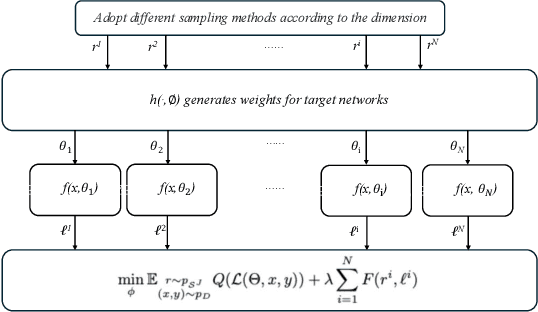
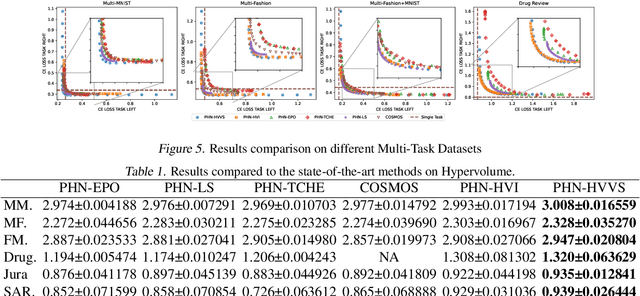
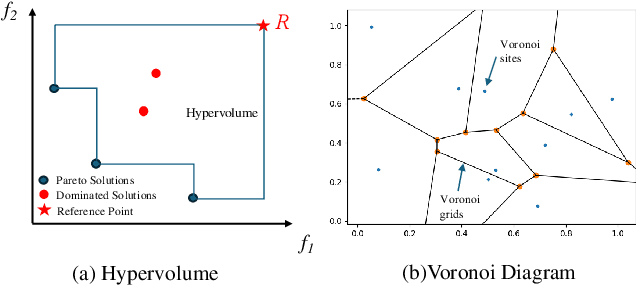
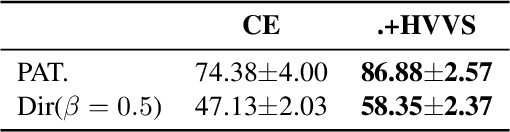
Multi-objective optimization (MOO) exists extensively in machine learning, and aims to find a set of Pareto-optimal solutions, called the Pareto front, e.g., it is fundamental for multiple avenues of research in federated learning (FL). Pareto-Front Learning (PFL) is a powerful method implemented using Hypernetworks (PHNs) to approximate the Pareto front. This method enables the acquisition of a mapping function from a given preference vector to the solutions on the Pareto front. However, most existing PFL approaches still face two challenges: (a) sampling rays in high-dimensional spaces; (b) failing to cover the entire Pareto Front which has a convex shape. Here, we introduce a novel PFL framework, called as PHN-HVVS, which decomposes the design space into Voronoi grids and deploys a genetic algorithm (GA) for Voronoi grid partitioning within high-dimensional space. We put forward a new loss function, which effectively contributes to more extensive coverage of the resultant Pareto front and maximizes the HV Indicator. Experimental results on multiple MOO machine learning tasks demonstrate that PHN-HVVS outperforms the baselines significantly in generating Pareto front. Also, we illustrate that PHN-HVVS advances the methodologies of several recent problems in the FL field. The code is available at https://github.com/buptcmm/phnhvvs}{https://github.com/buptcmm/phnhvvs.
Machine Learning-Accelerated Multi-Objective Design of Fractured Geothermal Systems
Nov 01, 2024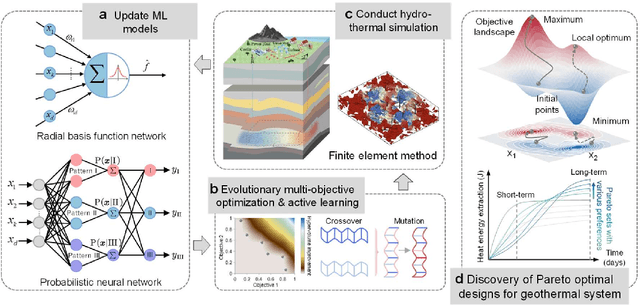
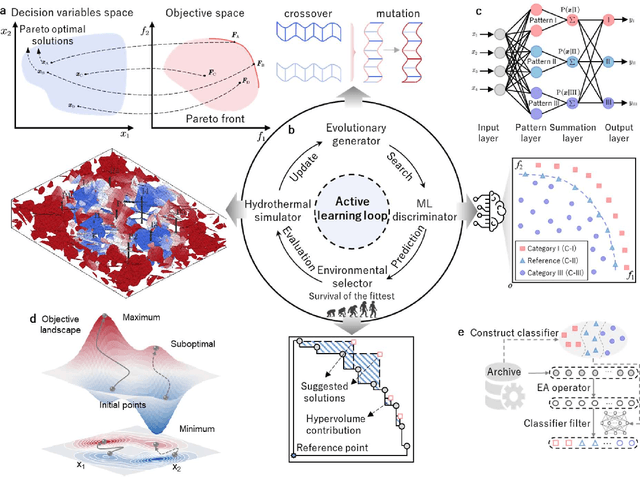
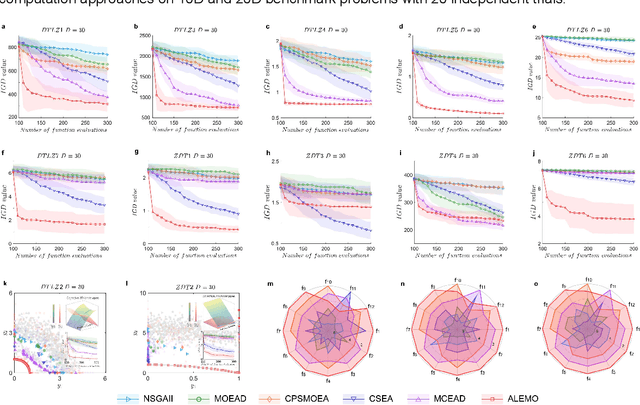
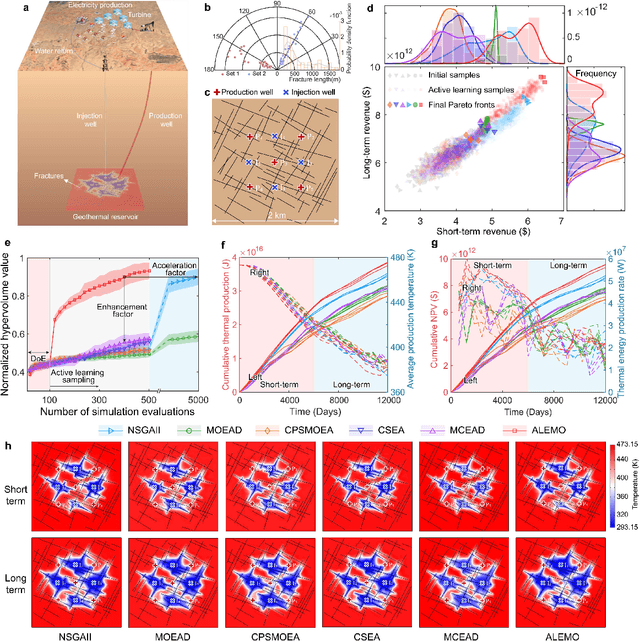
Multi-objective optimization has burgeoned as a potent methodology for informed decision-making in enhanced geothermal systems, aiming to concurrently maximize economic yield, ensure enduring geothermal energy provision, and curtail carbon emissions. However, addressing a multitude of design parameters inherent in computationally intensive physics-driven simulations constitutes a formidable impediment for geothermal design optimization, as well as across a broad range of scientific and engineering domains. Here we report an Active Learning enhanced Evolutionary Multi-objective Optimization algorithm, integrated with hydrothermal simulations in fractured media, to enable efficient optimization of fractured geothermal systems using few model evaluations. We introduce probabilistic neural network as classifier to learns to predict the Pareto dominance relationship between candidate samples and reference samples, thereby facilitating the identification of promising but uncertain offspring solutions. We then use active learning strategy to conduct hypervolume based attention subspace search with surrogate model by iteratively infilling informative samples within local promising parameter subspace. We demonstrate its effectiveness by conducting extensive experimental tests of the integrated framework, including multi-objective benchmark functions, a fractured geothermal model and a large-scale enhanced geothermal system. Results demonstrate that the ALEMO approach achieves a remarkable reduction in required simulations, with a speed-up of 1-2 orders of magnitude (10-100 times faster) than traditional evolutionary methods, thereby enabling accelerated decision-making. Our method is poised to advance the state-of-the-art of renewable geothermal energy system and enable widespread application to accelerate the discovery of optimal designs for complex systems.
Free-Rider and Conflict Aware Collaboration Formation for Cross-Silo Federated Learning
Oct 28, 2024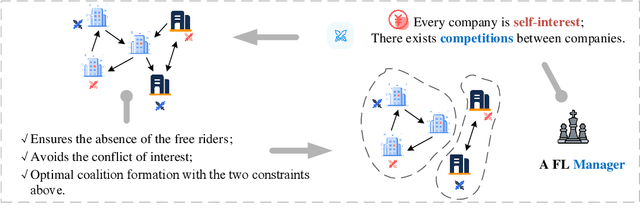

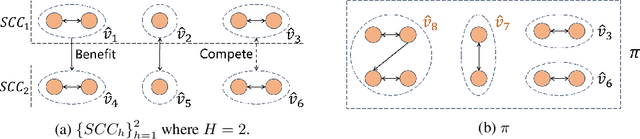

Federated learning (FL) is a machine learning paradigm that allows multiple FL participants (FL-PTs) to collaborate on training models without sharing private data. Due to data heterogeneity, negative transfer may occur in the FL training process. This necessitates FL-PT selection based on their data complementarity. In cross-silo FL, organizations that engage in business activities are key sources of FL-PTs. The resulting FL ecosystem has two features: (i) self-interest, and (ii) competition among FL-PTs. This requires the desirable FL-PT selection strategy to simultaneously mitigate the problems of free riders and conflicts of interest among competitors. To this end, we propose an optimal FL collaboration formation strategy -- FedEgoists -- which ensures that: (1) a FL-PT can benefit from FL if and only if it benefits the FL ecosystem, and (2) a FL-PT will not contribute to its competitors or their supporters. It provides an efficient clustering solution to group FL-PTs into coalitions, ensuring that within each coalition, FL-PTs share the same interest. We theoretically prove that the FL-PT coalitions formed are optimal since no coalitions can collaborate together to improve the utility of any of their members. Extensive experiments on widely adopted benchmark datasets demonstrate the effectiveness of FedEgoists compared to nine state-of-the-art baseline methods, and its ability to establish efficient collaborative networks in cross-silos FL with FL-PTs that engage in business activities.
Benchmarking Data Heterogeneity Evaluation Approaches for Personalized Federated Learning
Oct 09, 2024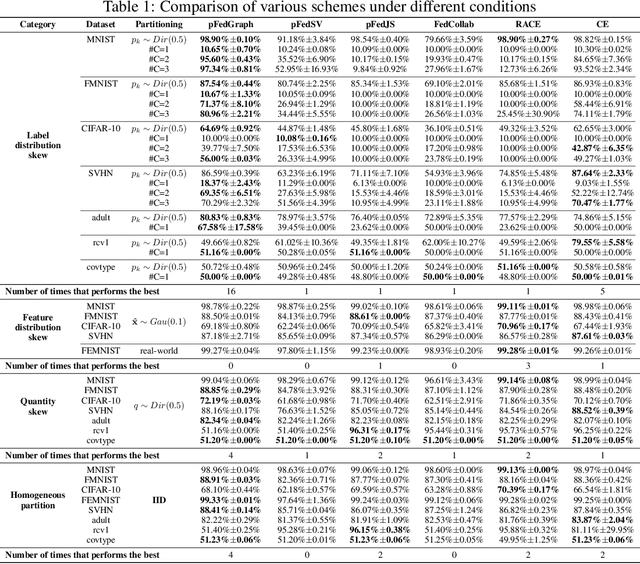
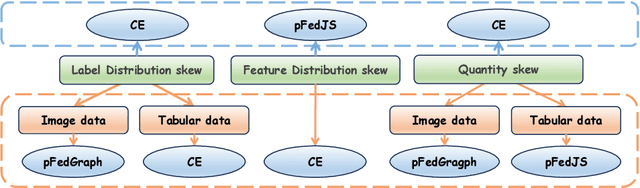
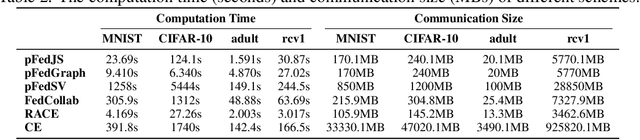

There is growing research interest in measuring the statistical heterogeneity of clients' local datasets. Such measurements are used to estimate the suitability for collaborative training of personalized federated learning (PFL) models. Currently, these research endeavors are taking place in silos and there is a lack of a unified benchmark to provide a fair and convenient comparison among various approaches in common settings. We aim to bridge this important gap in this paper. The proposed benchmarking framework currently includes six representative approaches. Extensive experiments have been conducted to compare these approaches under five standard non-IID FL settings, providing much needed insights into which approaches are advantageous under which settings. The proposed framework offers useful guidance on the suitability of various data divergence measures in FL systems. It is beneficial for keeping related research activities on the right track in terms of: (1) designing PFL schemes, (2) selecting appropriate data heterogeneity evaluation approaches for specific FL application scenarios, and (3) addressing fairness issues in collaborative model training. The code is available at https://github.com/Xiaoni-61/DH-Benchmark.
Identification of Energy Management Configuration Concepts from a Set of Pareto-optimal Solutions
Jun 14, 2023
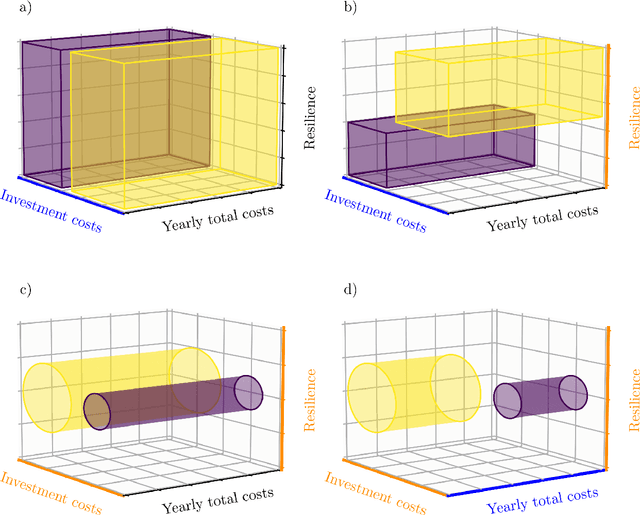


Optimizing building configurations for an efficient use of energy is increasingly receiving attention by current research and several methods have been developed to address this task. Selecting a suitable configuration based on multiple conflicting objectives, such as initial investment cost, recurring cost, robustness with respect to uncertainty of grid operation is, however, a difficult multi-criteria decision making problem. Concept identification can facilitate a decision maker by sorting configuration options into semantically meaningful groups (concepts), further introducing constraints to meet trade-off expectations for a selection of objectives. In this study, for a set of 20000 Pareto-optimal building energy management configurations, resulting from a many-objective evolutionary optimization, multiple concept identification iterations are conducted to provide a basis for making an informed investment decision. In a series of subsequent analysis steps, it is shown how the choice of description spaces, i.e., the partitioning of the features into sets for which consistent and non-overlapping concepts are required, impacts the type of information that can be extracted and that different setups of description spaces illuminate several different aspects of the configuration data - an important aspect that has not been addressed in previous work.