 Add to Chrome
 Add to Firefox
 Add to Edge
Beyond Correctness: Benchmarking and Aligning Response Behaviors in Hybrid-Thinking MLLMs
Aug 13, 2026
Hybrid-thinking multimodal large language models (MLLMs) allow a single model to alternate between deliberative thinking and latency-efficient non-thinking inference. Although these modes differ in reasoning budget, their delivered responses should satisfy the same user-facing standard. Correctness alone may not characterize this response quality; we therefore evaluate task accuracy and response-pattern failures as complementary outcomes. We study this gap through \textbf{response-pattern alignment}: whether thinking and non-thinking interfaces preserve acceptable final-response behavior. We introduce \textbf{PatternEval}, a failure-enriched diagnostic benchmark comprising 2,415 multimodal prompts spanning visual perception and grounding, structured image understanding, and multimodal knowledge reasoning. PatternEval tests four recurrent failures: chain-of-thought leakage, response repetition, logical contradiction, and performative reasoning. Response-pattern failures are widespread across models from different providers, with non-thinking inference exhibiting substantially higher failure rates and thereby creating systematic misalignment between thinking and non-thinking interfaces. Motivated by this diagnosis, we develop \textbf{PatternRM}, a response-level reward model, and \textbf{PatternRL}, which introduces pattern-specific penalties during reinforcement learning. Experiments on Qwen3-VL-4B and Qwen3-VL-8B show that incorporating pattern-specific penalties into reinforcement learning can mitigate cross-mode misalignment while incurring a marginal task performance trade-off. Together, PatternEval and PatternRL provide an evaluation-and-training framework for aligning user-visible response patterns across hybrid-thinking interfaces.

When Hard Negatives Hurt: Bridging the Generative-Discriminative Gap in Hard Negative Synthesis for Retrieval
May 31, 2026Hard negative mining has become the dominant strategy for training retrievers, yet it faces intrinsic limitations: negatives are bounded by corpus availability, selected by retriever score rather than diagnostic value, and increasingly contaminated by false positives as the retriever improves. LLM-based synthesis offers a principled alternative, where negatives that are unconstrained, targeted, and free from false positive risk. But we show that naively incorporating generated negatives into contrastive learning often degrades retrieval performance. We identify and formalize the root cause as a generative-discriminative gap: LLM generation optimizes for fluent, plausible text, while contrastive learning demands strategic violations of relevance at the decision boundary. Our analysis reveals two compounding failure modes: discriminative-agnostic generation, where the LLM lacks an explicit model of query information needs and defaults to generic or topic-drifted text that provides no contrastive signal; and source-dependent shortcuts, where distributional artifacts enable the model to distinguish negatives by origin rather than relevance, causing gradient drift that actively corrupts optimization. To close this gap, we propose CausalNeg consisting of two main modules: (1) CoT-guided counterfactual perturbation for data construction: decomposes why a document satisfies a query into explicit information requirements, then surgically violates individual requirements to construct negatives with controlled, interpretable hardness. (2) Query-view entropy maximization during training: disperses generated negatives across the similarity spectrum, minimizing the mutual information between source identity and similarity scores to suppress shortcut exploitation. We make our code publicly available at https://github.com/mzhangzhicheng/CausalNeg.
Length-Adaptive Interest Network for Balancing Long and Short Sequence Modeling in CTR Prediction
Jan 27, 2026User behavior sequences in modern recommendation systems exhibit significant length heterogeneity, ranging from sparse short-term interactions to rich long-term histories. While longer sequences provide more context, we observe that increasing the maximum input sequence length in existing CTR models paradoxically degrades performance for short-sequence users due to attention polarization and length imbalance in training data. To address this, we propose LAIN(Length-Adaptive Interest Network), a plug-and-play framework that explicitly incorporates sequence length as a conditioning signal to balance long- and short-sequence modeling. LAIN consists of three lightweight components: a Spectral Length Encoder that maps length into continuous representations, Length-Conditioned Prompting that injects global contextual cues into both long- and short-term behavior branches, and Length-Modulated Attention that adaptively adjusts attention sharpness based on sequence length. Extensive experiments on three real-world benchmarks across five strong CTR backbones show that LAIN consistently improves overall performance, achieving up to 1.15% AUC gain and 2.25% log loss reduction. Notably, our method significantly improves accuracy for short-sequence users without sacrificing longsequence effectiveness. Our work offers a general, efficient, and deployable solution to mitigate length-induced bias in sequential recommendation.
Towards Effective Ancient Chinese Translation: Dataset, Model, and Evaluation
Aug 01, 2023
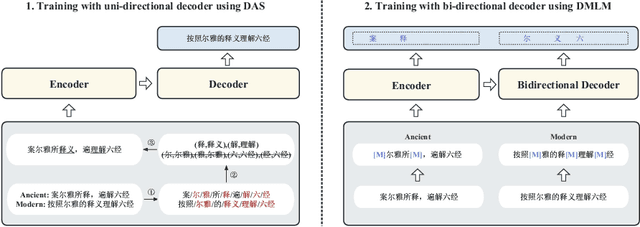


Interpreting ancient Chinese has been the key to comprehending vast Chinese literature, tradition, and civilization. In this paper, we propose Erya for ancient Chinese translation. From a dataset perspective, we collect, clean, and classify ancient Chinese materials from various sources, forming the most extensive ancient Chinese resource to date. From a model perspective, we devise Erya training method oriented towards ancient Chinese. We design two jointly-working tasks: disyllabic aligned substitution (DAS) and dual masked language model (DMLM). From an evaluation perspective, we build a benchmark to judge ancient Chinese translation quality in different scenarios and evaluate the ancient Chinese translation capacities of various existing models. Our model exhibits remarkable zero-shot performance across five domains, with over +12.0 BLEU against GPT-3.5 models and better human evaluation results than ERNIE Bot. Subsequent fine-tuning further shows the superior transfer capability of Erya model with +6.2 BLEU gain. We release all the above-mentioned resources at https://github.com/RUCAIBox/Erya.