 Add to Chrome
 Add to Firefox
 Add to Edge
SlimPer: Make Personalization Model Slim and Smart
Jul 14, 2026
Transformer-style architectures are increasingly adopted for industrial recommendation systems, yet they inherit a design premise misaligned with the task: generative models rely on per-token autoregressive prediction, which justifies maintaining large intermediate tensors that scale with sequence length. In contrast, recommendation systems produce a single set of relevance scores for each <user, item> pair without token-level supervision. Leveraging this observation, we propose SlimPer, which reformulates personalized ranking as iterative refinement of a compact, unified <user, item> knowledge base. At each layer, the model selectively queries raw multi-modal user-side tokens, computes explicit relevance matching scores, and refines the knowledge base, all in O(N) per-layer cost with a fixed-size intermediate representation. As a result, model depth is decoupled from user history length, enabling deeper relevance understanding without proportional growth in compute or memory; request-only optimization further trims memory by sharing a single copy of user-side tokens across all candidate items. SlimPer unifies sparse, dense, and sequence features within a single backbone and provides inherent interpretability through its attention mechanism. Deployed on Instagram Reels and Feed, SlimPer yields measurable improvements in user engagement while streamlining the overall system and enabling effective modeling of 10k+ fine-grained user history events.

Task-Differentiated Atomic Skill Expansion and Routing for Continual Learning Across Highly Heterogeneous Tasks
Jun 19, 2026Continual learning (CL) is commonly studied under the assumption that sequential tasks are semantically related or structurally similar. However, in highly heterogeneous settings, where tasks differ substantially in reasoning patterns and input-output formats, existing methods often suffer from catastrophic forgetting and inefficient capacity allocation. To address this challenge, we propose Task-differentiated Atomic Skill Expansion and Routing (\texttt{TASER}), a CL framework that jointly determines how many new atomic skills to introduce for each task and which skills to activate. The framework first uses atomic skill incremental learning to dynamically expand capacity based on task divergence and model uncertainty. It then applies orthogonality-enhanced skill detection to ensure these skills remain semantically distinct and independently reusable. Finally, a skill dynamic routing mechanism composes task-relevant skills through lightweight task-conditioned gating. We further introduce \texttt{HeteroCLBench}, a highly heterogeneous benchmark for CL, comprising 19 diverse tasks across 9 cognitive dimensions under a standardized sequential protocol. Experiments on \texttt{HeteroCLBench} show that \texttt{TASER} consistently outperforms strong baselines by improving plasticity and reducing catastrophic forgetting.
Benchmark Shadows: Data Alignment, Parameter Footprints, and Generalization in Large Language Models
Apr 01, 2026Large language models often achieve strong benchmark gains without corresponding improvements in broader capability. We hypothesize that this discrepancy arises from differences in training regimes induced by data distribution. To investigate this, we design controlled data interventions that isolate distributional effects under fixed training settings. We find that benchmark-aligned data improves narrow evaluation metrics while limiting broader representational development, whereas coverage-expanding data leads to more distributed parameter adaptation and better generalization. We further introduce parameter-space diagnostics based on spectral and rank analyses, which reveal distinct structural signatures of these regimes. Similar patterns are observed across diverse open-source model families, including multimodal models as a key case study, suggesting that these effects extend beyond controlled settings. A case study on prompt repetition shows that not all data artifacts induce regime shifts. These results indicate that benchmark performance alone is insufficient to characterize model capability, and highlight the importance of data distribution in shaping learning dynamics.
Weakly-supervised Instance Segmentation via Class-agnostic Learning with Salient Images
Apr 04, 2021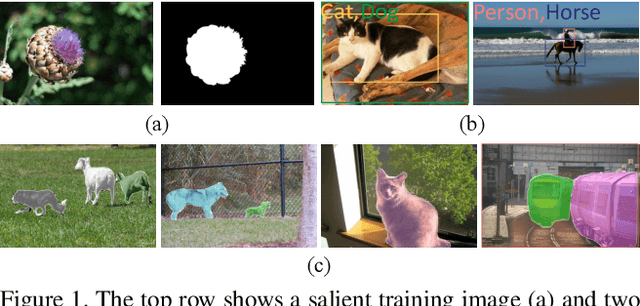
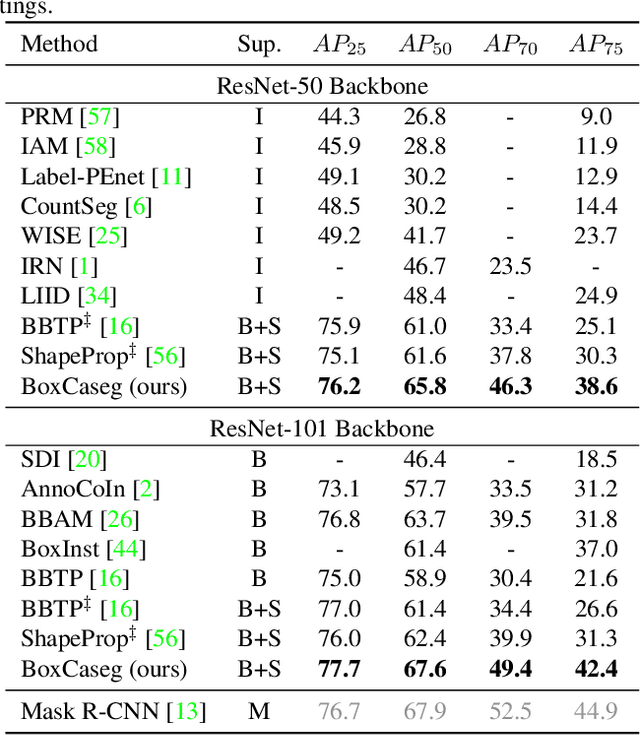
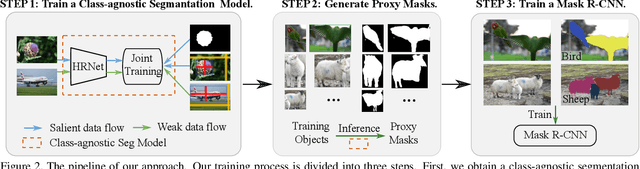

Humans have a strong class-agnostic object segmentation ability and can outline boundaries of unknown objects precisely, which motivates us to propose a box-supervised class-agnostic object segmentation (BoxCaseg) based solution for weakly-supervised instance segmentation. The BoxCaseg model is jointly trained using box-supervised images and salient images in a multi-task learning manner. The fine-annotated salient images provide class-agnostic and precise object localization guidance for box-supervised images. The object masks predicted by a pretrained BoxCaseg model are refined via a novel merged and dropped strategy as proxy ground truth to train a Mask R-CNN for weakly-supervised instance segmentation. Only using $7991$ salient images, the weakly-supervised Mask R-CNN is on par with fully-supervised Mask R-CNN on PASCAL VOC and significantly outperforms previous state-of-the-art box-supervised instance segmentation methods on COCO. The source code, pretrained models and datasets are available at \url{https://github.com/hustvl/BoxCaseg}.