 Add to Chrome
 Add to Firefox
 Add to Edge
DEPART: DEcomposing PARiTy across Multilingual LLMs
May 27, 2026
Multilingual Large Language Models (mLLMs) leaderboards report per-language accuracy but rarely explain why disparities emerge, leaving systemic biases unattributed and offering practitioners no actionable levers. We first establish that these gaps are systematic rather than artifacts of sampling noise via distribution-free Friedman and Kruskal--Wallis tests, then introduce a two-step Bayesian hierarchical framework that decomposes multilingual performance variance into interpretable components. First, isolating the variance attributable to language identity, we show that observable language features (script, family, typological distance) explain $R^2_{\text{ling}} = 79\%$ of this variance on understanding tasks and $92\%$ on reasoning, with a model's internal representational similarity to English emerging as the dominant predictor across both task buckets. Second, decomposing the full (model$\times$benchmark$\times$language) cube, we find that NLU and reasoning have fundamentally divergent variance profiles: model identity dominates understanding ($66.7\%$ of variance), whereas the benchmark$\times$model interaction dominates reasoning ($46.3\%$). Together these results recast multilingual evaluation from passive performance mapping into an explainable, diagnostic framework with concrete levers for targeting the root drivers of language disparity.

HARNESS-LM: A Three-Phase Training Recipe for Harnessing SLMs in Sponsored Search Retrieval
May 22, 2026In the competitive landscape of sponsored search, balancing retrieval quality with production latency is a critical challenge. While large retrieval models based on Small Language Models (SLMs) such as Qwen3-Embedding-4B/8B set strong upper bounds on public benchmarks, their deployment in high-throughput, latency-sensitive environments remains impractical. In this paper, we present HARNESS-LM (HLM), a three-phase training framework for transferring the capabilities of large-scale retrievers into compact, cost-efficient models. The approach comprises: (1) training a high-performance reference ("teacher") retriever by fine-tuning a billion-parameter-scale SLM; (2) aligning query representations via an L2 objective to distill knowledge into a sub-600M parameter student encoder; and (3) applying a final contrastive refinement stage to optimize the student for retrieval performance. We also present a comprehensive empirical study of key design choices, including alignment objectives, embedding dimensionality, model scale, architecture, and optimization strategies, to identify configurations that are most effective in production settings. On a real-world Bing Ads evaluation benchmark, HLM recovers over 98% of the reference retriever's precision across multiple settings, while delivering up to 27x lower online query-encoder latency and 20x higher throughput on NVIDIA A100 GPUs. Online A/B testing on Bing Ads further shows a +1% Revenue, +0.6% Impression, and +0.4% Click uplift over the current ensemble of retrievers running in production with the deployed 190M parameter model, clearly highlighting the practical efficacy of the HLM recipe in a real-world sponsored search setting.
MMTEB: Massive Multilingual Text Embedding Benchmark
Feb 19, 2025Text embeddings are typically evaluated on a limited set of tasks, which are constrained by language, domain, and task diversity. To address these limitations and provide a more comprehensive evaluation, we introduce the Massive Multilingual Text Embedding Benchmark (MMTEB) - a large-scale, community-driven expansion of MTEB, covering over 500 quality-controlled evaluation tasks across 250+ languages. MMTEB includes a diverse set of challenging, novel tasks such as instruction following, long-document retrieval, and code retrieval, representing the largest multilingual collection of evaluation tasks for embedding models to date. Using this collection, we develop several highly multilingual benchmarks, which we use to evaluate a representative set of models. We find that while large language models (LLMs) with billions of parameters can achieve state-of-the-art performance on certain language subsets and task categories, the best-performing publicly available model is multilingual-e5-large-instruct with only 560 million parameters. To facilitate accessibility and reduce computational cost, we introduce a novel downsampling method based on inter-task correlation, ensuring a diverse selection while preserving relative model rankings. Furthermore, we optimize tasks such as retrieval by sampling hard negatives, creating smaller but effective splits. These optimizations allow us to introduce benchmarks that drastically reduce computational demands. For instance, our newly introduced zero-shot English benchmark maintains a ranking order similar to the full-scale version but at a fraction of the computational cost.
CVQA: Culturally-diverse Multilingual Visual Question Answering Benchmark
Jun 10, 2024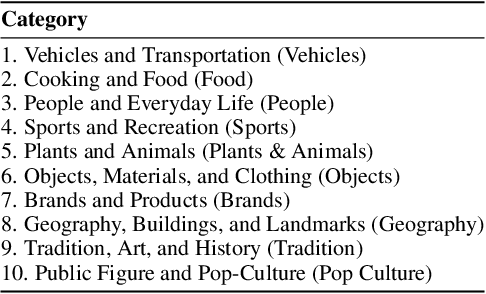
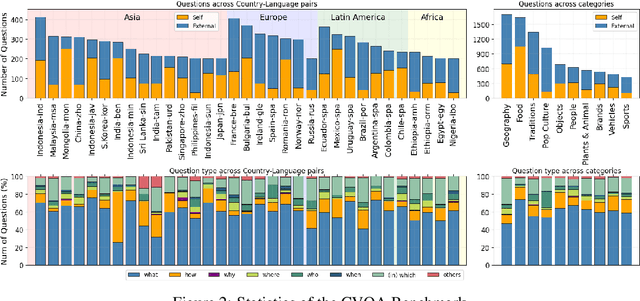
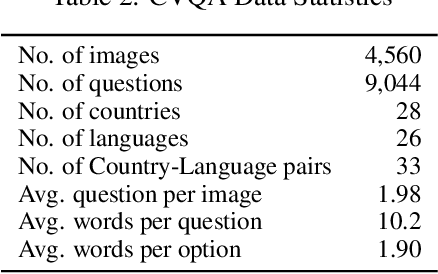

Visual Question Answering (VQA) is an important task in multimodal AI, and it is often used to test the ability of vision-language models to understand and reason on knowledge present in both visual and textual data. However, most of the current VQA models use datasets that are primarily focused on English and a few major world languages, with images that are typically Western-centric. While recent efforts have tried to increase the number of languages covered on VQA datasets, they still lack diversity in low-resource languages. More importantly, although these datasets often extend their linguistic range via translation or some other approaches, they usually keep images the same, resulting in narrow cultural representation. To address these limitations, we construct CVQA, a new Culturally-diverse multilingual Visual Question Answering benchmark, designed to cover a rich set of languages and cultures, where we engage native speakers and cultural experts in the data collection process. As a result, CVQA includes culturally-driven images and questions from across 28 countries on four continents, covering 26 languages with 11 scripts, providing a total of 9k questions. We then benchmark several Multimodal Large Language Models (MLLMs) on CVQA, and show that the dataset is challenging for the current state-of-the-art models. This benchmark can serve as a probing evaluation suite for assessing the cultural capability and bias of multimodal models and hopefully encourage more research efforts toward increasing cultural awareness and linguistic diversity in this field.