 Add to Chrome
 Add to Firefox
 Add to Edge
DEPART: DEcomposing PARiTy across Multilingual LLMs
May 27, 2026
Multilingual Large Language Models (mLLMs) leaderboards report per-language accuracy but rarely explain why disparities emerge, leaving systemic biases unattributed and offering practitioners no actionable levers. We first establish that these gaps are systematic rather than artifacts of sampling noise via distribution-free Friedman and Kruskal--Wallis tests, then introduce a two-step Bayesian hierarchical framework that decomposes multilingual performance variance into interpretable components. First, isolating the variance attributable to language identity, we show that observable language features (script, family, typological distance) explain $R^2_{\text{ling}} = 79\%$ of this variance on understanding tasks and $92\%$ on reasoning, with a model's internal representational similarity to English emerging as the dominant predictor across both task buckets. Second, decomposing the full (model$\times$benchmark$\times$language) cube, we find that NLU and reasoning have fundamentally divergent variance profiles: model identity dominates understanding ($66.7\%$ of variance), whereas the benchmark$\times$model interaction dominates reasoning ($46.3\%$). Together these results recast multilingual evaluation from passive performance mapping into an explainable, diagnostic framework with concrete levers for targeting the root drivers of language disparity.

Comics for Everyone: Generating Accessible Text Descriptions for Comic Strips
Oct 01, 2023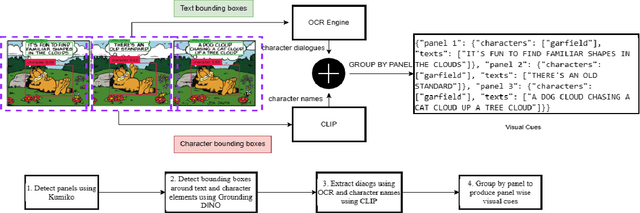
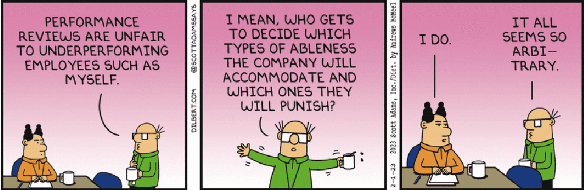
Comic strips are a popular and expressive form of visual storytelling that can convey humor, emotion, and information. However, they are inaccessible to the BLV (Blind or Low Vision) community, who cannot perceive the images, layouts, and text of comics. Our goal in this paper is to create natural language descriptions of comic strips that are accessible to the visually impaired community. Our method consists of two steps: first, we use computer vision techniques to extract information about the panels, characters, and text of the comic images; second, we use this information as additional context to prompt a multimodal large language model (MLLM) to produce the descriptions. We test our method on a collection of comics that have been annotated by human experts and measure its performance using both quantitative and qualitative metrics. The outcomes of our experiments are encouraging and promising.