 Add to Chrome
 Add to Firefox
 Add to Edge
Graph-based Target Back-Propagation for Context Adaptation in Multi-LLM Agentic Systems
Jun 12, 2026
Context adaptation automates prompt engineering in LLM-based systems by iteratively revising tunable prompts from task feedback, without modifying model weights. Extending this paradigm to multi-LLM agentic systems is crucial: existing methods suffer from inaccurate credit assignment and lack convergence guarantees. We propose \textbf{G}raph-based \textbf{T}arget \textbf{B}ack-\textbf{P}ropagation (GTBP), a context adaptation framework for agentic workflows modeled as directed acyclic graphs. GTBP propagates local target outputs backward through the workflow graph and uses target--output discrepancies to guide a stage-wise prompt update mechanism. Theoretically, we show that GTBP's stage-wise prompt updates become stable over iterations, and that a sufficiently capable LLM optimizer can decrease the overall objective. Empirically, GTBP consistently outperforms strong baselines across three benchmarks while maintaining comparable computational cost.

Fine-Tuning and Serving Gemma 4 31B on Google Cloud TPU: A Technical Comparison with GPU Baselines
May 25, 2026We present the first end-to-end demonstration of fine-tuning and serving Google's Gemma 4 31B model on TPU hardware, providing an empirical comparison of TPU and GPU platforms for large language model adaptation. Using LoRA on a Google TPU v5p-8 for training and TPU v6e-8 (Trillium) for inference, we document the full set of code-level adaptations required to port a GPU-native training recipe, built on PyTorch, HuggingFace TRL, and FSDP, to the JAX + Tunix/Qwix stack. These adaptations span mesh configuration, LoRA module naming conventions, sharding annotation corrections, gradient checkpointing, data pipeline restructuring, and a custom Orbax-to-safetensors checkpoint merging procedure. For inference, we detail the vLLM-TPU Docker setup necessary to serve Gemma 4 on v6e-8 and characterize the resulting latency and throughput profile. Compared with a 2xH100 GPU baseline under identical hyperparameters, TPU training completes 1.61x faster at 2.12x lower cost. Inference throughput is within 3% across platforms, while TPU achieves 2x lower time-to-first-token (235 ms vs. 475 ms). Together, the TPU configuration is 1.82x cheaper for a representative train-plus-service workload. Our work removes a critical gap in the open tooling ecosystem and provides practitioners with a reproducible, production-ready recipe for Gemma 4 deployment on TPU infrastructure.
HARNESS-LM: A Three-Phase Training Recipe for Harnessing SLMs in Sponsored Search Retrieval
May 22, 2026In the competitive landscape of sponsored search, balancing retrieval quality with production latency is a critical challenge. While large retrieval models based on Small Language Models (SLMs) such as Qwen3-Embedding-4B/8B set strong upper bounds on public benchmarks, their deployment in high-throughput, latency-sensitive environments remains impractical. In this paper, we present HARNESS-LM (HLM), a three-phase training framework for transferring the capabilities of large-scale retrievers into compact, cost-efficient models. The approach comprises: (1) training a high-performance reference ("teacher") retriever by fine-tuning a billion-parameter-scale SLM; (2) aligning query representations via an L2 objective to distill knowledge into a sub-600M parameter student encoder; and (3) applying a final contrastive refinement stage to optimize the student for retrieval performance. We also present a comprehensive empirical study of key design choices, including alignment objectives, embedding dimensionality, model scale, architecture, and optimization strategies, to identify configurations that are most effective in production settings. On a real-world Bing Ads evaluation benchmark, HLM recovers over 98% of the reference retriever's precision across multiple settings, while delivering up to 27x lower online query-encoder latency and 20x higher throughput on NVIDIA A100 GPUs. Online A/B testing on Bing Ads further shows a +1% Revenue, +0.6% Impression, and +0.4% Click uplift over the current ensemble of retrievers running in production with the deployed 190M parameter model, clearly highlighting the practical efficacy of the HLM recipe in a real-world sponsored search setting.
H2LooP Spark Preview: Continual Pretraining of Large Language Models for Low-Level Embedded Systems Code
Mar 11, 2026Large language models (LLMs) demonstrate strong code generation abilities in general-purpose programming languages but remain limited in specialized domains such as low-level embedded systems programming. This domain involves hardware register manipulation, vendor-specific SDKs, real-time operating system APIs, and hardware abstraction layers that are underrepresented in standard pretraining corpora. We introduce H2LooP Spark Preview, a continual pretraining (CPT) pipeline that adapts the OLMo-3-7B-a fully open language model to the embedded systems domain using BF16 LoRA with rank-stabilized scaling on 8 NVIDIA H100 GPUs. Our training corpus is constructed from repository-datasheet pairs covering 100B tokens of raw embedded systems data across 117 manufacturers, processed using the hierarchical datasheet-to-code mapping approach proposed in SpecMap (Nipane et al., 2026). The resulting curated dataset split contains 23.5B tokens across 13 embedded domains. Continual pretraining with high-rank LoRA (r=512) yields substantial gains, reducing in-domain perplexity by 70.4% and held-out repository perplexity by 66.1%. On generative code completion benchmarks spanning 13 embedded domains, our 7B model outperforms Claude Opus 4.6 and Qwen3-Coder-30B on 8 categories in token accuracy, showing that targeted continual pretraining enables smaller open-weight models to rival frontier systems on specialized technical tasks. We release the production training checkpoint on Huggingface as an open-source artifact.
SpecMap: Hierarchical LLM Agent for Datasheet-to-Code Traceability Link Recovery in Systems Engineering
Jan 16, 2026Establishing precise traceability between embedded systems datasheets and their corresponding code implementations remains a fundamental challenge in systems engineering, particularly for low-level software where manual mapping between specification documents and large code repositories is infeasible. Existing Traceability Link Recovery approaches primarily rely on lexical similarity and information retrieval techniques, which struggle to capture the semantic, structural, and symbol level relationships prevalent in embedded systems software. We present a hierarchical datasheet-to-code mapping methodology that employs large language models for semantic analysis while explicitly structuring the traceability process across multiple abstraction levels. Rather than performing direct specification-to-code matching, the proposed approach progressively narrows the search space through repository-level structure inference, file-level relevance estimation, and fine-grained symbollevel alignment. The method extends beyond function-centric mapping by explicitly covering macros, structs, constants, configuration parameters, and register definitions commonly found in systems-level C/C++ codebases. We evaluate the approach on multiple open-source embedded systems repositories using manually curated datasheet-to-code ground truth. Experimental results show substantial improvements over traditional information-retrieval-based baselines, achieving up to 73.3% file mapping accuracy. We significantly reduce computational overhead, lowering total LLM token consumption by 84% and end-to-end runtime by approximately 80%. This methodology supports automated analysis of large embedded software systems and enables downstream applications such as training data generation for systems-aware machine learning models, standards compliance verification, and large-scale specification coverage analysis.
Improving Retrieval in Sponsored Search by Leveraging Query Context Signals
Jul 19, 2024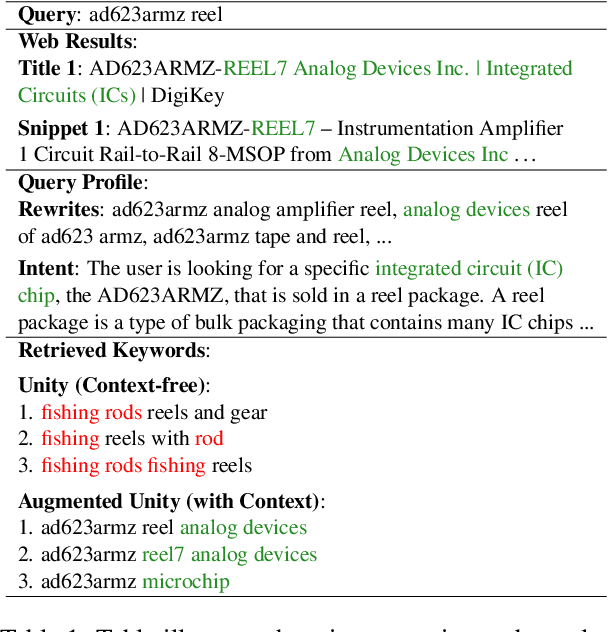
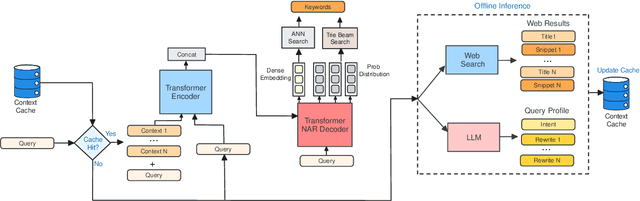
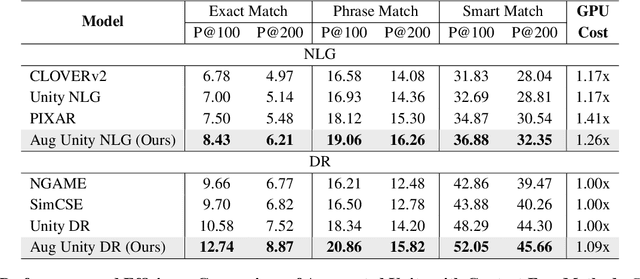
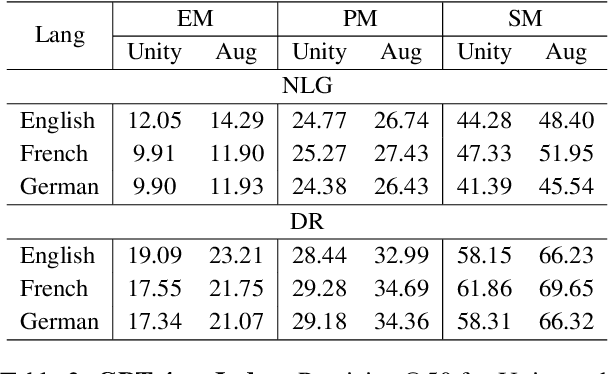
Accurately retrieving relevant bid keywords for user queries is critical in Sponsored Search but remains challenging, particularly for short, ambiguous queries. Existing dense and generative retrieval models often fail to capture nuanced user intent in these cases. To address this, we propose an approach to enhance query understanding by augmenting queries with rich contextual signals derived from web search results and large language models, stored in an online cache. Specifically, we use web search titles and snippets to ground queries in real-world information and utilize GPT-4 to generate query rewrites and explanations that clarify user intent. These signals are efficiently integrated through a Fusion-in-Decoder based Unity architecture, enabling both dense and generative retrieval with serving costs on par with traditional context-free models. To address scenarios where context is unavailable in the cache, we introduce context glancing, a curriculum learning strategy that improves model robustness and performance even without contextual signals during inference. Extensive offline experiments demonstrate that our context-aware approach substantially outperforms context-free models. Furthermore, online A/B testing on a prominent search engine across 160+ countries shows significant improvements in user engagement and revenue.
Scaling the Vocabulary of Non-autoregressive Models for Efficient Generative Retrieval
Jun 10, 2024Generative Retrieval introduces a new approach to Information Retrieval by reframing it as a constrained generation task, leveraging recent advancements in Autoregressive (AR) language models. However, AR-based Generative Retrieval methods suffer from high inference latency and cost compared to traditional dense retrieval techniques, limiting their practical applicability. This paper investigates fully Non-autoregressive (NAR) language models as a more efficient alternative for generative retrieval. While standard NAR models alleviate latency and cost concerns, they exhibit a significant drop in retrieval performance (compared to AR models) due to their inability to capture dependencies between target tokens. To address this, we question the conventional choice of limiting the target token space to solely words or sub-words. We propose PIXAR, a novel approach that expands the target vocabulary of NAR models to include multi-word entities and common phrases (up to 5 million tokens), thereby reducing token dependencies. PIXAR employs inference optimization strategies to maintain low inference latency despite the significantly larger vocabulary. Our results demonstrate that PIXAR achieves a relative improvement of 31.0% in MRR@10 on MS MARCO and 23.2% in Hits@5 on Natural Questions compared to standard NAR models with similar latency and cost. Furthermore, online A/B experiments on a large commercial search engine show that PIXAR increases ad clicks by 5.08% and revenue by 4.02%.
Forms of Understanding of XAI-Explanations
Nov 15, 2023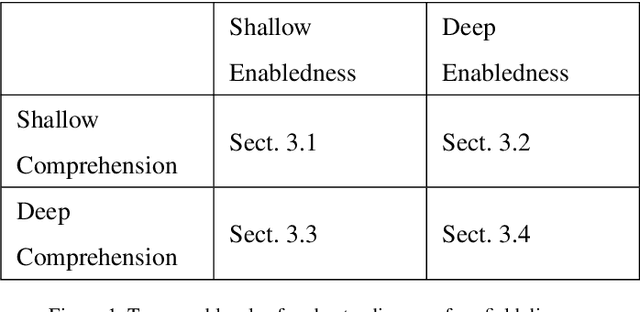
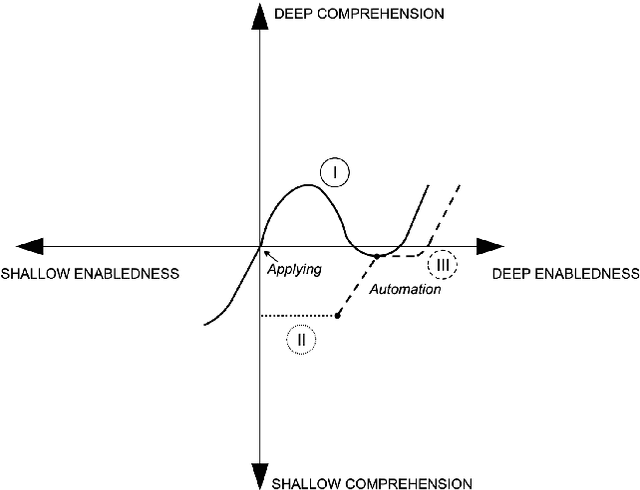
Explainability has become an important topic in computer science and artificial intelligence, leading to a subfield called Explainable Artificial Intelligence (XAI). The goal of providing or seeking explanations is to achieve (better) 'understanding' on the part of the explainee. However, what it means to 'understand' is still not clearly defined, and the concept itself is rarely the subject of scientific investigation. This conceptual article aims to present a model of forms of understanding in the context of XAI and beyond. From an interdisciplinary perspective bringing together computer science, linguistics, sociology, and psychology, a definition of understanding and its forms, assessment, and dynamics during the process of giving everyday explanations are explored. Two types of understanding are considered as possible outcomes of explanations, namely enabledness, 'knowing how' to do or decide something, and comprehension, 'knowing that' -- both in different degrees (from shallow to deep). Explanations regularly start with shallow understanding in a specific domain and can lead to deep comprehension and enabledness of the explanandum, which we see as a prerequisite for human users to gain agency. In this process, the increase of comprehension and enabledness are highly interdependent. Against the background of this systematization, special challenges of understanding in XAI are discussed.
Video and Synthetic MRI Pre-training of 3D Vision Architectures for Neuroimage Analysis
Sep 09, 2023Transfer learning represents a recent paradigm shift in the way we build artificial intelligence (AI) systems. In contrast to training task-specific models, transfer learning involves pre-training deep learning models on a large corpus of data and minimally fine-tuning them for adaptation to specific tasks. Even so, for 3D medical imaging tasks, we do not know if it is best to pre-train models on natural images, medical images, or even synthetically generated MRI scans or video data. To evaluate these alternatives, here we benchmarked vision transformers (ViTs) and convolutional neural networks (CNNs), initialized with varied upstream pre-training approaches. These methods were then adapted to three unique downstream neuroimaging tasks with a range of difficulty: Alzheimer's disease (AD) and Parkinson's disease (PD) classification, "brain age" prediction. Experimental tests led to the following key observations: 1. Pre-training improved performance across all tasks including a boost of 7.4% for AD classification and 4.6% for PD classification for the ViT and 19.1% for PD classification and reduction in brain age prediction error by 1.26 years for CNNs, 2. Pre-training on large-scale video or synthetic MRI data boosted performance of ViTs, 3. CNNs were robust in limited-data settings, and in-domain pretraining enhanced their performances, 4. Pre-training improved generalization to out-of-distribution datasets and sites. Overall, we benchmarked different vision architectures, revealing the value of pre-training them with emerging datasets for model initialization. The resulting pre-trained models can be adapted to a range of downstream neuroimaging tasks, even when training data for the target task is limited.
HEARTS: Multi-task Fusion of Dense Retrieval and Non-autoregressive Generation for Sponsored Search
Sep 13, 2022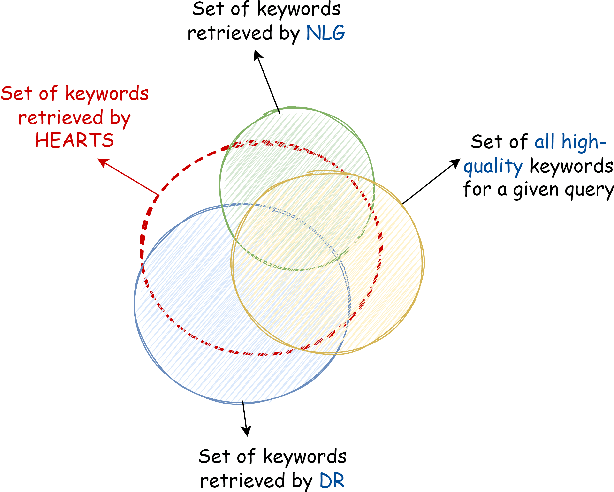
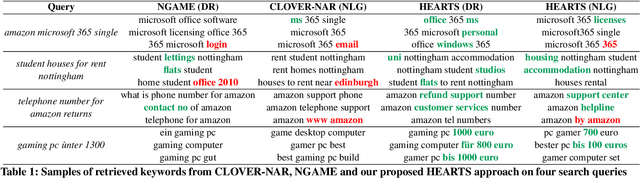
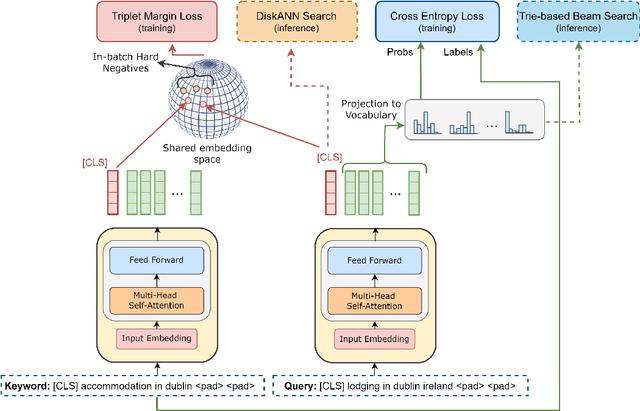
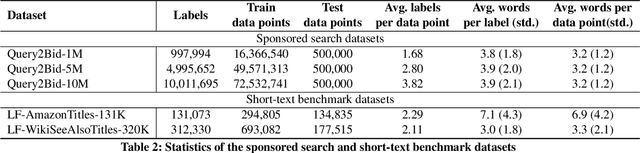
Matching user search queries with relevant keywords bid by advertisers in real-time is a crucial problem in sponsored search. In the literature, two broad set of approaches have been explored to solve this problem: (i) Dense Retrieval (DR) - learning dense vector representations for queries and bid keywords in a shared space, and (ii) Natural Language Generation (NLG) - learning to directly generate bid keywords given queries. In this work, we first conduct an empirical study of these two approaches and show that they offer complementary benefits that are additive. In particular, a large fraction of the keywords retrieved from NLG haven't been retrieved by DR and vice-versa. We then show that it is possible to effectively combine the advantages of these two approaches in one model. Specifically, we propose HEARTS: a novel multi-task fusion framework where we jointly optimize a shared encoder to perform both DR and non-autoregressive NLG. Through extensive experiments on search queries from over 30+ countries spanning 20+ languages, we show that HEARTS retrieves 40.3% more high-quality bid keywords than the baseline approaches with the same GPU compute. We also demonstrate that inferring on a single HEARTS model is as good as inferring on two different DR and NLG baseline models, with 2x the compute. Further, we show that DR models trained with the HEARTS objective are significantly better than those trained with the standard contrastive loss functions. Finally, we show that our HEARTS objective can be adopted to short-text retrieval tasks other than sponsored search and achieve significant performance gains.