 Add to Chrome
 Add to Firefox
 Add to Edge
Causalainer: Causal Explainer for Automatic Video Summarization
Apr 30, 2023

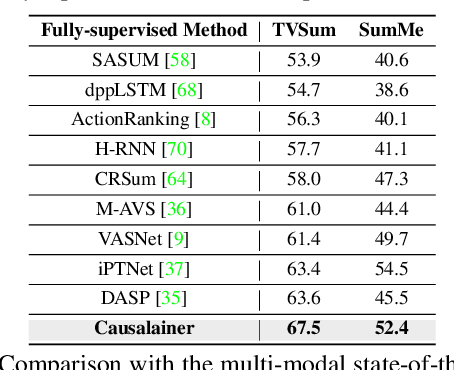
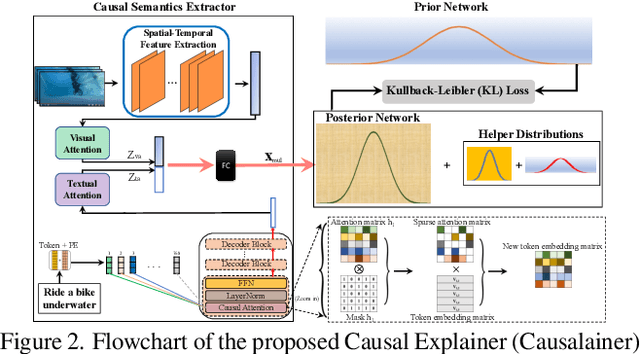
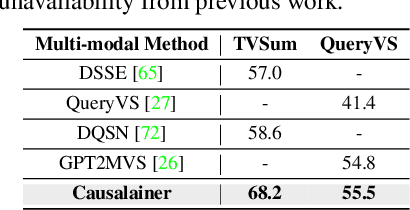
The goal of video summarization is to automatically shorten videos such that it conveys the overall story without losing relevant information. In many application scenarios, improper video summarization can have a large impact. For example in forensics, the quality of the generated video summary will affect an investigator's judgment while in journalism it might yield undesired bias. Because of this, modeling explainability is a key concern. One of the best ways to address the explainability challenge is to uncover the causal relations that steer the process and lead to the result. Current machine learning-based video summarization algorithms learn optimal parameters but do not uncover causal relationships. Hence, they suffer from a relative lack of explainability. In this work, a Causal Explainer, dubbed Causalainer, is proposed to address this issue. Multiple meaningful random variables and their joint distributions are introduced to characterize the behaviors of key components in the problem of video summarization. In addition, helper distributions are introduced to enhance the effectiveness of model training. In visual-textual input scenarios, the extra input can decrease the model performance. A causal semantics extractor is designed to tackle this issue by effectively distilling the mutual information from the visual and textual inputs. Experimental results on commonly used benchmarks demonstrate that the proposed method achieves state-of-the-art performance while being more explainable.

Virus2Vec: Viral Sequence Classification Using Machine Learning
Apr 24, 2023Understanding the host-specificity of different families of viruses sheds light on the origin of, e.g., SARS-CoV-2, rabies, and other such zoonotic pathogens in humans. It enables epidemiologists, medical professionals, and policymakers to curb existing epidemics and prevent future ones promptly. In the family Coronaviridae (of which SARS-CoV-2 is a member), it is well-known that the spike protein is the point of contact between the virus and the host cell membrane. On the other hand, the two traditional mammalian orders, Carnivora (carnivores) and Chiroptera (bats) are recognized to be responsible for maintaining and spreading the Rabies Lyssavirus (RABV). We propose Virus2Vec, a feature-vector representation for viral (nucleotide or amino acid) sequences that enable vector-space-based machine learning models to identify viral hosts. Virus2Vec generates numerical feature vectors for unaligned sequences, allowing us to forego the computationally expensive sequence alignment step from the pipeline. Virus2Vec leverages the power of both the \emph{minimizer} and position weight matrix (PWM) to generate compact feature vectors. Using several classifiers, we empirically evaluate Virus2Vec on real-world spike sequences of Coronaviridae and rabies virus sequence data to predict the host (identifying the reservoirs of infection). Our results demonstrate that Virus2Vec outperforms the predictive accuracies of baseline and state-of-the-art methods.
Overload: Latency Attacks on Object Detection for Edge Devices
Apr 12, 2023
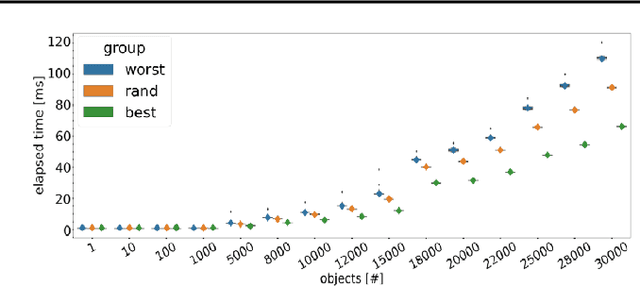
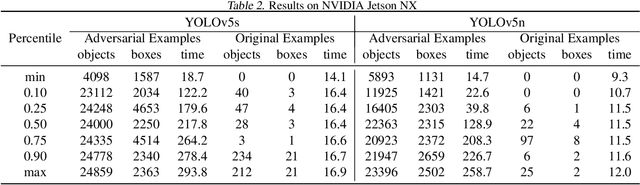
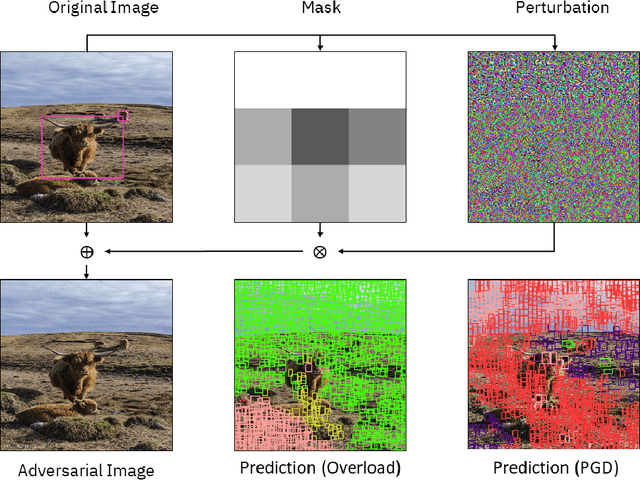
Nowadays, the deployment of deep learning based applications on edge devices is an essential task owing to the increasing demands on intelligent services. However, the limited computing resources on edge nodes make the models vulnerable to attacks, such that the predictions made by models are unreliable. In this paper, we investigate latency attacks on deep learning applications. Unlike common adversarial attacks for misclassification, the goal of latency attacks is to increase the inference time, which may stop applications from responding to the requests within a reasonable time. This kind of attack is ubiquitous for various applications, and we use object detection to demonstrate how such kind of attacks work. We also design a framework named Overload to generate latency attacks at scale. Our method is based on a newly formulated optimization problem and a novel technique, called spatial attention, to increase the inference time of object detection. We have conducted experiments using YOLOv5 models on Nvidia NX. The experimental results show that with latency attacks, the inference time of a single image can be increased ten times longer in reference to the normal setting. Moreover, comparing to existing methods, our attacking method is simpler and more effective.
Exploring the Benefits of Visual Prompting in Differential Privacy
Mar 22, 2023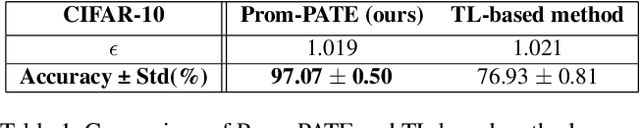
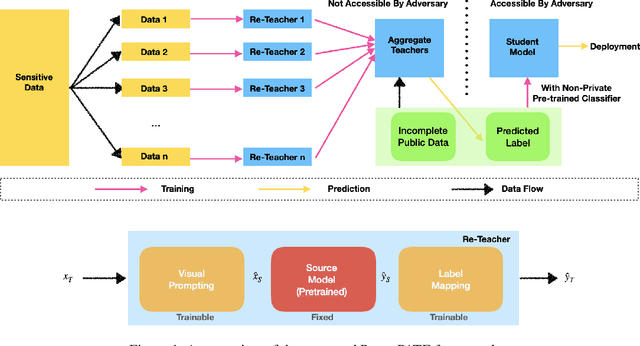
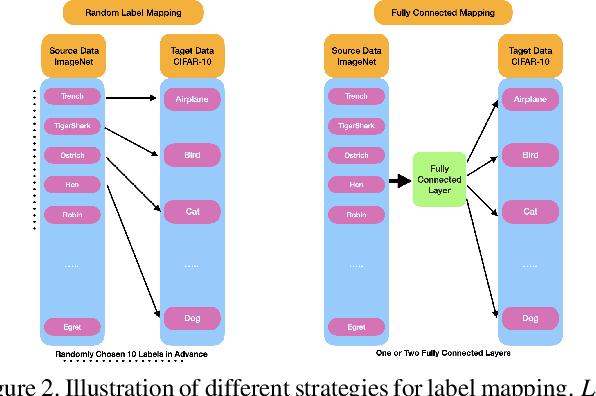

Visual Prompting (VP) is an emerging and powerful technique that allows sample-efficient adaptation to downstream tasks by engineering a well-trained frozen source model. In this work, we explore the benefits of VP in constructing compelling neural network classifiers with differential privacy (DP). We explore and integrate VP into canonical DP training methods and demonstrate its simplicity and efficiency. In particular, we discover that VP in tandem with PATE, a state-of-the-art DP training method that leverages the knowledge transfer from an ensemble of teachers, achieves the state-of-the-art privacy-utility trade-off with minimum expenditure of privacy budget. Moreover, we conduct additional experiments on cross-domain image classification with a sufficient domain gap to further unveil the advantage of VP in DP. Lastly, we also conduct extensive ablation studies to validate the effectiveness and contribution of VP under DP consideration.
Convex Bounds on the Softmax Function with Applications to Robustness Verification
Mar 03, 2023The softmax function is a ubiquitous component at the output of neural networks and increasingly in intermediate layers as well. This paper provides convex lower bounds and concave upper bounds on the softmax function, which are compatible with convex optimization formulations for characterizing neural networks and other ML models. We derive bounds using both a natural exponential-reciprocal decomposition of the softmax as well as an alternative decomposition in terms of the log-sum-exp function. The new bounds are provably and/or numerically tighter than linear bounds obtained in previous work on robustness verification of transformers. As illustrations of the utility of the bounds, we apply them to verification of transformers as well as of the robustness of predictive uncertainty estimates of deep ensembles.
MultiRobustBench: Benchmarking Robustness Against Multiple Attacks
Feb 21, 2023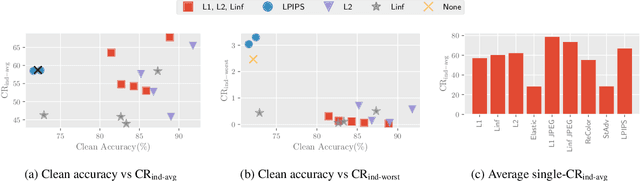
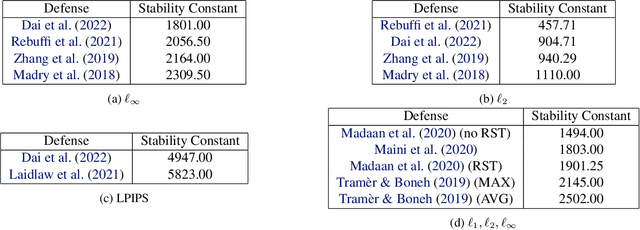
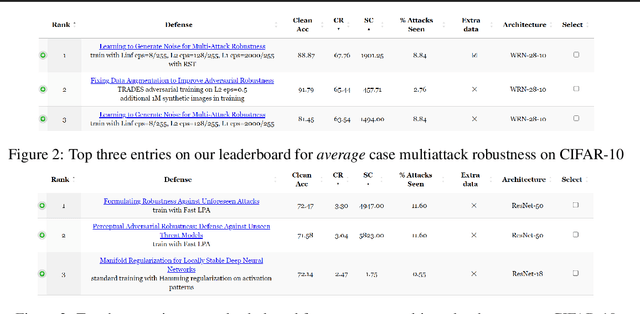
The bulk of existing research in defending against adversarial examples focuses on defending against a single (typically bounded Lp-norm) attack, but for a practical setting, machine learning (ML) models should be robust to a wide variety of attacks. In this paper, we present the first unified framework for considering multiple attacks against ML models. Our framework is able to model different levels of learner's knowledge about the test-time adversary, allowing us to model robustness against unforeseen attacks and robustness against unions of attacks. Using our framework, we present the first leaderboard, MultiRobustBench, for benchmarking multiattack evaluation which captures performance across attack types and attack strengths. We evaluate the performance of 16 defended models for robustness against a set of 9 different attack types, including Lp-based threat models, spatial transformations, and color changes, at 20 different attack strengths (180 attacks total). Additionally, we analyze the state of current defenses against multiple attacks. Our analysis shows that while existing defenses have made progress in terms of average robustness across the set of attacks used, robustness against the worst-case attack is still a big open problem as all existing models perform worse than random guessing.
Joint Edge-Model Sparse Learning is Provably Efficient for Graph Neural Networks
Feb 06, 2023Due to the significant computational challenge of training large-scale graph neural networks (GNNs), various sparse learning techniques have been exploited to reduce memory and storage costs. Examples include \textit{graph sparsification} that samples a subgraph to reduce the amount of data aggregation and \textit{model sparsification} that prunes the neural network to reduce the number of trainable weights. Despite the empirical successes in reducing the training cost while maintaining the test accuracy, the theoretical generalization analysis of sparse learning for GNNs remains elusive. To the best of our knowledge, this paper provides the first theoretical characterization of joint edge-model sparse learning from the perspective of sample complexity and convergence rate in achieving zero generalization error. It proves analytically that both sampling important nodes and pruning neurons with the lowest-magnitude can reduce the sample complexity and improve convergence without compromising the test accuracy. Although the analysis is centered on two-layer GNNs with structural constraints on data, the insights are applicable to more general setups and justified by both synthetic and practical citation datasets.
Certified Interpretability Robustness for Class Activation Mapping
Jan 26, 2023


Interpreting machine learning models is challenging but crucial for ensuring the safety of deep networks in autonomous driving systems. Due to the prevalence of deep learning based perception models in autonomous vehicles, accurately interpreting their predictions is crucial. While a variety of such methods have been proposed, most are shown to lack robustness. Yet, little has been done to provide certificates for interpretability robustness. Taking a step in this direction, we present CORGI, short for Certifiably prOvable Robustness Guarantees for Interpretability mapping. CORGI is an algorithm that takes in an input image and gives a certifiable lower bound for the robustness of the top k pixels of its CAM interpretability map. We show the effectiveness of CORGI via a case study on traffic sign data, certifying lower bounds on the minimum adversarial perturbation not far from (4-5x) state-of-the-art attack methods.
AI Maintenance: A Robustness Perspective
Jan 08, 2023With the advancements in machine learning (ML) methods and compute resources, artificial intelligence (AI) empowered systems are becoming a prevailing technology. However, current AI technology such as deep learning is not flawless. The significantly increased model complexity and data scale incur intensified challenges when lacking trustworthiness and transparency, which could create new risks and negative impacts. In this paper, we carve out AI maintenance from the robustness perspective. We start by introducing some highlighted robustness challenges in the AI lifecycle and motivating AI maintenance by making analogies to car maintenance. We then propose an AI model inspection framework to detect and mitigate robustness risks. We also draw inspiration from vehicle autonomy to define the levels of AI robustness automation. Our proposal for AI maintenance facilitates robustness assessment, status tracking, risk scanning, model hardening, and regulation throughout the AI lifecycle, which is an essential milestone toward building sustainable and trustworthy AI ecosystems.
Reprogramming Pretrained Language Models for Protein Sequence Representation Learning
Jan 05, 2023Machine Learning-guided solutions for protein learning tasks have made significant headway in recent years. However, success in scientific discovery tasks is limited by the accessibility of well-defined and labeled in-domain data. To tackle the low-data constraint, recent adaptions of deep learning models pretrained on millions of protein sequences have shown promise; however, the construction of such domain-specific large-scale model is computationally expensive. Here, we propose Representation Learning via Dictionary Learning (R2DL), an end-to-end representation learning framework in which we reprogram deep models for alternate-domain tasks that can perform well on protein property prediction with significantly fewer training samples. R2DL reprograms a pretrained English language model to learn the embeddings of protein sequences, by learning a sparse linear mapping between English and protein sequence vocabulary embeddings. Our model can attain better accuracy and significantly improve the data efficiency by up to $10^5$ times over the baselines set by pretrained and standard supervised methods. To this end, we reprogram an off-the-shelf pre-trained English language transformer and benchmark it on a set of protein physicochemical prediction tasks (secondary structure, stability, homology, stability) as well as on a biomedically relevant set of protein function prediction tasks (antimicrobial, toxicity, antibody affinity).