 Add to Chrome
 Add to Firefox
 Add to Edge
Discovering Multiscale Deep Formulas in Complex Systems via Neural-Guided Lambda Calculus
Jun 05, 2026
A fundamental problem in science is identifying underlying patterns of complex systems in the form of concise mathematical formulas. Current Artificial Intelligence (AI)-based methods have shown strong performance in single-scale systems, yet remain limited in identifying scale-specific formulas in multiscale complex systems. We present Deflex, an end-to-end AI method to automatically extract multiscale formulas with potentially different forms, including invariants and distributions, from complex systems. Deflex consists of two subsystems named Deflexformer and Deflexpressor. Deflexpressor is a lambda-calculus symbolic regression model for higher-order formulas. Deflexformer is a decomposable deep energy model for learning unified representations across scales. Deflexpressor generates synthetic data to pre-train Deflexformer, which then guides formula discovery by decoupling multiscale latent relationships. Across six representative complex systems with diverse behaviors, Deflex achieves up to 7-fold higher efficiency than the state-of-the-art methods while enabling automated multiscale discovery. Our work could be a useful tool for scientific discovery across disciplines.

FairGFL: Privacy-Preserving Fairness-Aware Federated Learning with Overlapping Subgraphs
Dec 29, 2025Graph federated learning enables the collaborative extraction of high-order information from distributed subgraphs while preserving the privacy of raw data. However, graph data often exhibits overlap among different clients. Previous research has demonstrated certain benefits of overlapping data in mitigating data heterogeneity. However, the negative effects have not been explored, particularly in cases where the overlaps are imbalanced across clients. In this paper, we uncover the unfairness issue arising from imbalanced overlapping subgraphs through both empirical observations and theoretical reasoning. To address this issue, we propose FairGFL (FAIRness-aware subGraph Federated Learning), a novel algorithm that enhances cross-client fairness while maintaining model utility in a privacy-preserving manner. Specifically, FairGFL incorporates an interpretable weighted aggregation approach to enhance fairness across clients, leveraging privacy-preserving estimation of their overlapping ratios. Furthermore, FairGFL improves the tradeoff between model utility and fairness by integrating a carefully crafted regularizer into the federated composite loss function. Through extensive experiments on four benchmark graph datasets, we demonstrate that FairGFL outperforms four representative baseline algorithms in terms of both model utility and fairness.
Rethinking Layer-wise Gaussian Noise Injection: Bridging Implicit Objectives and Privacy Budget Allocation
Sep 04, 2025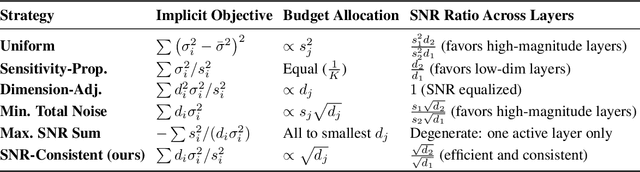
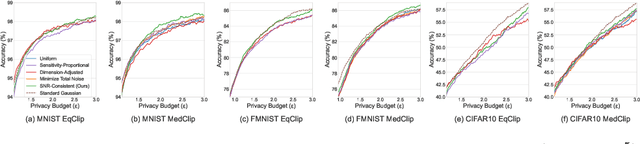
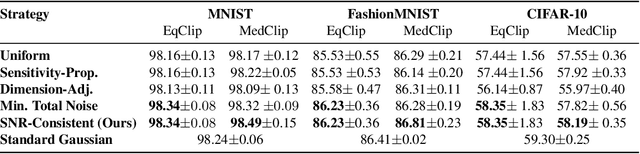
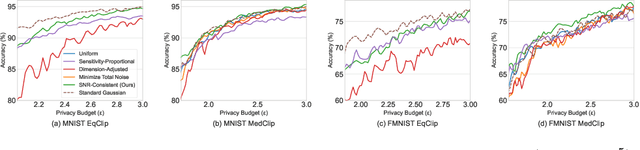
Layer-wise Gaussian mechanisms (LGM) enhance flexibility in differentially private deep learning by injecting noise into partitioned gradient vectors. However, existing methods often rely on heuristic noise allocation strategies, lacking a rigorous understanding of their theoretical grounding in connecting noise allocation to formal privacy-utility tradeoffs. In this paper, we present a unified analytical framework that systematically connects layer-wise noise injection strategies with their implicit optimization objectives and associated privacy budget allocations. Our analysis reveals that several existing approaches optimize ill-posed objectives -- either ignoring inter-layer signal-to-noise ratio (SNR) consistency or leading to inefficient use of the privacy budget. In response, we propose a SNR-Consistent noise allocation strategy that unifies both aspects, yielding a noise allocation scheme that achieves better signal preservation and more efficient privacy budget utilization. Extensive experiments in both centralized and federated learning settings demonstrate that our method consistently outperforms existing allocation strategies, achieving better privacy-utility tradeoffs. Our framework not only offers diagnostic insights into prior methods but also provides theoretical guidance for designing adaptive and effective noise injection schemes in deep models.
Review of Mathematical Optimization in Federated Learning
Dec 02, 2024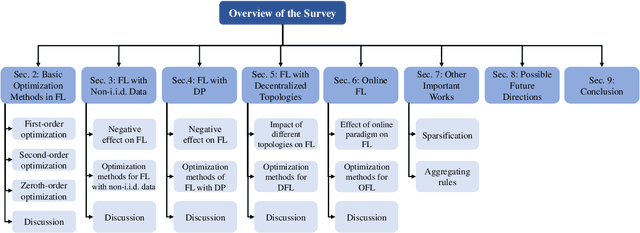
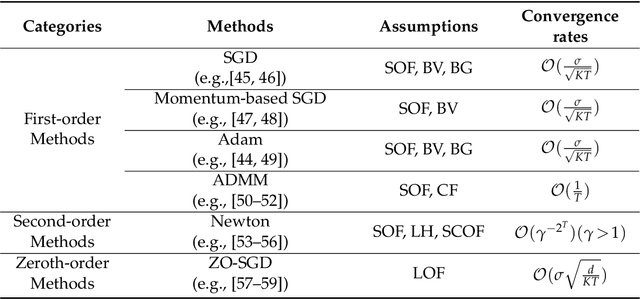
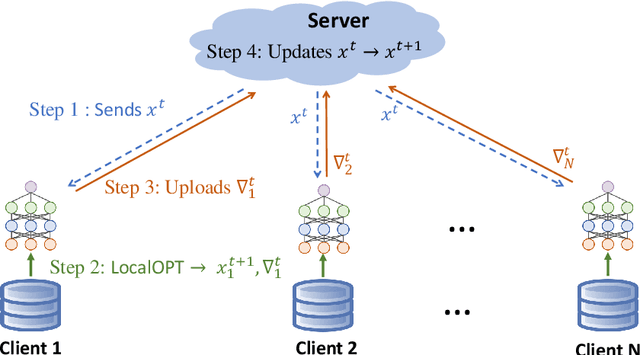
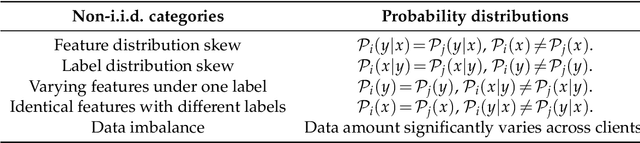
Federated Learning (FL) has been becoming a popular interdisciplinary research area in both applied mathematics and information sciences. Mathematically, FL aims to collaboratively optimize aggregate objective functions over distributed datasets while satisfying a variety of privacy and system constraints.Different from conventional distributed optimization methods, FL needs to address several specific issues (e.g., non-i.i.d. data distributions and differential private noises), which pose a set of new challenges in the problem formulation, algorithm design, and convergence analysis. In this paper, we will systematically review existing FL optimization research including their assumptions, formulations, methods, and theoretical results. Potential future directions are also discussed.
Understanding Byzantine Robustness in Federated Learning with A Black-box Server
Aug 12, 2024Federated learning (FL) becomes vulnerable to Byzantine attacks where some of participators tend to damage the utility or discourage the convergence of the learned model via sending their malicious model updates. Previous works propose to apply robust rules to aggregate updates from participators against different types of Byzantine attacks, while at the same time, attackers can further design advanced Byzantine attack algorithms targeting specific aggregation rule when it is known. In practice, FL systems can involve a black-box server that makes the adopted aggregation rule inaccessible to participants, which can naturally defend or weaken some Byzantine attacks. In this paper, we provide an in-depth understanding on the Byzantine robustness of the FL system with a black-box server. Our investigation demonstrates the improved Byzantine robustness of a black-box server employing a dynamic defense strategy. We provide both empirical evidence and theoretical analysis to reveal that the black-box server can mitigate the worst-case attack impact from a maximum level to an expectation level, which is attributed to the inherent inaccessibility and randomness offered by a black-box server.The source code is available at https://github.com/alibaba/FederatedScope/tree/Byzantine_attack_defense to promote further research in the community.
FedLED: Label-Free Equipment Fault Diagnosis with Vertical Federated Transfer Learning
Dec 29, 2023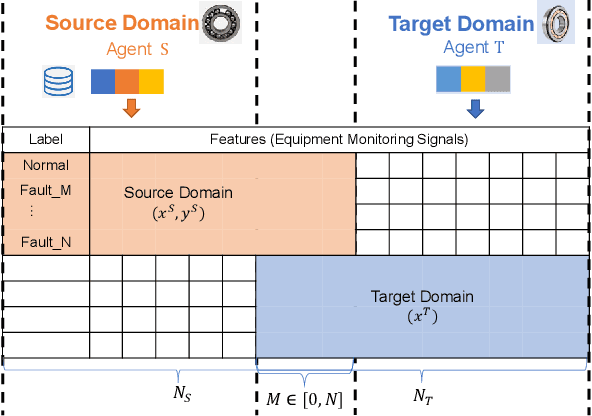


Intelligent equipment fault diagnosis based on Federated Transfer Learning (FTL) attracts considerable attention from both academia and industry. It allows real-world industrial agents with limited samples to construct a fault diagnosis model without jeopardizing their raw data privacy. Existing approaches, however, can neither address the intense sample heterogeneity caused by different working conditions of practical agents, nor the extreme fault label scarcity, even zero, of newly deployed equipment. To address these issues, we present FedLED, the first unsupervised vertical FTL equipment fault diagnosis method, where knowledge of the unlabeled target domain is further exploited for effective unsupervised model transfer. Results of extensive experiments using data of real equipment monitoring demonstrate that FedLED obviously outperforms SOTA approaches in terms of both diagnosis accuracy (up to 4.13 times) and generality. We expect our work to inspire further study on label-free equipment fault diagnosis systematically enhanced by target domain knowledge.
Exploring the Benefits of Visual Prompting in Differential Privacy
Mar 22, 2023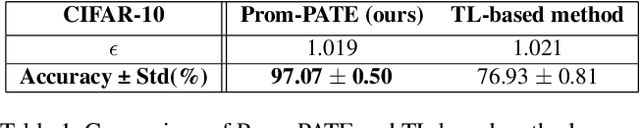
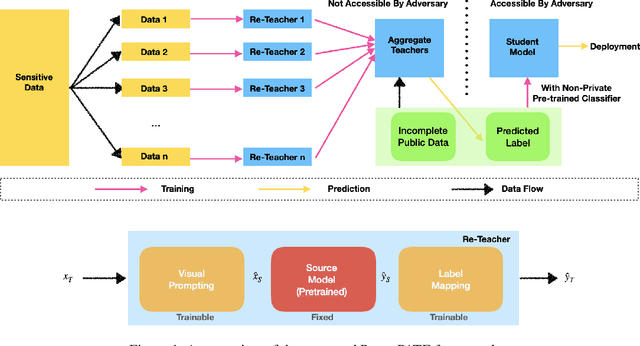
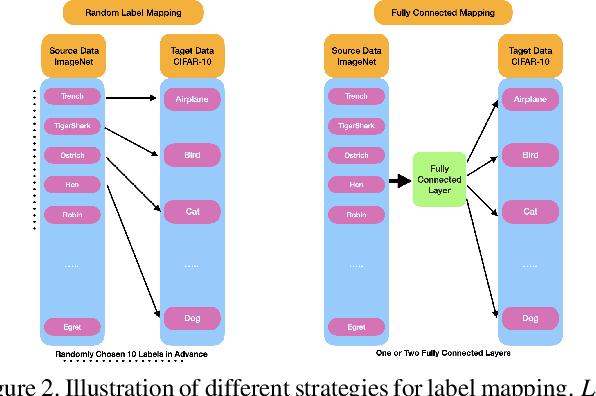

Visual Prompting (VP) is an emerging and powerful technique that allows sample-efficient adaptation to downstream tasks by engineering a well-trained frozen source model. In this work, we explore the benefits of VP in constructing compelling neural network classifiers with differential privacy (DP). We explore and integrate VP into canonical DP training methods and demonstrate its simplicity and efficiency. In particular, we discover that VP in tandem with PATE, a state-of-the-art DP training method that leverages the knowledge transfer from an ensemble of teachers, achieves the state-of-the-art privacy-utility trade-off with minimum expenditure of privacy budget. Moreover, we conduct additional experiments on cross-domain image classification with a sufficient domain gap to further unveil the advantage of VP in DP. Lastly, we also conduct extensive ablation studies to validate the effectiveness and contribution of VP under DP consideration.
Towards Efficient and Stable K-Asynchronous Federated Learning with Unbounded Stale Gradients on Non-IID Data
Mar 02, 2022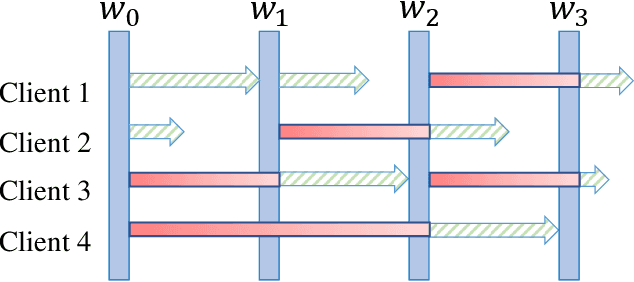
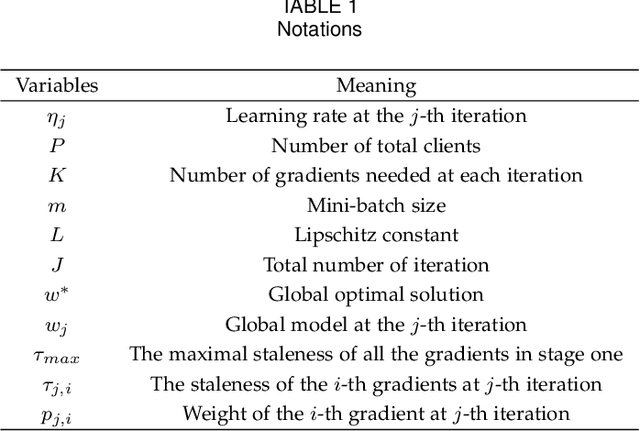
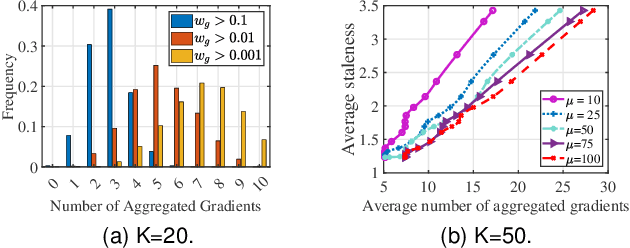
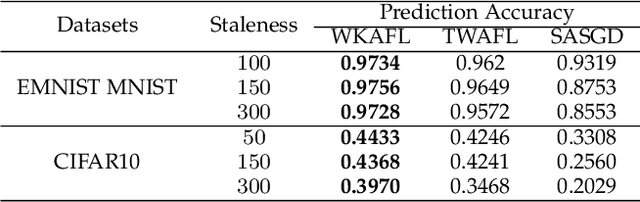
Federated learning (FL) is an emerging privacy-preserving paradigm that enables multiple participants collaboratively to train a global model without uploading raw data. Considering heterogeneous computing and communication capabilities of different participants, asynchronous FL can avoid the stragglers effect in synchronous FL and adapts to scenarios with vast participants. Both staleness and non-IID data in asynchronous FL would reduce the model utility. However, there exists an inherent contradiction between the solutions to the two problems. That is, mitigating the staleness requires to select less but consistent gradients while coping with non-IID data demands more comprehensive gradients. To address the dilemma, this paper proposes a two-stage weighted $K$ asynchronous FL with adaptive learning rate (WKAFL). By selecting consistent gradients and adjusting learning rate adaptively, WKAFL utilizes stale gradients and mitigates the impact of non-IID data, which can achieve multifaceted enhancement in training speed, prediction accuracy and training stability. We also present the convergence analysis for WKAFL under the assumption of unbounded staleness to understand the impact of staleness and non-IID data. Experiments implemented on both benchmark and synthetic FL datasets show that WKAFL has better overall performance compared to existing algorithms.
Latent Dirichlet Allocation Model Training with Differential Privacy
Oct 09, 2020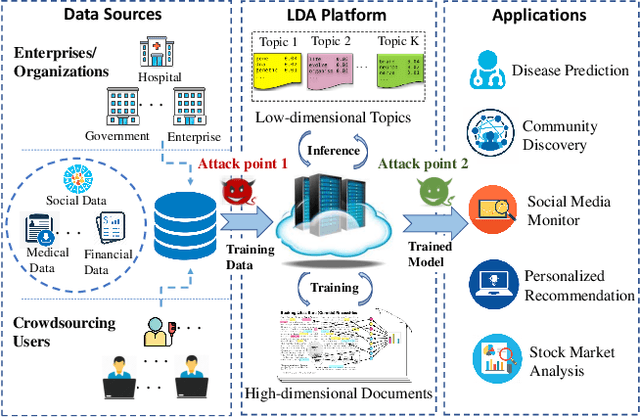
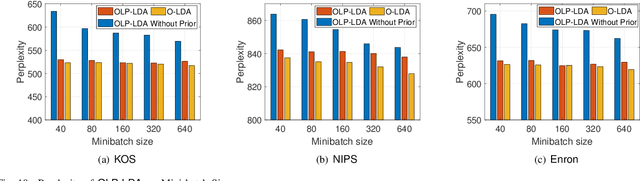
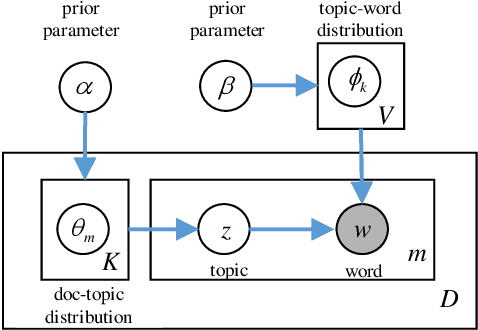
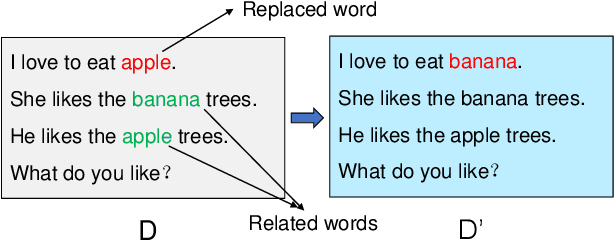
Latent Dirichlet Allocation (LDA) is a popular topic modeling technique for hidden semantic discovery of text data and serves as a fundamental tool for text analysis in various applications. However, the LDA model as well as the training process of LDA may expose the text information in the training data, thus bringing significant privacy concerns. To address the privacy issue in LDA, we systematically investigate the privacy protection of the main-stream LDA training algorithm based on Collapsed Gibbs Sampling (CGS) and propose several differentially private LDA algorithms for typical training scenarios. In particular, we present the first theoretical analysis on the inherent differential privacy guarantee of CGS based LDA training and further propose a centralized privacy-preserving algorithm (HDP-LDA) that can prevent data inference from the intermediate statistics in the CGS training. Also, we propose a locally private LDA training algorithm (LP-LDA) on crowdsourced data to provide local differential privacy for individual data contributors. Furthermore, we extend LP-LDA to an online version as OLP-LDA to achieve LDA training on locally private mini-batches in a streaming setting. Extensive analysis and experiment results validate both the effectiveness and efficiency of our proposed privacy-preserving LDA training algorithms.
OL4EL: Online Learning for Edge-cloud Collaborative Learning on Heterogeneous Edges with Resource Constraints
Apr 23, 2020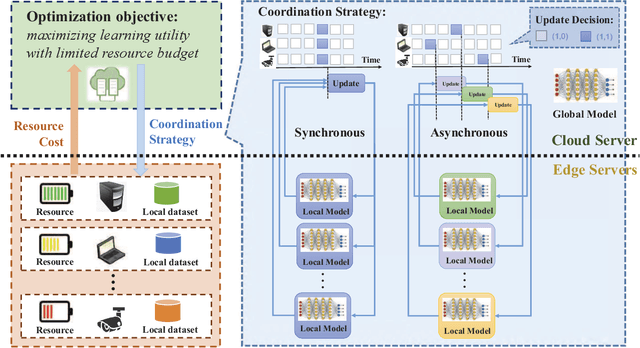
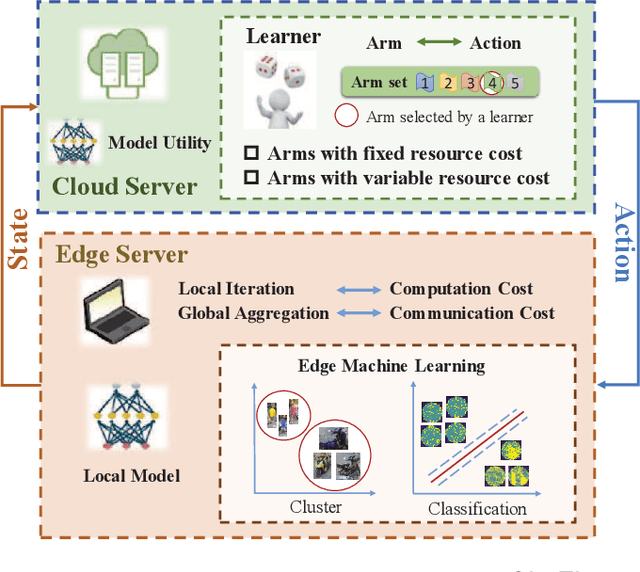
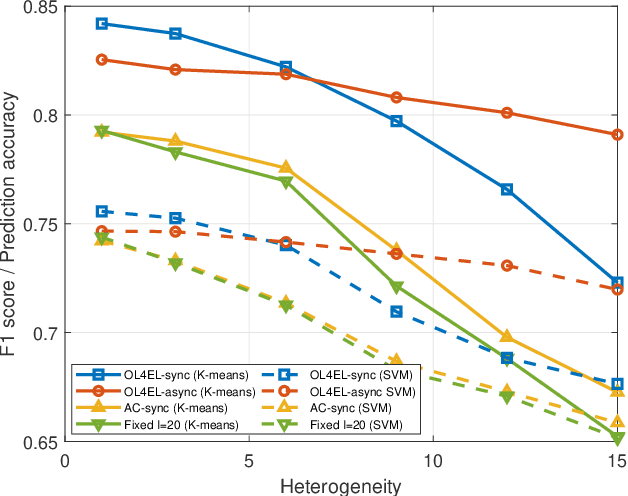
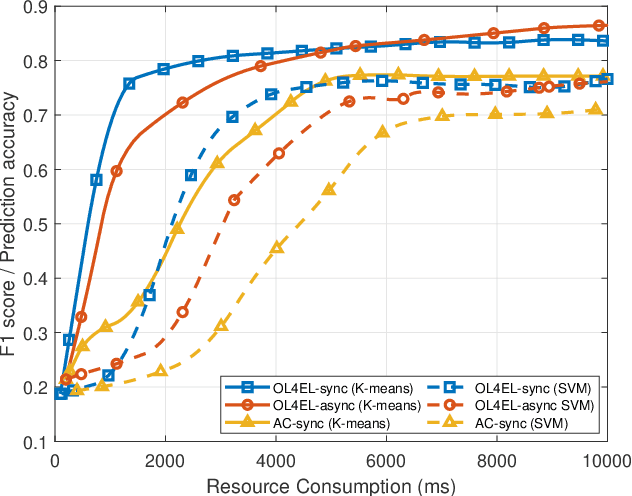
Distributed machine learning (ML) at network edge is a promising paradigm that can preserve both network bandwidth and privacy of data providers. However, heterogeneous and limited computation and communication resources on edge servers (or edges) pose great challenges on distributed ML and formulate a new paradigm of Edge Learning (i.e. edge-cloud collaborative machine learning). In this article, we propose a novel framework of 'learning to learn' for effective Edge Learning (EL) on heterogeneous edges with resource constraints. We first model the dynamic determination of collaboration strategy (i.e. the allocation of local iterations at edge servers and global aggregations on the Cloud during collaborative learning process) as an online optimization problem to achieve the tradeoff between the performance of EL and the resource consumption of edge servers. Then, we propose an Online Learning for EL (OL4EL) framework based on the budget-limited multi-armed bandit model. OL4EL supports both synchronous and asynchronous learning patterns, and can be used for both supervised and unsupervised learning tasks. To evaluate the performance of OL4EL, we conducted both real-world testbed experiments and extensive simulations based on docker containers, where both Support Vector Machine and K-means were considered as use cases. Experimental results demonstrate that OL4EL significantly outperforms state-of-the-art EL and other collaborative ML approaches in terms of the trade-off between learning performance and resource consumption.