 Add to Chrome
 Add to Firefox
 Add to Edge
End-to-End QGAN-Based Image Synthesis via Neural Noise Encoding and Intensity Calibration
Mar 19, 2026
Quantum Generative Adversarial Networks (QGANs) offer a promising path for learning data distributions on near-term quantum devices. However, existing QGANs for image synthesis avoid direct full-image generation, relying on classical post-processing or patch-based methods. These approaches dilute the quantum generator's role and struggle to capture global image semantics. To address this, we propose ReQGAN, an end-to-end framework that synthesizes an entire N=2^D-pixel image using a single D-qubit quantum circuit. ReQGAN overcomes two fundamental bottlenecks hindering direct pixel generation: (1) the rigid classical-to-quantum noise interface and (2) the output mismatch between normalized quantum statistics and the desired pixel-intensity space. We introduce a learnable Neural Noise Encoder for adaptive state preparation and a differentiable Intensity Calibration module to map measurements to a stable, visually meaningful pixel domain. Experiments on MNIST and Fashion-MNIST demonstrate that ReQGAN achieves stable training and effective image synthesis under stringent qubit budgets, with ablation studies verifying the contribution of each component.

A Self-supervised Learning Method for Raman Spectroscopy based on Masked Autoencoders
Apr 21, 2025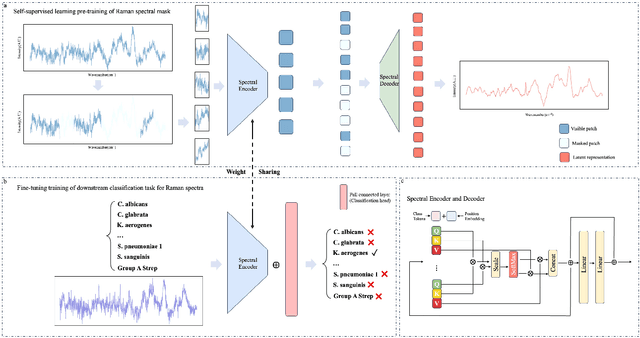
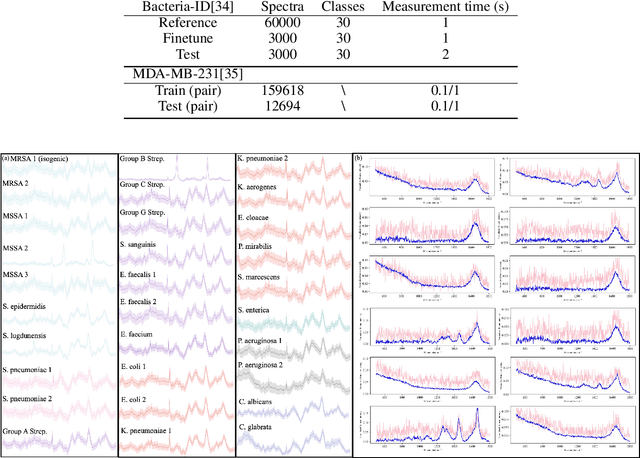

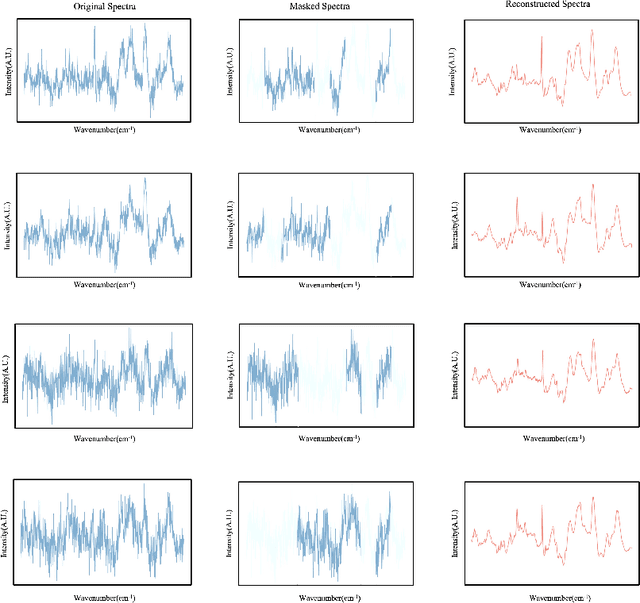
Raman spectroscopy serves as a powerful and reliable tool for analyzing the chemical information of substances. The integration of Raman spectroscopy with deep learning methods enables rapid qualitative and quantitative analysis of materials. Most existing approaches adopt supervised learning methods. Although supervised learning has achieved satisfactory accuracy in spectral analysis, it is still constrained by costly and limited well-annotated spectral datasets for training. When spectral annotation is challenging or the amount of annotated data is insufficient, the performance of supervised learning in spectral material identification declines. In order to address the challenge of feature extraction from unannotated spectra, we propose a self-supervised learning paradigm for Raman Spectroscopy based on a Masked AutoEncoder, termed SMAE. SMAE does not require any spectral annotations during pre-training. By randomly masking and then reconstructing the spectral information, the model learns essential spectral features. The reconstructed spectra exhibit certain denoising properties, improving the signal-to-noise ratio (SNR) by more than twofold. Utilizing the network weights obtained from masked pre-training, SMAE achieves clustering accuracy of over 80% for 30 classes of isolated bacteria in a pathogenic bacterial dataset, demonstrating significant improvements compared to classical unsupervised methods and other state-of-the-art deep clustering methods. After fine-tuning the network with a limited amount of annotated data, SMAE achieves an identification accuracy of 83.90% on the test set, presenting competitive performance against the supervised ResNet (83.40%).