 Add to Chrome
 Add to Firefox
 Add to Edge
GLOBE: Trajectory-Aligned Gradient Matching with Structured SparseOptimization for Coreset Selection
Aug 03, 2026
On-device training of deep neural networks is fundamentally constrained by the computational and memory costs of large-scale datasets. Coreset selection offers a practical solution by retaining only a compact subset of real training samples. However, existing gradient-based methods commonly rely on gradients computed at a single model snapshot and employ greedy or pursuit-based selection procedures, limiting their ability to capture evolving optimization dynamics and handle strongly correlated samples. We propose GLOBE (Gradient Local-Balanced Extraction), a trajectory-aligned coreset selection framework that formulates sample selection as a globally optimized sparse weighting problem. GLOBE represents each sample by a gradient trajectory constructed across multiple training checkpoints, thereby capturing its influence throughout different stages of optimization. To preserve the training behavior of the full dataset, we introduce a multi-order matching objective that jointly aligns the first-order mean and projected uncentered second-order moments of gradient trajectories. GLOBE further combines Group LASSO, Elastic Net regularization, and nonnegative budget constraints to induce group- and sample-level sparsity while stabilizing the weights of correlated trajectories. Finally, class-balanced Top-K selection maintains adequate category coverage under limited sampling budgets. Experiments across six benchmarks and five evaluation architectures demonstrate that GLOBE consistently outperforms existing coreset selection methods in downstream test accuracy, particularly at low retention ratios. These results highlight the effectiveness of combining dynamic gradient information, multi-order distribution matching, and structured sparsity for data-efficient learning.

Look Where It Matters: Adaptive Visual Refinement for Vision-Language-Action Models
Aug 03, 2026Visual representations of VLA models remain unreliable for spatially precise robotic manipulation. We uncover that vision encoders in VLAs also exhibit attention artifacts previously documented in generic Vision Transformers, and further show that, in embodied policies, these artifacts are closely associated with spatial perception capabilities acquired during post-training. As the encoder learns task-relevant information such as object location, depth ordering, and local geometry, limited global-token capacity causes part of this information to spill into low-information patch tokens. We introduce AtVLA, a framework that inserts learnable register tokens into the visual encoder. Trained end-to-end using only embodied data and the original action objective, these registers emerge as dedicated carriers of embodied spatial information, while the remaining patch tokens recover clean and spatially faithful attention distributions crucial for precise target localization and fine-grained contact. Clean attention restores reliable localization, but cannot recover geometric details lost in low-resolution observations. AtVLA therefore couples attention rectification with uncertainty-gated local refinement. The action expert samples multiple action chunks and estimates uncertainty from their disagreement; only for uncertain predictions, action-conditioned attention rollout identifies the task-relevant region, which is cropped, re-encoded at high resolution, and appended to the cached prefix for refined action generation. Across LIBERO, SimplerEnv, and a challenging single-view real-world benchmark, AtVLA improves the average LIBERO success rate from 94.2% to 98.4% and real-world success from 46.5% to 69.0%. The cropping is triggered on approximately 30% of replanning steps, resulting in only 1.4-1.6x the total computation of the base model under the representative deployment setting.
HAFI-VLM: A Frequency Perspective for Diagnosing and Enhancing Visual Perception in Vision-Language Models
Aug 03, 2026Vision-language models (VLMs) remain unreliable when predictions require fine-grained visual evidence. We identify a previously overlooked cause: spectral response rigidity. Despite substantial frequency variation across images and tasks, pretrained vision encoders exhibit persistent, encoder-specific layerwise spectral profiles that change only marginally under downstream fine-tuning. Since pretrained vision encoders only receive images, they cannot adapt spectral extraction to the evidence required by the current query. We therefore propose HAFI-VLM, which introduces a task-conditioned frequency pathway while preserving the pretrained semantic representation. Hierarchical Adaptive Frequency Injection (HAFI) retrieves complementary low-, mid-, and high-frequency evidence at multiple encoder depths using text-modulated, spatially aligned cross-attention. A Visual Enrichment Layer Adapter further recalibrates shallow LLM attention to effectively utilize the enriched visual tokens. Experiments on LLaVA-1.5 and Qwen2.5-VL demonstrate consistent improvements in general VQA, text-rich understanding, and hallucination robustness, outperforming representation-level enhancement methods and most resolution- or cropping-based approaches without additional high-resolution encoding. Mechanistic analyses show that HAFI restores task-dependent spectral allocation while retaining semantic attention, establishing frequency enrichment as a distinct and effective route for improving VLM perception.
Distill What RGB Can Recover: Privileged 3D Evidence for RGB-Only Vision-Language Models
Jul 31, 20263D scene understanding requires reasoning about entity existence, spatial layout, and object relations, yet RGB images alone often provide insufficient 3D cues. Existing 3D-VLMs commonly rely on depth or 3D-position-aware inputs at inference time, introducing additional acquisition, reconstruction, or annotation costs that limit RGB-only deployment. We therefore study how training-time 3D evidence can be converted into spatial reasoning capabilities retained under RGB-only inference. We propose a privileged-evidence distillation framework that constructs a distillable teacher through a unified evidence interface and controlled residual injection, and transfers its knowledge to a deployable student receiving only RGB images and questions through logit and structured representation distillation. To avoid imitating teacher signals unsupported by RGB, we further introduce evidence-sensitivity-guided distillation, which uses corrupted evidence to identify highly evidence-dependent targets and down-weight their supervision. We also define a recoverability decomposition based on the matched baseline, teacher, and student, separating privileged gains into RGB-recoverable improvements and residual teacher advantages. Across four benchmarks, the teacher achieves the best result on 7 of 11 reported metrics among the compared methods. The RGB-only student outperforms its matched baseline on all 11 metrics, including gains of 10.4 ScanQA CIDEr and 19.1 Scan2Cap CIDEr@0.5, without additional inference-time inputs. These results validate the effectiveness of training-time privileged 3D evidence distillation for both teacher performance and deployable RGB-only spatial reasoning. Separately, our matched baseline-teacher-student analysis characterizes privileged-gain transfer across evidence types and spatial skills.
MIND: From Passive Mimicry to Active Reasoning through Capability-Aware Multi-Perspective CoT Distillation
Jan 07, 2026While Large Language Models (LLMs) have emerged with remarkable capabilities in complex tasks through Chain-of-Thought reasoning, practical resource constraints have sparked interest in transferring these abilities to smaller models. However, achieving both domain performance and cross-domain generalization remains challenging. Existing approaches typically restrict students to following a single golden rationale and treat different reasoning paths independently. Due to distinct inductive biases and intrinsic preferences, alongside the student's evolving capacity and reasoning preferences during training, a teacher's "optimal" rationale could act as out-of-distribution noise. This misalignment leads to a degeneration of the student's latent reasoning distribution, causing suboptimal performance. To bridge this gap, we propose MIND, a capability-adaptive framework that transitions distillation from passive mimicry to active cognitive construction. We synthesize diverse teacher perspectives through a novel "Teaching Assistant" network. By employing a Feedback-Driven Inertia Calibration mechanism, this network utilizes inertia-filtered training loss to align supervision with the student's current adaptability, effectively enhancing performance while mitigating catastrophic forgetting. Extensive experiments demonstrate that MIND achieves state-of-the-art performance on both in-distribution and out-of-distribution benchmarks, and our sophisticated latent space analysis further confirms the mechanism of reasoning ability internalization.
RecGPT Technical Report
Jul 30, 2025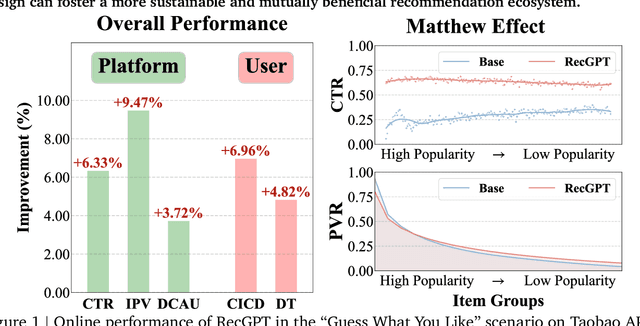
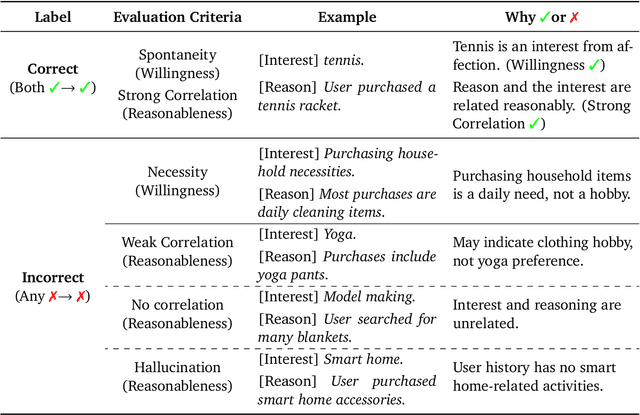
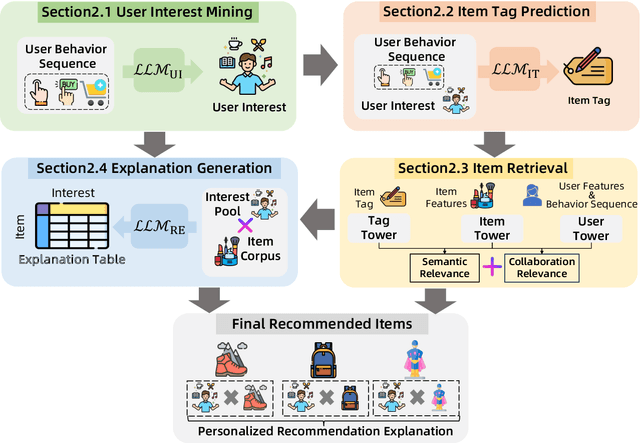

Recommender systems are among the most impactful applications of artificial intelligence, serving as critical infrastructure connecting users, merchants, and platforms. However, most current industrial systems remain heavily reliant on historical co-occurrence patterns and log-fitting objectives, i.e., optimizing for past user interactions without explicitly modeling user intent. This log-fitting approach often leads to overfitting to narrow historical preferences, failing to capture users' evolving and latent interests. As a result, it reinforces filter bubbles and long-tail phenomena, ultimately harming user experience and threatening the sustainability of the whole recommendation ecosystem. To address these challenges, we rethink the overall design paradigm of recommender systems and propose RecGPT, a next-generation framework that places user intent at the center of the recommendation pipeline. By integrating large language models (LLMs) into key stages of user interest mining, item retrieval, and explanation generation, RecGPT transforms log-fitting recommendation into an intent-centric process. To effectively align general-purpose LLMs to the above domain-specific recommendation tasks at scale, RecGPT incorporates a multi-stage training paradigm, which integrates reasoning-enhanced pre-alignment and self-training evolution, guided by a Human-LLM cooperative judge system. Currently, RecGPT has been fully deployed on the Taobao App. Online experiments demonstrate that RecGPT achieves consistent performance gains across stakeholders: users benefit from increased content diversity and satisfaction, merchants and the platform gain greater exposure and conversions. These comprehensive improvement results across all stakeholders validates that LLM-driven, intent-centric design can foster a more sustainable and mutually beneficial recommendation ecosystem.
Two-Stage Representation Learning for Analyzing Movement Behavior Dynamics in People Living with Dementia
Feb 13, 2025In remote healthcare monitoring, time series representation learning reveals critical patient behavior patterns from high-frequency data. This study analyzes home activity data from individuals living with dementia by proposing a two-stage, self-supervised learning approach tailored to uncover low-rank structures. The first stage converts time-series activities into text sequences encoded by a pre-trained language model, providing a rich, high-dimensional latent state space using a PageRank-based method. This PageRank vector captures latent state transitions, effectively compressing complex behaviour data into a succinct form that enhances interpretability. This low-rank representation not only enhances model interpretability but also facilitates clustering and transition analysis, revealing key behavioral patterns correlated with clinicalmetrics such as MMSE and ADAS-COG scores. Our findings demonstrate the framework's potential in supporting cognitive status prediction, personalized care interventions, and large-scale health monitoring.
Enhancing High-order Interaction Awareness in LLM-based Recommender Model
Sep 30, 2024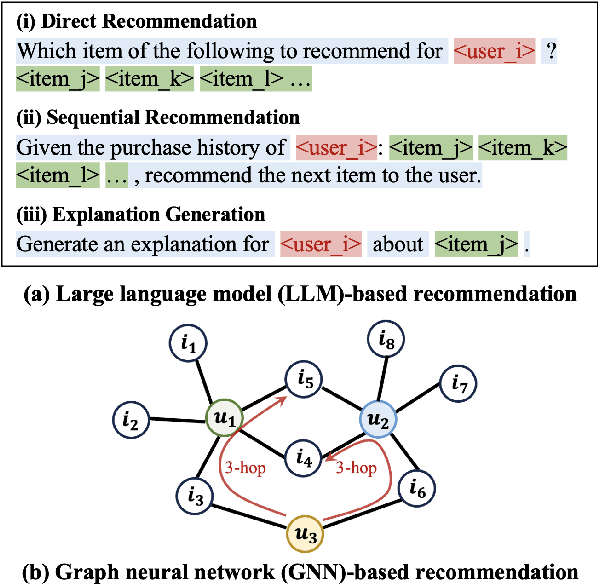
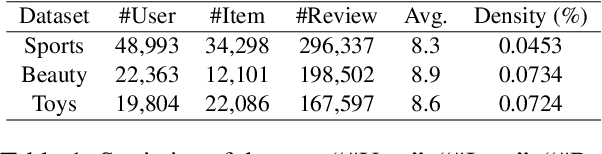
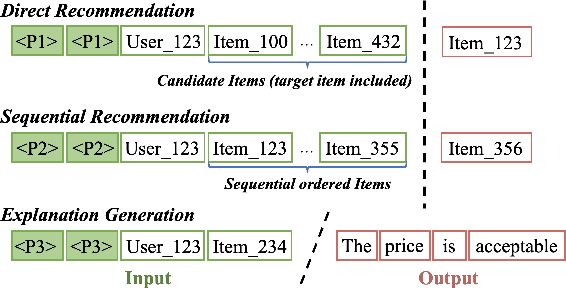
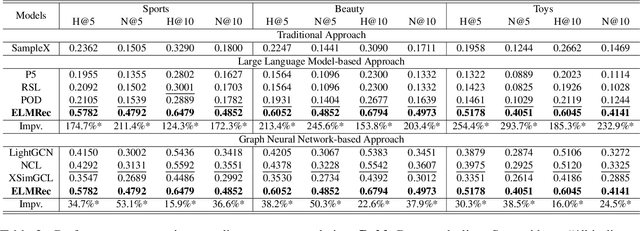
Large language models (LLMs) have demonstrated prominent reasoning capabilities in recommendation tasks by transforming them into text-generation tasks. % many NLP applications including However, existing approaches either disregard or ineffectively model the user--item high-order interactions. To this end, this paper presents an enhanced LLM-based recommender (ELMRec). We enhance whole-word embeddings to substantially enhance LLMs' interpretation of graph-constructed interactions for recommendations, without requiring graph pre-training. This finding may inspire endeavors to incorporate rich knowledge graphs into LLM-based recommenders via whole-word embedding. We also found that LLMs often recommend items based on users' earlier interactions rather than recent ones, and present a reranking solution. Our ELMRec outperforms state-of-the-art (SOTA) methods in both direct and sequential recommendations.
RDRec: Rationale Distillation for LLM-based Recommendation
May 17, 2024Large language model (LLM)-based recommender models that bridge users and items through textual prompts for effective semantic reasoning have gained considerable attention. However, few methods consider the underlying rationales behind interactions, such as user preferences and item attributes, limiting the reasoning capability of LLMs for recommendations. This paper proposes a rationale distillation recommender (RDRec), a compact model designed to learn rationales generated by a larger language model (LM). By leveraging rationales from reviews related to users and items, RDRec remarkably specifies their profiles for recommendations. Experiments show that RDRec achieves state-of-the-art (SOTA) performance in both top-N and sequential recommendations. Our source code is released at https://github.com/WangXFng/RDRec.
NFARec: A Negative Feedback-Aware Recommender Model
Apr 10, 2024Graph neural network (GNN)-based models have been extensively studied for recommendations, as they can extract high-order collaborative signals accurately which is required for high-quality recommender systems. However, they neglect the valuable information gained through negative feedback in two aspects: (1) different users might hold opposite feedback on the same item, which hampers optimal information propagation in GNNs, and (2) even when an item vastly deviates from users' preferences, they might still choose it and provide a negative rating. In this paper, we propose a negative feedback-aware recommender model (NFARec) that maximizes the leverage of negative feedback. To transfer information to multi-hop neighbors along an optimal path effectively, NFARec adopts a feedback-aware correlation that guides hypergraph convolutions (HGCs) to learn users' structural representations. Moreover, NFARec incorporates an auxiliary task - predicting the feedback sentiment polarity (i.e., positive or negative) of the next interaction - based on the Transformer Hawkes Process. The task is beneficial for understanding users by learning the sentiment expressed in their previous sequential feedback patterns and predicting future interactions. Extensive experiments demonstrate that NFARec outperforms competitive baselines. Our source code and data are released at https://github.com/WangXFng/NFARec.