 Add to Chrome
 Add to Firefox
 Add to Edge
Distill What RGB Can Recover: Privileged 3D Evidence for RGB-Only Vision-Language Models
Jul 31, 2026
3D scene understanding requires reasoning about entity existence, spatial layout, and object relations, yet RGB images alone often provide insufficient 3D cues. Existing 3D-VLMs commonly rely on depth or 3D-position-aware inputs at inference time, introducing additional acquisition, reconstruction, or annotation costs that limit RGB-only deployment. We therefore study how training-time 3D evidence can be converted into spatial reasoning capabilities retained under RGB-only inference. We propose a privileged-evidence distillation framework that constructs a distillable teacher through a unified evidence interface and controlled residual injection, and transfers its knowledge to a deployable student receiving only RGB images and questions through logit and structured representation distillation. To avoid imitating teacher signals unsupported by RGB, we further introduce evidence-sensitivity-guided distillation, which uses corrupted evidence to identify highly evidence-dependent targets and down-weight their supervision. We also define a recoverability decomposition based on the matched baseline, teacher, and student, separating privileged gains into RGB-recoverable improvements and residual teacher advantages. Across four benchmarks, the teacher achieves the best result on 7 of 11 reported metrics among the compared methods. The RGB-only student outperforms its matched baseline on all 11 metrics, including gains of 10.4 ScanQA CIDEr and 19.1 Scan2Cap CIDEr@0.5, without additional inference-time inputs. These results validate the effectiveness of training-time privileged 3D evidence distillation for both teacher performance and deployable RGB-only spatial reasoning. Separately, our matched baseline-teacher-student analysis characterizes privileged-gain transfer across evidence types and spatial skills.

MIND: From Passive Mimicry to Active Reasoning through Capability-Aware Multi-Perspective CoT Distillation
Jan 07, 2026While Large Language Models (LLMs) have emerged with remarkable capabilities in complex tasks through Chain-of-Thought reasoning, practical resource constraints have sparked interest in transferring these abilities to smaller models. However, achieving both domain performance and cross-domain generalization remains challenging. Existing approaches typically restrict students to following a single golden rationale and treat different reasoning paths independently. Due to distinct inductive biases and intrinsic preferences, alongside the student's evolving capacity and reasoning preferences during training, a teacher's "optimal" rationale could act as out-of-distribution noise. This misalignment leads to a degeneration of the student's latent reasoning distribution, causing suboptimal performance. To bridge this gap, we propose MIND, a capability-adaptive framework that transitions distillation from passive mimicry to active cognitive construction. We synthesize diverse teacher perspectives through a novel "Teaching Assistant" network. By employing a Feedback-Driven Inertia Calibration mechanism, this network utilizes inertia-filtered training loss to align supervision with the student's current adaptability, effectively enhancing performance while mitigating catastrophic forgetting. Extensive experiments demonstrate that MIND achieves state-of-the-art performance on both in-distribution and out-of-distribution benchmarks, and our sophisticated latent space analysis further confirms the mechanism of reasoning ability internalization.
DeepKD: A Deeply Decoupled and Denoised Knowledge Distillation Trainer
May 21, 2025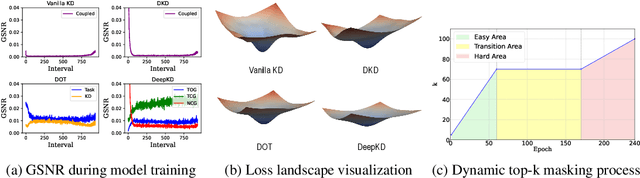
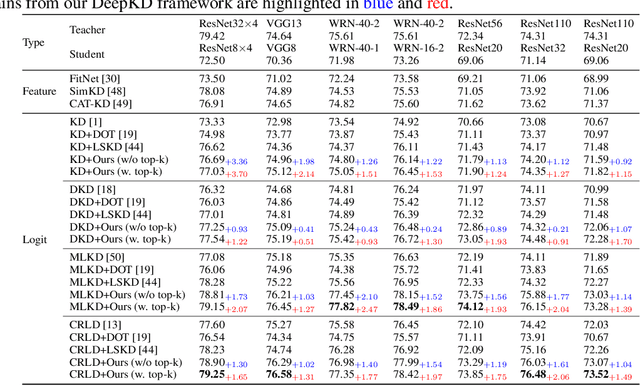
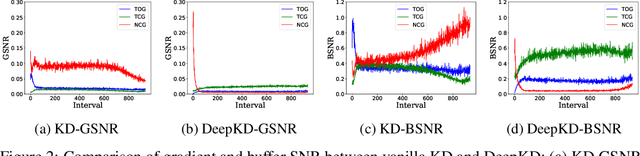
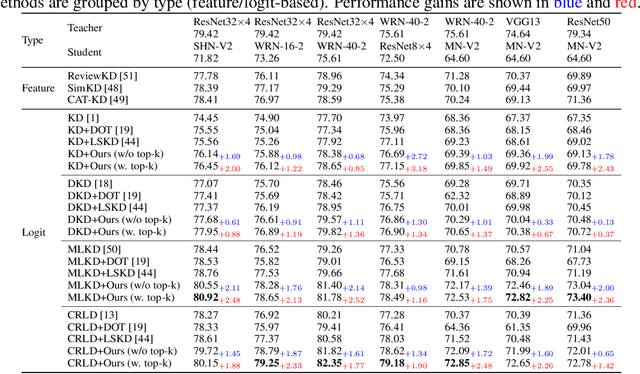
Recent advances in knowledge distillation have emphasized the importance of decoupling different knowledge components. While existing methods utilize momentum mechanisms to separate task-oriented and distillation gradients, they overlook the inherent conflict between target-class and non-target-class knowledge flows. Furthermore, low-confidence dark knowledge in non-target classes introduces noisy signals that hinder effective knowledge transfer. To address these limitations, we propose DeepKD, a novel training framework that integrates dual-level decoupling with adaptive denoising. First, through theoretical analysis of gradient signal-to-noise ratio (GSNR) characteristics in task-oriented and non-task-oriented knowledge distillation, we design independent momentum updaters for each component to prevent mutual interference. We observe that the optimal momentum coefficients for task-oriented gradient (TOG), target-class gradient (TCG), and non-target-class gradient (NCG) should be positively related to their GSNR. Second, we introduce a dynamic top-k mask (DTM) mechanism that gradually increases K from a small initial value to incorporate more non-target classes as training progresses, following curriculum learning principles. The DTM jointly filters low-confidence logits from both teacher and student models, effectively purifying dark knowledge during early training. Extensive experiments on CIFAR-100, ImageNet, and MS-COCO demonstrate DeepKD's effectiveness. Our code is available at https://github.com/haiduo/DeepKD.