 Add to Chrome
 Add to Firefox
 Add to Edge
SWE-Pruner: Self-Adaptive Context Pruning for Coding Agents
Jan 23, 2026
LLM agents have demonstrated remarkable capabilities in software development, but their performance is hampered by long interaction contexts, which incur high API costs and latency. While various context compression approaches such as LongLLMLingua have emerged to tackle this challenge, they typically rely on fixed metrics such as PPL, ignoring the task-specific nature of code understanding. As a result, they frequently disrupt syntactic and logical structure and fail to retain critical implementation details. In this paper, we propose SWE-Pruner, a self-adaptive context pruning framework tailored for coding agents. Drawing inspiration from how human programmers "selectively skim" source code during development and debugging, SWE-Pruner performs task-aware adaptive pruning for long contexts. Given the current task, the agent formulates an explicit goal (e.g., "focus on error handling") as a hint to guide the pruning targets. A lightweight neural skimmer (0.6B parameters) is trained to dynamically select relevant lines from the surrounding context given the goal. Evaluations across four benchmarks and multiple models validate SWE-Pruner's effectiveness in various scenarios, achieving 23-54% token reduction on agent tasks like SWE-Bench Verified and up to 14.84x compression on single-turn tasks like LongCodeQA with minimal performance impact.

UI-TARS: Pioneering Automated GUI Interaction with Native Agents
Jan 21, 2025This paper introduces UI-TARS, a native GUI agent model that solely perceives the screenshots as input and performs human-like interactions (e.g., keyboard and mouse operations). Unlike prevailing agent frameworks that depend on heavily wrapped commercial models (e.g., GPT-4o) with expert-crafted prompts and workflows, UI-TARS is an end-to-end model that outperforms these sophisticated frameworks. Experiments demonstrate its superior performance: UI-TARS achieves SOTA performance in 10+ GUI agent benchmarks evaluating perception, grounding, and GUI task execution. Notably, in the OSWorld benchmark, UI-TARS achieves scores of 24.6 with 50 steps and 22.7 with 15 steps, outperforming Claude (22.0 and 14.9 respectively). In AndroidWorld, UI-TARS achieves 46.6, surpassing GPT-4o (34.5). UI-TARS incorporates several key innovations: (1) Enhanced Perception: leveraging a large-scale dataset of GUI screenshots for context-aware understanding of UI elements and precise captioning; (2) Unified Action Modeling, which standardizes actions into a unified space across platforms and achieves precise grounding and interaction through large-scale action traces; (3) System-2 Reasoning, which incorporates deliberate reasoning into multi-step decision making, involving multiple reasoning patterns such as task decomposition, reflection thinking, milestone recognition, etc. (4) Iterative Training with Reflective Online Traces, which addresses the data bottleneck by automatically collecting, filtering, and reflectively refining new interaction traces on hundreds of virtual machines. Through iterative training and reflection tuning, UI-TARS continuously learns from its mistakes and adapts to unforeseen situations with minimal human intervention. We also analyze the evolution path of GUI agents to guide the further development of this domain.
A Grey-Box Approach to Automated Mechanism Design
Feb 08, 2010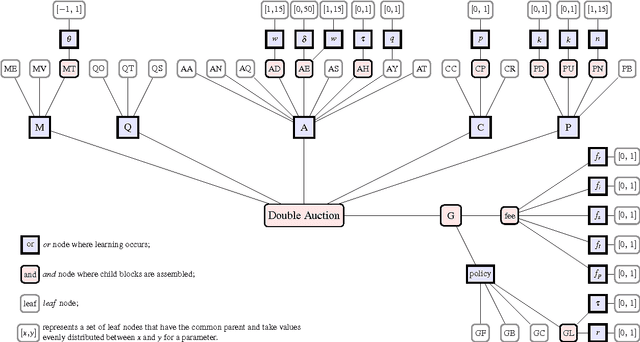
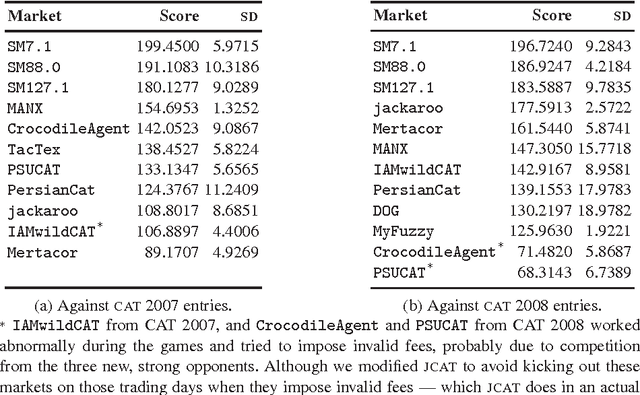
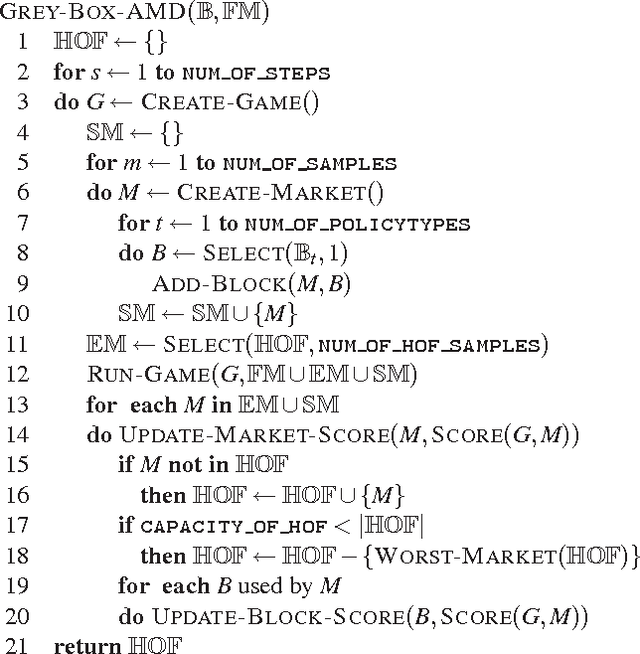
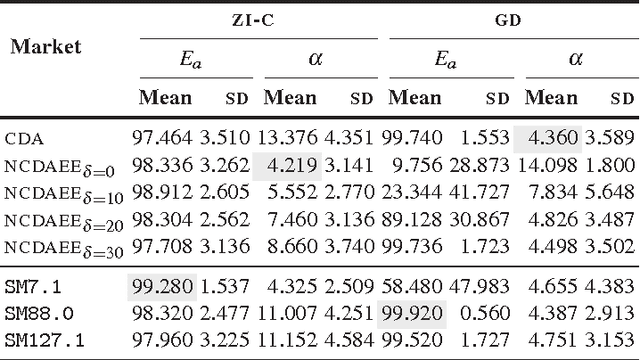
Auctions play an important role in electronic commerce, and have been used to solve problems in distributed computing. Automated approaches to designing effective auction mechanisms are helpful in reducing the burden of traditional game theoretic, analytic approaches and in searching through the large space of possible auction mechanisms. This paper presents an approach to automated mechanism design (AMD) in the domain of double auctions. We describe a novel parametrized space of double auctions, and then introduce an evolutionary search method that searches this space of parameters. The approach evaluates auction mechanisms using the framework of the TAC Market Design Game and relates the performance of the markets in that game to their constituent parts using reinforcement learning. Experiments show that the strongest mechanisms we found using this approach not only win the Market Design Game against known, strong opponents, but also exhibit desirable economic properties when they run in isolation.