 Add to Chrome
 Add to Firefox
 Add to Edge
Let's ViCE! Mimicking Human Cognitive Behavior in Image Generation Evaluation
Jul 19, 2023
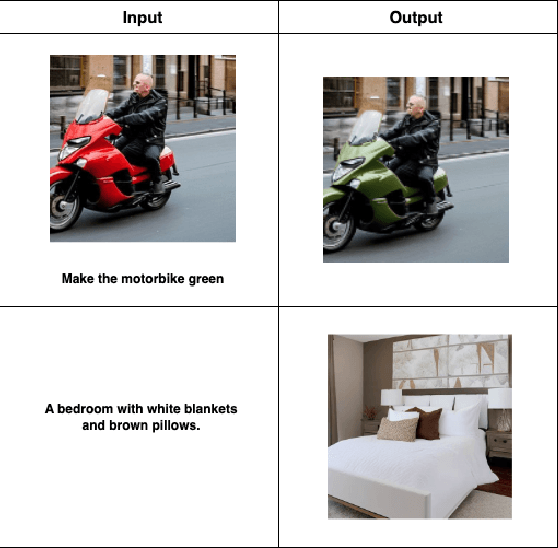
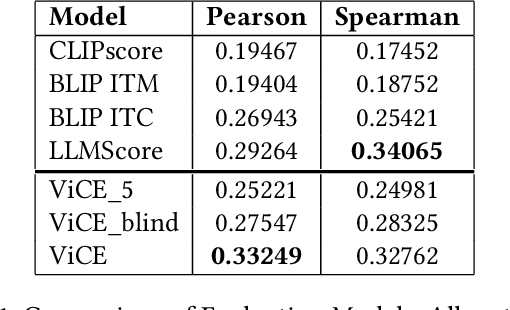
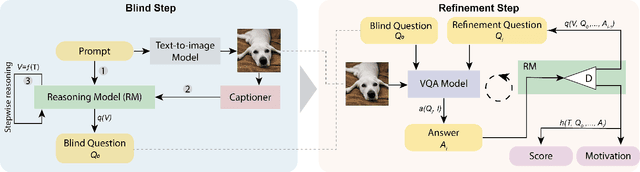
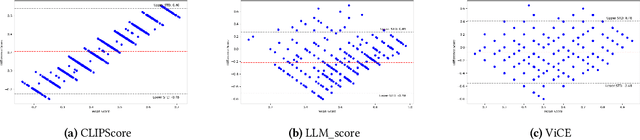
Research in Image Generation has recently made significant progress, particularly boosted by the introduction of Vision-Language models which are able to produce high-quality visual content based on textual inputs. Despite ongoing advancements in terms of generation quality and realism, no methodical frameworks have been defined yet to quantitatively measure the quality of the generated content and the adherence with the prompted requests: so far, only human-based evaluations have been adopted for quality satisfaction and for comparing different generative methods. We introduce a novel automated method for Visual Concept Evaluation (ViCE), i.e. to assess consistency between a generated/edited image and the corresponding prompt/instructions, with a process inspired by the human cognitive behaviour. ViCE combines the strengths of Large Language Models (LLMs) and Visual Question Answering (VQA) into a unified pipeline, aiming to replicate the human cognitive process in quality assessment. This method outlines visual concepts, formulates image-specific verification questions, utilizes the Q&A system to investigate the image, and scores the combined outcome. Although this brave new hypothesis of mimicking humans in the image evaluation process is in its preliminary assessment stage, results are promising and open the door to a new form of automatic evaluation which could have significant impact as the image generation or the image target editing tasks become more and more sophisticated.

Householder Projector for Unsupervised Latent Semantics Discovery
Jul 16, 2023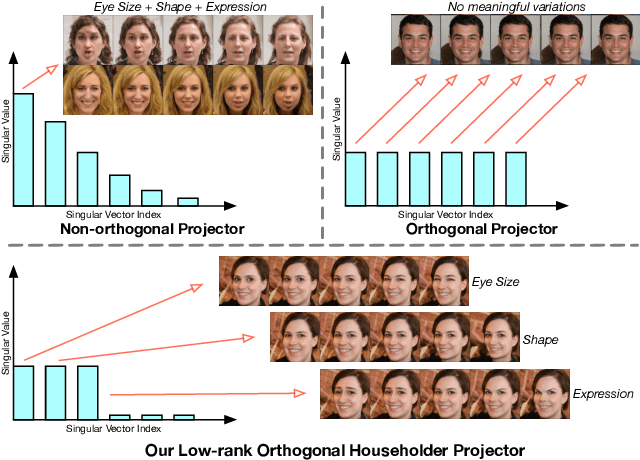

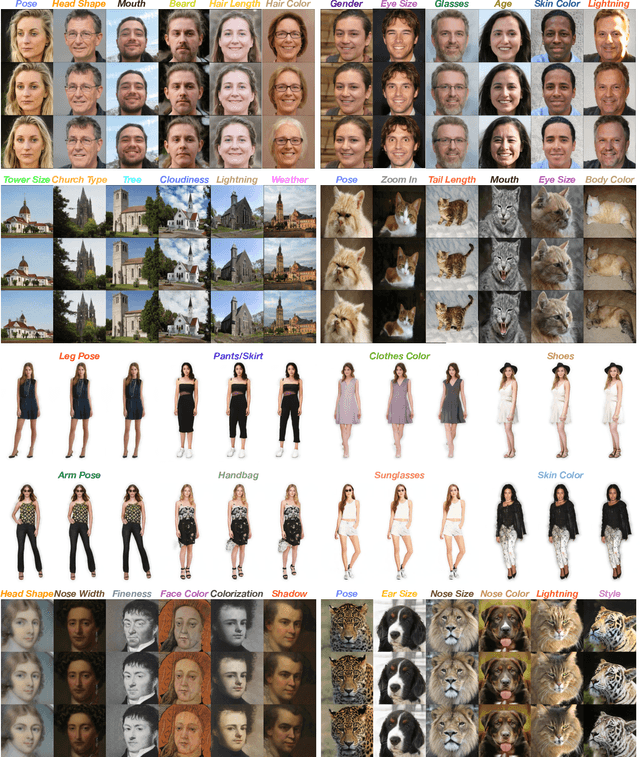
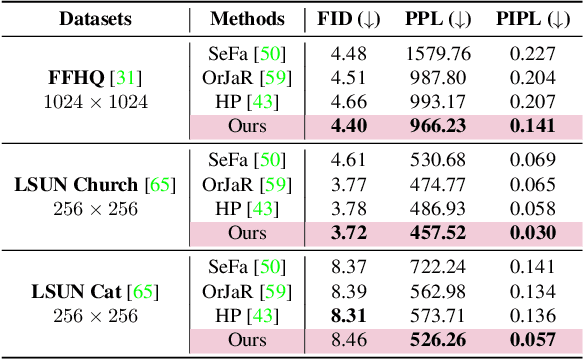
Generative Adversarial Networks (GANs), especially the recent style-based generators (StyleGANs), have versatile semantics in the structured latent space. Latent semantics discovery methods emerge to move around the latent code such that only one factor varies during the traversal. Recently, an unsupervised method proposed a promising direction to directly use the eigenvectors of the projection matrix that maps latent codes to features as the interpretable directions. However, one overlooked fact is that the projection matrix is non-orthogonal and the number of eigenvectors is too large. The non-orthogonality would entangle semantic attributes in the top few eigenvectors, and the large dimensionality might result in meaningless variations among the directions even if the matrix is orthogonal. To avoid these issues, we propose Householder Projector, a flexible and general low-rank orthogonal matrix representation based on Householder transformations, to parameterize the projection matrix. The orthogonality guarantees that the eigenvectors correspond to disentangled interpretable semantics, while the low-rank property encourages that each identified direction has meaningful variations. We integrate our projector into pre-trained StyleGAN2/StyleGAN3 and evaluate the models on several benchmarks. Within only $1\%$ of the original training steps for fine-tuning, our projector helps StyleGANs to discover more disentangled and precise semantic attributes without sacrificing image fidelity.
Point-PC: Point Cloud Completion Guided by Prior Knowledge via Causal Inference
May 28, 2023Point cloud completion aims to recover raw point clouds captured by scanners from partial observations caused by occlusion and limited view angles. Many approaches utilize a partial-complete paradigm in which missing parts are directly predicted by a global feature learned from partial inputs. This makes it hard to recover details because the global feature is unlikely to capture the full details of all missing parts. In this paper, we propose a novel approach to point cloud completion called Point-PC, which uses a memory network to retrieve shape priors and designs an effective causal inference model to choose missing shape information as additional geometric information to aid point cloud completion. Specifically, we propose a memory operating mechanism where the complete shape features and the corresponding shapes are stored in the form of ``key-value'' pairs. To retrieve similar shapes from the partial input, we also apply a contrastive learning-based pre-training scheme to transfer features of incomplete shapes into the domain of complete shape features. Moreover, we use backdoor adjustment to get rid of the confounder, which is a part of the shape prior that has the same semantic structure as the partial input. Experimental results on the ShapeNet-55, PCN, and KITTI datasets demonstrate that Point-PC performs favorably against the state-of-the-art methods.
T2TD: Text-3D Generation Model based on Prior Knowledge Guidance
May 25, 2023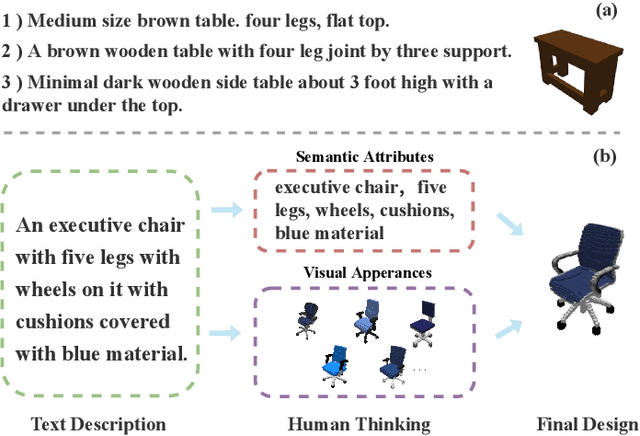
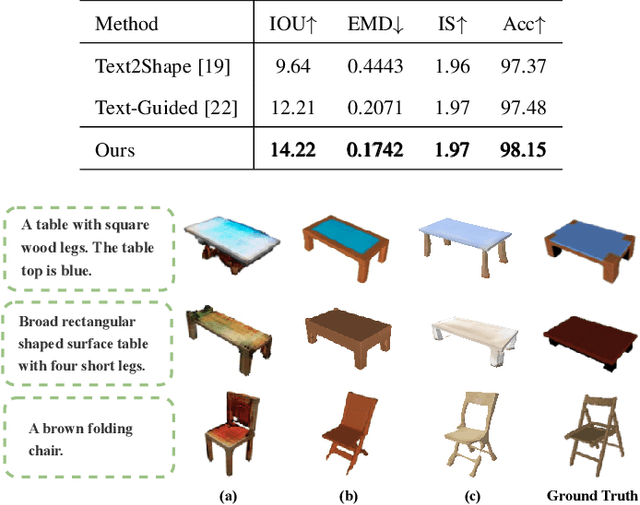
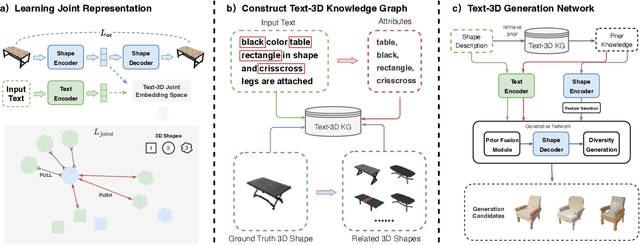
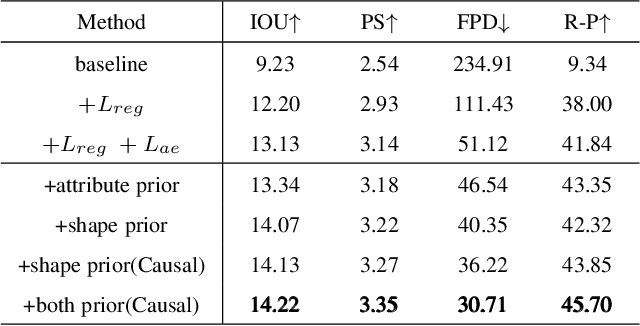
In recent years, 3D models have been utilized in many applications, such as auto-driver, 3D reconstruction, VR, and AR. However, the scarcity of 3D model data does not meet its practical demands. Thus, generating high-quality 3D models efficiently from textual descriptions is a promising but challenging way to solve this problem. In this paper, inspired by the ability of human beings to complement visual information details from ambiguous descriptions based on their own experience, we propose a novel text-3D generation model (T2TD), which introduces the related shapes or textual information as the prior knowledge to improve the performance of the 3D generation model. In this process, we first introduce the text-3D knowledge graph to save the relationship between 3D models and textual semantic information, which can provide the related shapes to guide the target 3D model generation. Second, we integrate an effective causal inference model to select useful feature information from these related shapes, which removes the unrelated shape information and only maintains feature information that is strongly relevant to the textual description. Meanwhile, to effectively integrate multi-modal prior knowledge into textual information, we adopt a novel multi-layer transformer structure to progressively fuse related shape and textual information, which can effectively compensate for the lack of structural information in the text and enhance the final performance of the 3D generation model. The final experimental results demonstrate that our approach significantly improves 3D model generation quality and outperforms the SOTA methods on the text2shape datasets.
Federated Generalized Category Discovery
May 23, 2023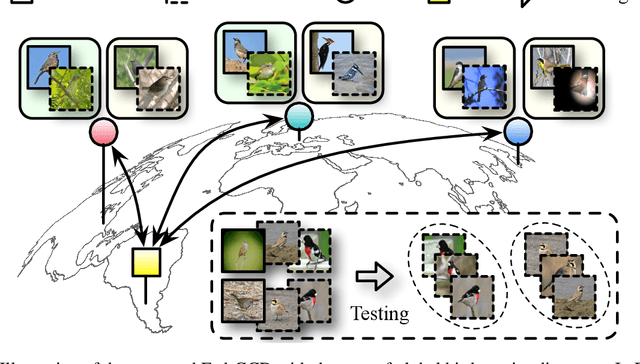

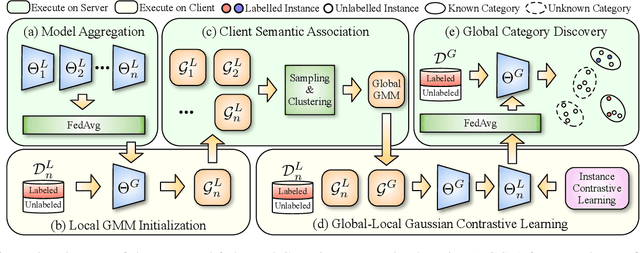
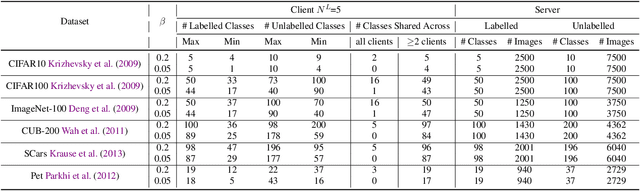
Generalized category discovery (GCD) aims at grouping unlabeled samples from known and unknown classes, given labeled data of known classes. To meet the recent decentralization trend in the community, we introduce a practical yet challenging task, namely Federated GCD (Fed-GCD), where the training data are distributively stored in local clients and cannot be shared among clients. The goal of Fed-GCD is to train a generic GCD model by client collaboration under the privacy-protected constraint. The Fed-GCD leads to two challenges: 1) representation degradation caused by training each client model with fewer data than centralized GCD learning, and 2) highly heterogeneous label spaces across different clients. To this end, we propose a novel Associated Gaussian Contrastive Learning (AGCL) framework based on learnable GMMs, which consists of a Client Semantics Association (CSA) and a global-local GMM Contrastive Learning (GCL). On the server, CSA aggregates the heterogeneous categories of local-client GMMs to generate a global GMM containing more comprehensive category knowledge. On each client, GCL builds class-level contrastive learning with both local and global GMMs. The local GCL learns robust representation with limited local data. The global GCL encourages the model to produce more discriminative representation with the comprehensive category relationships that may not exist in local data. We build a benchmark based on six visual datasets to facilitate the study of Fed-GCD. Extensive experiments show that our AGCL outperforms the FedAvg-based baseline on all datasets.
Riemannian Multiclass Logistics Regression for SPD Neural Networks
May 18, 2023Deep neural networks for learning symmetric positive definite (SPD) matrices are gaining increasing attention in machine learning. Despite the significant progress, most existing SPD networks use traditional Euclidean classifiers on approximated spaces rather than intrinsic classifiers that accurately capture the geometry of SPD manifolds. Inspired by the success of hyperbolic neural networks (HNNs), we propose Riemannian multiclass logistics regression (RMLR) for SPD networks. We introduce a general unified framework for a family of Riemannian metrics on SPD manifolds and showcase the specific $\orth{n}$-invariant Log-Euclidean Metrics for SPD networks. Moreover, we encompass the most popular classifier in existing SPD networks as a special case of our framework. Extensive experiments on popular SPD learning benchmarks demonstrate the superiority of our classifiers.
Latent Traversals in Generative Models as Potential Flows
Apr 25, 2023Despite the significant recent progress in deep generative models, the underlying structure of their latent spaces is still poorly understood, thereby making the task of performing semantically meaningful latent traversals an open research challenge. Most prior work has aimed to solve this challenge by modeling latent structures linearly, and finding corresponding linear directions which result in `disentangled' generations. In this work, we instead propose to model latent structures with a learned dynamic potential landscape, thereby performing latent traversals as the flow of samples down the landscape's gradient. Inspired by physics, optimal transport, and neuroscience, these potential landscapes are learned as physically realistic partial differential equations, thereby allowing them to flexibly vary over both space and time. To achieve disentanglement, multiple potentials are learned simultaneously, and are constrained by a classifier to be distinct and semantically self-consistent. Experimentally, we demonstrate that our method achieves both more qualitatively and quantitatively disentangled trajectories than state-of-the-art baselines. Further, we demonstrate that our method can be integrated as a regularization term during training, thereby acting as an inductive bias towards the learning of structured representations, ultimately improving model likelihood on similarly structured data.
PAIR-Diffusion: Object-Level Image Editing with Structure-and-Appearance Paired Diffusion Models
Mar 30, 2023Image editing using diffusion models has witnessed extremely fast-paced growth recently. There are various ways in which previous works enable controlling and editing images. Some works use high-level conditioning such as text, while others use low-level conditioning. Nevertheless, most of them lack fine-grained control over the properties of the different objects present in the image, i.e. object-level image editing. In this work, we consider an image as a composition of multiple objects, each defined by various properties. Out of these properties, we identify structure and appearance as the most intuitive to understand and useful for editing purposes. We propose Structure-and-Appearance Paired Diffusion model (PAIR-Diffusion), which is trained using structure and appearance information explicitly extracted from the images. The proposed model enables users to inject a reference image's appearance into the input image at both the object and global levels. Additionally, PAIR-Diffusion allows editing the structure while maintaining the style of individual components of the image unchanged. We extensively evaluate our method on LSUN datasets and the CelebA-HQ face dataset, and we demonstrate fine-grained control over both structure and appearance at the object level. We also applied the method to Stable Diffusion to edit any real image at the object level.
Dynamic Conceptional Contrastive Learning for Generalized Category Discovery
Mar 30, 2023

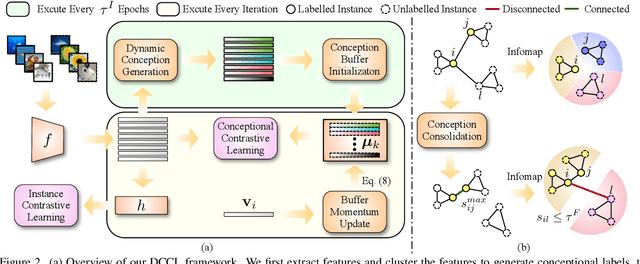
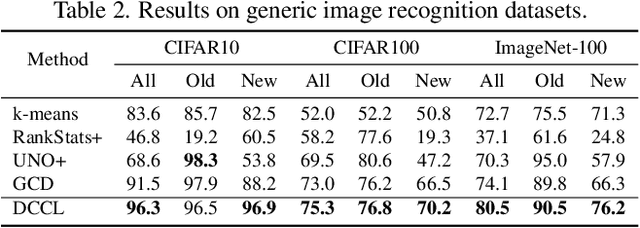
Generalized category discovery (GCD) is a recently proposed open-world problem, which aims to automatically cluster partially labeled data. The main challenge is that the unlabeled data contain instances that are not only from known categories of the labeled data but also from novel categories. This leads traditional novel category discovery (NCD) methods to be incapacitated for GCD, due to their assumption of unlabeled data are only from novel categories. One effective way for GCD is applying self-supervised learning to learn discriminate representation for unlabeled data. However, this manner largely ignores underlying relationships between instances of the same concepts (e.g., class, super-class, and sub-class), which results in inferior representation learning. In this paper, we propose a Dynamic Conceptional Contrastive Learning (DCCL) framework, which can effectively improve clustering accuracy by alternately estimating underlying visual conceptions and learning conceptional representation. In addition, we design a dynamic conception generation and update mechanism, which is able to ensure consistent conception learning and thus further facilitate the optimization of DCCL. Extensive experiments show that DCCL achieves new state-of-the-art performances on six generic and fine-grained visual recognition datasets, especially on fine-grained ones. For example, our method significantly surpasses the best competitor by 16.2% on the new classes for the CUB-200 dataset. Code is available at https://github.com/TPCD/DCCL.
Large-scale Pre-trained Models are Surprisingly Strong in Incremental Novel Class Discovery
Mar 29, 2023Discovering novel concepts from unlabelled data and in a continuous manner is an important desideratum of lifelong learners. In the literature such problems have been partially addressed under very restricted settings, where either access to labelled data is provided for discovering novel concepts (e.g., NCD) or learning occurs for a limited number of incremental steps (e.g., class-iNCD). In this work we challenge the status quo and propose a more challenging and practical learning paradigm called MSc-iNCD, where learning occurs continuously and unsupervisedly, while exploiting the rich priors from large-scale pre-trained models. To this end, we propose simple baselines that are not only resilient under longer learning scenarios, but are surprisingly strong when compared with sophisticated state-of-the-art methods. We conduct extensive empirical evaluation on a multitude of benchmarks and show the effectiveness of our proposed baselines, which significantly raises the bar.