 Add to Chrome
 Add to Firefox
 Add to Edge
Hybrid Beamforming in Non-Terrestrial Networks: Architectures, Design Challenges, and Opportunities
Aug 09, 2026
Hybrid analog-digital beamforming (HBF) has emerged as a key enabling technology for non-terrestrial networks (NTNs), where large antenna arrays are required to compensate for severe propagation loss but fully digital beamforming is often impractical due to radio-frequency (RF) chain cost, power consumption, and payload limitations. Compared with terrestrial networks, NTN platforms such as low Earth orbit (LEO) satellites and unmanned aerial vehicles (UAVs) impose distinctive HBF design challenges, including high mobility, Doppler effects, sparse line-of-sight-dominant channels, stringent on-board energy budgets, and, for UAVs, the additional coupling between beamforming and controllable platform placement or trajectory. This survey provides a systematic review of HBF techniques for NTN systems, with emphasis on LEO satellite and UAV communications. We first introduce common HBF architectures, signal models, channel representations, analog and digital precoder designs, and learning-aided approaches that form the shared technical foundation of existing works. We then survey both platforms under a common set of five categories, which cover system architecture and precoding design, time-varying beam management, network-level cooperation and scheduling, sensing capability and reconfigurable surfaces, and security and multiple access. Their platform-specific content differs most sharply in the second one, since the dominant time-varying mechanism is traffic-driven beam hopping on an LEO payload but mobility-aware beam tracking on a UAV. Finally, we discuss open research challenges and future directions toward scalable, robust, and hardware-efficient HBF in next-generation NTNs.

Artificial Intelligence for Spatially Reconfigurable Antennas: Movable, Fluid, and Pinching Antenna Systems
Jul 31, 2026Recently, sixth-generation (6G) wireless networks have moved beyond fixed-array designs toward antenna architectures that can adapt their spatial configuration to specific environmental conditions. Movable antenna, fluid antenna, and pinching antenna systems represent this principle in different ways, but they share a common vision: exploiting spatial flexibility as an additional degree of freedom (DoF) to improve communication, sensing, security, and resource efficiency. These new techniques, however, also bring challenging problems, as antenna configuration must be jointly considered with channel acquisition, beamforming, mobility, and network resource management. Therefore, artificial intelligence (AI) has become an important tool for learning fast and adaptive control policies for these highly coupled systems. In this survey, we provide a unified review of AI for spatially reconfigurable antenna systems. We first introduce the basic principles of movable, fluid, and pinching antennas, which is followed by a summary of the latest AI-enabled designs according to their primary optimization objectives. Furthermore, we compare the roles of deep learning (DL), deep reinforcement learning (DRL), multi-agent reinforcement learning (MARL), graph learning, Transformers, large language models (LLMs), and structure-guided learning across different antenna architectures. Finally, we discuss open challenges and future directions toward scalable, robust, and hardware-aware intelligent reconfigurable antenna networks.
Seeing Through WiFi: Lightweight Human Pose Estimation with Dynamic Kernel Attention
Jul 03, 2026WiFi-based human pose estimation (HPE) enables the detection and interpretation of human body positions and movements without the need for wearable devices while preserving individual privacy concerns. Implementing this solution requires enhancing model performance and maintaining efficiency, especially on resource-constrained devices. This paper introduces a novel framework, WiLHPE, for lightweight and efficient human pose estimation using WiFi CSI signals. Empowered by a camera-based model during training, WiLHPE processes raw WiFi signals directly to estimate human poses in the testing phase. It employs a novel neural network architecture to dynamically learn convolutional kernels and apply attention mechanisms across channel and frequency spaces. This innovative method diversifies the kernels to improve the recognition capabilities of WiFi signals without adding complexity, ensuring efficiency. Additionally, the Tree-Structured Parzen Estimator algorithm is employed to optimize the critical hyperparameters of the neural network efficiently, minimizing the time required for optimal hyperparameter search compared to heuristic methods. Results from experiments on both the MM-Fi and WiPose datasets highlight the superiority of WiLHPE over state-of-the-art approaches, achieving 85.96% and 94.27% at PCK50, respectively, with minimal computational overhead. Notably, WiLHPE performs impressively even under challenging conditions, maintaining around 80% at PCK50 under AWGN noise with an error variance of 0.5.
From Denoising to Decision Making: A Survey on Diffusion Model-Enabled Deep Reinforcement Learning for Wireless Networks
May 25, 2026Deep reinforcement learning (DRL) has long been a promising solution for sequential resource management in wireless networks. However, conventional DRL methods are fundamentally limited by their reliance on unimodal policy distributions, inefficient exploration in high-dimensional action spaces, and poor adaptability to dynamic and heterogeneous environments. Meanwhile, diffusion models (DMs) as one of the most powerful families of generative AI have demonstrted remarkable capabilities in modeling complex, multi-modal data distributions across diverse domains. The integration of DMs and DRL has opened a new and rapidly growing research direction, in which DM-enabled policies substantially enhance decision quality by capturing the complex, discontinuous, and multimodal action structures inherent in wireless resource management. In this paper, we present a comprehensive survey of DM-enabled DRL algorithms and their applications for various issues in wireless networks. Particularly, we first provide the theoretical background of DM and present different DM-enabled DRL algorithms. We then systematically review applications of DM-enabled DRL for across computation offloading in mobile edge computing, UAV-assisted, vehicular, and AIGC-driven systems, as well as wireless resource allocation, physical-layer security, and robotics and UAV planning. We conclude the paper by higlight future research directions.
Network-Aided Intelligent Traffic Steering in 6G ORAN: A Multi-Layer Optimization Framework
Feb 06, 2023To enable an intelligent, programmable and multi-vendor radio access network (RAN) for 6G networks, considerable efforts have been made in standardization and development of open RAN (ORAN). So far, however, the applicability of ORAN in controlling and optimizing RAN functions has not been widely investigated. In this paper, we jointly optimize the flow-split distribution, congestion control and scheduling (JFCS) to enable an intelligent traffic steering application in ORAN. Combining tools from network utility maximization and stochastic optimization, we introduce a multi-layer optimization framework that provides fast convergence, long-term utility-optimality and significant delay reduction compared to the state-of-the-art and baseline RAN approaches. Our main contributions are three-fold: i) we propose the novel JFCS framework to efficiently and adaptively direct traffic to appropriate radio units; ii) we develop low-complexity algorithms based on the reinforcement learning, inner approximation and bisection search methods to effectively solve the JFCS problem in different time scales; and iii) the rigorous theoretical performance results are analyzed to show that there exists a scaling factor to improve the tradeoff between delay and utility-optimization. Collectively, the insights in this work will open the door towards fully automated networks with enhanced control and flexibility. Numerical results are provided to demonstrate the effectiveness of the proposed algorithms in terms of the convergence rate, long-term utility-optimality and delay reduction.
Edge Computing for Semantic Communication Enabled Metaverse: An Incentive Mechanism Design
Dec 13, 2022Semantic communication (SemCom) and edge computing are two disruptive solutions to address emerging requirements of huge data communication, bandwidth efficiency and low latency data processing in Metaverse. However, edge computing resources are often provided by computing service providers and thus it is essential to design appealingly incentive mechanisms for the provision of limited resources. Deep learning (DL)- based auction has recently proposed as an incentive mechanism that maximizes the revenue while holding important economic properties, i.e., individual rationality and incentive compatibility. Therefore, in this work, we introduce the design of the DLbased auction for the computing resource allocation in SemComenabled Metaverse. First, we briefly introduce the fundamentals and challenges of Metaverse. Second, we present the preliminaries of SemCom and edge computing. Third, we review various incentive mechanisms for edge computing resource trading. Fourth, we present the design of the DL-based auction for edge resource allocation in SemCom-enabled Metaverse. Simulation results demonstrate that the DL-based auction improves the revenue while nearly satisfying the individual rationality and incentive compatibility constraints.
Deep Learning-Based Signal Detection for Dual-Mode Index Modulation 3D-OFDM
Sep 20, 2022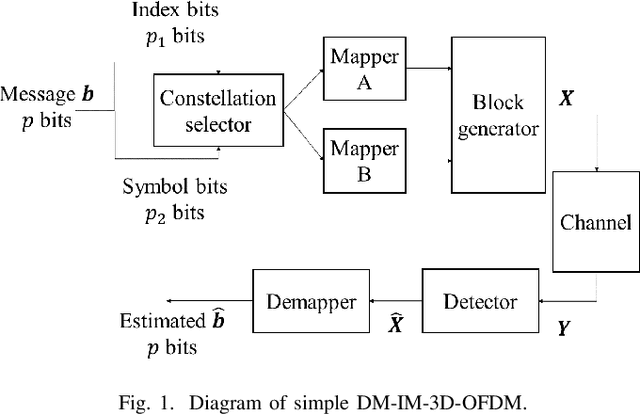
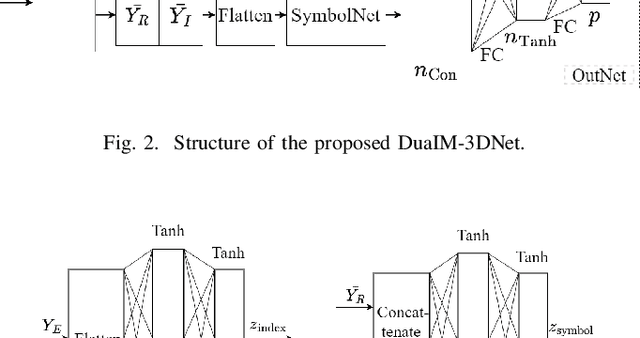
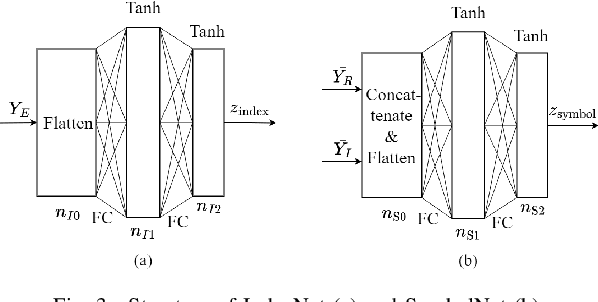
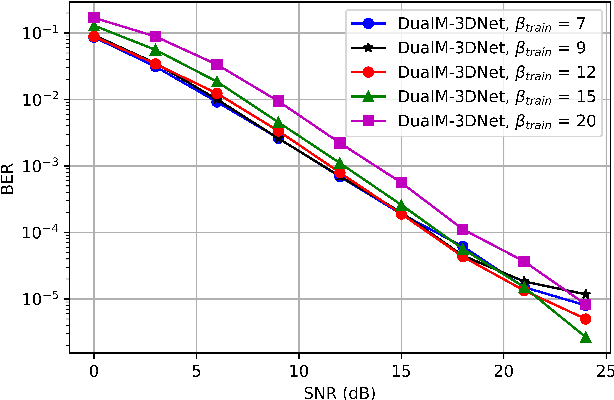
In this paper, we propose a deep learning-based signal detector called DuaIM-3DNet for dual-mode index modulation-based three-dimensional (3D) orthogonal frequency division multiplexing (DM-IM-3D-OFDM). Herein, DM-IM-3D- OFDM is a subcarrier index modulation scheme which conveys data bits via both dual-mode 3D constellation symbols and indices of active subcarriers. Thus, this scheme obtains better error performance than the existing IM schemes when using the conventional maximum likelihood (ML) detector, which, however, suffers from high computational complexity, especially when the system parameters increase. In order to address this fundamental issue, we propose the usage of a deep neural network (DNN) at the receiver to jointly and reliably detect both symbols and index bits of DM-IM-3D-OFDM under Rayleigh fading channels in a data-driven manner. Simulation results demonstrate that our proposed DNN detector achieves near-optimal performance at significantly lower runtime complexity compared to the ML detector.
Generalized BER of MCIK-OFDM with Imperfect CSI: Selection combining GD versus ML receivers
Jul 29, 2022


This paper analyzes the bit error rate (BER) of multicarrier index keying - orthogonal frequency division multiplexing (MCIK-OFDM) with selection combining (SC) diversity reception. Particularly, we propose a generalized framework to derive the BER for both the low-complexity greedy detector (GD) and maximum likelihood (ML) detector. Based on this, closedform expressions for the BERs of MCIK-OFDM with the SC using either the ML or the GD are derived in presence of the channel state information (CSI) imperfection. The asymptotic analysis is presented to gain helpful insights into effects of different CSI conditions on the BERs of these two detectors. More importantly, we theoretically provide opportunities for using the GD instead of the ML under each specific CSI uncertainty, which depend on the number of receiver antennas and the M-ary modulation size. Finally, extensive simulation results are provided in order to validate our theoretical expressions and analysis.
Enhancing Diversity of OFDM with Joint Spread Spectrum and Subcarrier Index Modulations
Jul 29, 2022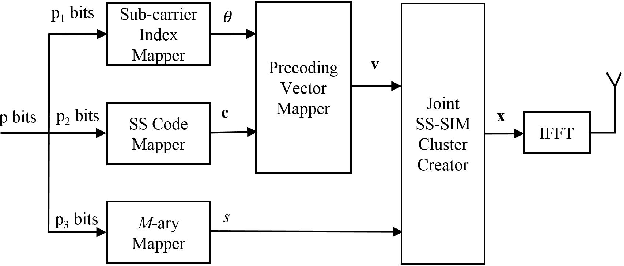

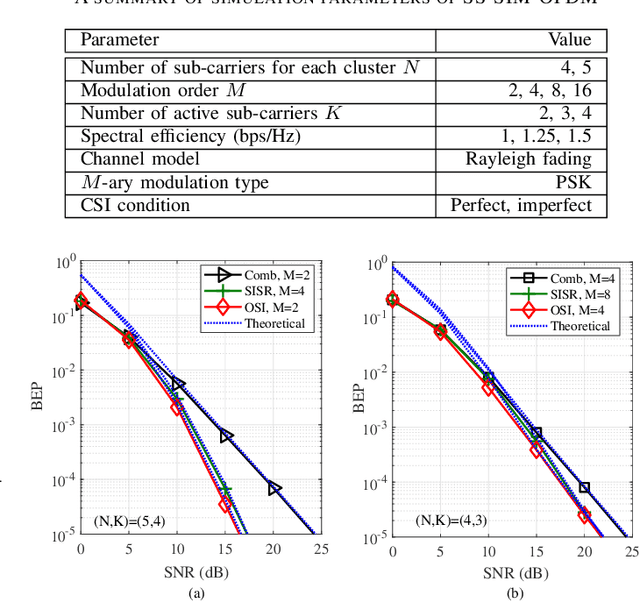
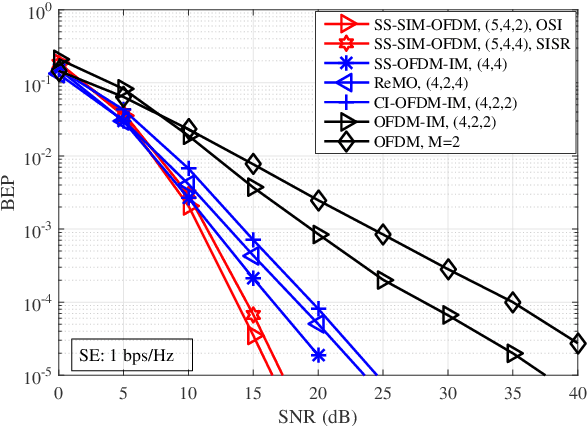
This paper proposes a novel spread spectrum and sub-carrier index modulation (SS-SIM) scheme, which is integrated to orthogonal frequency division multiplexing (OFDM) framework to enhance the diversity over the conventional IM schemes. Particularly, the resulting scheme, called SS-SIMOFDM, jointly employs both spread spectrum and sub-carrier index modulations to form a precoding vector which is then used to spread an M-ary complex symbol across all active sub-carriers. As a result, the proposed scheme enables a novel transmission of three signal domains: SS and sub-carrier indices, and a single M-ary symbol. For practical implementations, two reduced-complexity near-optimal detectors are proposed, which have complexities less depending on the M-ary modulation size. Then, the bit error probability and its upper bound are analyzed to gain an insight into the diversity gain, which is shown to be strongly affected by the order of sub-carrier indices. Based on this observation, we propose two novel sub-carrier index mapping methods, which significantly increase the diversity gain of SSSIM-OFDM. Finally, simulation results show that our scheme achieves better error performance than the benchmarks at the cost of lower spectral efficiency compared to classical OFDM and OFDM-IM, which can carry multiple M-ary symbols.
Incentive Mechanisms for Federated Learning: From Economic and Game Theoretic Perspective
Nov 20, 2021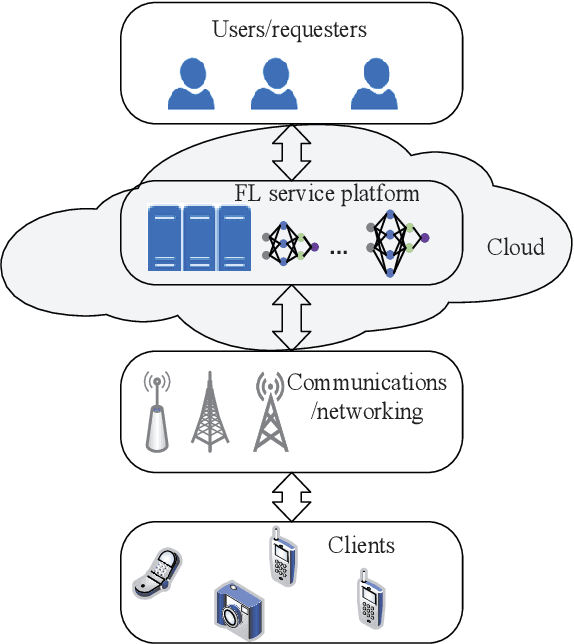
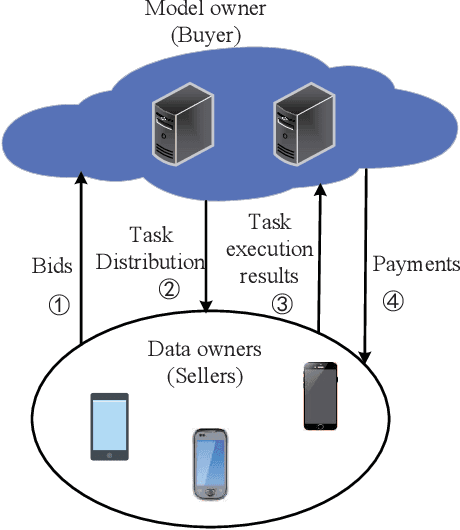
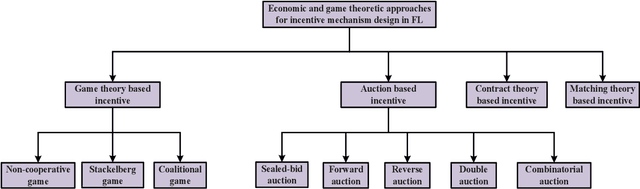
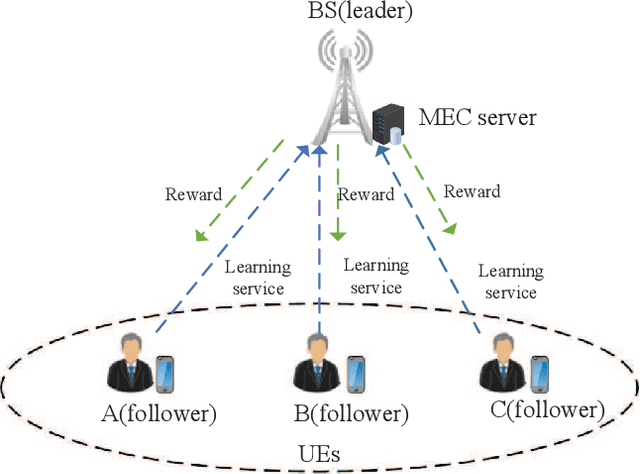
Federated learning (FL) becomes popular and has shown great potentials in training large-scale machine learning (ML) models without exposing the owners' raw data. In FL, the data owners can train ML models based on their local data and only send the model updates rather than raw data to the model owner for aggregation. To improve learning performance in terms of model accuracy and training completion time, it is essential to recruit sufficient participants. Meanwhile, the data owners are rational and may be unwilling to participate in the collaborative learning process due to the resource consumption. To address the issues, there have been various works recently proposed to motivate the data owners to contribute their resources. In this paper, we provide a comprehensive review for the economic and game theoretic approaches proposed in the literature to design various schemes for stimulating data owners to participate in FL training process. In particular, we first present the fundamentals and background of FL, economic theories commonly used in incentive mechanism design. Then, we review applications of game theory and economic approaches applied for incentive mechanisms design of FL. Finally, we highlight some open issues and future research directions concerning incentive mechanism design of FL.