 Add to Chrome
 Add to Firefox
 Add to Edge
SwinAD: Multi-stage feature reconstruction for unsupervised industrial anomaly detection
Jul 16, 2026
Industrial anomaly detection aims to identify and localize defective regions without relying on exhaustive annotations of all possible defect types. Although recent unsupervised methods have achieved strong performance, most are primarily designed for single-class settings and often struggle in multi-class scenarios, where diverse normal patterns may lead to over-generalization and reduce the discriminative capability between normal and anomalous regions. In this paper, we propose SwinAD, a reconstruction-based framework for multi-class unsupervised anomaly detection that leverages a frozen pretrained Swin Transformer V2 encoder and a feature diversity-preserving reconstruction decoder. The hierarchical encoder provides semantically rich multi-scale features, while stage-wise bottleneck modules with dropout prevent trivial identity mapping and encourage robust reconstruction of normal patterns. To further improve localization, we introduce a feature diversity-preserving reconstruction framework that maintains complementary reconstruction hypotheses instead of relying on a single decoding branch. The discrepancies between encoder features and the two reconstructed features are then aggregated across multiple scales to produce the final anomaly map. Experiments conducted on three industrial anomaly detection benchmarks, including MVTec AD, VisA, and Real-IAD, demonstrate that SwinAD achieves competitive image-level performance and strong pixel-level localization accuracy, with particularly notable improvements in pixel-level AP and 1 on MVTec AD. These results indicate that combining hierarchical Swin features with diverse multi-scale reconstruction substantially improve pixel-level localization in multi-class unsupervised anomaly setting.

After-Fatigue Condition: A Novel Analysis Based on Surface EMG Signals
Sep 09, 2023


This study introduces a novel muscle activation analysis based on surface electromyography (sEMG) signals to assess the muscle's after-fatigue condition. Previous studies have mainly focused on the before-fatigue and fatigue conditions. However, a comprehensive analysis of the after-fatigue condition has been overlooked. The proposed method analyzes muscle fatigue indicators at various maximal voluntary contraction (MVC) levels to compare the before-fatigue, fatigue, and after-fatigue conditions using amplitude-based, spectral-based, and muscle fiber conduction velocity (CV) parameters. In addition, the contraction time of each MVC level is also analyzed with the same indicators. The results show that in the after-fatigue condition, the muscle activation changes significantly in the ways such as higher CV, power spectral density shifting to the right, and longer contraction time until exhaustion compared to the before-fatigue and fatigue conditions. The results can provide a comprehensive and objective evaluation of muscle fatigue and recovery, which can be helpful in clinical diagnosis, rehabilitation, and sports performance.
Enhancing Diversity of OFDM with Joint Spread Spectrum and Subcarrier Index Modulations
Jul 29, 2022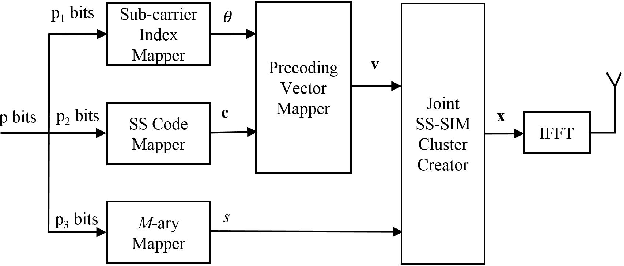

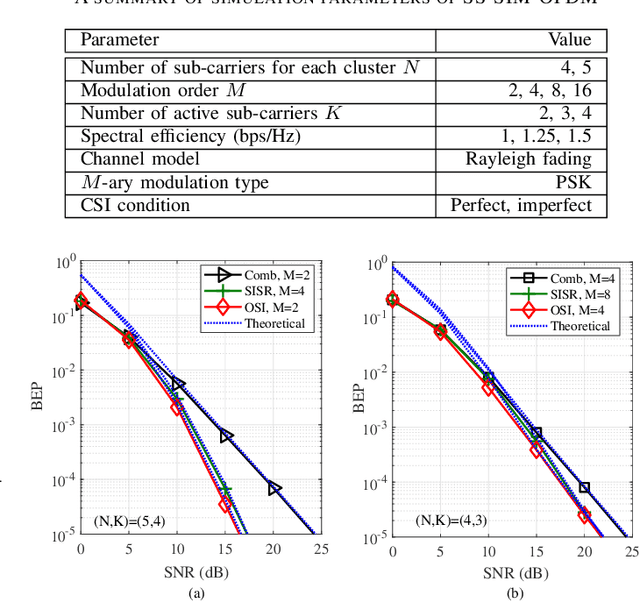
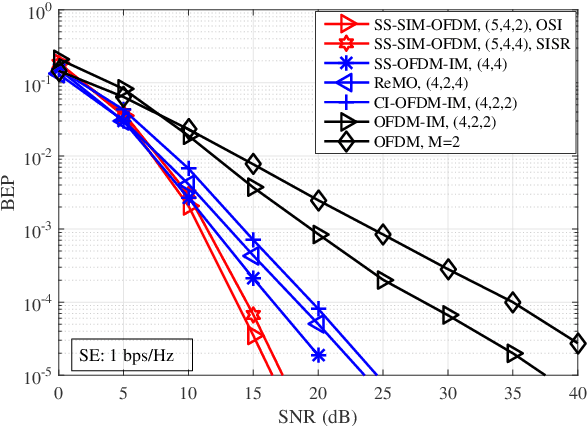
This paper proposes a novel spread spectrum and sub-carrier index modulation (SS-SIM) scheme, which is integrated to orthogonal frequency division multiplexing (OFDM) framework to enhance the diversity over the conventional IM schemes. Particularly, the resulting scheme, called SS-SIMOFDM, jointly employs both spread spectrum and sub-carrier index modulations to form a precoding vector which is then used to spread an M-ary complex symbol across all active sub-carriers. As a result, the proposed scheme enables a novel transmission of three signal domains: SS and sub-carrier indices, and a single M-ary symbol. For practical implementations, two reduced-complexity near-optimal detectors are proposed, which have complexities less depending on the M-ary modulation size. Then, the bit error probability and its upper bound are analyzed to gain an insight into the diversity gain, which is shown to be strongly affected by the order of sub-carrier indices. Based on this observation, we propose two novel sub-carrier index mapping methods, which significantly increase the diversity gain of SSSIM-OFDM. Finally, simulation results show that our scheme achieves better error performance than the benchmarks at the cost of lower spectral efficiency compared to classical OFDM and OFDM-IM, which can carry multiple M-ary symbols.