 Add to Chrome
 Add to Firefox
 Add to Edge
AfrIFact: Cultural Information Retrieval, Evidence Extraction and Fact Checking for African Languages
Apr 01, 2026
Assessing the veracity of a claim made online is a complex and important task with real-world implications. When these claims are directed at communities with limited access to information and the content concerns issues such as healthcare and culture, the consequences intensify, especially in low-resource languages. In this work, we introduce AfrIFact, a dataset that covers the necessary steps for automatic fact-checking (i.e., information retrieval, evidence extraction, and fact checking), in ten African languages and English. Our evaluation results show that even the best embedding models lack cross-lingual retrieval capabilities, and that cultural and news documents are easier to retrieve than healthcare-domain documents, both in large corpora and in single documents. We show that LLMs lack robust multilingual fact-verification capabilities in African languages, while few-shot prompting improves performance by up to 43% in AfriqueQwen-14B, and task-specific fine-tuning further improves fact-checking accuracy by up to 26%. These findings, along with our release of the AfrIFact dataset, encourage work on low-resource information retrieval, evidence retrieval, and fact checking.

AFRIDOC-MT: Document-level MT Corpus for African Languages
Jan 10, 2025

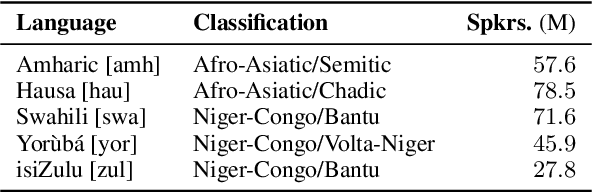

This paper introduces AFRIDOC-MT, a document-level multi-parallel translation dataset covering English and five African languages: Amharic, Hausa, Swahili, Yor\`ub\'a, and Zulu. The dataset comprises 334 health and 271 information technology news documents, all human-translated from English to these languages. We conduct document-level translation benchmark experiments by evaluating neural machine translation (NMT) models and large language models (LLMs) for translations between English and these languages, at both the sentence and pseudo-document levels. These outputs are realigned to form complete documents for evaluation. Our results indicate that NLLB-200 achieved the best average performance among the standard NMT models, while GPT-4o outperformed general-purpose LLMs. Fine-tuning selected models led to substantial performance gains, but models trained on sentences struggled to generalize effectively to longer documents. Furthermore, our analysis reveals that some LLMs exhibit issues such as under-generation, repetition of words or phrases, and off-target translations, especially for African languages.
Correcting FLORES Evaluation Dataset for Four African Languages
Sep 01, 2024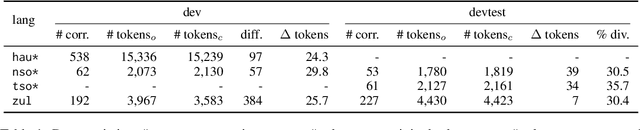
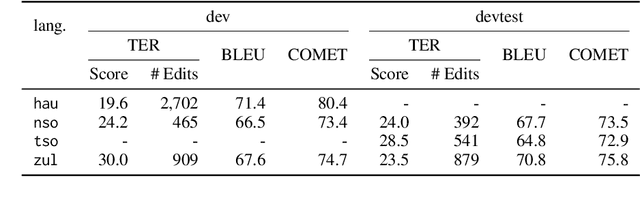
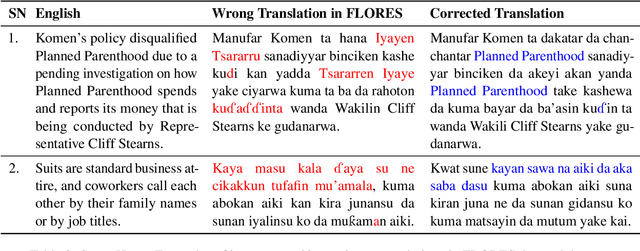
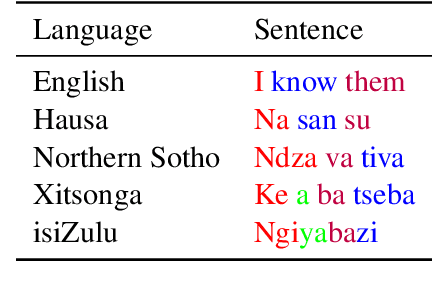
This paper describes the corrections made to the FLORES evaluation (dev and devtest) dataset for four African languages, namely Hausa, Northern Sotho (Sepedi), Xitsonga and isiZulu. The original dataset, though groundbreaking in its coverage of low-resource languages, exhibited various inconsistencies and inaccuracies in the reviewed languages that could potentially hinder the integrity of the evaluation of downstream tasks in natural language processing (NLP), especially machine translation. Through a meticulous review process by native speakers, several corrections were identified and implemented, improving the dataset's overall quality and reliability. For each language, we provide a concise summary of the errors encountered and corrected, and also present some statistical analysis that measure the difference between the existing and corrected datasets. We believe that our corrections enhance the linguistic accuracy and reliability of the data and, thereby, contributing to more effective evaluation of NLP tasks involving the four African languages.
AfriQA: Cross-lingual Open-Retrieval Question Answering for African Languages
May 11, 2023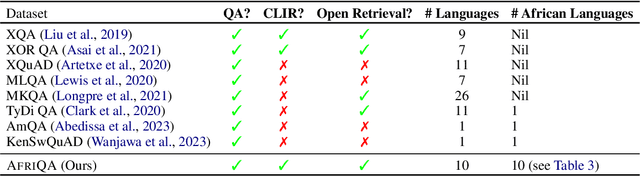
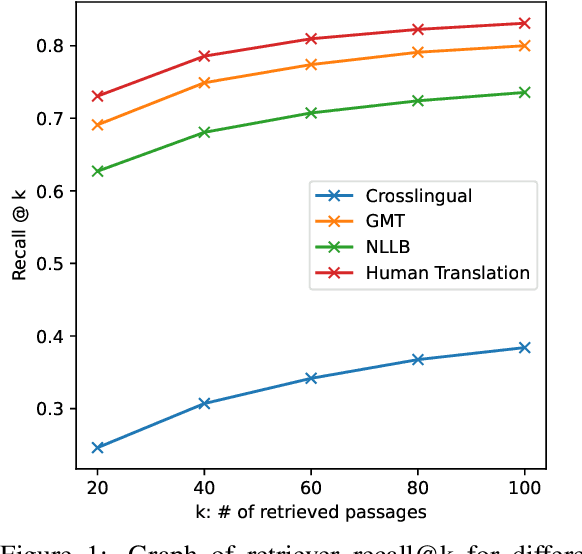
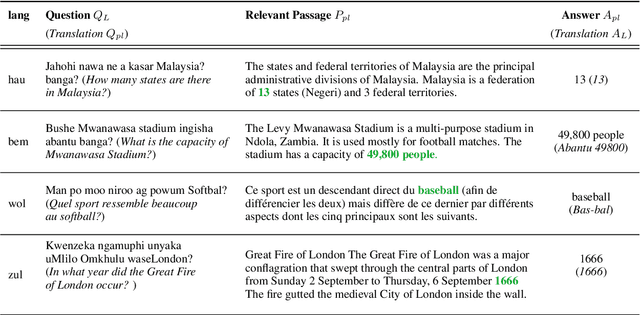
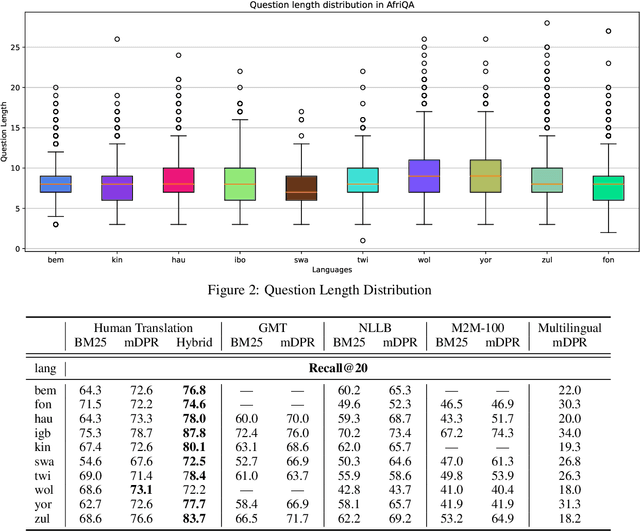
African languages have far less in-language content available digitally, making it challenging for question answering systems to satisfy the information needs of users. Cross-lingual open-retrieval question answering (XOR QA) systems -- those that retrieve answer content from other languages while serving people in their native language -- offer a means of filling this gap. To this end, we create AfriQA, the first cross-lingual QA dataset with a focus on African languages. AfriQA includes 12,000+ XOR QA examples across 10 African languages. While previous datasets have focused primarily on languages where cross-lingual QA augments coverage from the target language, AfriQA focuses on languages where cross-lingual answer content is the only high-coverage source of answer content. Because of this, we argue that African languages are one of the most important and realistic use cases for XOR QA. Our experiments demonstrate the poor performance of automatic translation and multilingual retrieval methods. Overall, AfriQA proves challenging for state-of-the-art QA models. We hope that the dataset enables the development of more equitable QA technology.