 Add to Chrome
 Add to Firefox
 Add to Edge
Hydra++: Real-Time Hierarchical 3D Scene Graph Construction With Object-Level Shape Estimation
Jul 10, 2026
3D scene graphs provide a hierarchical abstraction of environments by encoding spatial entities, such as objects and places, and their relationships. However, existing scene graph systems model object geometry coarsely, relying on partial point clouds or class-level CAD templates, which limits instance-specific shape detail. This paper presents Hydra++, a system-level investigation into how learning-based object shape estimators can be integrated into a hierarchical 3D scene graph pipeline. Hydra++ incorporates category-agnostic shape estimation and a reprojection-mask consistency check to reject degenerate predictions from partial observations or imprecise segmentation. In its default CRISP-based configuration, Hydra++ performs online scene graph construction; slower estimators such as SAM3D are evaluated as modular alternatives to demonstrate generalization-latency trade-offs. Furthermore, to address the challenges of sparse and noisy depth measurements in outdoor environments, Hydra++ supports a hybrid LiDAR-camera configuration for large-scale operation, improving scene-level reconstruction quality. Experiments in both simulation and real-world outdoor campus scenarios demonstrate that Hydra++ improves object- and scene-level reconstruction quality. Project page is available at https://hydra-plusplus.github.io/.

What Types of Human-AI Teams Exist?
Jul 02, 2026Human-AI teaming has received increasing attention in the literature. However, the range of studies conducted in multiple domains make it difficult to understand what types of teams are being studied, and in what ways are they similar/different from one another. In this study, we analyse 53 papers on human-AI teams and categorise them into five main clusters based on psychological taxonomies of teaming; AI Assistant, Ad-hoc Dependency, Ad-hoc Forced Dependency, Paired Equanimity, and Group Equanimity. Each cluster represents a unique combination of holistic team-level characteristics, indicating there are multiple disparate team types studied under the same definition. In turn, this raises the question of whether insights are truly transferable between papers. We conclude with guidance on how to identify the types of human-AI teams studied, a checklist for reporting a human-AI team in research work, and ways in which the field can be further synthesised.
3D Scene Graphs: Open Challenges and Future Directions
Jun 15, 20263D Scene Graphs (3DSGs) have emerged as a powerful representation for spatial AI by combining geometric grounding with semantic and relational abstractions of the environment. Their expressiveness has made them relevant to a broad range of problems in robotics and computer vision, including manipulation, navigation, task planning, scene understanding, and many others. However, the field remains fragmented: different communities adopt distinct formulations, construction pipelines, and evaluation protocols, making it difficult to compare methods, identify common assumptions, and assess remaining challenges for robust real-world deployment. This survey provides a unified and critical review of 3DSGs, with particular emphasis on open challenges and future directions. We first formalize 3DSGs under a common definition and analyze the principal modeling choices that characterize existing formulations, including node and edge attributes, hierarchical structure, dynamic scene representations, and affordance-aware extensions. We then review how 3DSGs are built from raw sensory observations, discussing the most common terminologies, conventions, and techniques. Finally, we examine downstream applications and evaluation strategies, from intrinsic graph quality to task-level performance. To support the community, we also provide a dedicated website that organizes and extends the surveyed content, accessible at https://3dscenegraphs.com/.
Language-Grounded Hierarchical Planning and Execution with Multi-Robot 3D Scene Graphs
Jun 09, 2025In this paper, we introduce a multi-robot system that integrates mapping, localization, and task and motion planning (TAMP) enabled by 3D scene graphs to execute complex instructions expressed in natural language. Our system builds a shared 3D scene graph incorporating an open-set object-based map, which is leveraged for multi-robot 3D scene graph fusion. This representation supports real-time, view-invariant relocalization (via the object-based map) and planning (via the 3D scene graph), allowing a team of robots to reason about their surroundings and execute complex tasks. Additionally, we introduce a planning approach that translates operator intent into Planning Domain Definition Language (PDDL) goals using a Large Language Model (LLM) by leveraging context from the shared 3D scene graph and robot capabilities. We provide an experimental assessment of the performance of our system on real-world tasks in large-scale, outdoor environments.
Clio: Real-time Task-Driven Open-Set 3D Scene Graphs
Apr 29, 2024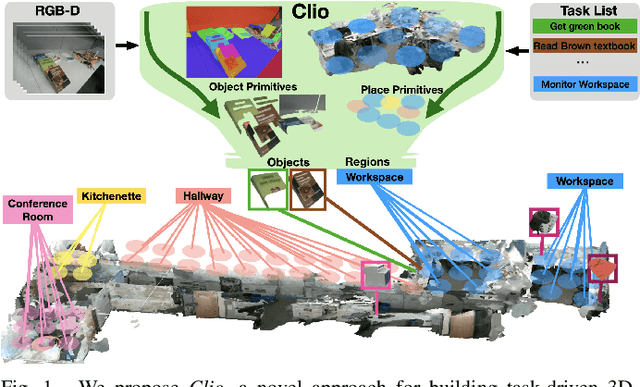
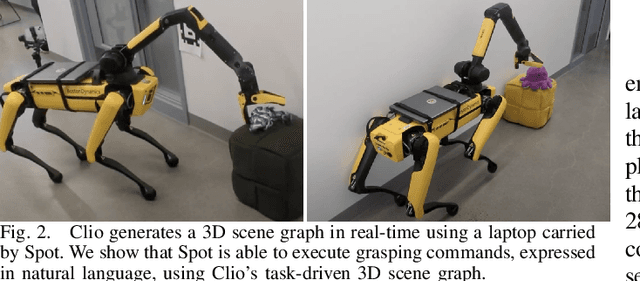
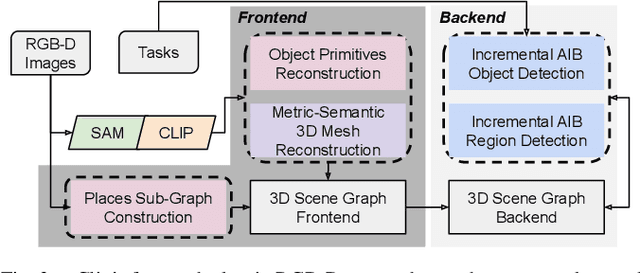
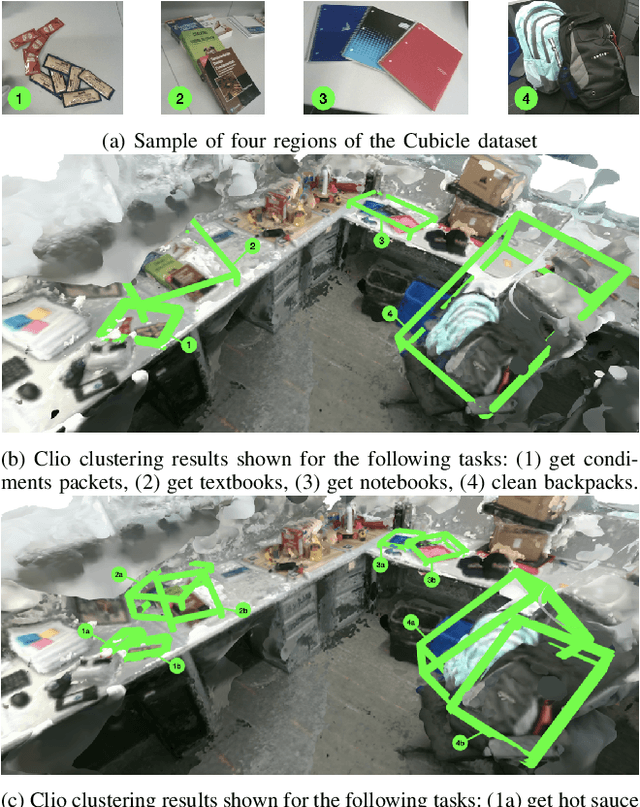
Modern tools for class-agnostic image segmentation (e.g., SegmentAnything) and open-set semantic understanding (e.g., CLIP) provide unprecedented opportunities for robot perception and mapping. While traditional closed-set metric-semantic maps were restricted to tens or hundreds of semantic classes, we can now build maps with a plethora of objects and countless semantic variations. This leaves us with a fundamental question: what is the right granularity for the objects (and, more generally, for the semantic concepts) the robot has to include in its map representation? While related work implicitly chooses a level of granularity by tuning thresholds for object detection, we argue that such a choice is intrinsically task-dependent. The first contribution of this paper is to propose a task-driven 3D scene understanding problem, where the robot is given a list of tasks in natural language and has to select the granularity and the subset of objects and scene structure to retain in its map that is sufficient to complete the tasks. We show that this problem can be naturally formulated using the Information Bottleneck (IB), an established information-theoretic framework. The second contribution is an algorithm for task-driven 3D scene understanding based on an Agglomerative IB approach, that is able to cluster 3D primitives in the environment into task-relevant objects and regions and executes incrementally. The third contribution is to integrate our task-driven clustering algorithm into a real-time pipeline, named Clio, that constructs a hierarchical 3D scene graph of the environment online using only onboard compute, as the robot explores it. Our final contribution is an extensive experimental campaign showing that Clio not only allows real-time construction of compact open-set 3D scene graphs, but also improves the accuracy of task execution by limiting the map to relevant semantic concepts.
Kimera2: Robust and Accurate Metric-Semantic SLAM in the Real World
Jan 12, 2024We present improvements to Kimera, an open-source metric-semantic visual-inertial SLAM library. In particular, we enhance Kimera-VIO, the visual-inertial odometry pipeline powering Kimera, to support better feature tracking, more efficient keyframe selection, and various input modalities (eg monocular, stereo, and RGB-D images, as well as wheel odometry). Additionally, Kimera-RPGO and Kimera-PGMO, Kimera's pose-graph optimization backends, are updated to support modern outlier rejection methods - specifically, Graduated-Non-Convexity - for improved robustness to spurious loop closures. These new features are evaluated extensively on a variety of simulated and real robotic platforms, including drones, quadrupeds, wheeled robots, and simulated self-driving cars. We present comparisons against several state-of-the-art visual-inertial SLAM pipelines and discuss strengths and weaknesses of the new release of Kimera. The newly added features have been released open-source at https://github.com/MIT-SPARK/Kimera.
Indoor and Outdoor 3D Scene Graph Generation via Language-Enabled Spatial Ontologies
Dec 18, 2023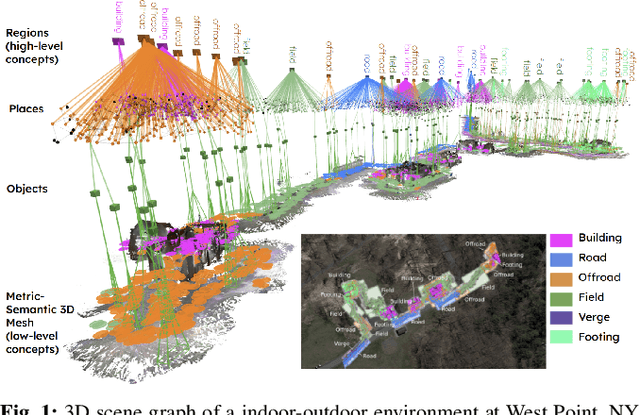
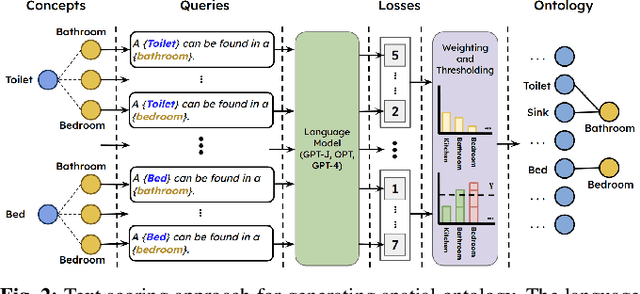
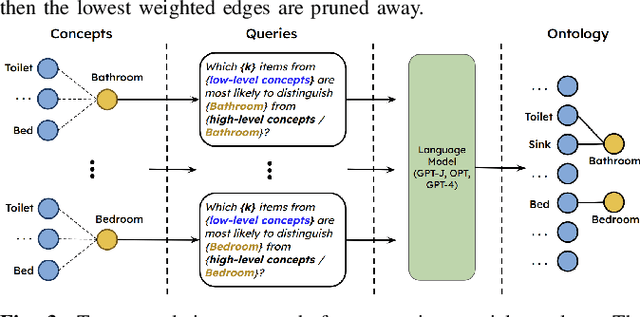
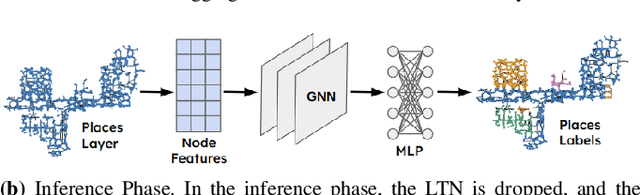
This paper proposes an approach to build 3D scene graphs in arbitrary (indoor and outdoor) environments. Such extension is challenging; the hierarchy of concepts that describe an outdoor environment is more complex than for indoors, and manually defining such hierarchy is time-consuming and does not scale. Furthermore, the lack of training data prevents the straightforward application of learning-based tools used in indoor settings. To address these challenges, we propose two novel extensions. First, we develop methods to build a spatial ontology defining concepts and relations relevant for indoor and outdoor robot operation. In particular, we use a Large Language Model (LLM) to build such an ontology, thus largely reducing the amount of manual effort required. Second, we leverage the spatial ontology for 3D scene graph construction using Logic Tensor Networks (LTN) to add logical rules, or axioms (e.g., "a beach contains sand"), which provide additional supervisory signals at training time thus reducing the need for labelled data, providing better predictions, and even allowing predicting concepts unseen at training time. We test our approach in a variety of datasets, including indoor, rural, and coastal environments, and show that it leads to a significant increase in the quality of the 3D scene graph generation with sparsely annotated data.
Foundations of Spatial Perception for Robotics: Hierarchical Representations and Real-time Systems
May 11, 20233D spatial perception is the problem of building and maintaining an actionable and persistent representation of the environment in real-time using sensor data and prior knowledge. Despite the fast-paced progress in robot perception, most existing methods either build purely geometric maps (as in traditional SLAM) or flat metric-semantic maps that do not scale to large environments or large dictionaries of semantic labels. The first part of this paper is concerned with representations: we show that scalable representations for spatial perception need to be hierarchical in nature. Hierarchical representations are efficient to store, and lead to layered graphs with small treewidth, which enable provably efficient inference. We then introduce an example of hierarchical representation for indoor environments, namely a 3D scene graph, and discuss its structure and properties. The second part of the paper focuses on algorithms to incrementally construct a 3D scene graph as the robot explores the environment. Our algorithms combine 3D geometry, topology (to cluster the places into rooms), and geometric deep learning (e.g., to classify the type of rooms the robot is moving across). The third part of the paper focuses on algorithms to maintain and correct 3D scene graphs during long-term operation. We propose hierarchical descriptors for loop closure detection and describe how to correct a scene graph in response to loop closures, by solving a 3D scene graph optimization problem. We conclude the paper by combining the proposed perception algorithms into Hydra, a real-time spatial perception system that builds a 3D scene graph from visual-inertial data in real-time. We showcase Hydra's performance in photo-realistic simulations and real data collected by a Clearpath Jackal robots and a Unitree A1 robot. We release an open-source implementation of Hydra at https://github.com/MIT-SPARK/Hydra.
Hydra-Multi: Collaborative Online Construction of 3D Scene Graphs with Multi-Robot Teams
Apr 26, 20233D scene graphs have recently emerged as an expressive high-level map representation that describes a 3D environment as a layered graph where nodes represent spatial concepts at multiple levels of abstraction (e.g., objects, rooms, buildings) and edges represent relations between concepts (e.g., inclusion, adjacency). This paper describes Hydra-Multi, the first multi-robot spatial perception system capable of constructing a multi-robot 3D scene graph online from sensor data collected by robots in a team. In particular, we develop a centralized system capable of constructing a joint 3D scene graph by taking incremental inputs from multiple robots, effectively finding the relative transforms between the robots' frames, and incorporating loop closure detections to correctly reconcile the scene graph nodes from different robots. We evaluate Hydra-Multi on simulated and real scenarios and show it is able to reconstruct accurate 3D scene graphs online. We also demonstrate Hydra-Multi's capability of supporting heterogeneous teams by fusing different map representations built by robots with different sensor suites.
Hydra: A Real-time Spatial Perception Engine for 3D Scene Graph Construction and Optimization
Jan 31, 2022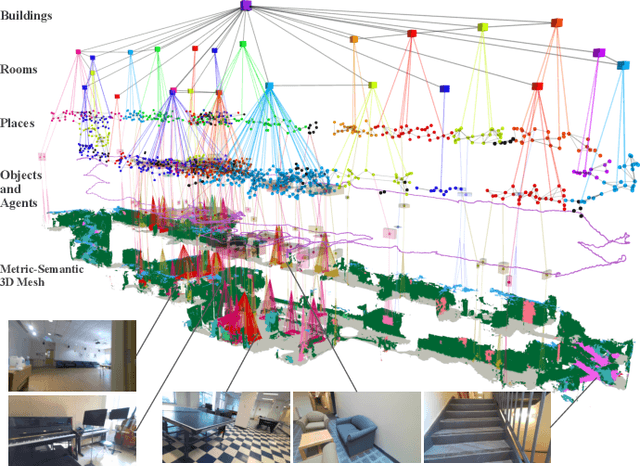
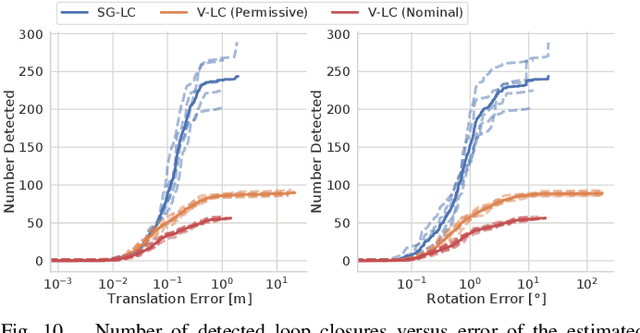
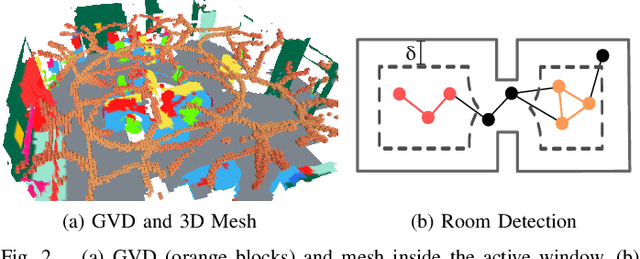
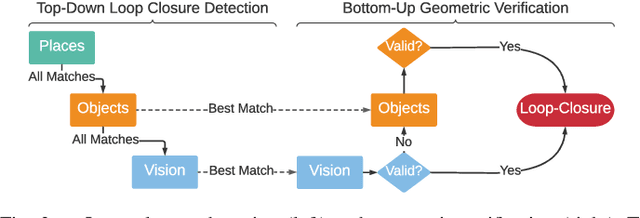
3D scene graphs have recently emerged as a powerful high-level representation of 3D environments. A 3D scene graph describes the environment as a layered graph where nodes represent spatial concepts at multiple levels of abstraction and edges represent relations between concepts. While 3D scene graphs can serve as an advanced "mental model" for robots, how to build such a rich representation in real-time is still uncharted territory. This paper describes the first real-time Spatial Perception engINe (SPIN), a suite of algorithms to build a 3D scene graph from sensor data in real-time. Our first contribution is to develop real-time algorithms to incrementally construct the layers of a scene graph as the robot explores the environment; these algorithms build a local Euclidean Signed Distance Function (ESDF) around the current robot location, extract a topological map of places from the ESDF, and then segment the places into rooms using an approach inspired by community-detection techniques. Our second contribution is to investigate loop closure detection and optimization in 3D scene graphs. We show that 3D scene graphs allow defining hierarchical descriptors for loop closure detection; our descriptors capture statistics across layers in the scene graph, ranging from low-level visual appearance, to summary statistics about objects and places. We then propose the first algorithm to optimize a 3D scene graph in response to loop closures; our approach relies on embedded deformation graphs to simultaneously correct all layers of the scene graph. We implement the proposed SPIN into a highly parallelized architecture, named Hydra, that combines fast early and mid-level perception processes with slower high-level perception. We evaluate Hydra on simulated and real data and show it is able to reconstruct 3D scene graphs with an accuracy comparable with batch offline methods, while running online.