 Add to Chrome
 Add to Firefox
 Add to Edge
The Synergy Between Optimal Transport Theory and Multi-Agent Reinforcement Learning
Jan 24, 2024
This paper explores the integration of optimal transport (OT) theory with multi-agent reinforcement learning (MARL). This integration uses OT to handle distributions and transportation problems to enhance the efficiency, coordination, and adaptability of MARL. There are five key areas where OT can impact MARL: (1) policy alignment, where OT's Wasserstein metric is used to align divergent agent strategies towards unified goals; (2) distributed resource management, employing OT to optimize resource allocation among agents; (3) addressing non-stationarity, using OT to adapt to dynamic environmental shifts; (4) scalable multi-agent learning, harnessing OT for decomposing large-scale learning objectives into manageable tasks; and (5) enhancing energy efficiency, applying OT principles to develop sustainable MARL systems. This paper articulates how the synergy between OT and MARL can address scalability issues, optimize resource distribution, align agent policies in cooperative environments, and ensure adaptability in dynamically changing conditions.

Multi-Agent Dynamic Relational Reasoning for Social Robot Navigation
Jan 22, 2024Social robot navigation can be helpful in various contexts of daily life but requires safe human-robot interactions and efficient trajectory planning. While modeling pairwise relations has been widely studied in multi-agent interacting systems, the ability to capture larger-scale group-wise activities is limited. In this paper, we propose a systematic relational reasoning approach with explicit inference of the underlying dynamically evolving relational structures, and we demonstrate its effectiveness for multi-agent trajectory prediction and social robot navigation. In addition to the edges between pairs of nodes (i.e., agents), we propose to infer hyperedges that adaptively connect multiple nodes to enable group-wise reasoning in an unsupervised manner. Our approach infers dynamically evolving relation graphs and hypergraphs to capture the evolution of relations, which the trajectory predictor employs to generate future states. Meanwhile, we propose to regularize the sharpness and sparsity of the learned relations and the smoothness of the relation evolution, which proves to enhance training stability and model performance. The proposed approach is validated on synthetic crowd simulations and real-world benchmark datasets. Experiments demonstrate that the approach infers reasonable relations and achieves state-of-the-art prediction performance. In addition, we present a deep reinforcement learning (DRL) framework for social robot navigation, which incorporates relational reasoning and trajectory prediction systematically. In a group-based crowd simulation, our method outperforms the strongest baseline by a significant margin in terms of safety, efficiency, and social compliance in dense, interactive scenarios.
Graph Q-Learning for Combinatorial Optimization
Jan 11, 2024Graph-structured data is ubiquitous throughout natural and social sciences, and Graph Neural Networks (GNNs) have recently been shown to be effective at solving prediction and inference problems on graph data. In this paper, we propose and demonstrate that GNNs can be applied to solve Combinatorial Optimization (CO) problems. CO concerns optimizing a function over a discrete solution space that is often intractably large. To learn to solve CO problems, we formulate the optimization process as a sequential decision making problem, where the return is related to how close the candidate solution is to optimality. We use a GNN to learn a policy to iteratively build increasingly promising candidate solutions. We present preliminary evidence that GNNs trained through Q-Learning can solve CO problems with performance approaching state-of-the-art heuristic-based solvers, using only a fraction of the parameters and training time.
Disentangled Neural Relational Inference for Interpretable Motion Prediction
Jan 07, 2024Effective interaction modeling and behavior prediction of dynamic agents play a significant role in interactive motion planning for autonomous robots. Although existing methods have improved prediction accuracy, few research efforts have been devoted to enhancing prediction model interpretability and out-of-distribution (OOD) generalizability. This work addresses these two challenging aspects by designing a variational auto-encoder framework that integrates graph-based representations and time-sequence models to efficiently capture spatio-temporal relations between interactive agents and predict their dynamics. Our model infers dynamic interaction graphs in a latent space augmented with interpretable edge features that characterize the interactions. Moreover, we aim to enhance model interpretability and performance in OOD scenarios by disentangling the latent space of edge features, thereby strengthening model versatility and robustness. We validate our approach through extensive experiments on both simulated and real-world datasets. The results show superior performance compared to existing methods in modeling spatio-temporal relations, motion prediction, and identifying time-invariant latent features.
Interactive Autonomous Navigation with Internal State Inference and Interactivity Estimation
Nov 27, 2023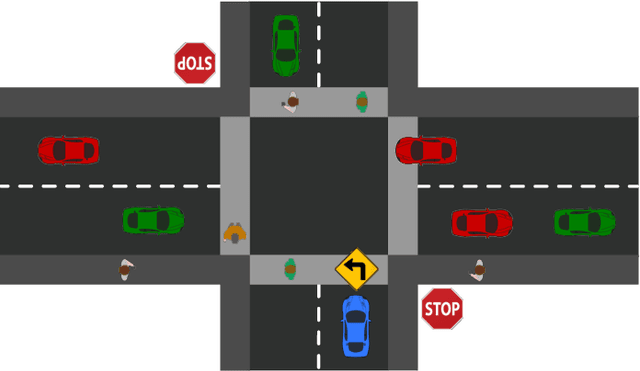
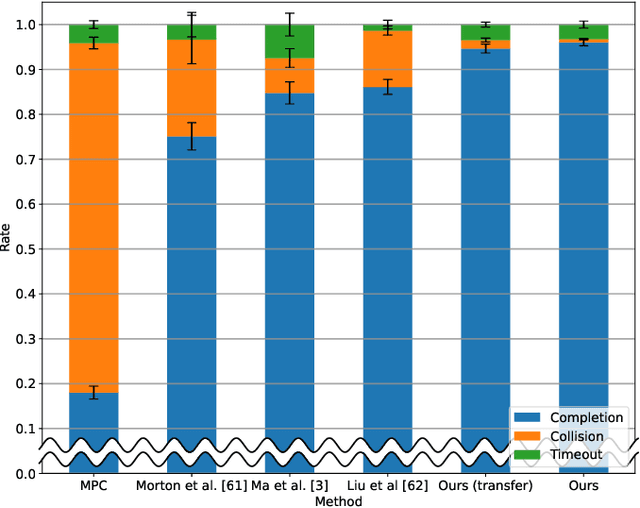
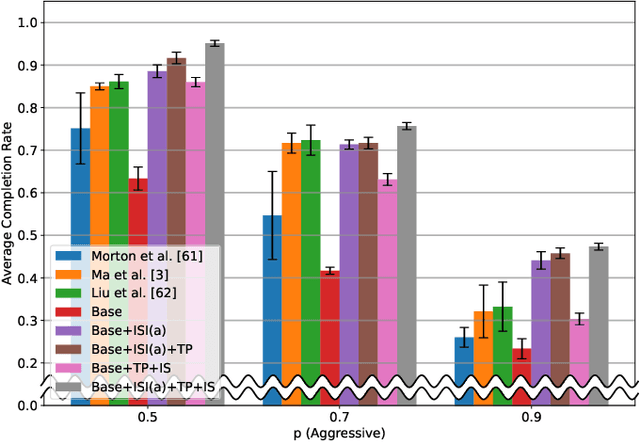
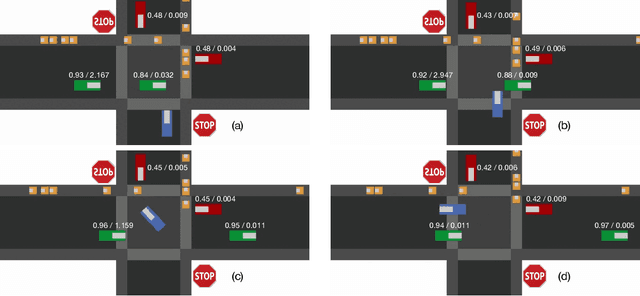
Deep reinforcement learning (DRL) provides a promising way for intelligent agents (e.g., autonomous vehicles) to learn to navigate complex scenarios. However, DRL with neural networks as function approximators is typically considered a black box with little explainability and often suffers from suboptimal performance, especially for autonomous navigation in highly interactive multi-agent environments. To address these issues, we propose three auxiliary tasks with spatio-temporal relational reasoning and integrate them into the standard DRL framework, which improves the decision making performance and provides explainable intermediate indicators. We propose to explicitly infer the internal states (i.e., traits and intentions) of surrounding agents (e.g., human drivers) as well as to predict their future trajectories in the situations with and without the ego agent through counterfactual reasoning. These auxiliary tasks provide additional supervision signals to infer the behavior patterns of other interactive agents. Multiple variants of framework integration strategies are compared. We also employ a spatio-temporal graph neural network to encode relations between dynamic entities, which enhances both internal state inference and decision making of the ego agent. Moreover, we propose an interactivity estimation mechanism based on the difference between predicted trajectories in these two situations, which indicates the degree of influence of the ego agent on other agents. To validate the proposed method, we design an intersection driving simulator based on the Intelligent Intersection Driver Model (IIDM) that simulates vehicles and pedestrians. Our approach achieves robust and state-of-the-art performance in terms of standard evaluation metrics and provides explainable intermediate indicators (i.e., internal states, and interactivity scores) for decision making.
Large-Scale Multi-Robot Assembly Planning for Autonomous Manufacturing
Oct 31, 2023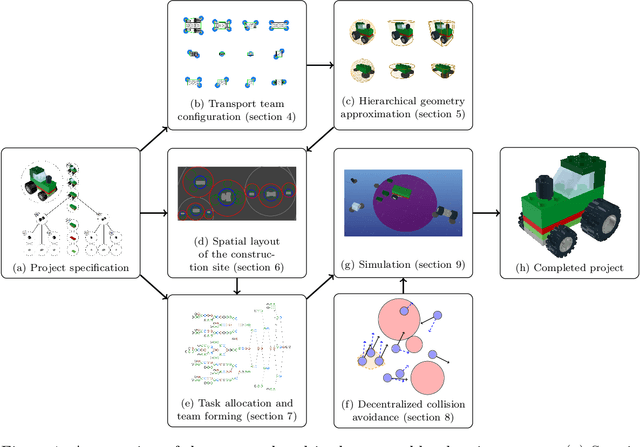
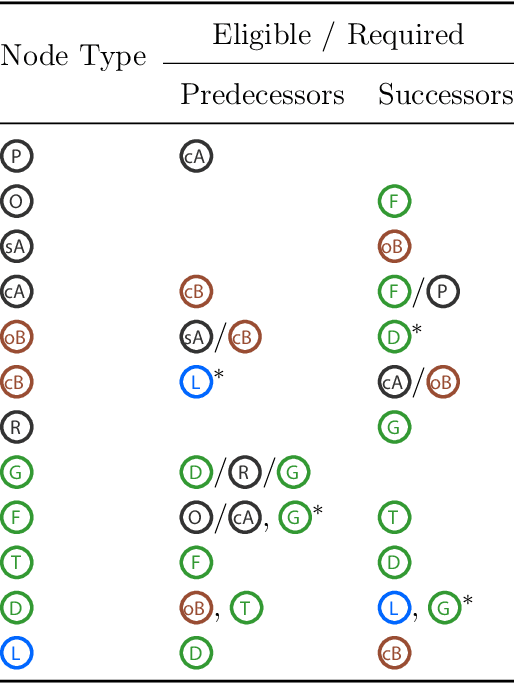
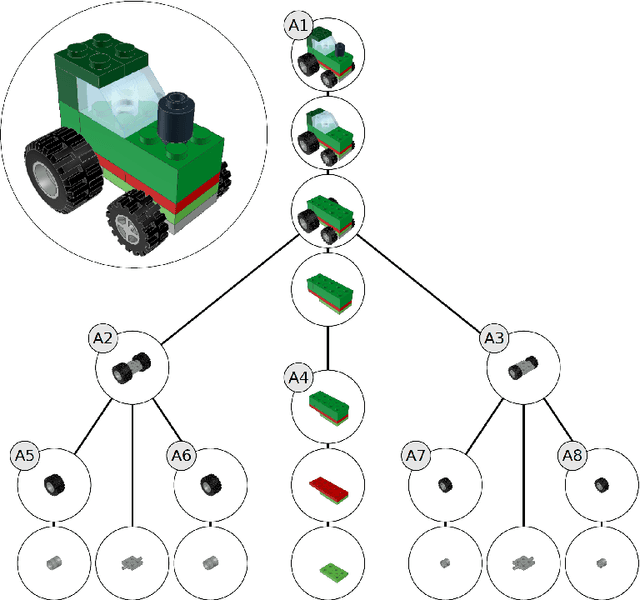
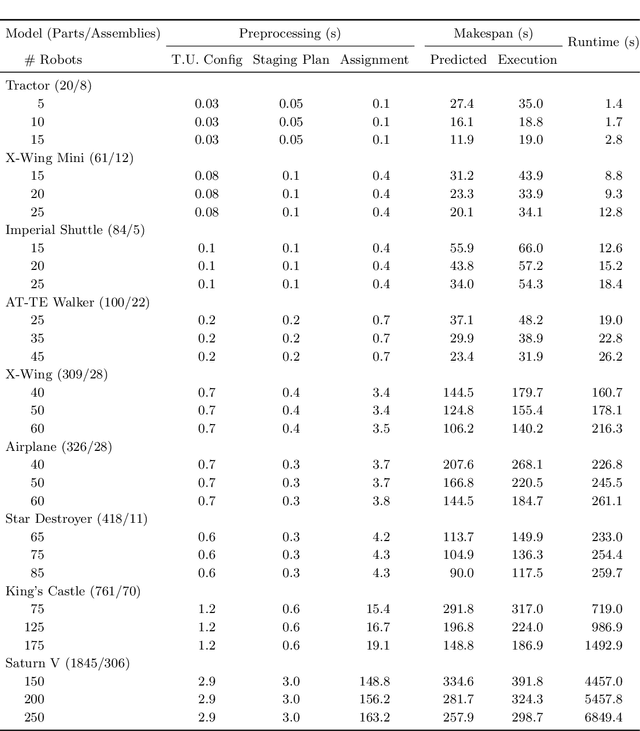
Mobile autonomous robots have the potential to revolutionize manufacturing processes. However, employing large robot fleets in manufacturing requires addressing challenges including collision-free movement in a shared workspace, effective multi-robot collaboration to manipulate and transport large payloads, complex task allocation due to coupled manufacturing processes, and spatial planning for parallel assembly and transportation of nested subassemblies. We propose a full algorithmic stack for large-scale multi-robot assembly planning that addresses these challenges and can synthesize construction plans for complex assemblies with thousands of parts in a matter of minutes. Our approach takes in a CAD-like product specification and automatically plans a full-stack assembly procedure for a group of robots to manufacture the product. We propose an algorithmic stack that comprises: (i) an iterative radial layout optimization procedure to define a global staging layout for the manufacturing facility, (ii) a graph-repair mixed-integer program formulation and a modified greedy task allocation algorithm to optimally allocate robots and robot sub-teams to assembly and transport tasks, (iii) a geometric heuristic and a hill-climbing algorithm to plan collaborative carrying configurations of robot sub-teams, and (iv) a distributed control policy that enables robots to execute the assembly motion plan collision-free. We also present an open-source multi-robot manufacturing simulator implemented in Julia as a resource to the research community, to test our algorithms and to facilitate multi-robot manufacturing research more broadly. Our empirical results demonstrate the scalability and effectiveness of our approach by generating plans to manufacture a LEGO model of a Saturn V launch vehicle with 1845 parts, 306 subassemblies, and 250 robots in under three minutes on a standard laptop computer.
Constrained Hierarchical Monte Carlo Belief-State Planning
Oct 30, 2023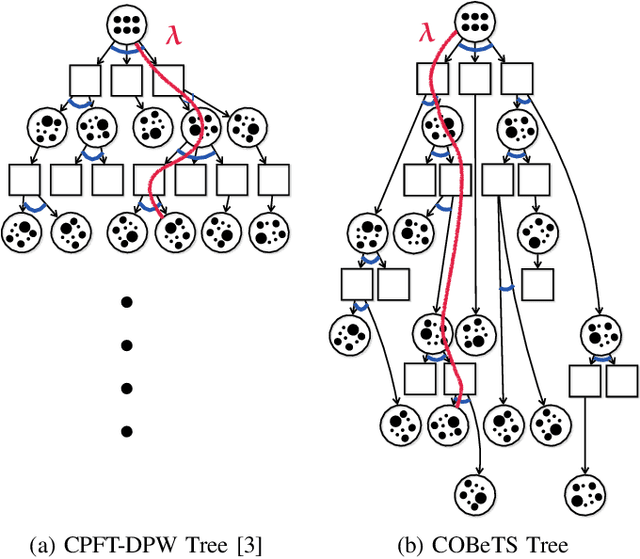
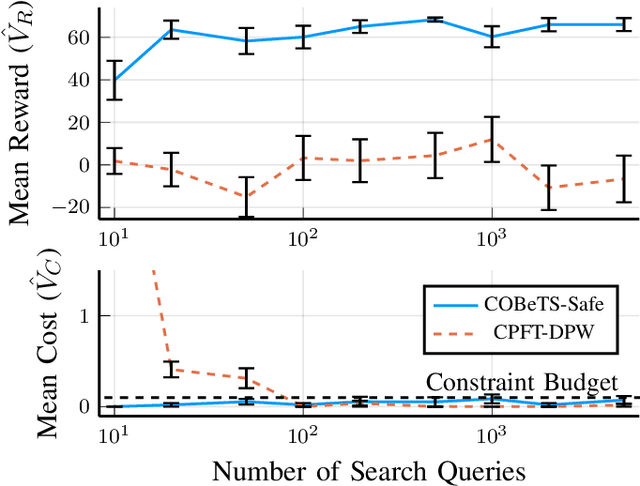
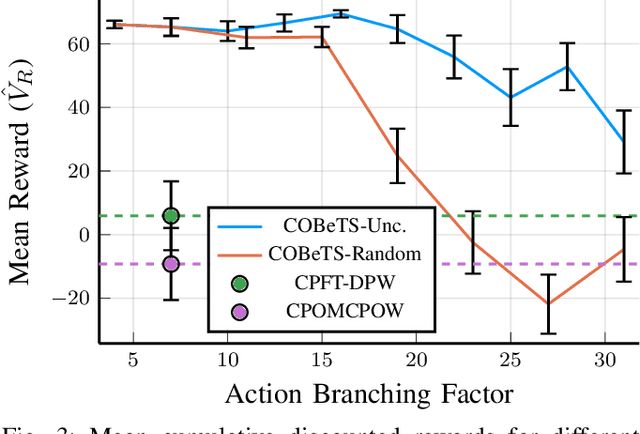

Optimal plans in Constrained Partially Observable Markov Decision Processes (CPOMDPs) maximize reward objectives while satisfying hard cost constraints, generalizing safe planning under state and transition uncertainty. Unfortunately, online CPOMDP planning is extremely difficult in large or continuous problem domains. In many large robotic domains, hierarchical decomposition can simplify planning by using tools for low-level control given high-level action primitives (options). We introduce Constrained Options Belief Tree Search (COBeTS) to leverage this hierarchy and scale online search-based CPOMDP planning to large robotic problems. We show that if primitive option controllers are defined to satisfy assigned constraint budgets, then COBeTS will satisfy constraints anytime. Otherwise, COBeTS will guide the search towards a safe sequence of option primitives, and hierarchical monitoring can be used to achieve runtime safety. We demonstrate COBeTS in several safety-critical, constrained partially observable robotic domains, showing that it can plan successfully in continuous CPOMDPs while non-hierarchical baselines cannot.
Predicting Future Spatiotemporal Occupancy Grids with Semantics for Autonomous Driving
Oct 03, 2023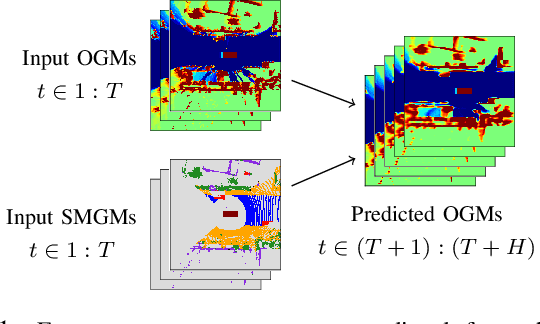

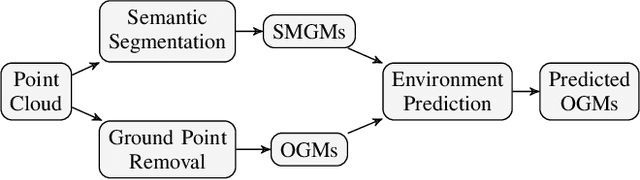
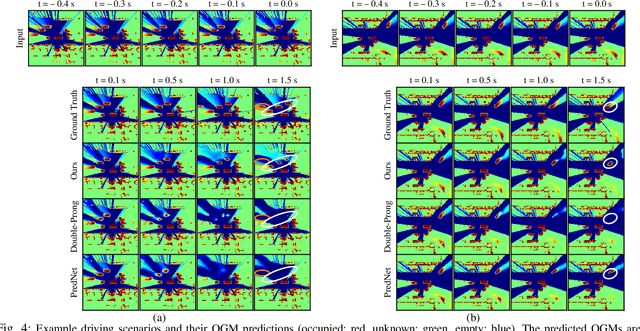
For autonomous vehicles to proactively plan safe trajectories and make informed decisions, they must be able to predict the future occupancy states of the local environment. However, common issues with occupancy prediction include predictions where moving objects vanish or become blurred, particularly at longer time horizons. We propose an environment prediction framework that incorporates environment semantics for future occupancy prediction. Our method first semantically segments the environment and uses this information along with the occupancy information to predict the spatiotemporal evolution of the environment. We validate our approach on the real-world Waymo Open Dataset. Compared to baseline methods, our model has higher prediction accuracy and is capable of maintaining moving object appearances in the predictions for longer prediction time horizons.
SAVME: Efficient Safety Validation for Autonomous Systems Using Meta-Learning
Sep 30, 2023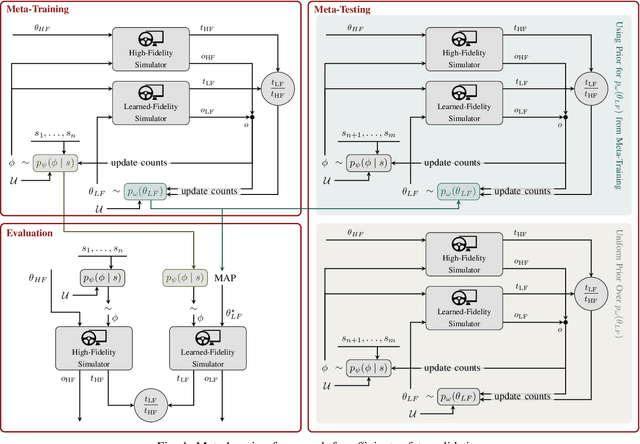
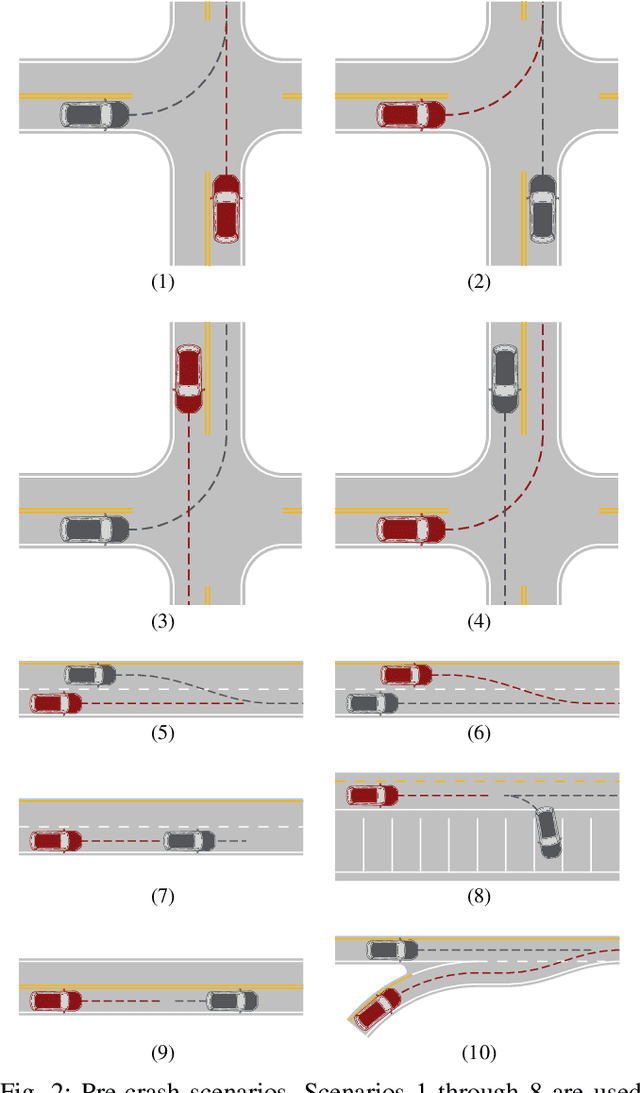
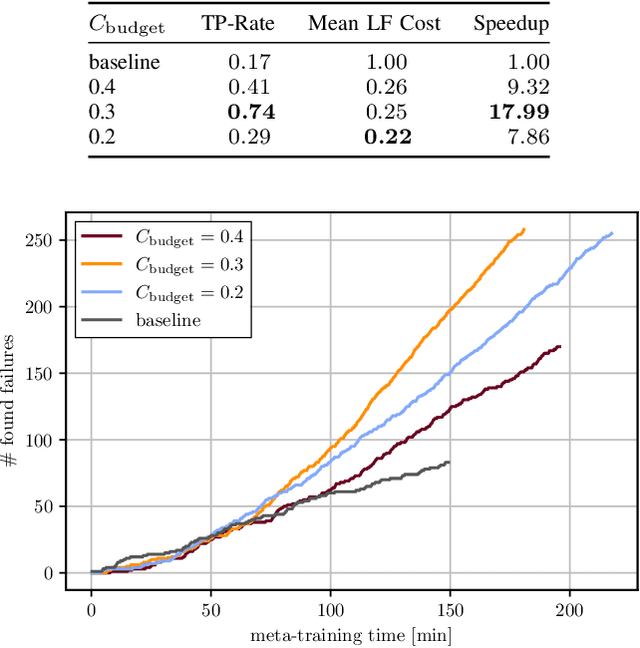
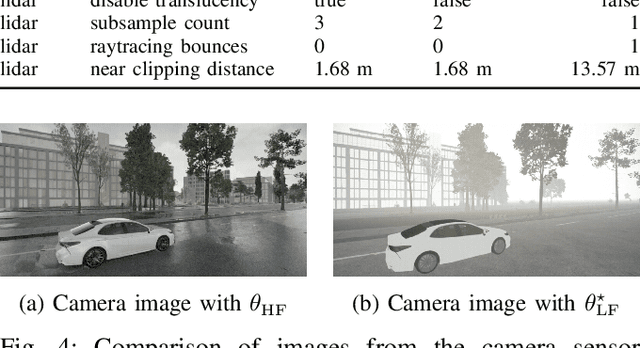
Discovering potential failures of an autonomous system is important prior to deployment. Falsification-based methods are often used to assess the safety of such systems, but the cost of running many accurate simulation can be high. The validation can be accelerated by identifying critical failure scenarios for the system under test and by reducing the simulation runtime. We propose a Bayesian approach that integrates meta-learning strategies with a multi-armed bandit framework. Our method involves learning distributions over scenario parameters that are prone to triggering failures in the system under test, as well as a distribution over fidelity settings that enable fast and accurate simulations. In the spirit of meta-learning, we also assess whether the learned fidelity settings distribution facilitates faster learning of the scenario parameter distributions for new scenarios. We showcase our methodology using a cutting-edge 3D driving simulator, incorporating 16 fidelity settings for an autonomous vehicle stack that includes camera and lidar sensors. We evaluate various scenarios based on an autonomous vehicle pre-crash typology. As a result, our approach achieves a significant speedup, up to 18 times faster compared to traditional methods that solely rely on a high-fidelity simulator.
Scene Informer: Anchor-based Occlusion Inference and Trajectory Prediction in Partially Observable Environments
Sep 25, 2023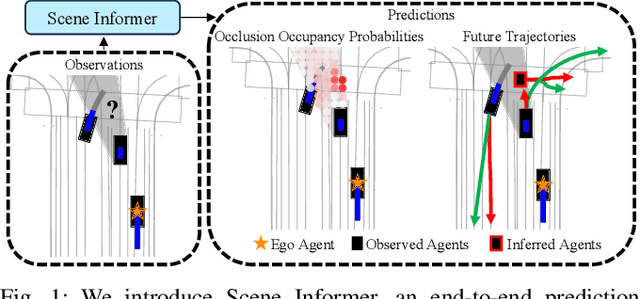
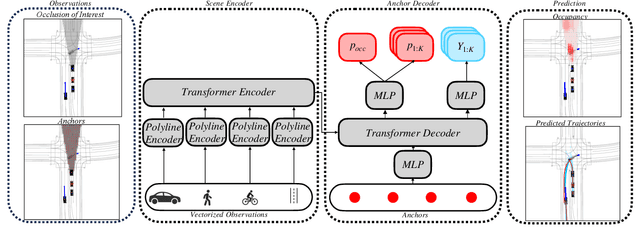
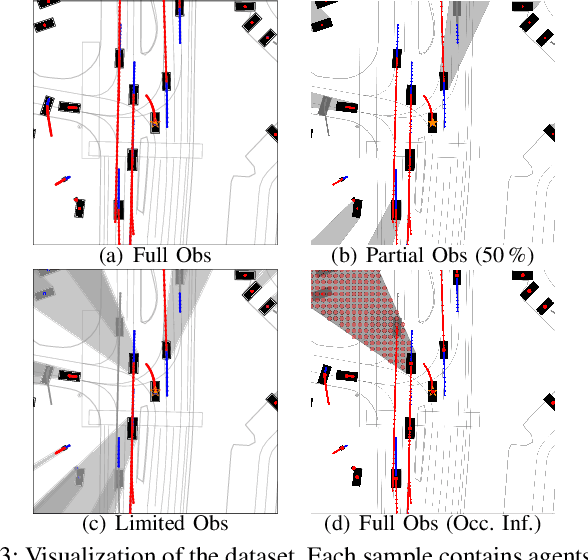
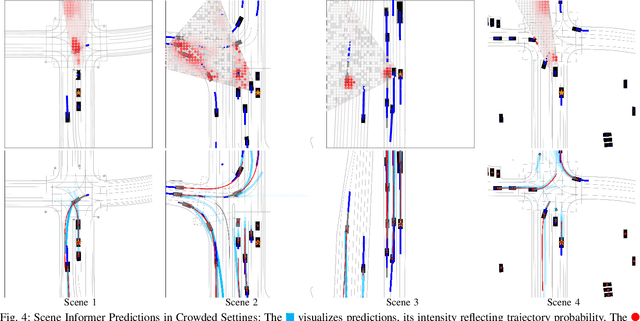
Navigating complex and dynamic environments requires autonomous vehicles (AVs) to reason about both visible and occluded regions. This involves predicting the future motion of observed agents, inferring occluded ones, and modeling their interactions based on vectorized scene representations of the partially observable environment. However, prior work on occlusion inference and trajectory prediction have developed in isolation, with the former based on simplified rasterized methods and the latter assuming full environment observability. We introduce the Scene Informer, a unified approach for predicting both observed agent trajectories and inferring occlusions in a partially observable setting. It uses a transformer to aggregate various input modalities and facilitate selective queries on occlusions that might intersect with the AV's planned path. The framework estimates occupancy probabilities and likely trajectories for occlusions, as well as forecast motion for observed agents. We explore common observability assumptions in both domains and their performance impact. Our approach outperforms existing methods in both occupancy prediction and trajectory prediction in partially observable setting on the Waymo Open Motion Dataset.