 Add to Chrome
 Add to Firefox
 Add to Edge
Learning Actuator-Aware Spectral Submanifolds for Precise Control of Continuum Robots
Mar 24, 2026
Continuum robots exhibit high-dimensional, nonlinear dynamics which are often coupled with their actuation mechanism. Spectral submanifold (SSM) reduction has emerged as a leading method for reducing high-dimensional nonlinear dynamical systems to low-dimensional invariant manifolds. Our proposed control-augmented SSMs (caSSMs) extend this methodology by explicitly incorporating control inputs into the state representation, enabling these models to capture nonlinear state-input couplings. Training these models relies solely on controlled decay trajectories of the actuator-augmented state, thereby removing the additional actuation-calibration step commonly needed by prior SSM-for-control methods. We learn a compact caSSM model for a tendon-driven trunk robot, enabling real-time control and reducing open-loop prediction error by 40% compared to existing methods. In closed-loop experiments with model predictive control (MPC), caSSM reduces tracking error by 52%, demonstrating improved performance against Koopman and SSM based MPC and practical deployability on hardware continuum robots.

Sparse Autoencoders Reveal Interpretable and Steerable Features in VLA Models
Mar 19, 2026Vision-Language-Action (VLA) models have emerged as a promising approach for general-purpose robot manipulation. However, their generalization is inconsistent: while these models can perform impressively in some settings, fine-tuned variants often fail on novel objects, scenes, and instructions. We apply mechanistic interpretability techniques to better understand the inner workings of VLA models. To probe internal representations, we train Sparse Autoencoders (SAEs) on hidden layer activations of the VLA. SAEs learn a sparse dictionary whose features act as a compact, interpretable basis for the model's computation. We find that the large majority of extracted SAE features correspond to memorized sequences from specific training demonstrations. However, some features correspond to interpretable, general, and steerable motion primitives and semantic properties, offering a promising glimpse toward VLA generalizability. We propose a metric to categorize features according to whether they represent generalizable transferable primitives or episode-specific memorization. We validate these findings through steering experiments on the LIBERO benchmark. We show that individual SAE features causally influence robot behavior. Steering general features induces behaviors consistent with their semantic meaning and can be applied across tasks and scenes. This work provides the first mechanistic evidence that VLAs can learn generalizable features across tasks and scenes. We observe that supervised fine-tuning on small robotics datasets disproportionately amplifies memorization. In contrast, training on larger, more diverse datasets (e.g., DROID) or using knowledge insulation promotes more general features. We provide an open-source codebase and user-friendly interface for activation collection, SAE training, and feature steering. Our project page is located at http://drvla.github.io
Observing and Controlling Features in Vision-Language-Action Models
Mar 05, 2026Vision-Language-Action Models (VLAs) have shown remarkable progress towards embodied intelligence. While their architecture partially resembles that of Large Language Models (LLMs), VLAs exhibit higher complexity due to their multi-modal inputs/outputs and often hybrid nature of transformer and diffusion heads. This is part of the reason why insights from mechanistic interpretability in LLMs, which explain how the internal model representations relate to their output behavior, do not trivially transfer to VLA counterparts. In this work, we propose to close this gap by introducing and analyzing two main concepts: feature-observability and feature-controllability. In particular, we first study features that are linearly encoded in representation space, and show how they can be observed by means of a linear classifier. Then, we use a minimal linear intervention grounded in optimal control to accurately place internal representations and steer the VLA's output towards a desired region. Our results show that targeted, lightweight interventions can reliably steer a robot's behavior while preserving closed-loop capabilities. We demonstrate on different VLA architectures ($π_{0.5}$ and OpenVLA) through simulation experiments that VLAs possess interpretable internal structure amenable to online adaptation without fine-tuning, enabling real-time alignment with user preferences and task requirements.
Graph Neural Model Predictive Control for High-Dimensional Systems
Feb 19, 2026The control of high-dimensional systems, such as soft robots, requires models that faithfully capture complex dynamics while remaining computationally tractable. This work presents a framework that integrates Graph Neural Network (GNN)-based dynamics models with structure-exploiting Model Predictive Control to enable real-time control of high-dimensional systems. By representing the system as a graph with localized interactions, the GNN preserves sparsity, while a tailored condensing algorithm eliminates state variables from the control problem, ensuring efficient computation. The complexity of our condensing algorithm scales linearly with the number of system nodes, and leverages Graphics Processing Unit (GPU) parallelization to achieve real-time performance. The proposed approach is validated in simulation and experimentally on a physical soft robotic trunk. Results show that our method scales to systems with up to 1,000 nodes at 100 Hz in closed-loop, and demonstrates real-time reference tracking on hardware with sub-centimeter accuracy, outperforming baselines by 63.6%. Finally, we show the capability of our method to achieve effective full-body obstacle avoidance.
Taming High-Dimensional Dynamics: Learning Optimal Projections onto Spectral Submanifolds
Apr 04, 2025
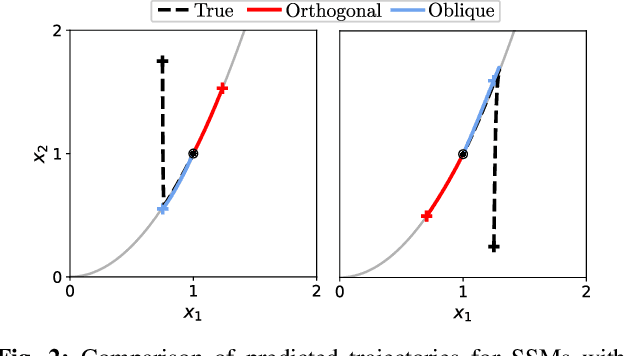
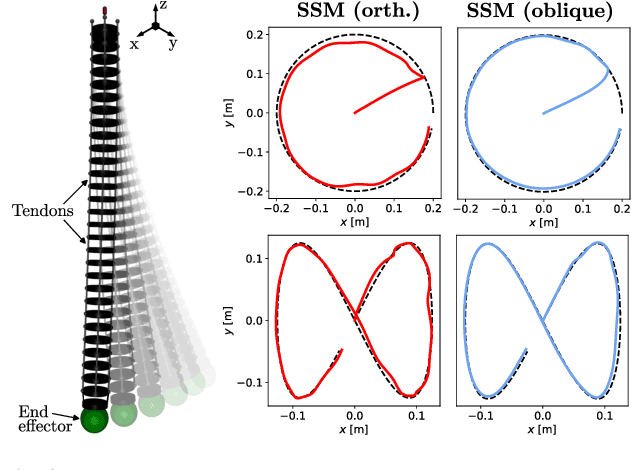

High-dimensional nonlinear systems pose considerable challenges for modeling and control across many domains, from fluid mechanics to advanced robotics. Such systems are typically approximated with reduced order models, which often rely on orthogonal projections, a simplification that may lead to large prediction errors. In this work, we derive optimality of fiber-aligned projections onto spectral submanifolds, preserving the nonlinear geometric structure and minimizing long-term prediction error. We propose a computationally tractable procedure to approximate these projections from data, and show how the effect of control can be incorporated. For a 180-dimensional robotic system, we demonstrate that our reduced-order models outperform previous state-of-the-art approaches by up to fivefold in trajectory tracking accuracy under model predictive control.
Constrained Hierarchical Monte Carlo Belief-State Planning
Oct 30, 2023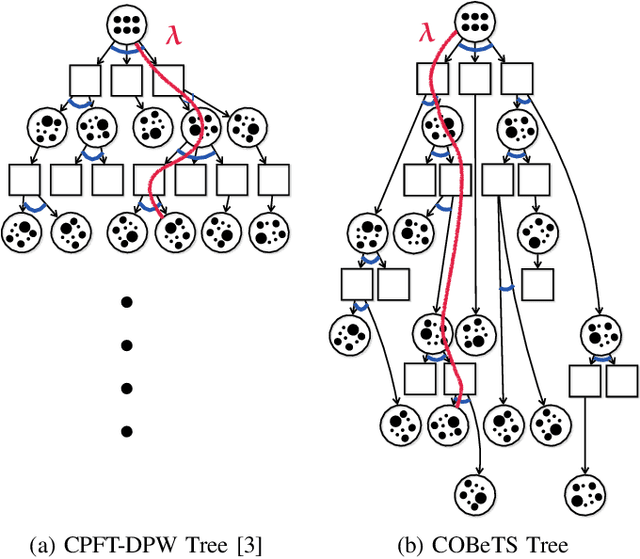
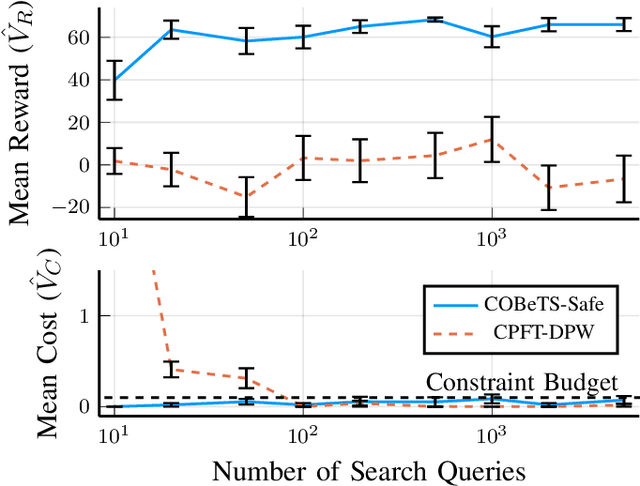
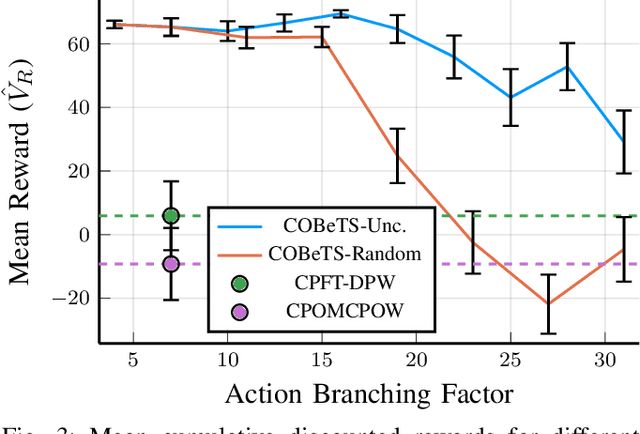

Optimal plans in Constrained Partially Observable Markov Decision Processes (CPOMDPs) maximize reward objectives while satisfying hard cost constraints, generalizing safe planning under state and transition uncertainty. Unfortunately, online CPOMDP planning is extremely difficult in large or continuous problem domains. In many large robotic domains, hierarchical decomposition can simplify planning by using tools for low-level control given high-level action primitives (options). We introduce Constrained Options Belief Tree Search (COBeTS) to leverage this hierarchy and scale online search-based CPOMDP planning to large robotic problems. We show that if primitive option controllers are defined to satisfy assigned constraint budgets, then COBeTS will satisfy constraints anytime. Otherwise, COBeTS will guide the search towards a safe sequence of option primitives, and hierarchical monitoring can be used to achieve runtime safety. We demonstrate COBeTS in several safety-critical, constrained partially observable robotic domains, showing that it can plan successfully in continuous CPOMDPs while non-hierarchical baselines cannot.