 Add to Chrome
 Add to Firefox
 Add to Edge
Disentangled Generative Graph Representation Learning
Aug 24, 2024
Recently, generative graph models have shown promising results in learning graph representations through self-supervised methods. However, most existing generative graph representation learning (GRL) approaches rely on random masking across the entire graph, which overlooks the entanglement of learned representations. This oversight results in non-robustness and a lack of explainability. Furthermore, disentangling the learned representations remains a significant challenge and has not been sufficiently explored in GRL research. Based on these insights, this paper introduces DiGGR (Disentangled Generative Graph Representation Learning), a self-supervised learning framework. DiGGR aims to learn latent disentangled factors and utilizes them to guide graph mask modeling, thereby enhancing the disentanglement of learned representations and enabling end-to-end joint learning. Extensive experiments on 11 public datasets for two different graph learning tasks demonstrate that DiGGR consistently outperforms many previous self-supervised methods, verifying the effectiveness of the proposed approach.

Openstory++: A Large-scale Dataset and Benchmark for Instance-aware Open-domain Visual Storytelling
Aug 07, 2024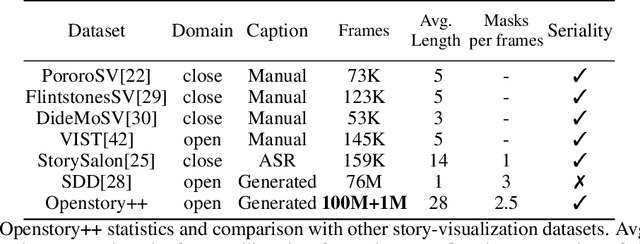
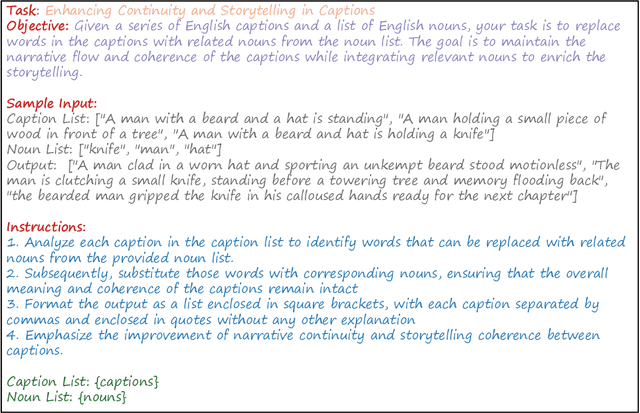

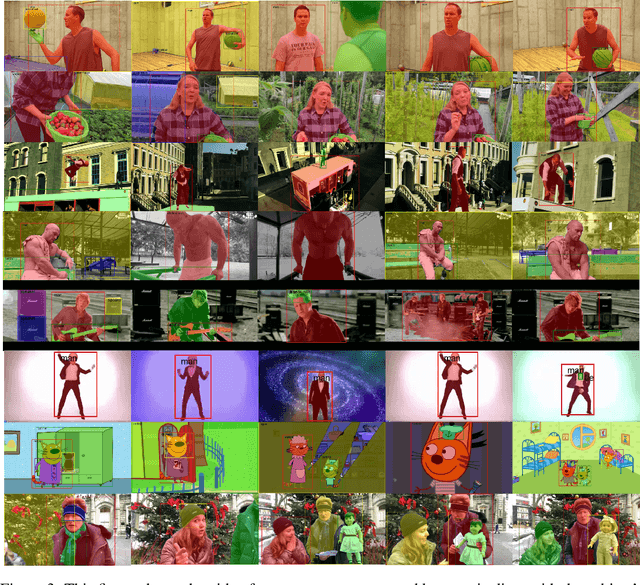
Recent image generation models excel at creating high-quality images from brief captions. However, they fail to maintain consistency of multiple instances across images when encountering lengthy contexts. This inconsistency is largely due to in existing training datasets the absence of granular instance feature labeling in existing training datasets. To tackle these issues, we introduce Openstory++, a large-scale dataset combining additional instance-level annotations with both images and text. Furthermore, we develop a training methodology that emphasizes entity-centric image-text generation, ensuring that the models learn to effectively interweave visual and textual information. Specifically, Openstory++ streamlines the process of keyframe extraction from open-domain videos, employing vision-language models to generate captions that are then polished by a large language model for narrative continuity. It surpasses previous datasets by offering a more expansive open-domain resource, which incorporates automated captioning, high-resolution imagery tailored for instance count, and extensive frame sequences for temporal consistency. Additionally, we present Cohere-Bench, a pioneering benchmark framework for evaluating the image generation tasks when long multimodal context is provided, including the ability to keep the background, style, instances in the given context coherent. Compared to existing benchmarks, our work fills critical gaps in multi-modal generation, propelling the development of models that can adeptly generate and interpret complex narratives in open-domain environments. Experiments conducted within Cohere-Bench confirm the superiority of Openstory++ in nurturing high-quality visual storytelling models, enhancing their ability to address open-domain generation tasks. More details can be found at https://openstorypp.github.io/
A Non-negative VAE:the Generalized Gamma Belief Network
Aug 06, 2024The gamma belief network (GBN), often regarded as a deep topic model, has demonstrated its potential for uncovering multi-layer interpretable latent representations in text data. Its notable capability to acquire interpretable latent factors is partially attributed to sparse and non-negative gamma-distributed latent variables. However, the existing GBN and its variations are constrained by the linear generative model, thereby limiting their expressiveness and applicability. To address this limitation, we introduce the generalized gamma belief network (Generalized GBN) in this paper, which extends the original linear generative model to a more expressive non-linear generative model. Since the parameters of the Generalized GBN no longer possess an analytic conditional posterior, we further propose an upward-downward Weibull inference network to approximate the posterior distribution of the latent variables. The parameters of both the generative model and the inference network are jointly trained within the variational inference framework. Finally, we conduct comprehensive experiments on both expressivity and disentangled representation learning tasks to evaluate the performance of the Generalized GBN against state-of-the-art Gaussian variational autoencoders serving as baselines.
Contrastive Factor Analysis
Aug 01, 2024

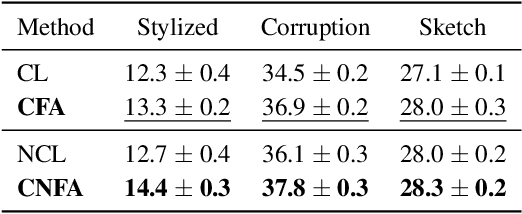

Factor analysis, often regarded as a Bayesian variant of matrix factorization, offers superior capabilities in capturing uncertainty, modeling complex dependencies, and ensuring robustness. As the deep learning era arrives, factor analysis is receiving less and less attention due to their limited expressive ability. On the contrary, contrastive learning has emerged as a potent technique with demonstrated efficacy in unsupervised representational learning. While the two methods are different paradigms, recent theoretical analysis has revealed the mathematical equivalence between contrastive learning and matrix factorization, providing a potential possibility for factor analysis combined with contrastive learning. Motivated by the interconnectedness of contrastive learning, matrix factorization, and factor analysis, this paper introduces a novel Contrastive Factor Analysis framework, aiming to leverage factor analysis's advantageous properties within the realm of contrastive learning. To further leverage the interpretability properties of non-negative factor analysis, which can learn disentangled representations, contrastive factor analysis is extended to a non-negative version. Finally, extensive experimental validation showcases the efficacy of the proposed contrastive (non-negative) factor analysis methodology across multiple key properties, including expressiveness, robustness, interpretability, and accurate uncertainty estimation.
Advancing Graph Generation through Beta Diffusion
Jun 13, 2024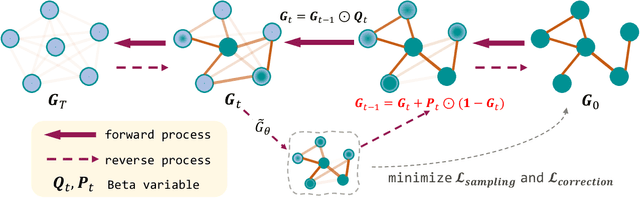
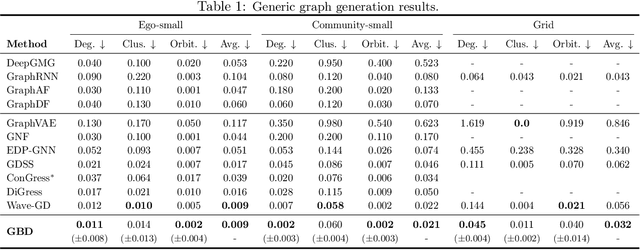
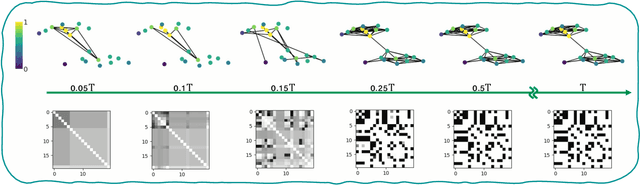
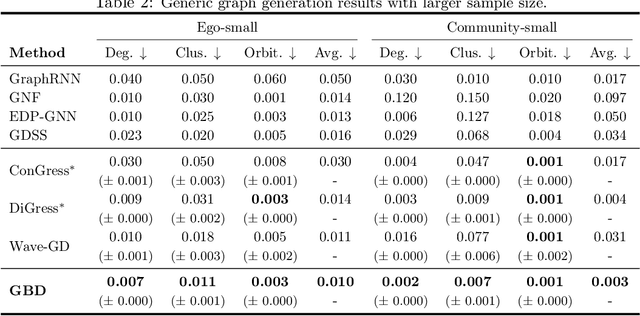
Diffusion models have demonstrated effectiveness in generating natural images and have been extended to generate diverse data types, including graphs. This new generation of diffusion-based graph generative models has demonstrated significant performance improvements over methods that rely on variational autoencoders or generative adversarial networks. It's important to recognize, however, that most of these models employ Gaussian or categorical diffusion processes, which can struggle with sparse and long-tailed data distributions. In our work, we introduce Graph Beta Diffusion (GBD), a diffusion-based generative model particularly adept at capturing diverse graph structures. GBD utilizes a beta diffusion process, tailored for the sparse and range-bounded characteristics of graph adjacency matrices. Furthermore, we have developed a modulation technique that enhances the realism of the generated graphs by stabilizing the generation of critical graph structures, while preserving flexibility elsewhere. The outstanding performance of GBD across three general graph benchmarks and two biochemical graph benchmarks highlights its capability to effectively capture the complexities of real-world graph data. The code will be made available at https://github.com/YH-UtMSB/Graph_Beta_Diffusion
Diffusion-RPO: Aligning Diffusion Models through Relative Preference Optimization
Jun 10, 2024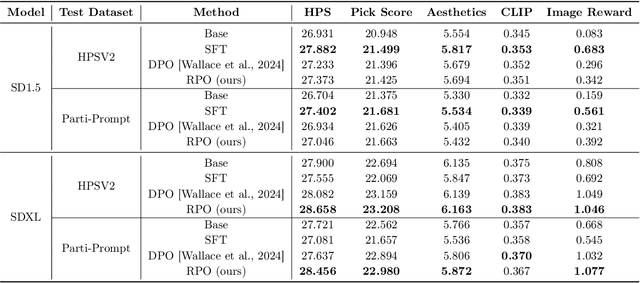
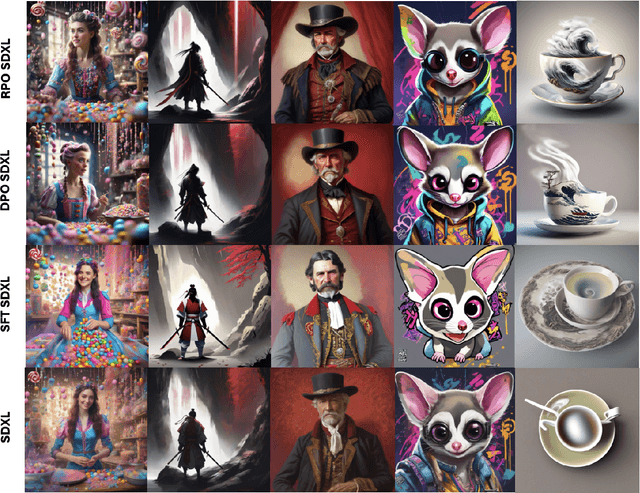
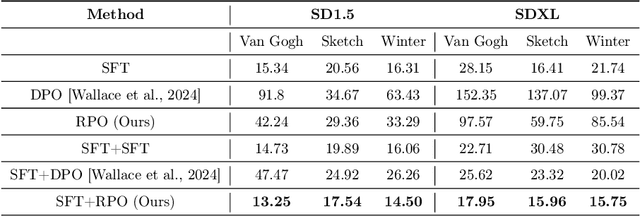

Aligning large language models with human preferences has emerged as a critical focus in language modeling research. Yet, integrating preference learning into Text-to-Image (T2I) generative models is still relatively uncharted territory. The Diffusion-DPO technique made initial strides by employing pairwise preference learning in diffusion models tailored for specific text prompts. We introduce Diffusion-RPO, a new method designed to align diffusion-based T2I models with human preferences more effectively. This approach leverages both prompt-image pairs with identical prompts and those with semantically related content across various modalities. Furthermore, we have developed a new evaluation metric, style alignment, aimed at overcoming the challenges of high costs, low reproducibility, and limited interpretability prevalent in current evaluations of human preference alignment. Our findings demonstrate that Diffusion-RPO outperforms established methods such as Supervised Fine-Tuning and Diffusion-DPO in tuning Stable Diffusion versions 1.5 and XL-1.0, achieving superior results in both automated evaluations of human preferences and style alignment. Our code is available at https://github.com/yigu1008/Diffusion-RPO
Long and Short Guidance in Score identity Distillation for One-Step Text-to-Image Generation
Jun 03, 2024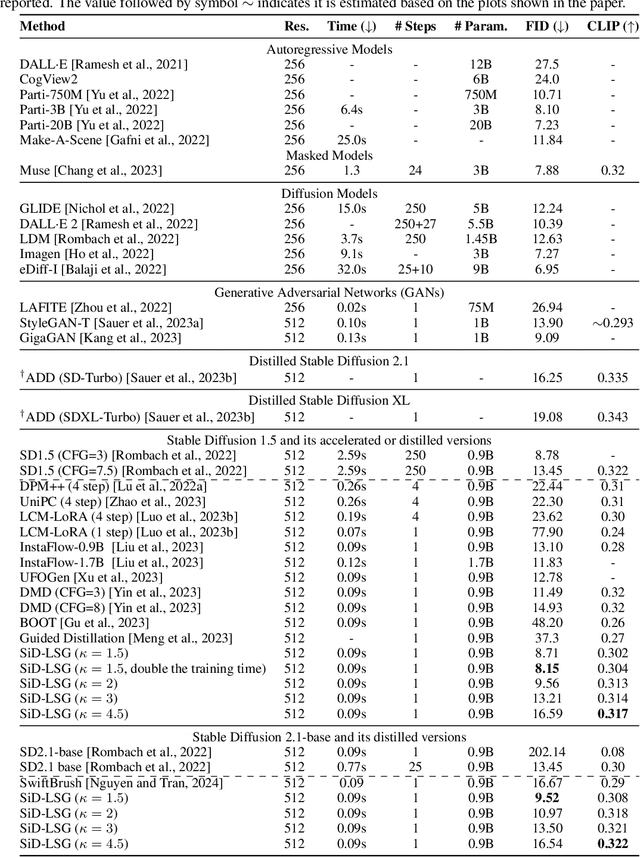


Diffusion-based text-to-image generation models trained on extensive text-image pairs have shown the capacity to generate photorealistic images consistent with textual descriptions. However, a significant limitation of these models is their slow sample generation, which requires iterative refinement through the same network. In this paper, we enhance Score identity Distillation (SiD) by developing long and short classifier-free guidance (LSG) to efficiently distill pretrained Stable Diffusion models without using real training data. SiD aims to optimize a model-based explicit score matching loss, utilizing a score-identity-based approximation alongside the proposed LSG for practical computation. By training exclusively with fake images synthesized with its one-step generator, SiD equipped with LSG rapidly improves FID and CLIP scores, achieving state-of-the-art FID performance while maintaining a competitive CLIP score. Specifically, its data-free distillation of Stable Diffusion 1.5 achieves a record low FID of 8.15 on the COCO-2014 validation set, with a CLIP score of 0.304 at an LSG scale of 1.5, and a FID of 9.56 with a CLIP score of 0.313 at an LSG scale of 2. We will make our PyTorch implementation and distilled Stable Diffusion one-step generators available at https://github.com/mingyuanzhou/SiD-LSG
Diffusion Boosted Trees
Jun 03, 2024Combining the merits of both denoising diffusion probabilistic models and gradient boosting, the diffusion boosting paradigm is introduced for tackling supervised learning problems. We develop Diffusion Boosted Trees (DBT), which can be viewed as both a new denoising diffusion generative model parameterized by decision trees (one single tree for each diffusion timestep), and a new boosting algorithm that combines the weak learners into a strong learner of conditional distributions without making explicit parametric assumptions on their density forms. We demonstrate through experiments the advantages of DBT over deep neural network-based diffusion models as well as the competence of DBT on real-world regression tasks, and present a business application (fraud detection) of DBT for classification on tabular data with the ability of learning to defer.
Self-Augmented Preference Optimization: Off-Policy Paradigms for Language Model Alignment
May 31, 2024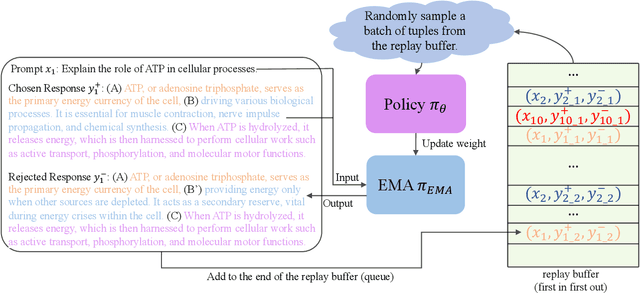
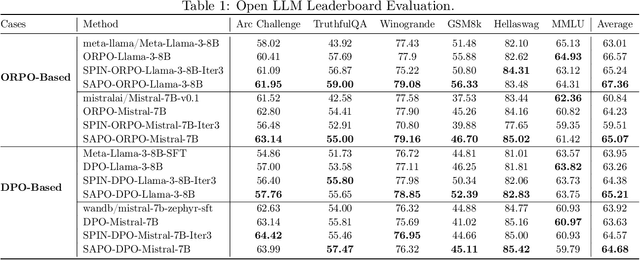
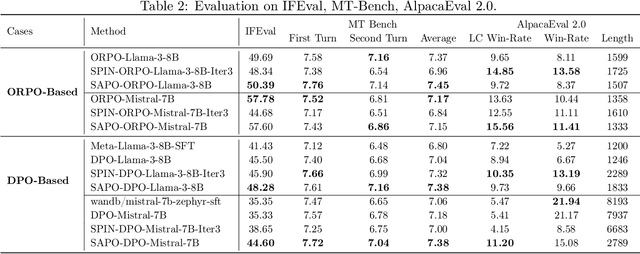
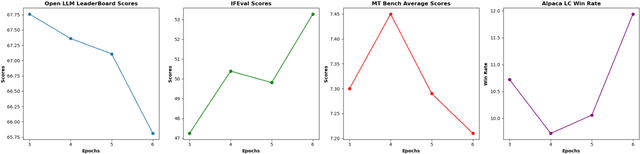
Traditional language model alignment methods, such as Direct Preference Optimization (DPO), are limited by their dependence on static, pre-collected paired preference data, which hampers their adaptability and practical applicability. To overcome this limitation, we introduce Self-Augmented Preference Optimization (SAPO), an effective and scalable training paradigm that does not require existing paired data. Building on the self-play concept, which autonomously generates negative responses, we further incorporate an off-policy learning pipeline to enhance data exploration and exploitation. Specifically, we employ an Exponential Moving Average (EMA) model in conjunction with a replay buffer to enable dynamic updates of response segments, effectively integrating real-time feedback with insights from historical data. Our comprehensive evaluations of the LLaMA3-8B and Mistral-7B models across benchmarks, including the Open LLM Leaderboard, IFEval, AlpacaEval 2.0, and MT-Bench, demonstrate that SAPO matches or surpasses established offline contrastive baselines, such as DPO and Odds Ratio Preference Optimization, and outperforms offline self-play methods like SPIN. Our code is available at https://github.com/yinyueqin/SAPO
Diffusion Policies creating a Trust Region for Offline Reinforcement Learning
May 31, 2024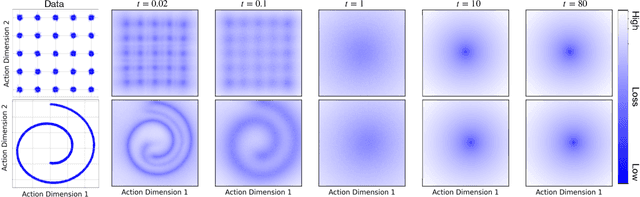
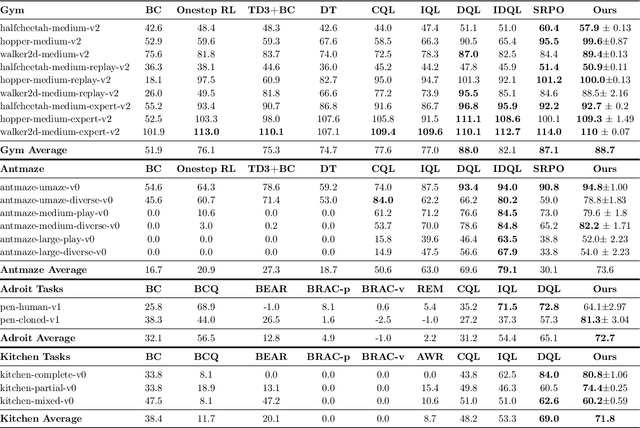
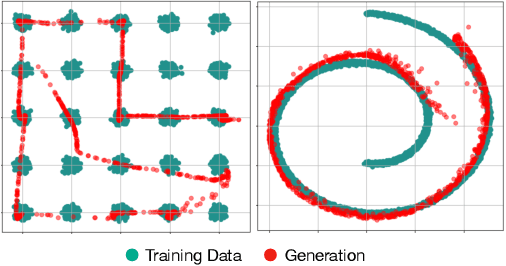
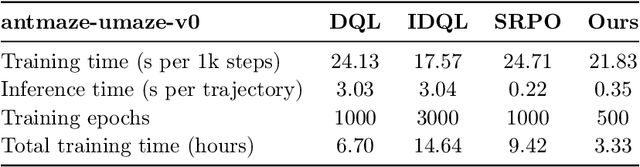
Offline reinforcement learning (RL) leverages pre-collected datasets to train optimal policies. Diffusion Q-Learning (DQL), introducing diffusion models as a powerful and expressive policy class, significantly boosts the performance of offline RL. However, its reliance on iterative denoising sampling to generate actions slows down both training and inference. While several recent attempts have tried to accelerate diffusion-QL, the improvement in training and/or inference speed often results in degraded performance. In this paper, we introduce a dual policy approach, Diffusion Trusted Q-Learning (DTQL), which comprises a diffusion policy for pure behavior cloning and a practical one-step policy. We bridge the two polices by a newly introduced diffusion trust region loss. The diffusion policy maintains expressiveness, while the trust region loss directs the one-step policy to explore freely and seek modes within the region defined by the diffusion policy. DTQL eliminates the need for iterative denoising sampling during both training and inference, making it remarkably computationally efficient. We evaluate its effectiveness and algorithmic characteristics against popular Kullback-Leibler (KL) based distillation methods in 2D bandit scenarios and gym tasks. We then show that DTQL could not only outperform other methods on the majority of the D4RL benchmark tasks but also demonstrate efficiency in training and inference speeds. The PyTorch implementation is available at https://github.com/TianyuCodings/Diffusion_Trusted_Q_Learning.