 Add to Chrome
 Add to Firefox
 Add to Edge
Temporal Prototyping and Hierarchical Alignment for Unsupervised Video-based Visible-Infrared Person Re-Identification
Apr 23, 2026
Visible-infrared person re-identification (VI-ReID) enables cross-modality identity matching for all-day surveillance, yet existing methods predominantly focus on the image level or rely heavily on costly identity annotations. While video-based VI-ReID has recently emerged to exploit temporal dynamics for improved robustness, existing studies remain limited to supervised settings. Crucially, the unsupervised video VI-ReID problem, where models must learn from RGB and infrared tracklets without identity labels, remains largely unexplored despite its practical importance in real-world deployment. To bridge this gap, we propose HiTPro (Hierarchical Temporal Prototyping), a prototype-driven framework without explicit hard pseudo-label assignment for unsupervised video-based VI-ReID. HiTPro begins with an efficient Temporal-aware Feature Encoder that first extracts discriminative frame-level features and then aggregates them into a robust tracklet-level representation. Building upon these features, HiTPro first constructs reliable intra-camera prototypes via Intra-Camera Tracklet Prototyping by aggregating features from temporally partitioned sub-tracklets. Through Hierarchical Cross-Prototype Alignment, we perform a two-stage positive mining process: progressing from within-modality associations to cross-modality matching, enhanced by Dynamic Threshold Strategy and Soft Weight Assignment. Finally, {Hierarchical Contrastive Learning} progressively optimizes feature-prototype alignment across three levels: intra-camera discrimination, cross-camera same-modality consistency, and cross-modality invariance. Extensive experiments on HITSZ-VCM and BUPTCampus demonstrate that HiTPro achieves state-of-the-art performance under fully unsupervised settings, significantly outperforming adapted baselines and establishes a strong baseline for future research.

RuntimeSlicer: Towards Generalizable Unified Runtime State Representation for Failure Management
Mar 23, 2026Modern software systems operate at unprecedented scale and complexity, where effective failure management is critical yet increasingly challenging. Metrics, traces, and logs provide complementary views of system runtime behavior, but existing failure management approaches typically rely on task-oriented pipelines that tightly couple modality-specific preprocessing, representation learning, and downstream models, resulting in limited generalization across tasks and systems. To fill this gap, we propose RuntimeSlicer, a unified runtime state representation model towards generalizable failure management. RuntimeSlicer pre-trains a task-agnostic representation model that directly encodes metrics, traces, and logs into a single, aligned system-state embedding capturing the holistic runtime condition of the system. To train RuntimeSlicer, we introduce Unified Runtime Contrastive Learning, which integrates heterogeneous training data sources and optimizes complementary objectives for cross-modality alignment and temporal consistency. Building upon the learned system-state embeddings, we further propose State-Aware Task-Oriented Tuning, which performs unsupervised partitioning of runtime states and enables state-conditioned adaptation for downstream tasks. This design allows lightweight task-oriented models to be trained on top of the unified embedding without redesigning modality-specific encoders or preprocessing pipelines. Preliminary experiments on the AIOps 2022 dataset demonstrate the feasibility and effectiveness of RuntimeSlicer for system state modeling and failure management tasks.
Efficient Failure Management for Multi-Agent Systems with Reasoning Trace Representation
Mar 23, 2026Large Language Models (LLM)-based Multi-Agent Systems (MASs) have emerged as a new paradigm in software system design, increasingly demonstrating strong reasoning and collaboration capabilities. As these systems become more complex and autonomous, effective failure management is essential to ensure reliability and availability. However, existing approaches often rely on per-trace reasoning, which leads to low efficiency, and neglect historical failure patterns, limiting diagnostic accuracy. In this paper, we conduct a preliminary empirical study to demonstrate the necessity, potential, and challenges of leveraging historical failure patterns to enhance failure management in MASs. Building on this insight, we propose \textbf{EAGER}, an efficient failure management framework for multi-agent systems based on reasoning trace representation. EAGER employs unsupervised reasoning-scoped contrastive learning to encode both intra-agent reasoning and inter-agent coordination, enabling real-time step-wise failure detection, diagnosis, and reflexive mitigation guided by historical failure knowledge. Preliminary evaluations on three open-source MASs demonstrate the effectiveness of EAGER and highlight promising directions for future research in reliable multi-agent system operations.
Aime: Towards Fully-Autonomous Multi-Agent Framework
Jul 16, 2025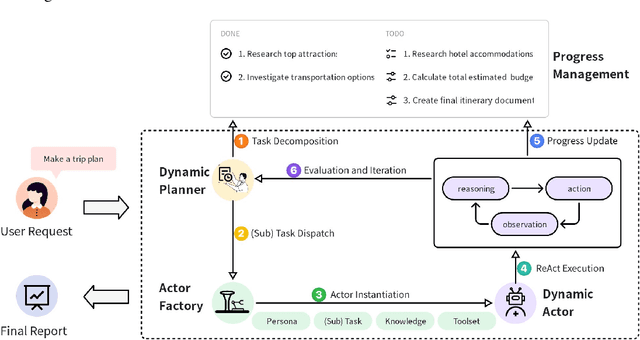
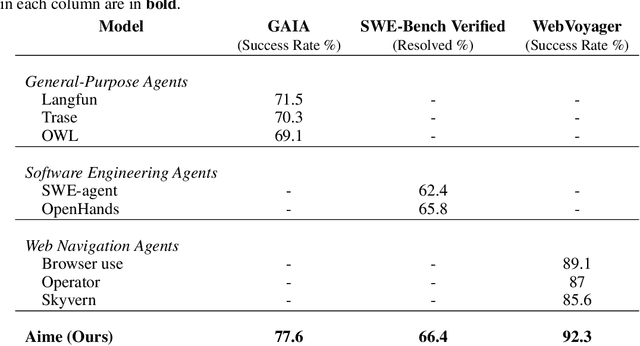
Multi-Agent Systems (MAS) powered by Large Language Models (LLMs) are emerging as a powerful paradigm for solving complex, multifaceted problems. However, the potential of these systems is often constrained by the prevalent plan-and-execute framework, which suffers from critical limitations: rigid plan execution, static agent capabilities, and inefficient communication. These weaknesses hinder their adaptability and robustness in dynamic environments. This paper introduces Aime, a novel multi-agent framework designed to overcome these challenges through dynamic, reactive planning and execution. Aime replaces the conventional static workflow with a fluid and adaptive architecture. Its core innovations include: (1) a Dynamic Planner that continuously refines the overall strategy based on real-time execution feedback; (2) an Actor Factory that implements Dynamic Actor instantiation, assembling specialized agents on-demand with tailored tools and knowledge; and (3) a centralized Progress Management Module that serves as a single source of truth for coherent, system-wide state awareness. We empirically evaluated Aime on a diverse suite of benchmarks spanning general reasoning (GAIA), software engineering (SWE-bench Verified), and live web navigation (WebVoyager). The results demonstrate that Aime consistently outperforms even highly specialized state-of-the-art agents in their respective domains. Its superior adaptability and task success rate establish Aime as a more resilient and effective foundation for multi-agent collaboration.
FactCG: Enhancing Fact Checkers with Graph-Based Multi-Hop Data
Jan 28, 2025Prior research on training grounded factuality classification models to detect hallucinations in large language models (LLMs) has relied on public natural language inference (NLI) data and synthetic data. However, conventional NLI datasets are not well-suited for document-level reasoning, which is critical for detecting LLM hallucinations. Recent approaches to document-level synthetic data generation involve iteratively removing sentences from documents and annotating factuality using LLM-based prompts. While effective, this method is computationally expensive for long documents and limited by the LLM's capabilities. In this work, we analyze the differences between existing synthetic training data used in state-of-the-art models and real LLM output claims. Based on our findings, we propose a novel approach for synthetic data generation, CG2C, that leverages multi-hop reasoning on context graphs extracted from documents. Our fact checker model, FactCG, demonstrates improved performance with more connected reasoning, using the same backbone models. Experiments show it even outperforms GPT-4-o on the LLM-Aggrefact benchmark with much smaller model size.
InvisMark: Invisible and Robust Watermarking for AI-generated Image Provenance
Nov 19, 2024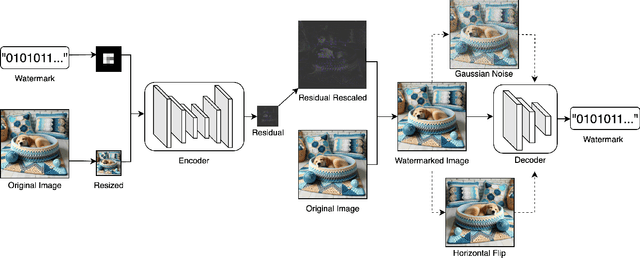

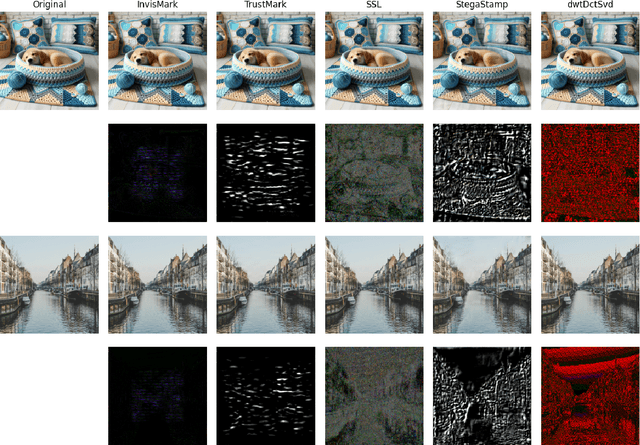

The proliferation of AI-generated images has intensified the need for robust content authentication methods. We present InvisMark, a novel watermarking technique designed for high-resolution AI-generated images. Our approach leverages advanced neural network architectures and training strategies to embed imperceptible yet highly robust watermarks. InvisMark achieves state-of-the-art performance in imperceptibility (PSNR$\sim$51, SSIM $\sim$ 0.998) while maintaining over 97\% bit accuracy across various image manipulations. Notably, we demonstrate the successful encoding of 256-bit watermarks, significantly expanding payload capacity while preserving image quality. This enables the embedding of UUIDs with error correction codes, achieving near-perfect decoding success rates even under challenging image distortions. We also address potential vulnerabilities against advanced attacks and propose mitigation strategies. By combining high imperceptibility, extended payload capacity, and resilience to manipulations, InvisMark provides a robust foundation for ensuring media provenance in an era of increasingly sophisticated AI-generated content. Source code of this paper is available at: https://github.com/microsoft/InvisMark.
SLM Meets LLM: Balancing Latency, Interpretability and Consistency in Hallucination Detection
Aug 22, 2024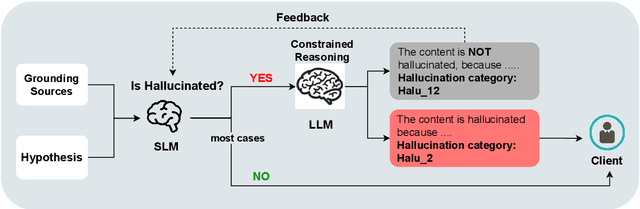
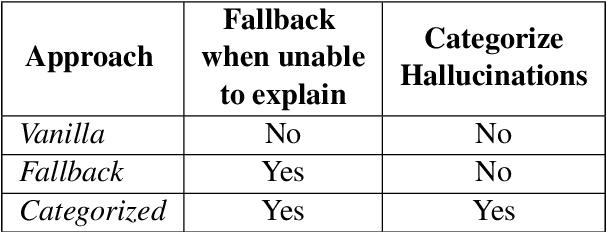
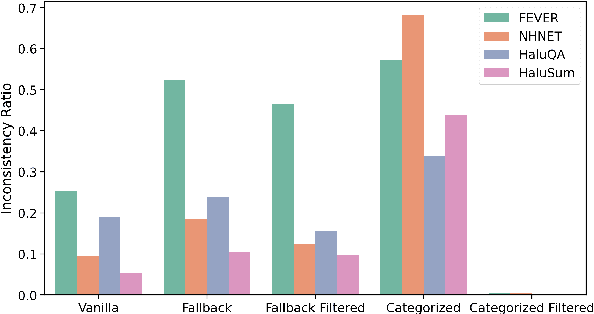
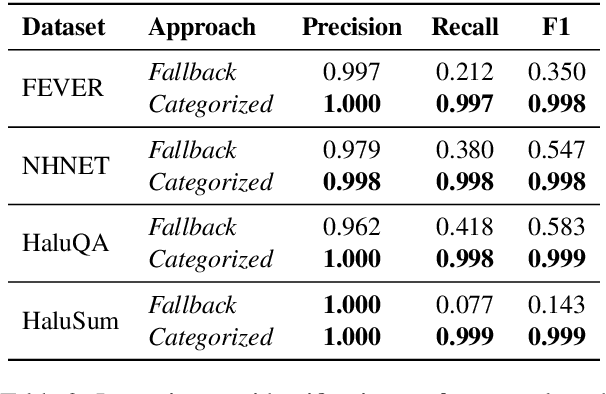
Large language models (LLMs) are highly capable but face latency challenges in real-time applications, such as conducting online hallucination detection. To overcome this issue, we propose a novel framework that leverages a small language model (SLM) classifier for initial detection, followed by a LLM as constrained reasoner to generate detailed explanations for detected hallucinated content. This study optimizes the real-time interpretable hallucination detection by introducing effective prompting techniques that align LLM-generated explanations with SLM decisions. Empirical experiment results demonstrate its effectiveness, thereby enhancing the overall user experience.
Group Distributionally Robust Dataset Distillation with Risk Minimization
Feb 07, 2024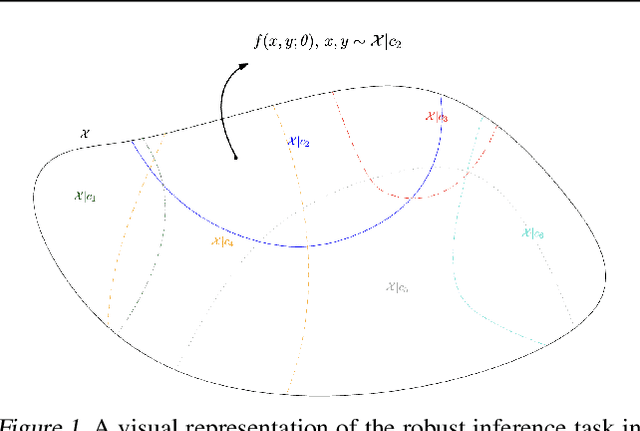
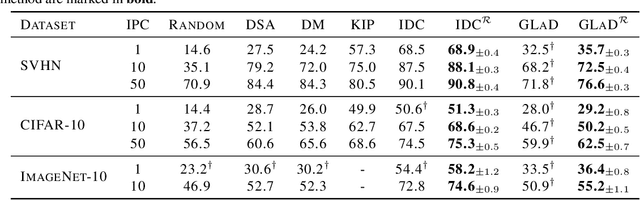
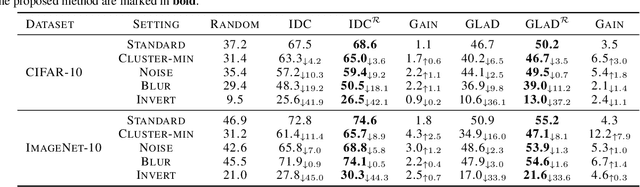
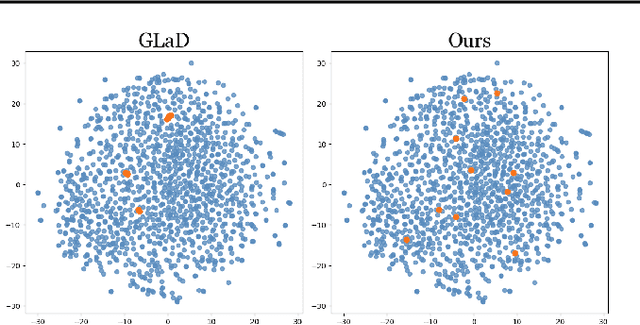
Dataset distillation (DD) has emerged as a widely adopted technique for crafting a synthetic dataset that captures the essential information of a training dataset, facilitating the training of accurate neural models. Its applications span various domains, including transfer learning, federated learning, and neural architecture search. The most popular methods for constructing the synthetic data rely on matching the convergence properties of training the model with the synthetic dataset and the training dataset. However, targeting the training dataset must be thought of as auxiliary in the same sense that the training set is an approximate substitute for the population distribution, and the latter is the data of interest. Yet despite its popularity, an aspect that remains unexplored is the relationship of DD to its generalization, particularly across uncommon subgroups. That is, how can we ensure that a model trained on the synthetic dataset performs well when faced with samples from regions with low population density? Here, the representativeness and coverage of the dataset become salient over the guaranteed training error at inference. Drawing inspiration from distributionally robust optimization, we introduce an algorithm that combines clustering with the minimization of a risk measure on the loss to conduct DD. We provide a theoretical rationale for our approach and demonstrate its effective generalization and robustness across subgroups through numerical experiments.
Self-Supervised Bird's Eye View Motion Prediction with Cross-Modality Signals
Jan 21, 2024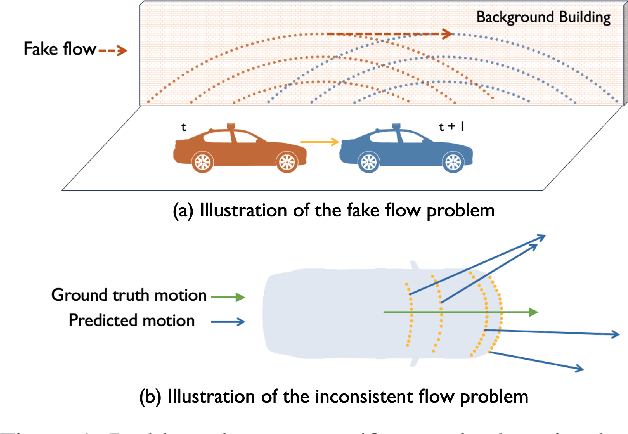
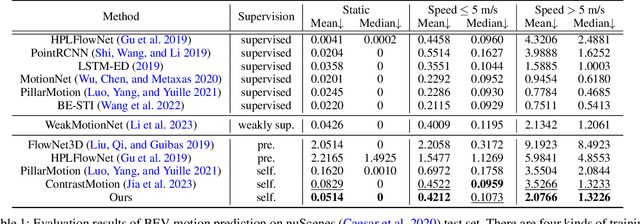
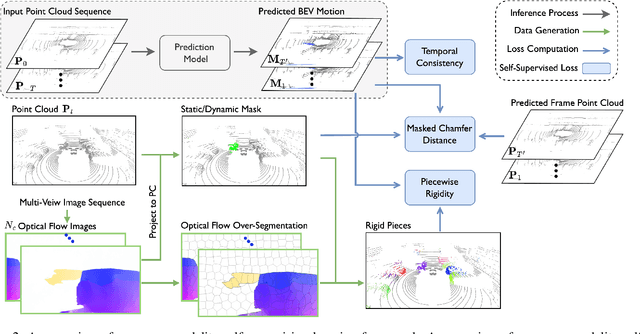
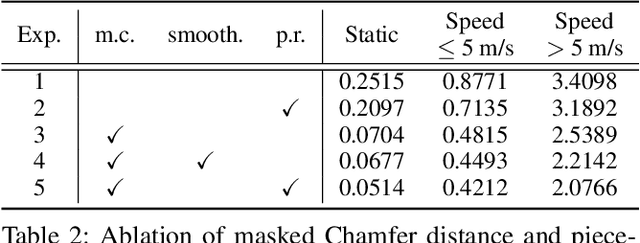
Learning the dense bird's eye view (BEV) motion flow in a self-supervised manner is an emerging research for robotics and autonomous driving. Current self-supervised methods mainly rely on point correspondences between point clouds, which may introduce the problems of fake flow and inconsistency, hindering the model's ability to learn accurate and realistic motion. In this paper, we introduce a novel cross-modality self-supervised training framework that effectively addresses these issues by leveraging multi-modality data to obtain supervision signals. We design three innovative supervision signals to preserve the inherent properties of scene motion, including the masked Chamfer distance loss, the piecewise rigidity loss, and the temporal consistency loss. Through extensive experiments, we demonstrate that our proposed self-supervised framework outperforms all previous self-supervision methods for the motion prediction task.
Chain of Natural Language Inference for Reducing Large Language Model Ungrounded Hallucinations
Oct 09, 2023Large language models (LLMs) can generate fluent natural language texts when given relevant documents as background context. This ability has attracted considerable interest in developing industry applications of LLMs. However, LLMs are prone to generate hallucinations that are not supported by the provided sources. In this paper, we propose a hierarchical framework to detect and mitigate such ungrounded hallucination. Our framework uses Chain of Natural Language Inference (CoNLI) for hallucination detection and hallucination reduction via post-editing. Our approach achieves state-of-the-art performance on hallucination detection and enhances text quality through rewrite, using LLMs without any fine-tuning or domain-specific prompt engineering. We show that this simple plug-and-play framework can serve as an effective choice for hallucination detection and reduction, achieving competitive performance across various contexts.