 Add to Chrome
 Add to Firefox
 Add to Edge
Video2Code: Generating Interactive Webpages from UI Videos via Action-Aware Revisit
Jun 16, 2026
UI videos provide a natural input for generating interactive webpages, as they capture both webpage appearance and action-triggered state transitions. However, directly applying video-capable vision-language models to this task remains insufficient. Existing models typically rely on sparse sampling or compressed temporal representations, which may miss short action boundaries and break the state-action-state transitions needed to implement webpage behavior. We formulate UI video-to-code generation as executable state-transition recovery from interaction videos, and identify this failure mode as state-transition misalignment. We introduce Video2Code, an action-aware video-to-code approach for recovering executable UI state transitions. Rather than allocating the visual budget uniformly across the video, Video2Code first performs coarse video understanding to locate action-critical regions, then invokes a temporal clipping tool to revisit these regions at higher temporal resolution before generating HTML/CSS/JavaScript code. We instantiate Video2Code with action-aligned video-code supervision and evaluate it under both visual and functional criteria. Experiments show that Video2Code substantially strengthens the underlying open-source model for UI video-to-code generation, improving functional correctness over direct video observation, especially on dense multi-step interactions.

LongWebBench: Evaluating Structural and Functional Webpage Generation in Long-Horizon Settings
Jun 16, 2026Recent vision-language models (VLMs) have shown promising progress in generating webpages from visual inputs, yet existing evaluations mainly focus on short, single-screen, and largely static webpages. We introduce LongWebBench, a benchmark for evaluating long-horizon webpage generation from both structural and functional perspectives. LongWebBench contains 490 real-world long webpages for structural fidelity evaluation and 507 goal-oriented interaction tasks over 129 webpages for functional evaluation. It employs two complementary protocols: a multi-dimensional VLM-based metric for assessing long-range structural coherence, and a DOM-augmented agent-based pipeline for end-to-end functional verification. We further examine the automatic evaluation protocols through human agreement analysis. Experiments with state-of-the-art open-source and proprietary VLMs under single-image and multi-image settings reveal that structural fidelity degrades as webpage length increases, while visually plausible generations often fail to support executable multi-step interactions. These results highlight the need to evaluate long webpage generation beyond visual similarity, with executable interaction as a core criterion. Our code and data are available at https://github.com/zheny2751-dotcom/LongWebBench.
An Immersive Multi-Elevation Multi-Seasonal Dataset for 3D Reconstruction and Visualization
Dec 19, 2024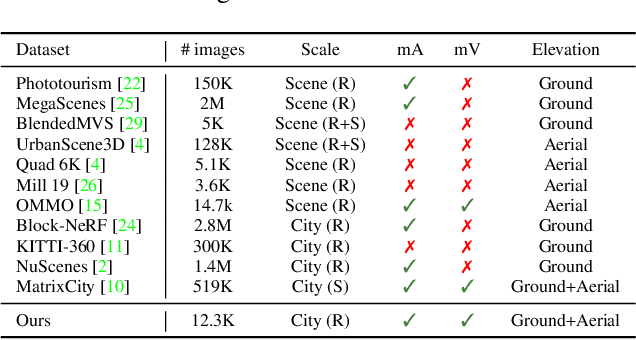
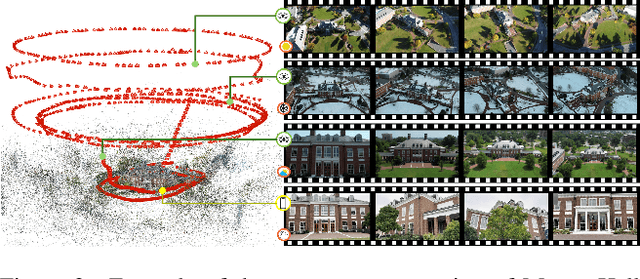
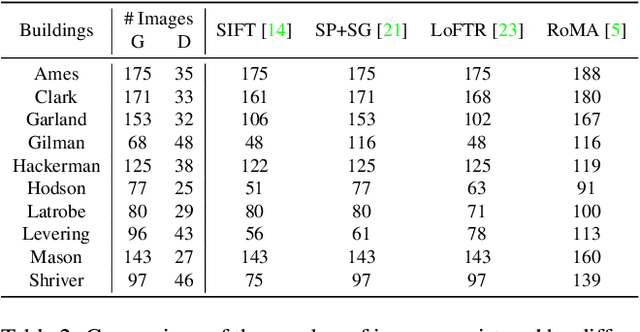
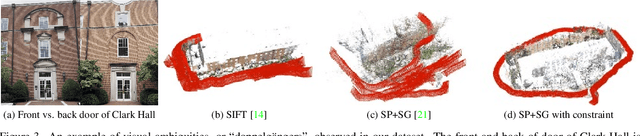
Significant progress has been made in photo-realistic scene reconstruction over recent years. Various disparate efforts have enabled capabilities such as multi-appearance or large-scale modeling; however, there lacks a welldesigned dataset that can evaluate the holistic progress of scene reconstruction. We introduce a collection of imagery of the Johns Hopkins Homewood Campus, acquired at different seasons, times of day, in multiple elevations, and across a large scale. We perform a multi-stage calibration process, which efficiently recover camera parameters from phone and drone cameras. This dataset can enable researchers to rigorously explore challenges in unconstrained settings, including effects of inconsistent illumination, reconstruction from large scale and from significantly different perspectives, etc.
BAGS: Blur Agnostic Gaussian Splatting through Multi-Scale Kernel Modeling
Mar 07, 2024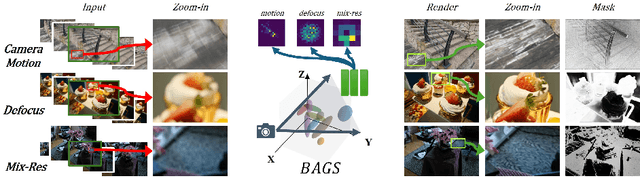
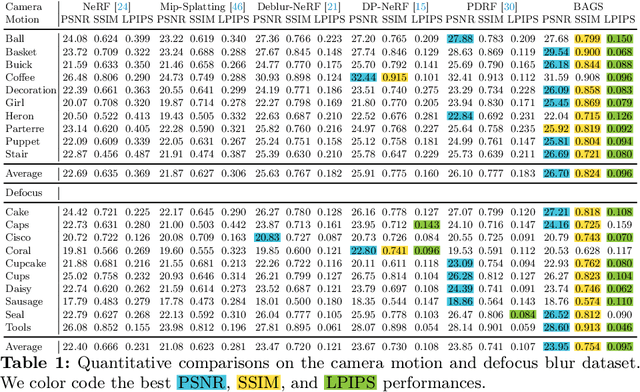
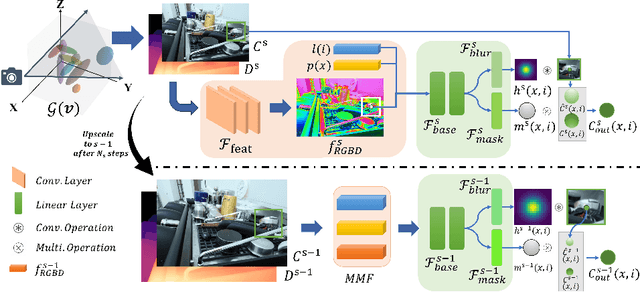
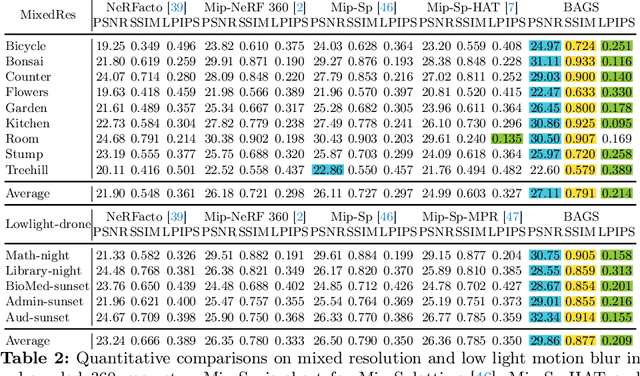
Recent efforts in using 3D Gaussians for scene reconstruction and novel view synthesis can achieve impressive results on curated benchmarks; however, images captured in real life are often blurry. In this work, we analyze the robustness of Gaussian-Splatting-based methods against various image blur, such as motion blur, defocus blur, downscaling blur, \etc. Under these degradations, Gaussian-Splatting-based methods tend to overfit and produce worse results than Neural-Radiance-Field-based methods. To address this issue, we propose Blur Agnostic Gaussian Splatting (BAGS). BAGS introduces additional 2D modeling capacities such that a 3D-consistent and high quality scene can be reconstructed despite image-wise blur. Specifically, we model blur by estimating per-pixel convolution kernels from a Blur Proposal Network (BPN). BPN is designed to consider spatial, color, and depth variations of the scene to maximize modeling capacity. Additionally, BPN also proposes a quality-assessing mask, which indicates regions where blur occur. Finally, we introduce a coarse-to-fine kernel optimization scheme; this optimization scheme is fast and avoids sub-optimal solutions due to a sparse point cloud initialization, which often occurs when we apply Structure-from-Motion on blurry images. We demonstrate that BAGS achieves photorealistic renderings under various challenging blur conditions and imaging geometry, while significantly improving upon existing approaches.