 Add to Chrome
 Add to Firefox
 Add to Edge
Learning-based Hierarchical Tracheal Anatomy Understanding from Sparse Surgical Demonstration Annotations for Ultrasound Robots
Jul 24, 2026
Tracheostomy requires precise localization of the tracheal incision site; however, conventional manual palpation is subjective and often unreliable, while ultrasound utility remains operator-dependent. This work presents a learning-based framework for hierarchical tracheal anatomy understanding, designed specifically for ultrasound-guided robotic systems. We propose a two-stage perception pipeline integrating a YOLOv8n localization backbone with a sparse, prompt-optimized SAM2 decoder to achieve high-fidelity segmentation from sparse surgical annotations. Our hybrid training strategy, bridging curated laboratory data with unconstrained sequences, ensures clinical robustness. Experimental benchmarks demonstrate that this decoupled architecture effectively balances generalization, precision, and efficiency. The YOLOv8n and SAM2 framework achieves a consistent Mean Dice Similarity Coefficient (DSC) of 0.777 across both controlled and generalized domains. This significantly outperforms U-Net baselines, which often suffer from anatomical fragmentation and performance degradation (Generalization DSC $\le$ 0.494). By constraining mask decoding to targeted, sparse regions of interest, our model achieves a throughput of 6.92 FPS, which is vital for closed-loop robotic teleoperation. This study confirms that a robust hierarchical understanding of tracheal anatomy can be derived by coupling lightweight localization with foundation-scale visual models. Our framework establishes a scalable foundation for standardized, autonomous surgical assistance, effectively navigating the variability of real-world ultrasound to enhance the safety and precision of robotic-assisted tracheostomy.

Action-Conditioned World Model for Goal Plane Probe Guidance in Robotic Ultrasound
Jul 24, 2026We present an action-conditioned world model framework for goal plane probe guidance in robotic ultrasound, with a focus on neck ultrasound scanning. Autonomous ultrasound tasks often require large numbers of probe-motion trajectories for training, but collecting high-quality demonstrations is labor-intensive and explicit simulators are difficult to build because ultrasound appearance depends on contact, tissue deformation, and view-dependent acoustic artifacts. We address this problem with a two-stage model-based learning pipeline. First, a latent conditional diffusion world model predicts future ultrasound observations from recent context frames, probe motions and temporal offset. Second, a goal-conditioned temporal transformer predicts ordered probe motions and is fine-tuned using rewards from the frozen world model. Experiments on the self-collected dataset show that the world model preserves action-dependent anatomical structure on target-directed scans. In real-world closed loop experiments, the framework achieves success rates of 70.0\% for carotid guidance and 65.0\% for thyroid guidance. These results demonstrate the potential of learned ultrasound dynamics for training goal-directed robotic probe navigation.
USPilot: An Embodied Robotic Assistant Ultrasound System with Large Language Model Enhanced Graph Planner
Feb 18, 2025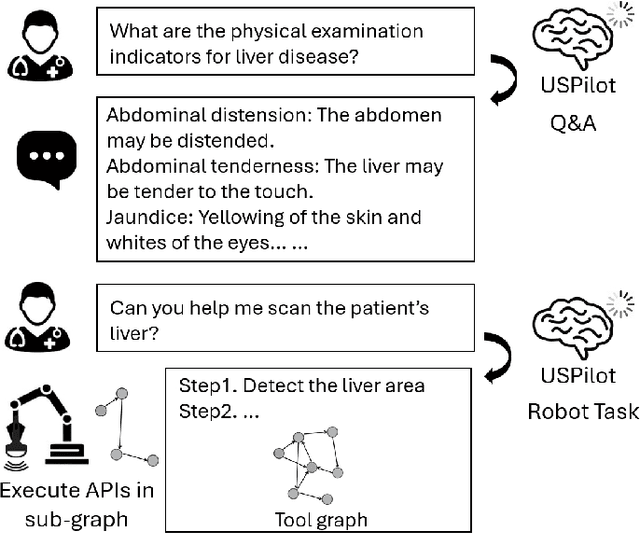
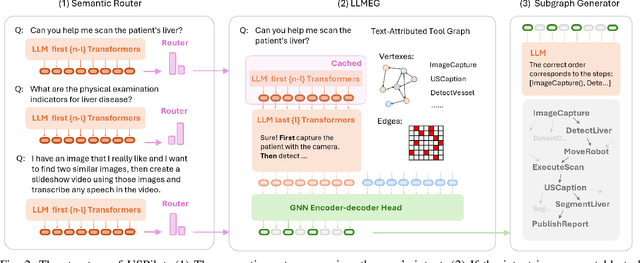

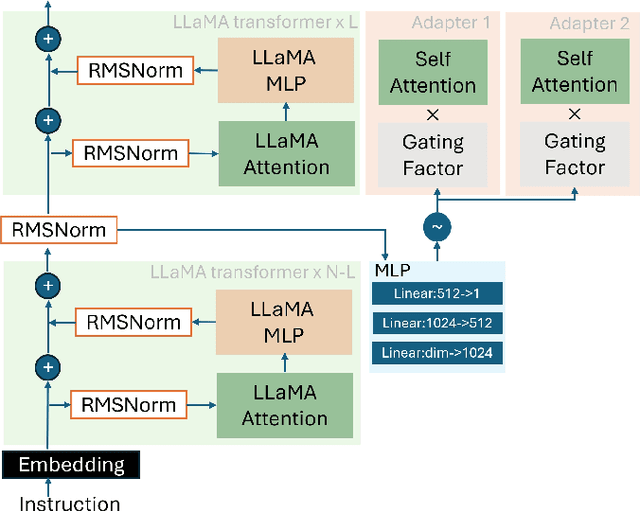
In the era of Large Language Models (LLMs), embodied artificial intelligence presents transformative opportunities for robotic manipulation tasks. Ultrasound imaging, a widely used and cost-effective medical diagnostic procedure, faces challenges due to the global shortage of professional sonographers. To address this issue, we propose USPilot, an embodied robotic assistant ultrasound system powered by an LLM-based framework to enable autonomous ultrasound acquisition. USPilot is designed to function as a virtual sonographer, capable of responding to patients' ultrasound-related queries and performing ultrasound scans based on user intent. By fine-tuning the LLM, USPilot demonstrates a deep understanding of ultrasound-specific questions and tasks. Furthermore, USPilot incorporates an LLM-enhanced Graph Neural Network (GNN) to manage ultrasound robotic APIs and serve as a task planner. Experimental results show that the LLM-enhanced GNN achieves unprecedented accuracy in task planning on public datasets. Additionally, the system demonstrates significant potential in autonomously understanding and executing ultrasound procedures. These advancements bring us closer to achieving autonomous and potentially unmanned robotic ultrasound systems, addressing critical resource gaps in medical imaging.
Force Sensing Guided Artery-Vein Segmentation via Sequential Ultrasound Images
Jul 31, 2024Accurate identification of arteries and veins in ultrasound images is crucial for vascular examinations and interventions in robotics-assisted surgeries. However, current methods for ultrasound vessel segmentation face challenges in distinguishing between arteries and veins due to their morphological similarities. To address this challenge, this study introduces a novel force sensing guided segmentation approach to enhance artery-vein segmentation accuracy by leveraging their distinct deformability. Our proposed method utilizes force magnitude to identify key frames with the most significant vascular deformation in a sequence of ultrasound images. These key frames are then integrated with the current frame through attention mechanisms, with weights assigned in accordance with force magnitude. Our proposed force sensing guided framework can be seamlessly integrated into various segmentation networks and achieves significant performance improvements in multiple U-shaped networks such as U-Net, Swin-unet and Transunet. Furthermore, we contribute the first multimodal ultrasound artery-vein segmentation dataset, Mus-V, which encompasses both force and image data simultaneously. The dataset comprises 3114 ultrasound images of carotid and femoral vessels extracted from 105 videos, with corresponding force data recorded by the force sensor mounted on the US probe. Our code and dataset will be publicly available.
Design and Visual Servoing Control of a Hybrid Dual-Segment Flexible Neurosurgical Robot for Intraventricular Biopsy
Feb 23, 2024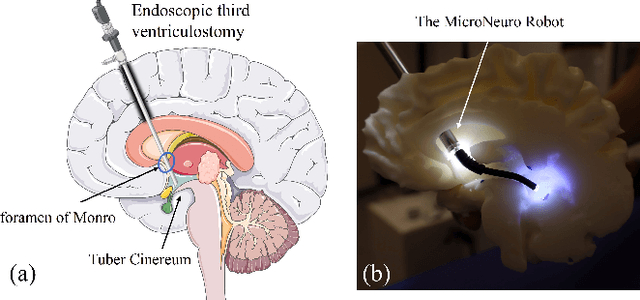
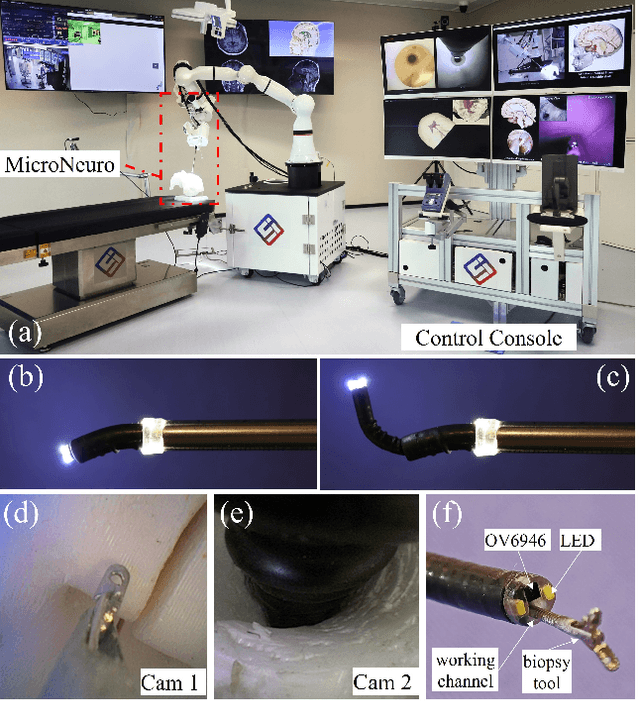
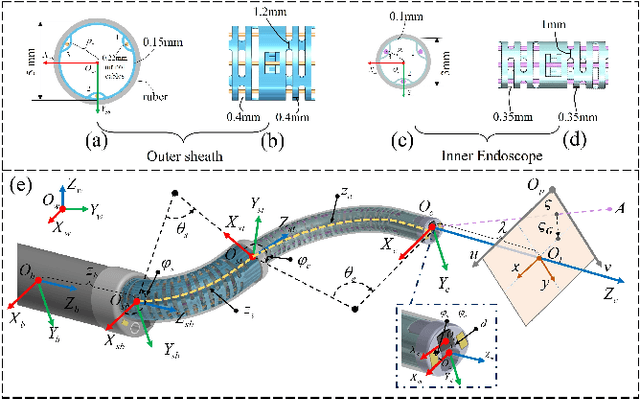
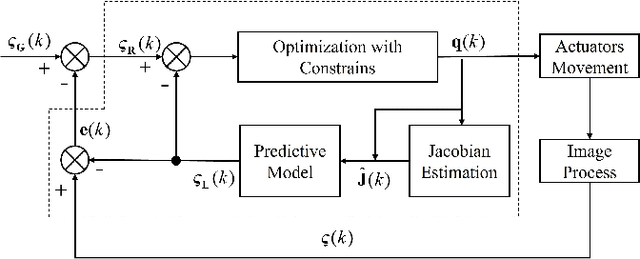
Traditional rigid endoscopes have challenges in flexibly treating tumors located deep in the brain, and low operability and fixed viewing angles limit its development. This study introduces a novel dual-segment flexible robotic endoscope MicroNeuro, designed to perform biopsies with dexterous surgical manipulation deep in the brain. Taking into account the uncertainty of the control model, an image-based visual servoing with online robot Jacobian estimation has been implemented to enhance motion accuracy. Furthermore, the application of model predictive control with constraints significantly bolsters the flexible robot's ability to adaptively track mobile objects and resist external interference. Experimental results underscore that the proposed control system enhances motion stability and precision. Phantom testing substantiates its considerable potential for deployment in neurosurgery.
DaFoEs: Mixing Datasets towards the generalization of vision-state deep-learning Force Estimation in Minimally Invasive Robotic Surgery
Jan 17, 2024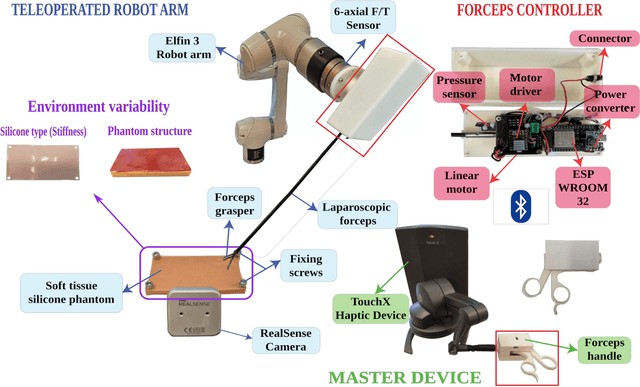
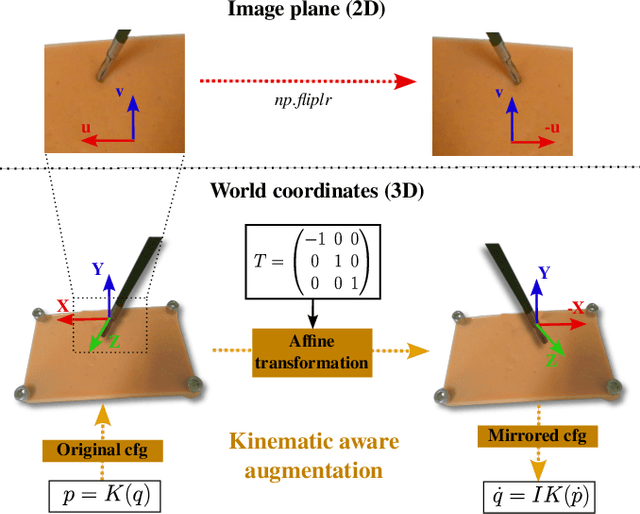
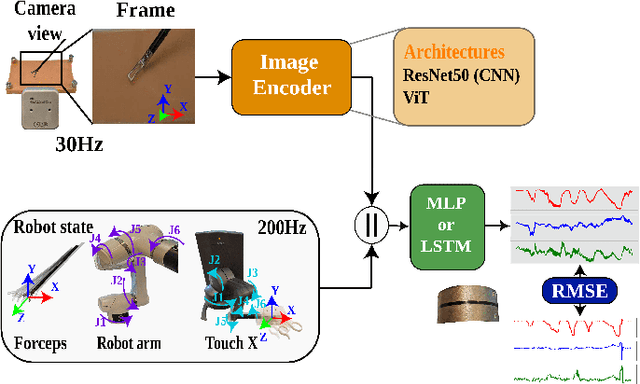
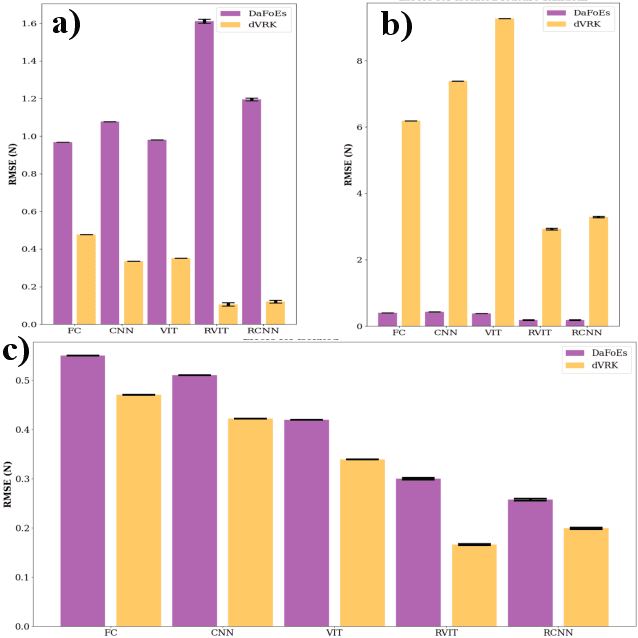
Precisely determining the contact force during safe interaction in Minimally Invasive Robotic Surgery (MIRS) is still an open research challenge. Inspired by post-operative qualitative analysis from surgical videos, the use of cross-modality data driven deep neural network models has been one of the newest approaches to predict sensorless force trends. However, these methods required for large and variable datasets which are not currently available. In this paper, we present a new vision-haptic dataset (DaFoEs) with variable soft environments for the training of deep neural models. In order to reduce the bias from a single dataset, we present a pipeline to generalize different vision and state data inputs for mixed dataset training, using a previously validated dataset with different setup. Finally, we present a variable encoder-decoder architecture to predict the forces done by the laparoscopic tool using single input or sequence of inputs. For input sequence, we use a recurrent decoder, named with the prefix R, and a new temporal sampling to represent the acceleration of the tool. During our training, we demonstrate that single dataset training tends to overfit to the training data domain, but has difficulties on translating the results across new domains. However, dataset mixing presents a good translation with a mean relative estimated force error of 5% and 12% for the recurrent and non-recurrent models respectively. Our method, also marginally increase the effectiveness of transformers for force estimation up to a maximum of ~15%, as the volume of available data is increase by 150%. In conclusion, we demonstrate that mixing experimental set ups for vision-state force estimation in MIRS is a possible approach towards the general solution of the problem.