 Add to Chrome
 Add to Firefox
 Add to Edge
StableMimic: Smooth Human-Like Recovery for Humanoid Motion Tracking - Learning Beyond the Tracking Distribution for Structured Post-Fall Behavior
Aug 03, 2026
Humanoid motion trackers perform reliably within learned tracking distributions, but falls can move the robot into low-height, contact-rich states from which an advancing command is temporarily unreachable. Tracking-only policies may chase infeasible references, producing rapid, large-amplitude limb corrections that increase risk to the robot and its surroundings. We present StableMimic, a unified tracker trained beyond the nominal tracking distribution. Perturbed resets around multiple human get-up references expose prone, supine, off-balance, and intermediate ground-contact states, shaping structured recovery that returns the robot to the trackable region. Because tracking and recovery occupy markedly different state--action distributions, StableMimic uses dedicated experts for each regime and a proprioceptive gate that continuously blends their actions. A hidden successor-state objective teaches human-reference-shaped recovery without exposing reference identity or phase to the deployed Actor; deployment requires no get-up reference, recovery command, trajectory retrieval, or external policy switch. On the complete retargeted LAFAN1 dance subset, StableMimic achieves the lowest errors on all four tracking metrics among five methods. Across 100 matched push-to-fall trials per method, it recovers in 100/100 and attains the lowest values on six of seven post-fall motion and load measures, supporting improved interaction safety under this protocol. Real Unitree G1 dance and standing-reference deployments qualitatively demonstrate bounded limb motion, autonomous recovery, and command resumption.

MUSCLE-NET: Predicted-Multiscale-Aware Network for Pedestrian Trajectory Forecasting
May 30, 2026Accurate pedestrian trajectory prediction is essential for safe navigation in autonomous driving and intelligent transportation systems. Despite substantial progress made by recent methods, most existing approaches are limited in fully exploiting diverse observations and often overlook the scale dependency of future motion, treating multiscale features uniformly regardless of underlying motion dynamics. This limits their robustness across diverse pedestrian behaviors. To address these challenges, we propose a Predicted-MUltiSCale-Aware Network (MUSCLE-NET) for Pedestrian Trajectory Forecasting that integrates complementary multimodal cues with scale-adaptive prediction mechanisms. The proposed framework is built upon a Multiscale Multimodal Feature Extraction (MMFE) module, which combines multiscale representation, modality-aware recalibration, and directional cross-modal fusion to construct semantically aligned representations from bounding boxes, velocities, and pose information. Building on these features, a Multiscale Enhanced Hierarchical Prediction (MEHP) module performs prediction-aware future-motion refinement via a probabilistic coarse predictor, scale-aligned fusion, and progressive refinement, adaptively selecting scale-relevant cues to mitigate spatial drift. Extensive experiments on the JAAD and PIE benchmarks demonstrate that the proposed MUSCLE-Net achieves competitive performance and consistent gains compared with state-of-the-art trajectory prediction methods.
Ultra-High-Definition Image Quality Assessment via Graph Representation Learning
May 21, 2026Blind image quality assessment (BIQA) for ultrahighdefinition (UHD) images remains challenging because native-resolution inference is computationally expensive, whereas aggressive resizing or isolated cropping may suppress scale-sensitive distortions and weaken the relationship between local artifacts and global scene context. This paper aims to improve UHD-BIQA by explicitly modeling the structural dependencies among sampled image regions rather than treating them as independent views, and a graph representation learning framework UHD-GCN-BIQA is proposed. The framework samples aspect-ratio-aligned patches from each UHD image, encodes them as graph nodes, and constructs a hybrid k-nearest-neighbor graph using spatial proximity and feature similarity. Residual graph convolution is used to propagate contextual information across regions, and gated attention pooling aggregates patchlevel evidence into an imagelevel quality prediction. An exponential moving average normalized multiobjective loss function is adopted to stabilize the joint optimization of regression, correlation, and ranking objectives. Experiments on the UHD-IQA benchmark show that UHD-GCN-BIQA achieves PLCC = 0.7784, SRCC = 0.8019, and RMSE = 0.0519, obtaining competitive correlation performance and the lowest RMSE among the compared methods. These results indicate that graph-based region relation modeling is effective for UHD image quality assessment, particularly for improving absolute quality score estimation under high-resolution visual content.
ASAP: An Azimuth-Priority Strip-Based Search Approach to Planar Microphone Array DOA Estimation in 3D
Apr 28, 2026Direction-of-arrival (DOA) estimation is an important task in microphone array processing and many downstream applications. The steered response power with phase transform (SRP-PHAT) method has been widely adopted for DOA estimation in recent years. However, accurate SRP-PHAT estimation in 3D scenarios requires evaluating steering responses over thousands of candidate directions, severely limiting real-time performance on resource-constrained platforms. This challenge becomes even more critical for planar arrays, which are widely used in robotics due to their structural simplicity. Motivated by the fact that azimuth estimation is usually more reliable than elevation estimation for most arrays, we propose ASAP, an azimuth-priority strip-based search approach to planar microphone array DOA estimation in 3D. In the first stage, ASAP performs coarse-to-fine region contraction within azimuthal strips to lock azimuth angles while retaining multiple maxima through spherical caps. In the second stage, it refines elevation along the great-circle arc between two close candidates. Extensive simulations and real-world experiments validate the efficiency and merits of the proposed method over existing approaches.
ProtRLSearch: A Multi-Round Multimodal Protein Search Agent with Large Language Models Trained via Reinforcement Learning
Mar 02, 2026Protein analysis tasks arising in healthcare settings often require accurate reasoning under protein sequence constraints, involving tasks such as functional interpretation of disease-related variants, protein-level analysis for clinical research, and similar scenarios. To address such tasks, search agents are introduced to search protein-related information, providing support for disease-related variant analysis and protein function reasoning in protein-centric inference. However, such search agents are mostly limited to single-round, text-only modality search, which prevents the protein sequence modality from being incorporated as a multimodal input into the search decision-making process. Meanwhile, their reliance on reinforcement learning (RL) supervision that focuses solely on the final answer results in a lack of search process constraints, making deviations in keyword selection and reasoning directions difficult to identify and correct in a timely manner. To address these limitations, we propose ProtRLSearch, a multi-round protein search agent trained with multi-dimensional reward based RL, which jointly leverages protein sequence and text as multimodal inputs during real-time search to produce high quality reports. To evaluate the ability of models to integrate protein sequence information and text-based multimodal inputs in realistic protein query settings, we construct ProtMCQs, a benchmark of 3,000 multiple choice questions (MCQs) organized into three difficulty levels. The benchmark evaluates protein query tasks that range from sequence constrained reasoning about protein function and phenotype changes to comprehensive protein reasoning that integrates multi-dimensional sequence features with signal pathways and regulatory networks.
Multi-Label Classification with Generative AI Models in Healthcare: A Case Study of Suicidality and Risk Factors
Jul 22, 2025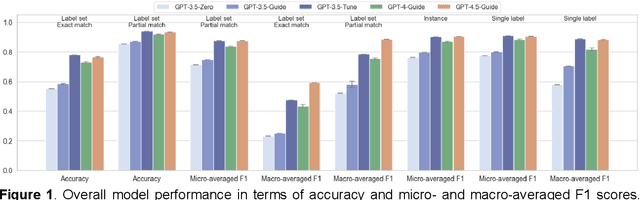
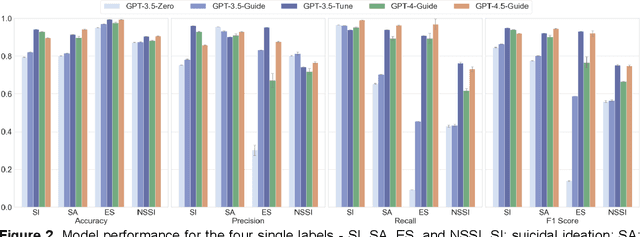
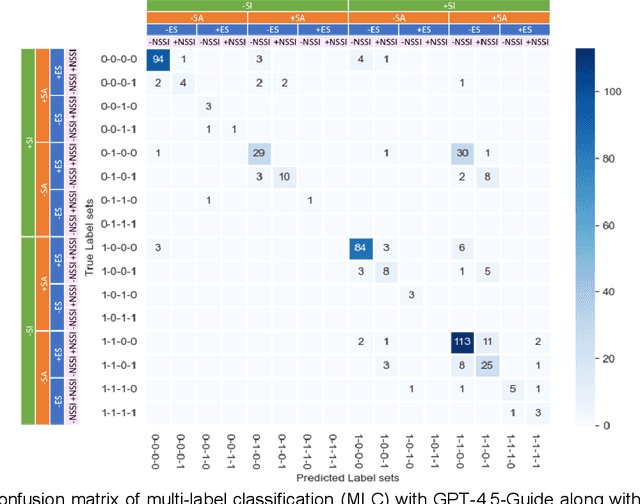
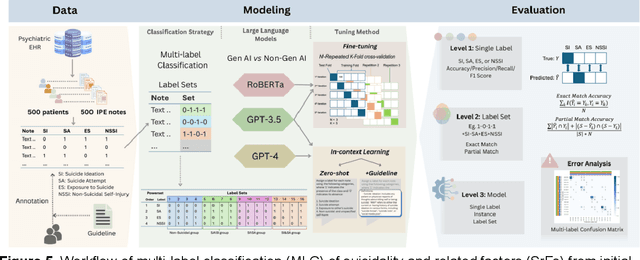
Suicide remains a pressing global health crisis, with over 720,000 deaths annually and millions more affected by suicide ideation (SI) and suicide attempts (SA). Early identification of suicidality-related factors (SrFs), including SI, SA, exposure to suicide (ES), and non-suicidal self-injury (NSSI), is critical for timely intervention. While prior studies have applied AI to detect SrFs in clinical notes, most treat suicidality as a binary classification task, overlooking the complexity of cooccurring risk factors. This study explores the use of generative large language models (LLMs), specifically GPT-3.5 and GPT-4.5, for multi-label classification (MLC) of SrFs from psychiatric electronic health records (EHRs). We present a novel end to end generative MLC pipeline and introduce advanced evaluation methods, including label set level metrics and a multilabel confusion matrix for error analysis. Finetuned GPT-3.5 achieved top performance with 0.94 partial match accuracy and 0.91 F1 score, while GPT-4.5 with guided prompting showed superior performance across label sets, including rare or minority label sets, indicating a more balanced and robust performance. Our findings reveal systematic error patterns, such as the conflation of SI and SA, and highlight the models tendency toward cautious over labeling. This work not only demonstrates the feasibility of using generative AI for complex clinical classification tasks but also provides a blueprint for structuring unstructured EHR data to support large scale clinical research and evidence based medicine.
A Comprehensive Survey of Small Language Models in the Era of Large Language Models: Techniques, Enhancements, Applications, Collaboration with LLMs, and Trustworthiness
Nov 04, 2024Large language models (LLM) have demonstrated emergent abilities in text generation, question answering, and reasoning, facilitating various tasks and domains. Despite their proficiency in various tasks, LLMs like LaPM 540B and Llama-3.1 405B face limitations due to large parameter sizes and computational demands, often requiring cloud API use which raises privacy concerns, limits real-time applications on edge devices, and increases fine-tuning costs. Additionally, LLMs often underperform in specialized domains such as healthcare and law due to insufficient domain-specific knowledge, necessitating specialized models. Therefore, Small Language Models (SLMs) are increasingly favored for their low inference latency, cost-effectiveness, efficient development, and easy customization and adaptability. These models are particularly well-suited for resource-limited environments and domain knowledge acquisition, addressing LLMs' challenges and proving ideal for applications that require localized data handling for privacy, minimal inference latency for efficiency, and domain knowledge acquisition through lightweight fine-tuning. The rising demand for SLMs has spurred extensive research and development. However, a comprehensive survey investigating issues related to the definition, acquisition, application, enhancement, and reliability of SLM remains lacking, prompting us to conduct a detailed survey on these topics. The definition of SLMs varies widely, thus to standardize, we propose defining SLMs by their capability to perform specialized tasks and suitability for resource-constrained settings, setting boundaries based on the minimal size for emergent abilities and the maximum size sustainable under resource constraints. For other aspects, we provide a taxonomy of relevant models/methods and develop general frameworks for each category to enhance and utilize SLMs effectively.
Suicide Phenotyping from Clinical Notes in Safety-Net Psychiatric Hospital Using Multi-Label Classification with Pre-Trained Language Models
Sep 27, 2024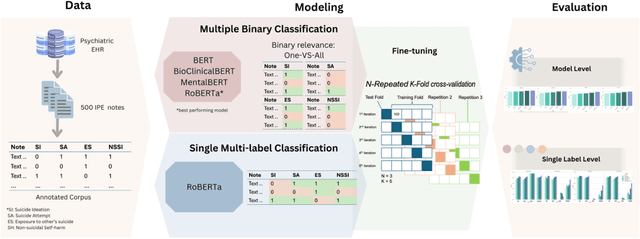

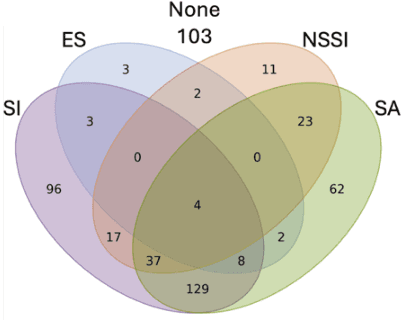
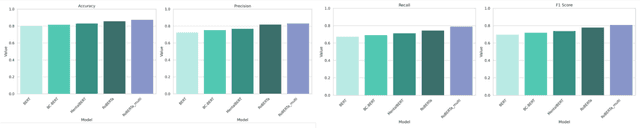
Accurate identification and categorization of suicidal events can yield better suicide precautions, reducing operational burden, and improving care quality in high-acuity psychiatric settings. Pre-trained language models offer promise for identifying suicidality from unstructured clinical narratives. We evaluated the performance of four BERT-based models using two fine-tuning strategies (multiple single-label and single multi-label) for detecting coexisting suicidal events from 500 annotated psychiatric evaluation notes. The notes were labeled for suicidal ideation (SI), suicide attempts (SA), exposure to suicide (ES), and non-suicidal self-injury (NSSI). RoBERTa outperformed other models using binary relevance (acc=0.86, F1=0.78). MentalBERT (F1=0.74) also exceeded BioClinicalBERT (F1=0.72). RoBERTa fine-tuned with a single multi-label classifier further improved performance (acc=0.88, F1=0.81), highlighting that models pre-trained on domain-relevant data and the single multi-label classification strategy enhance efficiency and performance. Keywords: EHR-based Phynotyping; Natural Language Processing; Secondary Use of EHR Data; Suicide Classification; BERT-based Model; Psychiatry; Mental Health
Can GPT-4 Help Detect Quit Vaping Intentions? An Exploration of Automatic Data Annotation Approach
Jun 28, 2024
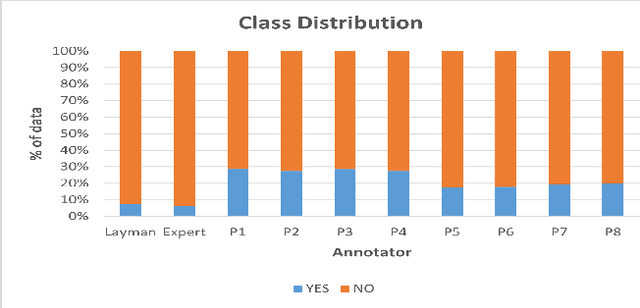
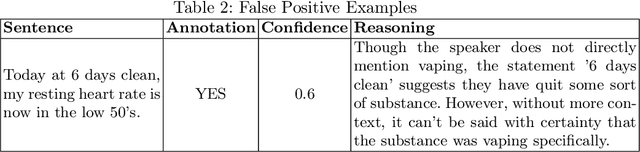
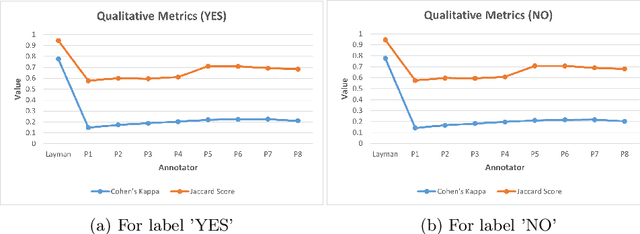
In recent years, the United States has witnessed a significant surge in the popularity of vaping or e-cigarette use, leading to a notable rise in cases of e-cigarette and vaping use-associated lung injury (EVALI) that caused hospitalizations and fatalities during the EVALI outbreak in 2019, highlighting the urgency to comprehend vaping behaviors and develop effective strategies for cessation. Due to the ubiquity of social media platforms, over 4.7 billion users worldwide use them for connectivity, communications, news, and entertainment with a significant portion of the discourse related to health, thereby establishing social media data as an invaluable organic data resource for public health research. In this study, we extracted a sample dataset from one vaping sub-community on Reddit to analyze users' quit-vaping intentions. Leveraging OpenAI's latest large language model GPT-4 for sentence-level quit vaping intention detection, this study compares the outcomes of this model against layman and clinical expert annotations. Using different prompting strategies such as zero-shot, one-shot, few-shot and chain-of-thought prompting, we developed 8 prompts with varying levels of detail to explain the task to GPT-4 and also evaluated the performance of the strategies against each other. These preliminary findings emphasize the potential of GPT-4 in social media data analysis, especially in identifying users' subtle intentions that may elude human detection.
Utilizing Large Language Models to Identify Reddit Users Considering Vaping Cessation for Digital Interventions
Apr 25, 2024The widespread adoption of social media platforms globally not only enhances users' connectivity and communication but also emerges as a vital channel for the dissemination of health-related information, thereby establishing social media data as an invaluable organic data resource for public health research. The surge in popularity of vaping or e-cigarette use in the United States and other countries has caused an outbreak of e-cigarette and vaping use-associated lung injury (EVALI), leading to hospitalizations and fatalities in 2019, highlighting the urgency to comprehend vaping behaviors and develop effective strategies for cession. In this study, we extracted a sample dataset from one vaping sub-community on Reddit to analyze users' quit vaping intentions. Leveraging large language models including both the latest GPT-4 and traditional BERT-based language models for sentence-level quit-vaping intention prediction tasks, this study compares the outcomes of these models against human annotations. Notably, when compared to human evaluators, GPT-4 model demonstrates superior consistency in adhering to annotation guidelines and processes, showcasing advanced capabilities to detect nuanced user quit-vaping intentions that human evaluators might overlook. These preliminary findings emphasize the potential of GPT-4 in enhancing the accuracy and reliability of social media data analysis, especially in identifying subtle users' intentions that may elude human detection.