 Add to Chrome
 Add to Firefox
 Add to Edge
Closed-form Symbolic Solutions: A New Perspective on Solving Partial Differential Equations
May 23, 2024
Solving partial differential equations (PDEs) in Euclidean space with closed-form symbolic solutions has long been a dream for mathematicians. Inspired by deep learning, Physics-Informed Neural Networks (PINNs) have shown great promise in numerically solving PDEs. However, since PINNs essentially approximate solutions within the continuous function space, their numerical solutions fall short in both precision and interpretability compared to symbolic solutions. This paper proposes a novel framework: a closed-form \textbf{Sym}bolic framework for \textbf{PDE}s (SymPDE), exploring the use of deep reinforcement learning to directly obtain symbolic solutions for PDEs. SymPDE alleviates the challenges PINNs face in fitting high-frequency and steeply changing functions. To our knowledge, no prior work has implemented this approach. Experiments on solving the Poisson's equation and heat equation in time-independent and spatiotemporal dynamical systems respectively demonstrate that SymPDE can provide accurate closed-form symbolic solutions for various types of PDEs.

From Algorithm to Hardware: A Survey on Efficient and Safe Deployment of Deep Neural Networks
May 09, 2024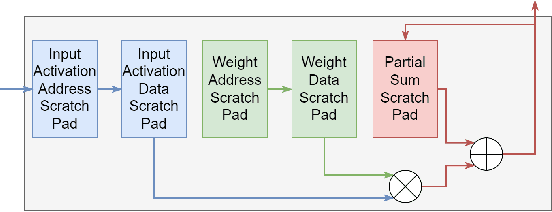
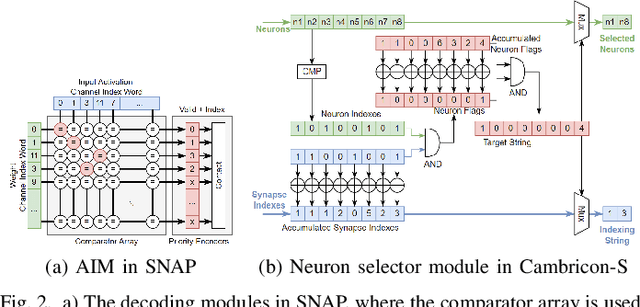
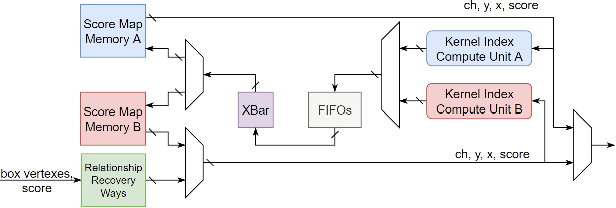
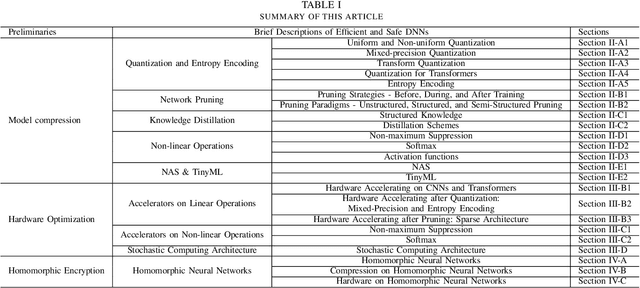
Deep neural networks (DNNs) have been widely used in many artificial intelligence (AI) tasks. However, deploying them brings significant challenges due to the huge cost of memory, energy, and computation. To address these challenges, researchers have developed various model compression techniques such as model quantization and model pruning. Recently, there has been a surge in research of compression methods to achieve model efficiency while retaining the performance. Furthermore, more and more works focus on customizing the DNN hardware accelerators to better leverage the model compression techniques. In addition to efficiency, preserving security and privacy is critical for deploying DNNs. However, the vast and diverse body of related works can be overwhelming. This inspires us to conduct a comprehensive survey on recent research toward the goal of high-performance, cost-efficient, and safe deployment of DNNs. Our survey first covers the mainstream model compression techniques such as model quantization, model pruning, knowledge distillation, and optimizations of non-linear operations. We then introduce recent advances in designing hardware accelerators that can adapt to efficient model compression approaches. Additionally, we discuss how homomorphic encryption can be integrated to secure DNN deployment. Finally, we discuss several issues, such as hardware evaluation, generalization, and integration of various compression approaches. Overall, we aim to provide a big picture of efficient DNNs, from algorithm to hardware accelerators and security perspectives.
TSLANet: Rethinking Transformers for Time Series Representation Learning
Apr 12, 2024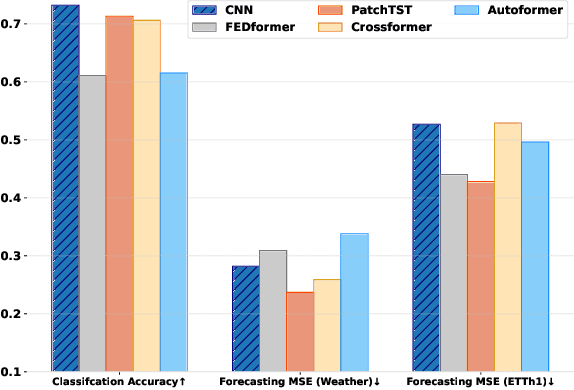
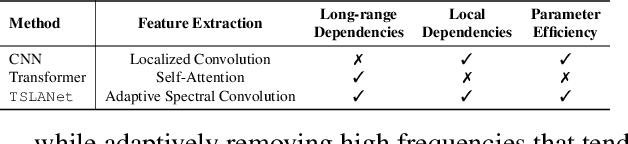
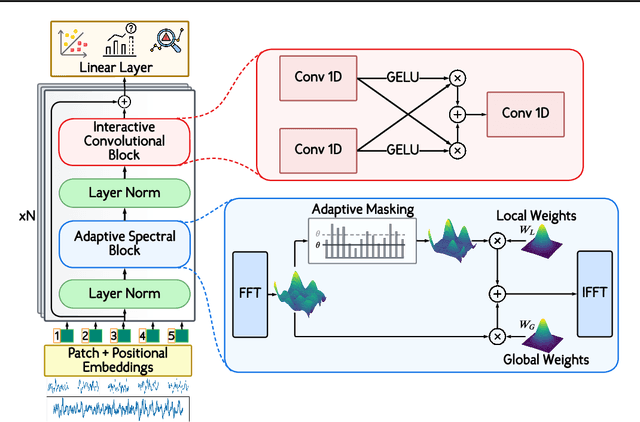

Time series data, characterized by its intrinsic long and short-range dependencies, poses a unique challenge across analytical applications. While Transformer-based models excel at capturing long-range dependencies, they face limitations in noise sensitivity, computational efficiency, and overfitting with smaller datasets. In response, we introduce a novel Time Series Lightweight Adaptive Network (TSLANet), as a universal convolutional model for diverse time series tasks. Specifically, we propose an Adaptive Spectral Block, harnessing Fourier analysis to enhance feature representation and to capture both long-term and short-term interactions while mitigating noise via adaptive thresholding. Additionally, we introduce an Interactive Convolution Block and leverage self-supervised learning to refine the capacity of TSLANet for decoding complex temporal patterns and improve its robustness on different datasets. Our comprehensive experiments demonstrate that TSLANet outperforms state-of-the-art models in various tasks spanning classification, forecasting, and anomaly detection, showcasing its resilience and adaptability across a spectrum of noise levels and data sizes. The code is available at \url{https://github.com/emadeldeen24/TSLANet}
Generative Pre-Trained Transformer for Symbolic Regression Base In-Context Reinforcement Learning
Apr 09, 2024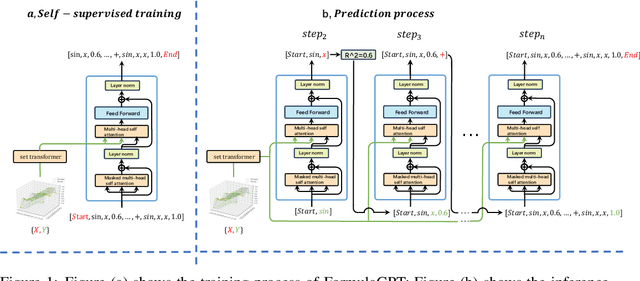
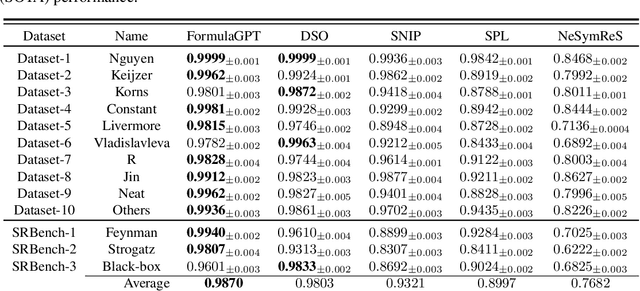
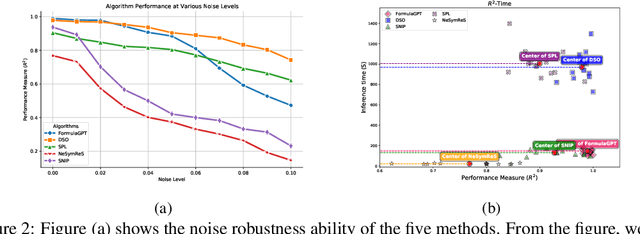
The mathematical formula is the human language to describe nature and is the essence of scientific research. Finding mathematical formulas from observational data is a major demand of scientific research and a major challenge of artificial intelligence. This area is called symbolic regression. Originally symbolic regression was often formulated as a combinatorial optimization problem and solved using GP or reinforcement learning algorithms. These two kinds of algorithms have strong noise robustness ability and good Versatility. However, inference time usually takes a long time, so the search efficiency is relatively low. Later, based on large-scale pre-training data proposed, such methods use a large number of synthetic data points and expression pairs to train a Generative Pre-Trained Transformer(GPT). Then this GPT can only need to perform one forward propagation to obtain the results, the advantage is that the inference speed is very fast. However, its performance is very dependent on the training data and performs poorly on data outside the training set, which leads to poor noise robustness and Versatility of such methods. So, can we combine the advantages of the above two categories of SR algorithms? In this paper, we propose \textbf{FormulaGPT}, which trains a GPT using massive sparse reward learning histories of reinforcement learning-based SR algorithms as training data. After training, the SR algorithm based on reinforcement learning is distilled into a Transformer. When new test data comes, FormulaGPT can directly generate a "reinforcement learning process" and automatically update the learning policy in context. Tested on more than ten datasets including SRBench, formulaGPT achieves the state-of-the-art performance in fitting ability compared with four baselines. In addition, it achieves satisfactory results in noise robustness, versatility, and inference efficiency.
MMSR: Symbolic Regression is a Multimodal Task
Mar 14, 2024Mathematical formulas are the crystallization of human wisdom in exploring the laws of nature for thousands of years. Describing the complex laws of nature with a concise mathematical formula is a constant pursuit of scientists and a great challenge for artificial intelligence. This field is called symbolic regression. Symbolic regression was originally formulated as a combinatorial optimization problem, and GP and reinforcement learning algorithms were used to solve it. However, GP is sensitive to hyperparameters, and these two types of algorithms are inefficient. To solve this problem, researchers treat the mapping from data to expressions as a translation problem. And the corresponding large-scale pre-trained model is introduced. However, the data and expression skeletons do not have very clear word correspondences as the two languages do. Instead, they are more like two modalities (e.g., image and text). Therefore, in this paper, we proposed MMSR. The SR problem is solved as a pure multimodal problem, and contrastive learning is also introduced in the training process for modal alignment to facilitate later modal feature fusion. It is worth noting that in order to better promote the modal feature fusion, we adopt the strategy of training contrastive learning loss and other losses at the same time, which only needs one-step training, instead of training contrastive learning loss first and then training other losses. Because our experiments prove training together can make the feature extraction module and feature fusion module running-in better. Experimental results show that compared with multiple large-scale pre-training baselines, MMSR achieves the most advanced results on multiple mainstream datasets including SRBench.
Balancing Fairness and Accuracy in Data-Restricted Binary Classification
Mar 12, 2024Applications that deal with sensitive information may have restrictions placed on the data available to a machine learning (ML) classifier. For example, in some applications, a classifier may not have direct access to sensitive attributes, affecting its ability to produce accurate and fair decisions. This paper proposes a framework that models the trade-off between accuracy and fairness under four practical scenarios that dictate the type of data available for analysis. Prior works examine this trade-off by analyzing the outputs of a scoring function that has been trained to implicitly learn the underlying distribution of the feature vector, class label, and sensitive attribute of a dataset. In contrast, our framework directly analyzes the behavior of the optimal Bayesian classifier on this underlying distribution by constructing a discrete approximation it from the dataset itself. This approach enables us to formulate multiple convex optimization problems, which allow us to answer the question: How is the accuracy of a Bayesian classifier affected in different data restricting scenarios when constrained to be fair? Analysis is performed on a set of fairness definitions that include group and individual fairness. Experiments on three datasets demonstrate the utility of the proposed framework as a tool for quantifying the trade-offs among different fairness notions and their distributional dependencies.
K-Link: Knowledge-Link Graph from LLMs for Enhanced Representation Learning in Multivariate Time-Series Data
Mar 06, 2024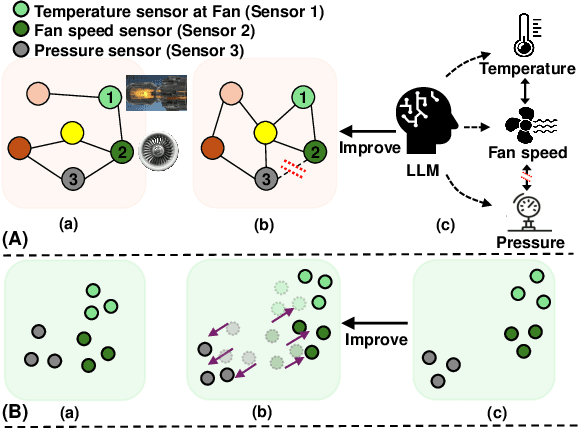
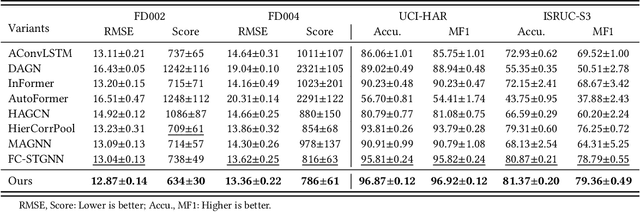
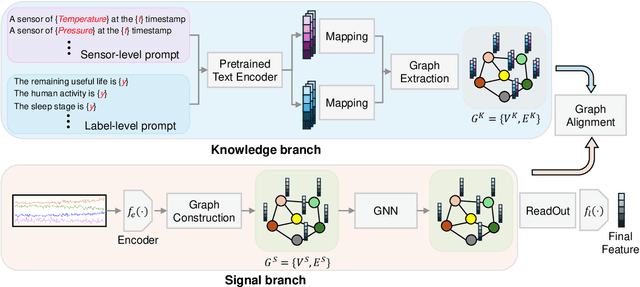
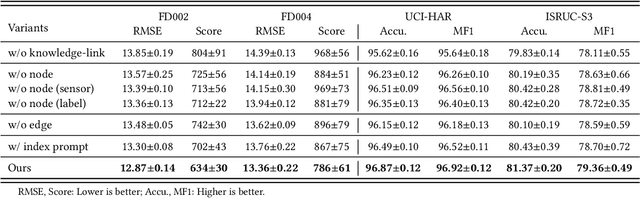
Sourced from various sensors and organized chronologically, Multivariate Time-Series (MTS) data involves crucial spatial-temporal dependencies, e.g., correlations among sensors. To capture these dependencies, Graph Neural Networks (GNNs) have emerged as powerful tools, yet their effectiveness is restricted by the quality of graph construction from MTS data. Typically, existing approaches construct graphs solely from MTS signals, which may introduce bias due to a small training dataset and may not accurately represent underlying dependencies. To address this challenge, we propose a novel framework named K-Link, leveraging Large Language Models (LLMs) to encode extensive general knowledge and thereby providing effective solutions to reduce the bias. Leveraging the knowledge embedded in LLMs, such as physical principles, we extract a \textit{Knowledge-Link graph}, capturing vast semantic knowledge of sensors and the linkage of the sensor-level knowledge. To harness the potential of the knowledge-link graph in enhancing the graph derived from MTS data, we propose a graph alignment module, facilitating the transfer of semantic knowledge within the knowledge-link graph into the MTS-derived graph. By doing so, we can improve the graph quality, ensuring effective representation learning with GNNs for MTS data. Extensive experiments demonstrate the efficacy of our approach for superior performance across various MTS-related downstream tasks.
PowerSkel: A Device-Free Framework Using CSI Signal for Human Skeleton Estimation in Power Station
Mar 04, 2024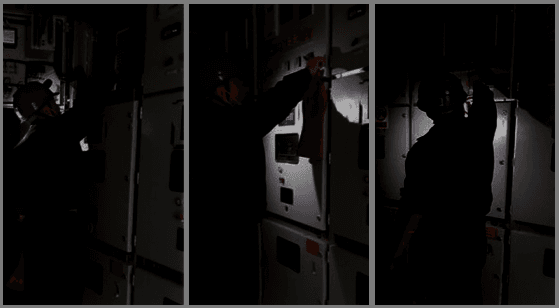
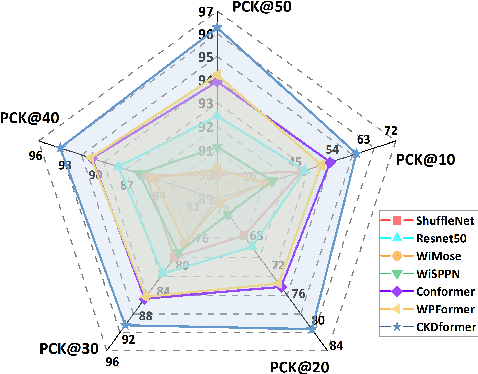
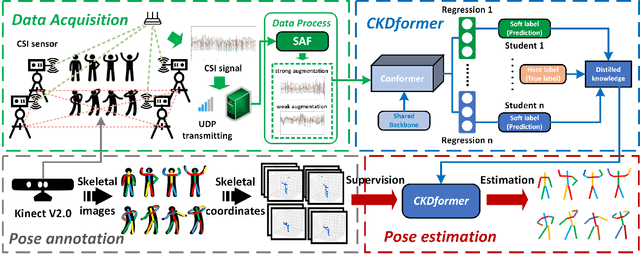
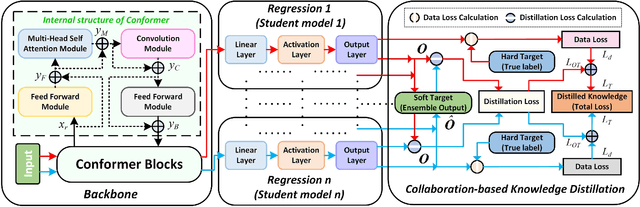
Safety monitoring of power operations in power stations is crucial for preventing accidents and ensuring stable power supply. However, conventional methods such as wearable devices and video surveillance have limitations such as high cost, dependence on light, and visual blind spots. WiFi-based human pose estimation is a suitable method for monitoring power operations due to its low cost, device-free, and robustness to various illumination conditions.In this paper, a novel Channel State Information (CSI)-based pose estimation framework, namely PowerSkel, is developed to address these challenges. PowerSkel utilizes self-developed CSI sensors to form a mutual sensing network and constructs a CSI acquisition scheme specialized for power scenarios. It significantly reduces the deployment cost and complexity compared to the existing solutions. To reduce interference with CSI in the electricity scenario, a sparse adaptive filtering algorithm is designed to preprocess the CSI. CKDformer, a knowledge distillation network based on collaborative learning and self-attention, is proposed to extract the features from CSI and establish the mapping relationship between CSI and keypoints. The experiments are conducted in a real-world power station, and the results show that the PowerSkel achieves high performance with a PCK@50 of 96.27%, and realizes a significant visualization on pose estimation, even in dark environments. Our work provides a novel low-cost and high-precision pose estimation solution for power operation.
Balancing Spectral, Temporal and Spatial Information for EEG-based Alzheimer's Disease Classification
Feb 21, 2024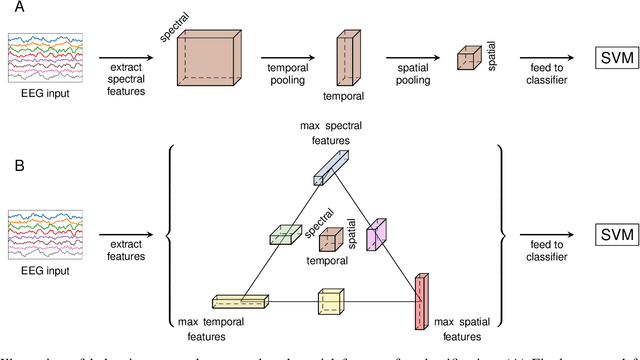
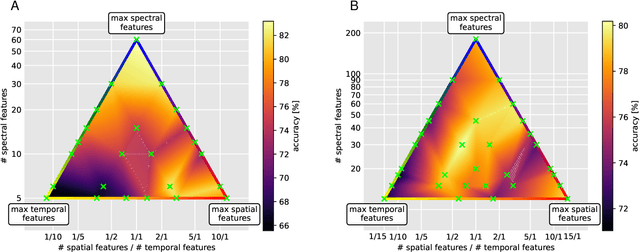
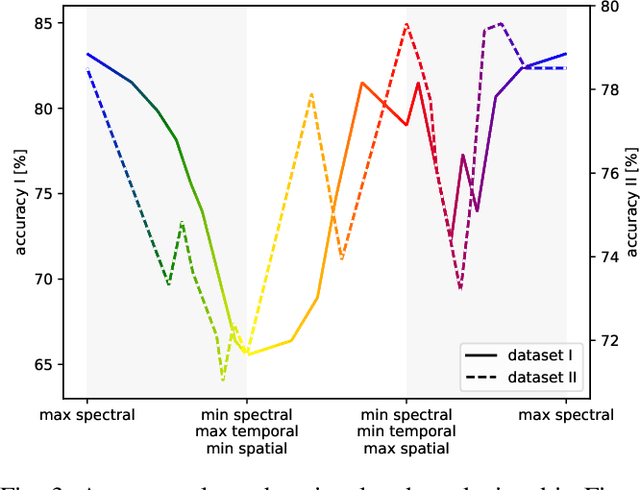
The prospect of future treatment warrants the development of cost-effective screening for Alzheimer's disease (AD). A promising candidate in this regard is electroencephalography (EEG), as it is one of the most economic imaging modalities. Recent efforts in EEG analysis have shifted towards leveraging spatial information, employing novel frameworks such as graph signal processing or graph neural networks. Here, we systematically investigate the importance of spatial information relative to spectral or temporal information by varying the proportion of each dimension for AD classification. To do so, we test various dimension resolution configurations on two routine EEG datasets. We find that spatial information is consistently more relevant than temporal information and equally relevant as spectral information. These results emphasise the necessity to consider spatial information for EEG-based AD classification. On our second dataset, we further find that well-balanced feature resolutions boost classification accuracy by up to 1.6%. Our resolution-based feature extraction has the potential to improve AD classification specifically, and multivariate signal classification generally.
Stochastic Graph Heat Modelling for Diffusion-based Connectivity Retrieval
Feb 20, 2024Heat diffusion describes the process by which heat flows from areas with higher temperatures to ones with lower temperatures. This concept was previously adapted to graph structures, whereby heat flows between nodes of a graph depending on the graph topology. Here, we combine the graph heat equation with the stochastic heat equation, which ultimately yields a model for multivariate time signals on a graph. We show theoretically how the model can be used to directly compute the diffusion-based connectivity structure from multivariate signals. Unlike other connectivity measures, our heat model-based approach is inherently multivariate and yields an absolute scaling factor, namely the graph thermal diffusivity, which captures the extent of heat-like graph propagation in the data. On two datasets, we show how the graph thermal diffusivity can be used to characterise Alzheimer's disease. We find that the graph thermal diffusivity is lower for Alzheimer's patients than healthy controls and correlates with dementia scores, suggesting structural impairment in patients in line with previous findings.