 Add to Chrome
 Add to Firefox
 Add to Edge
Roomer: Reflective Object-Grounded Model Editing and Repair for 3D Indoor Layout Synthesis
Aug 03, 2026
Existing indoor layout generators produce globally plausible layouts yet may retain local violations such as collisions, out-of-bounds placements, obstructed openings, and blocked circulation. Most prior work focuses on full-scene synthesis or scene-level optimization, with limited support for identifying responsible objects and locally repairing affected regions. We present Roomer, a reflective repair framework that casts these violations as sparse, object-grounded repair problems. Roomer encodes layouts as ``RoState'' and uses ``RoReview'' to bind measured violations to implicated objects. A geometry-conditioned vision-language model planner proposes a structured local edit, while a deterministic solver validates it and generates a finite set of candidate edits when needed. Each candidate is committed only if full-scene verification confirms that it resolves the target violation without new hard violations or broken protected constraints. We train the planner on Roomer-CC, a controlled-corruption dataset that pairs faulty layouts with object-grounded violation evidence and known-feasible inverse StatePatches. Since existing benchmarks rarely assess whether physically valid layouts are usable, we introduce Roomer-Eval to assess distributional quality, physical validity, and practical usability. Experiments show that Roomer repairs residual violations while preserving valid regions, improves physical validity and usability, and transfers across external generators.

StyleForge: Indoor Furniture Styling by Counterfactual Reasoning in a Hypergraph Field
Aug 03, 2026Fixed-layout indoor furniture styling requires selecting assets that form a coherent room without changing the prescribed furniture categories, positions, orientations, or scales. Existing approaches typically retrieve each asset independently or rely on static local relations, making them prone to shape, material, and color conflicts after scene composition. We introduce StyleForge, a scene-level structured selection framework built on a dynamic hypergraph style field. A frozen multimodal large language model extracts structured style priors from an open-ended style request and the fixed layout, while StyleForge maintains a learnable candidate distribution for each furniture slot. Conditioned on the target style, the dynamic hypergraph style field adaptively activates and weights layout-induced hyperedges to capture higher-order dependencies among furniture. Counterfactual style preference learning then treats each candidate as a local substitution in the current style field and evaluates its contextual compatibility using Mahalanobis energies. Training alternates between optimizing the style field and the candidate logits. At inference, the model remains frozen and test-time training updates only room-specific candidate logits, progressively correcting cross-slot style conflicts as the global scene context evolves. Experiments on 3D-FRONT demonstrate state-of-the-art furniture retrieval and scene-level style coherence, producing more coherent fixed-layout furniture arrangements than object- and scene-level retrieval baselines.
Improving low-resource ASR using bilingual fine-tuning with language identification: a cross-linguistic evaluation
Jun 16, 2026This study explores how bilingual fine-tuning affects automatic speech recognition (ASR) in low-resource languages. We evaluate this method across nine linguistically and geographically diverse language pairs, covering a range of language families and writing systems. To distinguish the two languages, during training, we pre-pend each input text with a language identification token. At inference, the model jointly predicts both the language and transcription from the speech input alone. As texts for which the language is incorrectly determined show low ASR performance, we also conduct a follow-up experiment in which the language identification token is provided both during training and inference. Our results show that bilingual fine-tuning can be beneficial when language identification accuracy is high, and that in cases where language identification performance is low, including the language identification token at inference helps to improve ASR performance.
Can Large Language Models Reliably Correct Errors in Low-Resource ASR? A Contamination-Aware Case Study on West Frisian
May 19, 2026Automatic speech recognition (ASR) has improved substantially in recent years, yet performance remains limited for low-resource languages. Large language models (LLMs) have shown promise for improving ASR through generative error correction (GER), but their effectiveness in low-resource settings remains underexplored. In addition, it remains unclear to what extent data contamination influences the reported improvements in LLM-based GER. This study investigates LLM-based GER for low-resource Frisian. In addition to a public corpus, we construct and use a Frisian offline dataset with non-public texts for evaluation to control for potential data contamination. Results show that GER improves ASR performance in most settings, with the best GPT-5.1 results surpassing oracle WERs. Comparable gains on the offline dataset indicate that improvements reflect true correction ability. We further provide a detailed error analysis revealing model correction patterns.
Inverse Materials Design by Large Language Model-Assisted Generative Framework
Feb 25, 2025Deep generative models hold great promise for inverse materials design, yet their efficiency and accuracy remain constrained by data scarcity and model architecture. Here, we introduce AlloyGAN, a closed-loop framework that integrates Large Language Model (LLM)-assisted text mining with Conditional Generative Adversarial Networks (CGANs) to enhance data diversity and improve inverse design. Taking alloy discovery as a case study, AlloyGAN systematically refines material candidates through iterative screening and experimental validation. For metallic glasses, the framework predicts thermodynamic properties with discrepancies of less than 8% from experiments, demonstrating its robustness. By bridging generative AI with domain knowledge and validation workflows, AlloyGAN offers a scalable approach to accelerate the discovery of materials with tailored properties, paving the way for broader applications in materials science.
Evaluating Standard and Dialectal Frisian ASR: Multilingual Fine-tuning and Language Identification for Improved Low-resource Performance
Feb 07, 2025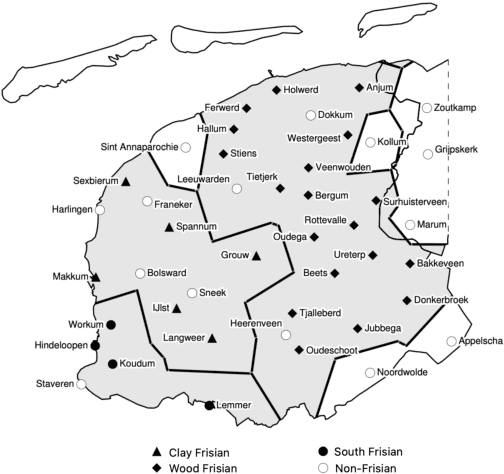
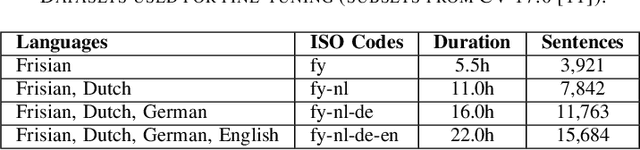
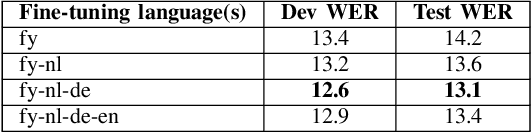
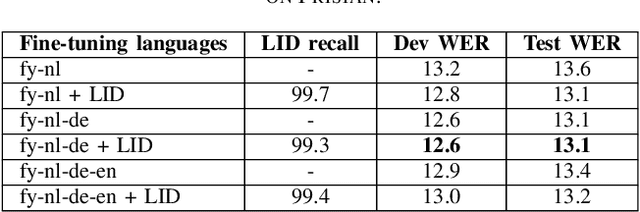
Automatic Speech Recognition (ASR) performance for low-resource languages is still far behind that of higher-resource languages such as English, due to a lack of sufficient labeled data. State-of-the-art methods deploy self-supervised transfer learning where a model pre-trained on large amounts of data is fine-tuned using little labeled data in a target low-resource language. In this paper, we present and examine a method for fine-tuning an SSL-based model in order to improve the performance for Frisian and its regional dialects (Clay Frisian, Wood Frisian, and South Frisian). We show that Frisian ASR performance can be improved by using multilingual (Frisian, Dutch, English and German) fine-tuning data and an auxiliary language identification task. In addition, our findings show that performance on dialectal speech suffers substantially, and, importantly, that this effect is moderated by the elicitation approach used to collect the dialectal data. Our findings also particularly suggest that relying solely on standard language data for ASR evaluation may underestimate real-world performance, particularly in languages with substantial dialectal variation.
An Overview of zbMATH Open Digital Library
Oct 09, 2024
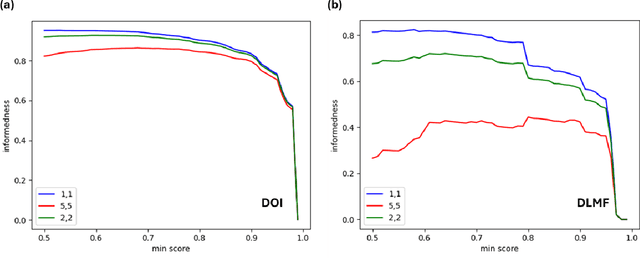

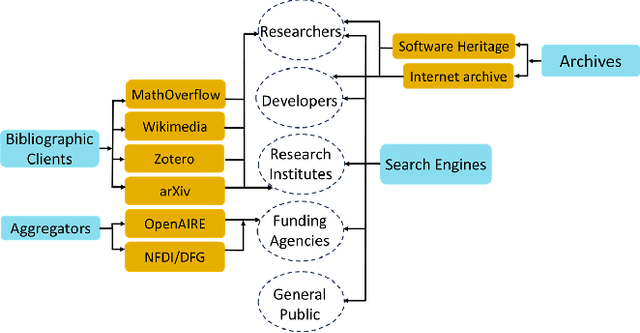
Mathematical research thrives on the effective dissemination and discovery of knowledge. zbMATH Open has emerged as a pivotal platform in this landscape, offering a comprehensive repository of mathematical literature. Beyond indexing and abstracting, it serves as a unified quality-assured infrastructure for finding, evaluating, and connecting mathematical information that advances mathematical research as well as interdisciplinary exploration. zbMATH Open enables scientific quality control by post-publication reviews and promotes connections between researchers, institutions, and research outputs. This paper represents the functionalities of the most significant features of this open-access service, highlighting its role in shaping the future of mathematical information retrieval.
Hybrid Classification-Regression Adaptive Loss for Dense Object Detection
Aug 30, 2024


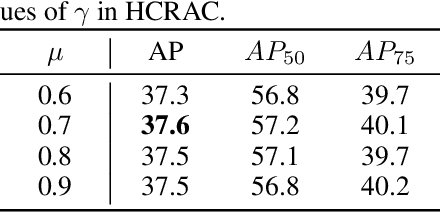
For object detection detectors, enhancing model performance hinges on the ability to simultaneously consider inconsistencies across tasks and focus on difficult-to-train samples. Achieving this necessitates incorporating information from both the classification and regression tasks. However, prior work tends to either emphasize difficult-to-train samples within their respective tasks or simply compute classification scores with IoU, often leading to suboptimal model performance. In this paper, we propose a Hybrid Classification-Regression Adaptive Loss, termed as HCRAL. Specifically, we introduce the Residual of Classification and IoU (RCI) module for cross-task supervision, addressing task inconsistencies, and the Conditioning Factor (CF) to focus on difficult-to-train samples within each task. Furthermore, we introduce a new strategy named Expanded Adaptive Training Sample Selection (EATSS) to provide additional samples that exhibit classification and regression inconsistencies. To validate the effectiveness of the proposed method, we conduct extensive experiments on COCO test-dev. Experimental evaluations demonstrate the superiority of our approachs. Additionally, we designed experiments by separately combining the classification and regression loss with regular loss functions in popular one-stage models, demonstrating improved performance.