 Add to Chrome
 Add to Firefox
 Add to Edge
Chatbots Output Meaningful (but Problematic) Language
Jun 02, 2026
Are utterances by AI chatbots meaningful? Concretely, if a user asks, say, Anthropic's agent Claude, "What is the capital of Spain?" and Claude answers, "Madrid is the capital of Spain," does that sentence have its ordinary meaning -- and does it express a true proposition? Most ordinary users, as well as AI engineers, take the answer to be trivially "yes." However, many cognitive scientists, linguists, and philosophers of language argue that dominant intentionalist accounts of language and meaning deliver the opposite conclusion. Theorists more sympathetic to ordinary users' intuitions have therefore advocated a radical "de-anthropomorphization" of language, revising our understanding of mental states, intentions, and semantic content to capture the intuition that the outputs of LLMs are meaningful. We take a different approach. While we, too, argue that LLM outputs are meaningful, we contend that a proper theory of human language already applies, as is, to current chatbots. Meaning is a low bar: claiming that LLM outputs are meaningful does not require positing mental states, intentions, rationality, or the cognitive capacities requisite for communication in LLMs -- or, indeed, making any other anthropomorphic assumptions. People do have communicative intentions (typically successful ones), but nevertheless, even in humans, language production can depart from what the speaker has in mind. Our view has important consequences for how we should theorize about -- and critically engage with -- both human linguistic output and synthetically generated text. In particular, to say that chatbots produce meaningful text is not by any means to endorse what they output, or to assume that the technology is (or is not) good, powerful, appropriate, or useful.

Dialogue with Robots: Proposals for Broadening Participation and Research in the SLIVAR Community
Apr 01, 2024


The ability to interact with machines using natural human language is becoming not just commonplace, but expected. The next step is not just text interfaces, but speech interfaces and not just with computers, but with all machines including robots. In this paper, we chronicle the recent history of this growing field of spoken dialogue with robots and offer the community three proposals, the first focused on education, the second on benchmarks, and the third on the modeling of language when it comes to spoken interaction with robots. The three proposals should act as white papers for any researcher to take and build upon.
Socially Cognizant Robotics for a Technology Enhanced Society
Oct 27, 2023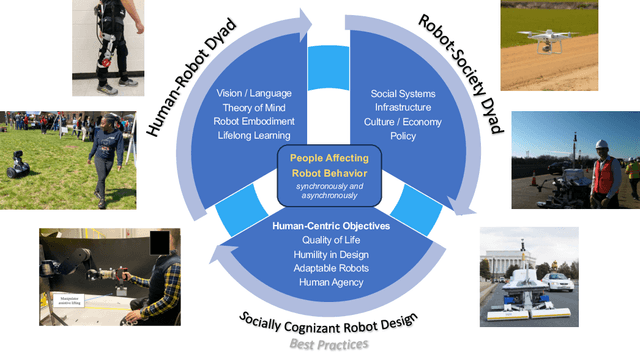


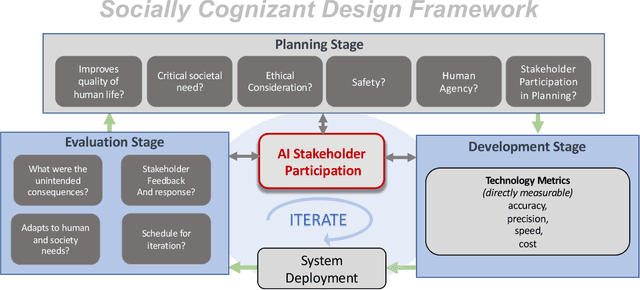
Emerging applications of robotics, and concerns about their impact, require the research community to put human-centric objectives front-and-center. To meet this challenge, we advocate an interdisciplinary approach, socially cognizant robotics, which synthesizes technical and social science methods. We argue that this approach follows from the need to empower stakeholder participation (from synchronous human feedback to asynchronous societal assessment) in shaping AI-driven robot behavior at all levels, and leads to a range of novel research perspectives and problems both for improving robots' interactions with individuals and impacts on society. Drawing on these arguments, we develop best practices for socially cognizant robot design that balance traditional technology-based metrics (e.g. efficiency, precision and accuracy) with critically important, albeit challenging to measure, human and society-based metrics.
Investigating Reinforcement Learning for Communication Strategies in a Task-Initiative Setting
Aug 03, 2023Many conversational domains require the system to present nuanced information to users. Such systems must follow up what they say to address clarification questions and repair misunderstandings. In this work, we explore this interactive strategy in a referential communication task. Using simulation, we analyze the communication trade-offs between initial presentation and subsequent followup as a function of user clarification strategy, and compare the performance of several baseline strategies to policies derived by reinforcement learning. We find surprising advantages to coherence-based representations of dialogue strategy, which bring minimal data requirements, explainable choices, and strong audit capabilities, but incur little loss in predicted outcomes across a wide range of user models.
Zero-shot Cross-Linguistic Learning of Event Semantics
Jul 05, 2022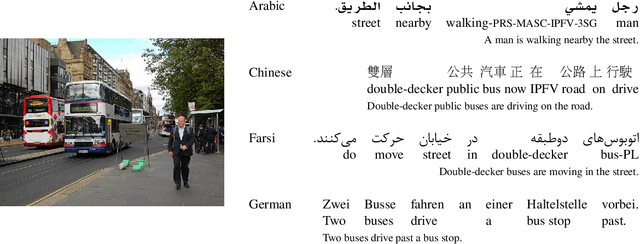


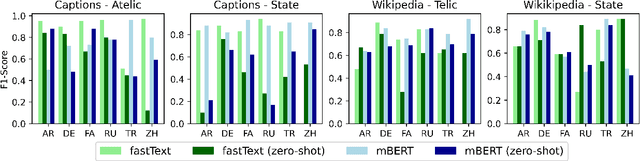
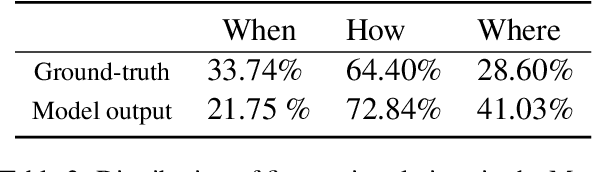
Typologically diverse languages offer systems of lexical and grammatical aspect that allow speakers to focus on facets of event structure in ways that comport with the specific communicative setting and discourse constraints they face. In this paper, we look specifically at captions of images across Arabic, Chinese, Farsi, German, Russian, and Turkish and describe a computational model for predicting lexical aspects. Despite the heterogeneity of these languages, and the salient invocation of distinctive linguistic resources across their caption corpora, speakers of these languages show surprising similarities in the ways they frame image content. We leverage this observation for zero-shot cross-lingual learning and show that lexical aspects can be predicted for a given language despite not having observed any annotated data for this language at all.
Cross-Modal Coherence for Text-to-Image Retrieval
Sep 22, 2021
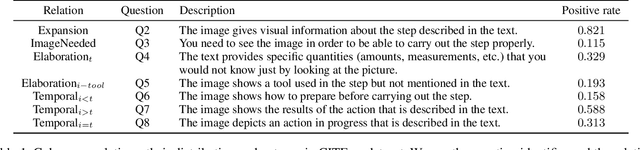
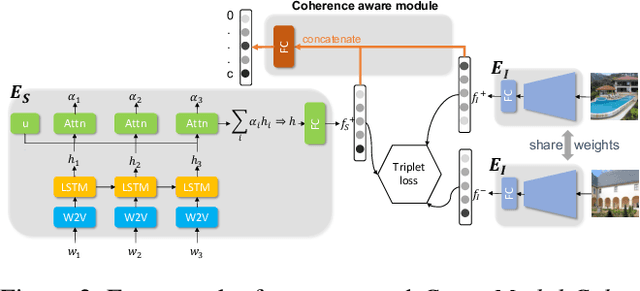
Common image-text joint understanding techniques presume that images and the associated text can universally be characterized by a single implicit model. However, co-occurring images and text can be related in qualitatively different ways, and explicitly modeling it could improve the performance of current joint understanding models. In this paper, we train a Cross-Modal Coherence Modelfor text-to-image retrieval task. Our analysis shows that models trained with image--text coherence relations can retrieve images originally paired with target text more often than coherence-agnostic models. We also show via human evaluation that images retrieved by the proposed coherence-aware model are preferred over a coherence-agnostic baseline by a huge margin. Our findings provide insights into the ways that different modalities communicate and the role of coherence relations in capturing commonsense inferences in text and imagery.
COSMic: A Coherence-Aware Generation Metric for Image Descriptions
Sep 11, 2021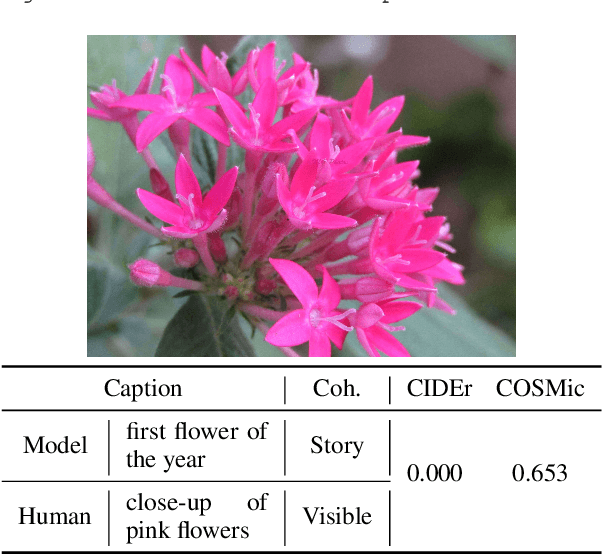
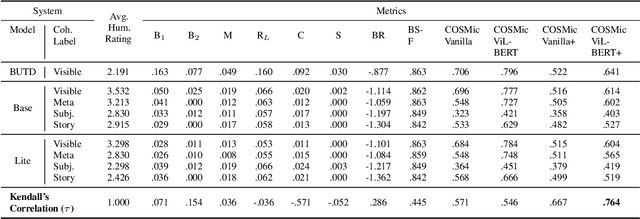

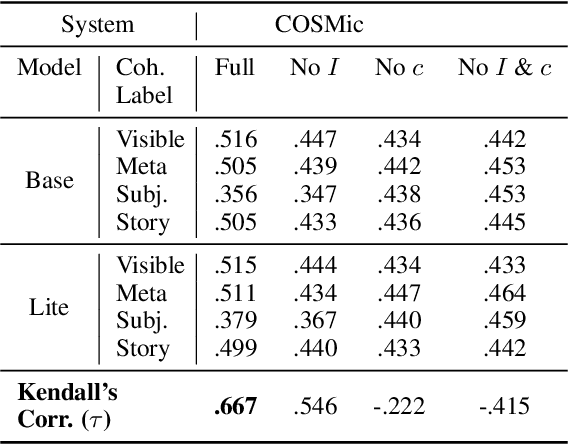
Developers of text generation models rely on automated evaluation metrics as a stand-in for slow and expensive manual evaluations. However, image captioning metrics have struggled to give accurate learned estimates of the semantic and pragmatic success of output text. We address this weakness by introducing the first discourse-aware learned generation metric for evaluating image descriptions. Our approach is inspired by computational theories of discourse for capturing information goals using coherence. We present a dataset of image$\unicode{x2013}$description pairs annotated with coherence relations. We then train a coherence-aware metric on a subset of the Conceptual Captions dataset and measure its effectiveness$\unicode{x2014}$its ability to predict human ratings of output captions$\unicode{x2014}$on a test set composed of out-of-domain images. We demonstrate a higher Kendall Correlation Coefficient for our proposed metric with the human judgments for the results of a number of state-of-the-art coherence-aware caption generation models when compared to several other metrics including recently proposed learned metrics such as BLEURT and BERTScore.
Aspectuality Across Genre: A Distributional Semantics Approach
Oct 31, 2020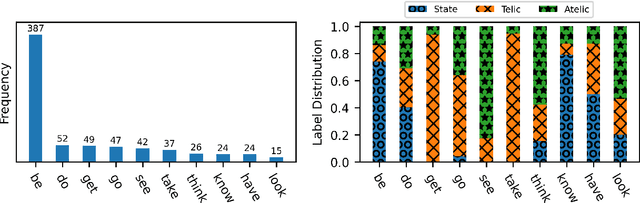
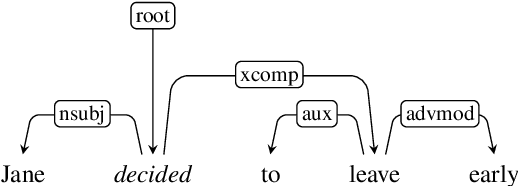
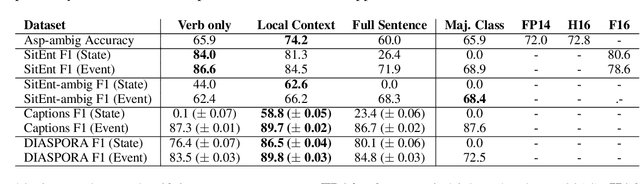
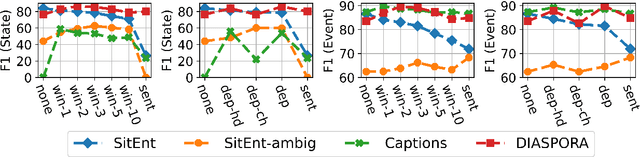
The interpretation of the lexical aspect of verbs in English plays a crucial role for recognizing textual entailment and learning discourse-level inferences. We show that two elementary dimensions of aspectual class, states vs. events, and telic vs. atelic events, can be modelled effectively with distributional semantics. We find that a verb's local context is most indicative of its aspectual class, and demonstrate that closed class words tend to be stronger discriminating contexts than content words. Our approach outperforms previous work on three datasets. Lastly, we contribute a dataset of human--human conversations annotated with lexical aspect and present experiments that show the correlation of telicity with genre and discourse goals.
Discourse Coherence, Reference Grounding and Goal Oriented Dialogue
Jul 08, 2020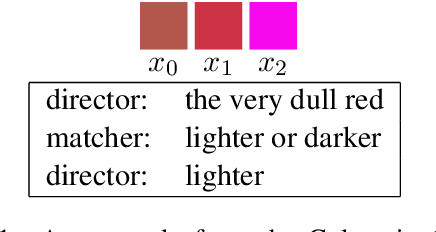
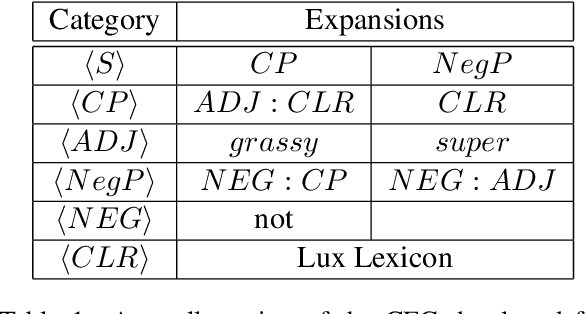
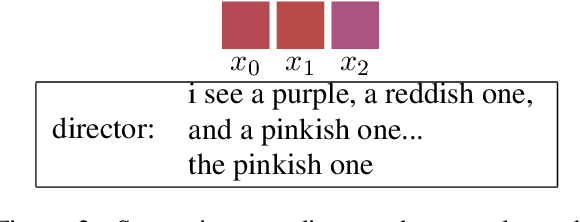
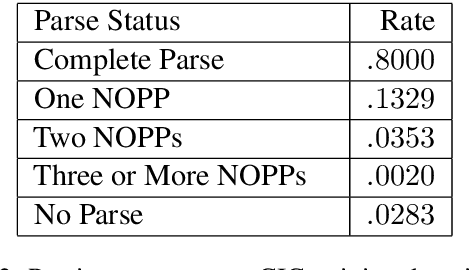
Prior approaches to realizing mixed-initiative human--computer referential communication have adopted information-state or collaborative problem-solving approaches. In this paper, we argue for a new approach, inspired by coherence-based models of discourse such as SDRT \cite{asher-lascarides:2003a}, in which utterances attach to an evolving discourse structure and the associated knowledge graph of speaker commitments serves as an interface to real-world reasoning and conversational strategy. As first steps towards implementing the approach, we describe a simple dialogue system in a referential communication domain that accumulates constraints across discourse, interprets them using a learned probabilistic model, and plans clarification using reinforcement learning.
Clue: Cross-modal Coherence Modeling for Caption Generation
May 02, 2020

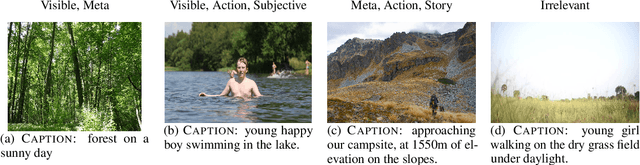
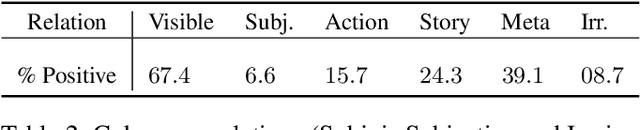
We use coherence relations inspired by computational models of discourse to study the information needs and goals of image captioning. Using an annotation protocol specifically devised for capturing image--caption coherence relations, we annotate 10,000 instances from publicly-available image--caption pairs. We introduce a new task for learning inferences in imagery and text, coherence relation prediction, and show that these coherence annotations can be exploited to learn relation classifiers as an intermediary step, and also train coherence-aware, controllable image captioning models. The results show a dramatic improvement in the consistency and quality of the generated captions with respect to information needs specified via coherence relations.