 Add to Chrome
 Add to Firefox
 Add to Edge
When Similar Means Different: Evaluating LLMs on Arabic--Hebrew Cognates
Jun 11, 2026
Arabic and Hebrew, as closely related Semitic languages, share a substantial lexicon of true cognates, misleading false friends, and modern loanwords. This overlap poses a challenge for cross-lingual semantic understanding in large language models (LLMs). To evaluate this capability, we introduce SemCog Bench, a curated benchmark of 1,858 Arabic--Hebrew word pairs with sentence-level annotations for cognate identification and semantic disambiguation. We evaluate open-source and commercial LLMs across multiple input representations (raw, diacritized, Romanized, and phonetic) and reveal a critical gap in cross-lingual reasoning. While models achieve high accuracy on true cognates, performance drops sharply on false friends and loanwords, reflecting a strong reliance on surface-form similarity. Furthermore, sentence-level context yields only modest improvements, suggesting that contextual cues alone are insufficient to overcome misleading form-based signals. These findings reveal a fundamental limitation of current LLMs in resolving cross-lingual form--meaning conflicts and establish SemCog Bench as a rigorous benchmark for multilingual semantic reasoning. Our code and data are publicly available.

ArabiGEE: A Hierarchical Taxonomy for Arabic Grammatical Error Explanation
Jun 09, 2026We introduce ArabiGEE, the first comprehensive Arabic grammatical error explanation (GEE) taxonomy grounded in explicit error types. Unlike existing GEE approaches that treat explanation generation as free-form text, ArabiGEE organizes grammatical explanations through a hierarchical structure spanning orthographic, morphological, syntactic, and lexical dimensions. The taxonomy consists of 27 error types, 140 correction types, and 324 associated explanations. We apply ArabiGEE to manually annotate portions of existing Arabic grammatical error correction corpora and demonstrate how structured grammatical explanations can support automatic evaluation of LLMs on Arabic GEE. Our code and data are publicly available.
Arabic Sentence Segmentation Across Genres and Punctuation Conditions
Jun 06, 2026Sentence segmentation in Arabic is challenging due to ambiguous and inconsistent punctuation, with many texts lacking reliable sentence boundary markers. Existing approaches rely heavily on punctuation cues and are typically evaluated on well-formed text, limiting their robustness in realistic Arabic settings. To address this, we introduce AraSEG, a genre-diverse sentence segmentation corpus spanning eight genres and a wide range of punctuation and document structure conditions. Using AraSEG, we evaluate LLMs, lightweight encoder models, and dependency parser-based models under increasingly challenging segmentation settings. Our experiments show that lightweight encoders, and even dependency parser-based models, outperform LLMs in the most challenging settings. We further investigate the effects of training data size and genre diversity, finding that performance eventually saturates and cross-genre generalization remains challenging. We also demonstrate that accurate sentence segmentation substantially improves downstream dependency parsing. We make our code, data, and models publicly available.
Arabic Morphosyntactic Tagging and Dependency Parsing with Large Language Models
Mar 17, 2026Large language models (LLMs) perform strongly on many NLP tasks, but their ability to produce explicit linguistic structure remains unclear. We evaluate instruction-tuned LLMs on two structured prediction tasks for Standard Arabic: morphosyntactic tagging and labeled dependency parsing. Arabic provides a challenging testbed due to its rich morphology and orthographic ambiguity, which create strong morphology-syntax interactions. We compare zero-shot prompting with retrieval-based in-context learning (ICL) using examples from Arabic treebanks. Results show that prompt design and demonstration selection strongly affect performance: proprietary models approach supervised baselines for feature-level tagging and become competitive with specialized dependency parsers. In raw-text settings, tokenization remains challenging, though retrieval-based ICL improves both parsing and tokenization. Our analysis highlights which aspects of Arabic morphosyntax and syntax LLMs capture reliably and which remain difficult.
BALSAM: A Platform for Benchmarking Arabic Large Language Models
Jul 30, 2025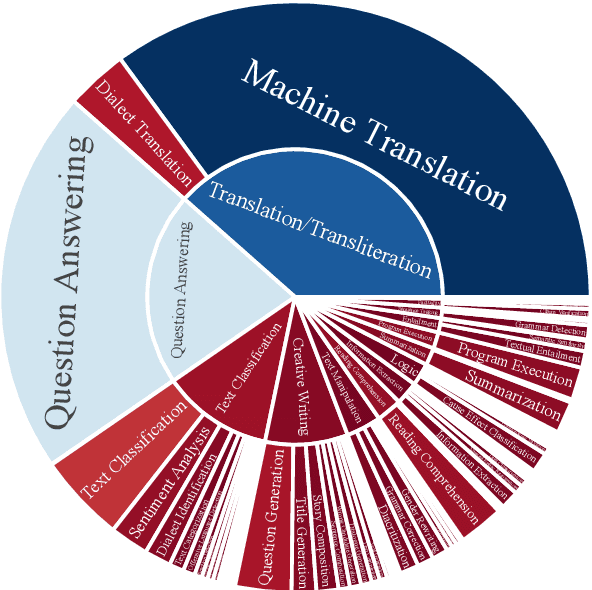
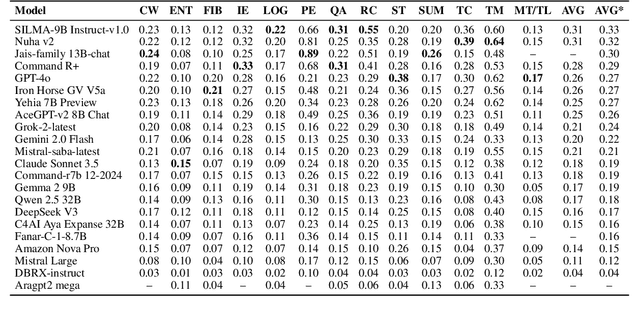
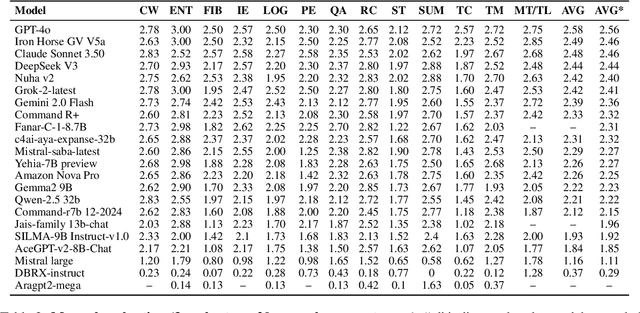
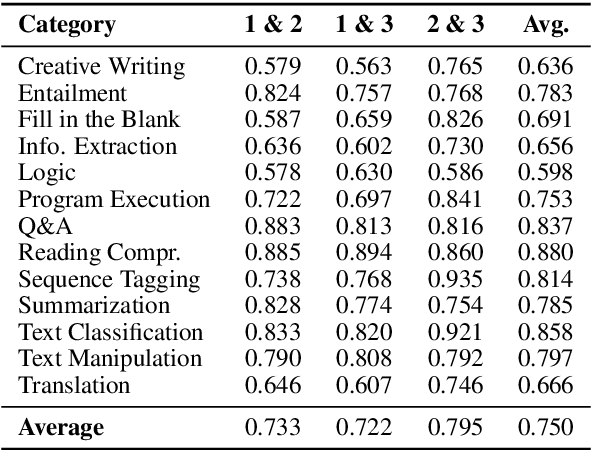
The impressive advancement of Large Language Models (LLMs) in English has not been matched across all languages. In particular, LLM performance in Arabic lags behind, due to data scarcity, linguistic diversity of Arabic and its dialects, morphological complexity, etc. Progress is further hindered by the quality of Arabic benchmarks, which typically rely on static, publicly available data, lack comprehensive task coverage, or do not provide dedicated platforms with blind test sets. This makes it challenging to measure actual progress and to mitigate data contamination. Here, we aim to bridge these gaps. In particular, we introduce BALSAM, a comprehensive, community-driven benchmark aimed at advancing Arabic LLM development and evaluation. It includes 78 NLP tasks from 14 broad categories, with 52K examples divided into 37K test and 15K development, and a centralized, transparent platform for blind evaluation. We envision BALSAM as a unifying platform that sets standards and promotes collaborative research to advance Arabic LLM capabilities.
Opportunities and Challenges of LLMs in Education: An NLP Perspective
Jul 30, 2025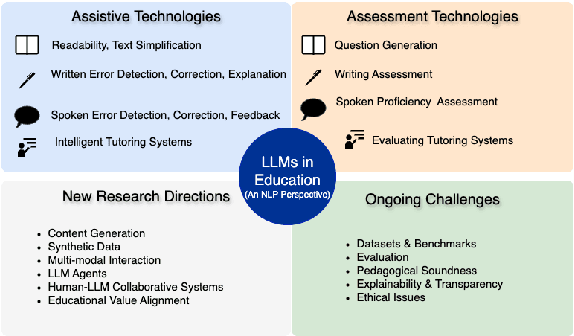

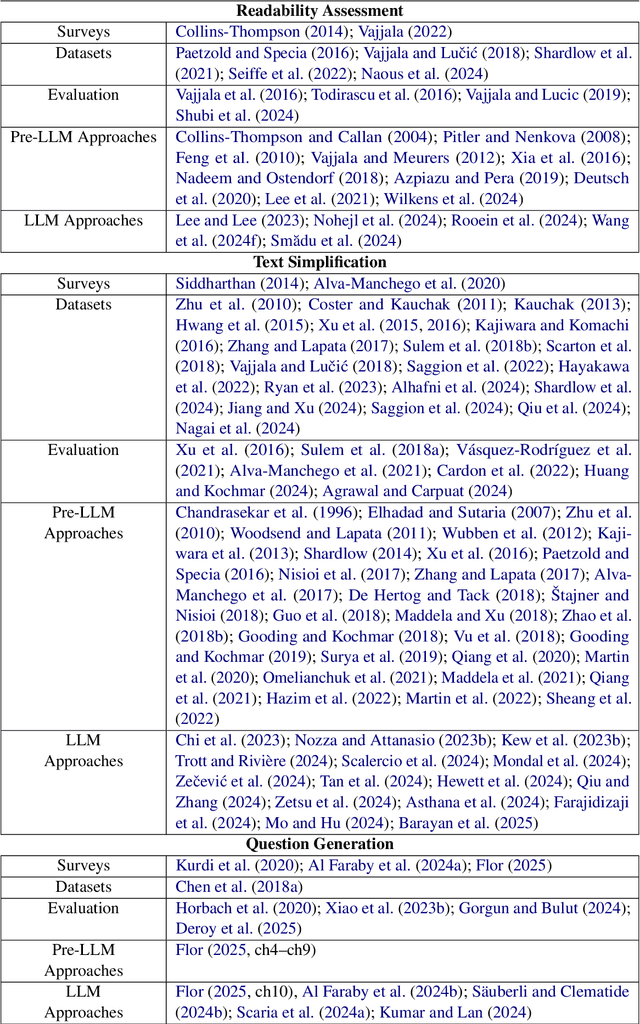
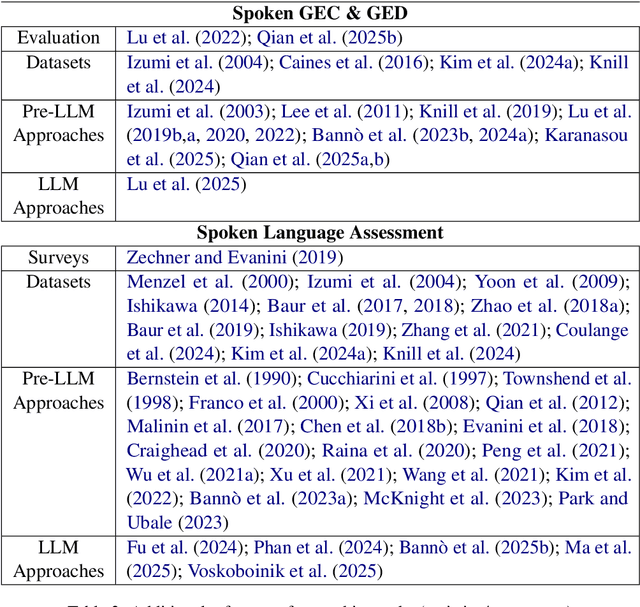
Interest in the role of large language models (LLMs) in education is increasing, considering the new opportunities they offer for teaching, learning, and assessment. In this paper, we examine the impact of LLMs on educational NLP in the context of two main application scenarios: {\em assistance} and {\em assessment}, grounding them along the four dimensions -- reading, writing, speaking, and tutoring. We then present the new directions enabled by LLMs, and the key challenges to address. We envision that this holistic overview would be useful for NLP researchers and practitioners interested in exploring the role of LLMs in developing language-focused and NLP-enabled educational applications of the future.
ARWI: Arabic Write and Improve
Apr 16, 2025Although Arabic is spoken by over 400 million people, advanced Arabic writing assistance tools remain limited. To address this gap, we present ARWI, a new writing assistant that helps learners improve essay writing in Modern Standard Arabic. ARWI is the first publicly available Arabic writing assistant to include a prompt database for different proficiency levels, an Arabic text editor, state-of-the-art grammatical error detection and correction, and automated essay scoring aligned with the Common European Framework of Reference standards for language attainment. Moreover, ARWI can be used to gather a growing auto-annotated corpus, facilitating further research on Arabic grammar correction and essay scoring, as well as profiling patterns of errors made by native speakers and non-native learners. A preliminary user study shows that ARWI provides actionable feedback, helping learners identify grammatical gaps, assess language proficiency, and guide improvement.
Enhancing Text Editing for Grammatical Error Correction: Arabic as a Case Study
Mar 02, 2025Text editing frames grammatical error correction (GEC) as a sequence tagging problem, where edit tags are assigned to input tokens, and applying these edits results in the corrected text. This approach has gained attention for its efficiency and interpretability. However, while extensively explored for English, text editing remains largely underexplored for morphologically rich languages like Arabic. In this paper, we introduce a text editing approach that derives edit tags directly from data, eliminating the need for language-specific edits. We demonstrate its effectiveness on Arabic, a diglossic and morphologically rich language, and investigate the impact of different edit representations on model performance. Our approach achieves SOTA results on two Arabic GEC benchmarks and performs on par with SOTA on two others. Additionally, our models are over six times faster than existing Arabic GEC systems, making our approach more practical for real-world applications. Finally, we explore ensemble models, demonstrating how combining different models leads to further performance improvements. We make our code, data, and pretrained models publicly available.
LLMs in Education: Novel Perspectives, Challenges, and Opportunities
Sep 18, 2024The role of large language models (LLMs) in education is an increasing area of interest today, considering the new opportunities they offer for teaching, learning, and assessment. This cutting-edge tutorial provides an overview of the educational applications of NLP and the impact that the recent advances in LLMs have had on this field. We will discuss the key challenges and opportunities presented by LLMs, grounding them in the context of four major educational applications: reading, writing, and speaking skills, and intelligent tutoring systems (ITS). This COLING 2025 tutorial is designed for researchers and practitioners interested in the educational applications of NLP and the role LLMs have to play in this area. It is the first of its kind to address this timely topic.
Exploiting Dialect Identification in Automatic Dialectal Text Normalization
Jul 03, 2024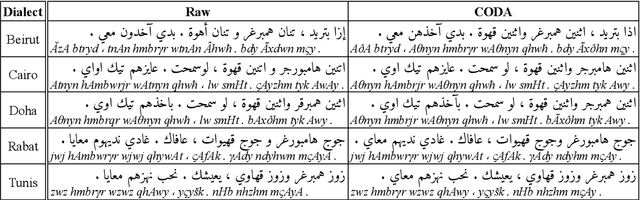
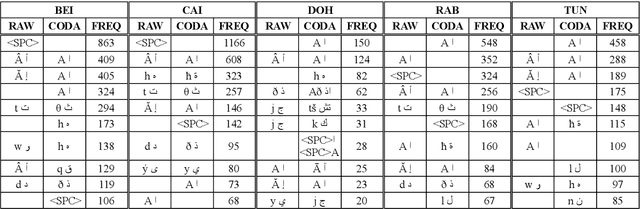
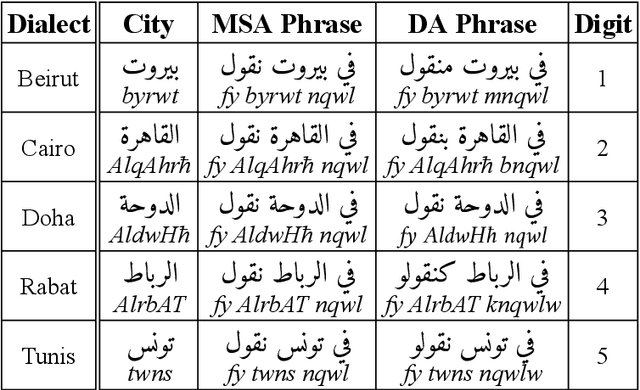
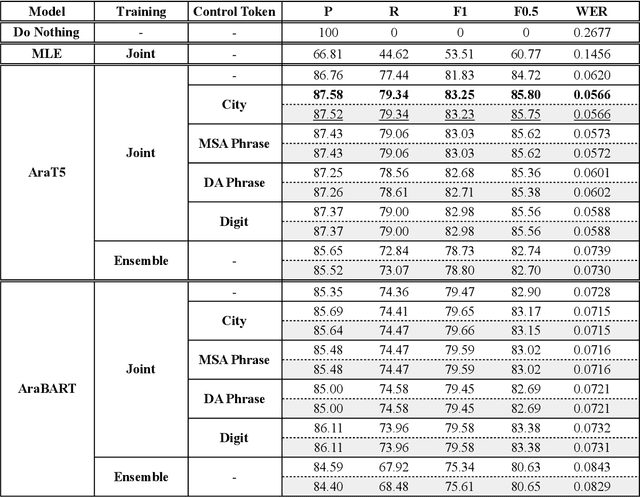
Dialectal Arabic is the primary spoken language used by native Arabic speakers in daily communication. The rise of social media platforms has notably expanded its use as a written language. However, Arabic dialects do not have standard orthographies. This, combined with the inherent noise in user-generated content on social media, presents a major challenge to NLP applications dealing with Dialectal Arabic. In this paper, we explore and report on the task of CODAfication, which aims to normalize Dialectal Arabic into the Conventional Orthography for Dialectal Arabic (CODA). We work with a unique parallel corpus of multiple Arabic dialects focusing on five major city dialects. We benchmark newly developed pretrained sequence-to-sequence models on the task of CODAfication. We further show that using dialect identification information improves the performance across all dialects. We make our code, data, and pretrained models publicly available.