 Add to Chrome
 Add to Firefox
 Add to Edge
Learning with Complementary Labels Revisited: A Consistent Approach via Negative-Unlabeled Learning
Nov 27, 2023
Complementary-label learning is a weakly supervised learning problem in which each training example is associated with one or multiple complementary labels indicating the classes to which it does not belong. Existing consistent approaches have relied on the uniform distribution assumption to model the generation of complementary labels, or on an ordinary-label training set to estimate the transition matrix. However, both conditions may not be satisfied in real-world scenarios. In this paper, we propose a novel complementary-label learning approach that does not rely on these conditions. We find that complementary-label learning can be expressed as a set of negative-unlabeled binary classification problems when using the one-versus-rest strategy. This observation allows us to propose a risk-consistent approach with theoretical guarantees. Furthermore, we introduce a risk correction approach to address overfitting problems when using complex models. We also prove the statistical consistency and convergence rate of the corrected risk estimator. Extensive experimental results on both synthetic and real-world benchmark datasets validate the superiority of our proposed approach over state-of-the-art methods.

Diversified Outlier Exposure for Out-of-Distribution Detection via Informative Extrapolation
Oct 26, 2023
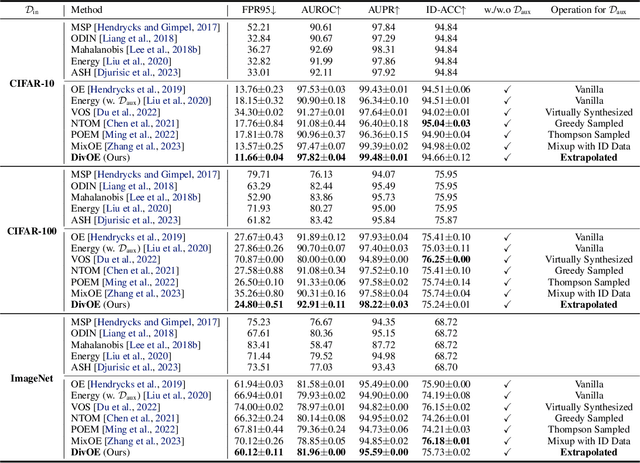
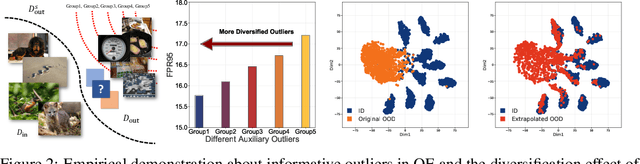
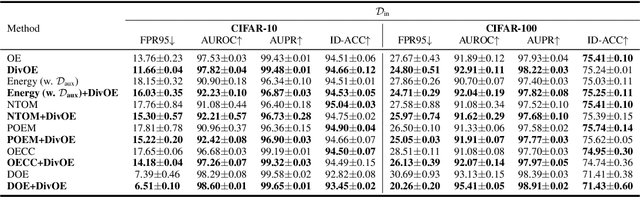
Out-of-distribution (OOD) detection is important for deploying reliable machine learning models on real-world applications. Recent advances in outlier exposure have shown promising results on OOD detection via fine-tuning model with informatively sampled auxiliary outliers. However, previous methods assume that the collected outliers can be sufficiently large and representative to cover the boundary between ID and OOD data, which might be impractical and challenging. In this work, we propose a novel framework, namely, Diversified Outlier Exposure (DivOE), for effective OOD detection via informative extrapolation based on the given auxiliary outliers. Specifically, DivOE introduces a new learning objective, which diversifies the auxiliary distribution by explicitly synthesizing more informative outliers for extrapolation during training. It leverages a multi-step optimization method to generate novel outliers beyond the original ones, which is compatible with many variants of outlier exposure. Extensive experiments and analyses have been conducted to characterize and demonstrate the effectiveness of the proposed DivOE. The code is publicly available at: https://github.com/tmlr-group/DivOE.
Fixed-Budget Real-Valued Combinatorial Pure Exploration of Multi-Armed Bandit
Oct 24, 2023We study the real-valued combinatorial pure exploration of the multi-armed bandit in the fixed-budget setting. We first introduce the Combinatorial Successive Asign (CSA) algorithm, which is the first algorithm that can identify the best action even when the size of the action class is exponentially large with respect to the number of arms. We show that the upper bound of the probability of error of the CSA algorithm matches a lower bound up to a logarithmic factor in the exponent. Then, we introduce another algorithm named the Minimax Combinatorial Successive Accepts and Rejects (Minimax-CombSAR) algorithm for the case where the size of the action class is polynomial, and show that it is optimal, which matches a lower bound. Finally, we experimentally compare the algorithms with previous methods and show that our algorithm performs better.
Atom-Motif Contrastive Transformer for Molecular Property Prediction
Oct 11, 2023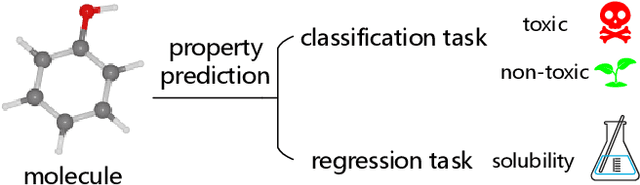
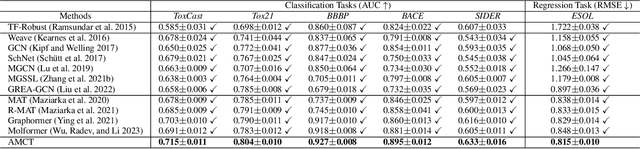
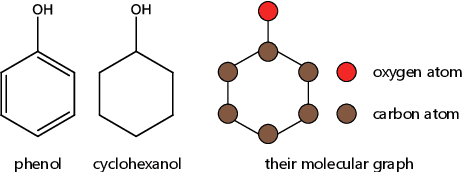

Recently, Graph Transformer (GT) models have been widely used in the task of Molecular Property Prediction (MPP) due to their high reliability in characterizing the latent relationship among graph nodes (i.e., the atoms in a molecule). However, most existing GT-based methods usually explore the basic interactions between pairwise atoms, and thus they fail to consider the important interactions among critical motifs (e.g., functional groups consisted of several atoms) of molecules. As motifs in a molecule are significant patterns that are of great importance for determining molecular properties (e.g., toxicity and solubility), overlooking motif interactions inevitably hinders the effectiveness of MPP. To address this issue, we propose a novel Atom-Motif Contrastive Transformer (AMCT), which not only explores the atom-level interactions but also considers the motif-level interactions. Since the representations of atoms and motifs for a given molecule are actually two different views of the same instance, they are naturally aligned to generate the self-supervisory signals for model training. Meanwhile, the same motif can exist in different molecules, and hence we also employ the contrastive loss to maximize the representation agreement of identical motifs across different molecules. Finally, in order to clearly identify the motifs that are critical in deciding the properties of each molecule, we further construct a property-aware attention mechanism into our learning framework. Our proposed AMCT is extensively evaluated on seven popular benchmark datasets, and both quantitative and qualitative results firmly demonstrate its effectiveness when compared with the state-of-the-art methods.
Binary Classification with Confidence Difference
Oct 09, 2023
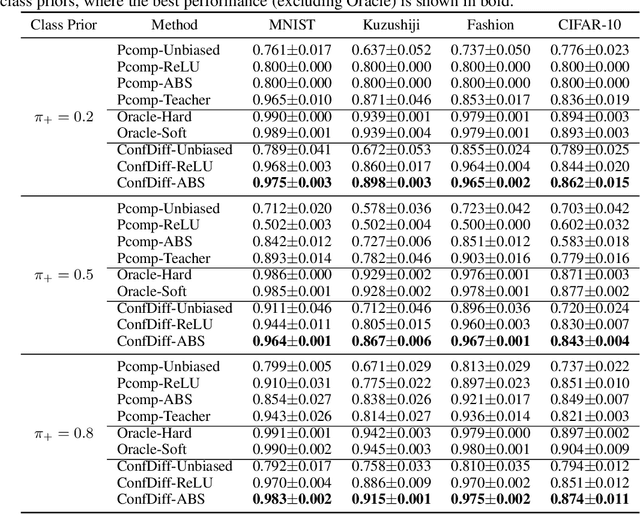
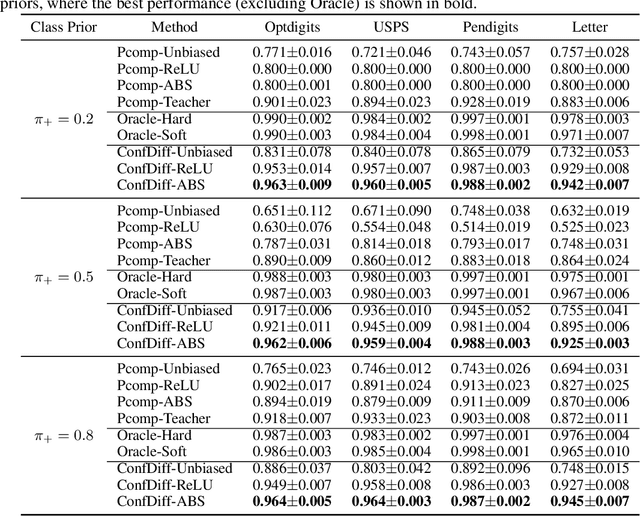
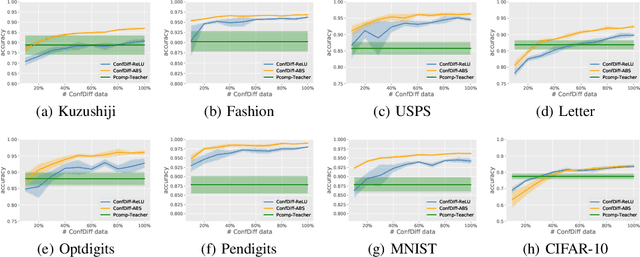
Recently, learning with soft labels has been shown to achieve better performance than learning with hard labels in terms of model generalization, calibration, and robustness. However, collecting pointwise labeling confidence for all training examples can be challenging and time-consuming in real-world scenarios. This paper delves into a novel weakly supervised binary classification problem called confidence-difference (ConfDiff) classification. Instead of pointwise labeling confidence, we are given only unlabeled data pairs with confidence difference that specifies the difference in the probabilities of being positive. We propose a risk-consistent approach to tackle this problem and show that the estimation error bound achieves the optimal convergence rate. We also introduce a risk correction approach to mitigate overfitting problems, whose consistency and convergence rate are also proven. Extensive experiments on benchmark data sets and a real-world recommender system data set validate the effectiveness of our proposed approaches in exploiting the supervision information of the confidence difference.
Thompson Exploration with Best Challenger Rule in Best Arm Identification
Oct 01, 2023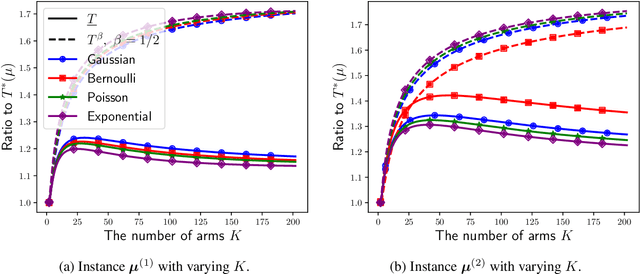
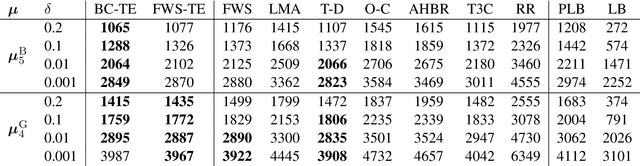

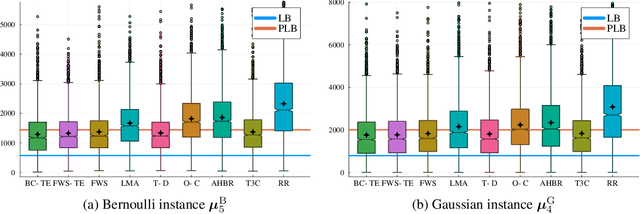
This paper studies the fixed-confidence best arm identification (BAI) problem in the bandit framework in the canonical single-parameter exponential models. For this problem, many policies have been proposed, but most of them require solving an optimization problem at every round and/or are forced to explore an arm at least a certain number of times except those restricted to the Gaussian model. To address these limitations, we propose a novel policy that combines Thompson sampling with a computationally efficient approach known as the best challenger rule. While Thompson sampling was originally considered for maximizing the cumulative reward, we demonstrate that it can be used to naturally explore arms in BAI without forcing it. We show that our policy is asymptotically optimal for any two-armed bandit problems and achieves near optimality for general $K$-armed bandit problems for $K\geq 3$. Nevertheless, in numerical experiments, our policy shows competitive performance compared to asymptotically optimal policies in terms of sample complexity while requiring less computation cost. In addition, we highlight the advantages of our policy by comparing it to the concept of $\beta$-optimality, a relaxed notion of asymptotic optimality commonly considered in the analysis of a class of policies including the proposed one.
Understanding and Mitigating the Label Noise in Pre-training on Downstream Tasks
Sep 29, 2023
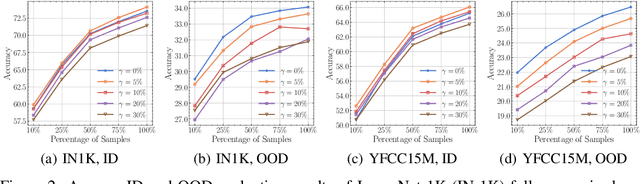


Pre-training on large-scale datasets and then fine-tuning on downstream tasks have become a standard practice in deep learning. However, pre-training data often contain label noise that may adversely affect the generalization of the model. This paper aims to understand the nature of noise in pre-training datasets and to mitigate its impact on downstream tasks. More specifically, through extensive experiments of supervised pre-training models on synthetic noisy ImageNet-1K and YFCC15M datasets, we demonstrate that while slight noise in pre-training can benefit in-domain (ID) transfer performance, where the training and testing data share the same distribution, it always deteriorates out-of-domain (OOD) performance, where training and testing data distribution are different. We empirically verify that the reason behind is noise in pre-training shapes the feature space differently. We then propose a lightweight black-box tuning method (NMTune) to affine the feature space to mitigate the malignant effect of noise and improve generalization on both ID and OOD tasks, considering one may not be able to fully fine-tune or even access the pre-trained models. We conduct practical experiments on popular vision and language models that are pre-trained on noisy data for evaluation of our approach. Our analysis and results show the importance of this interesting and novel research direction, which we term Noisy Model Learning.
Unified Risk Analysis for Weakly Supervised Learning
Sep 15, 2023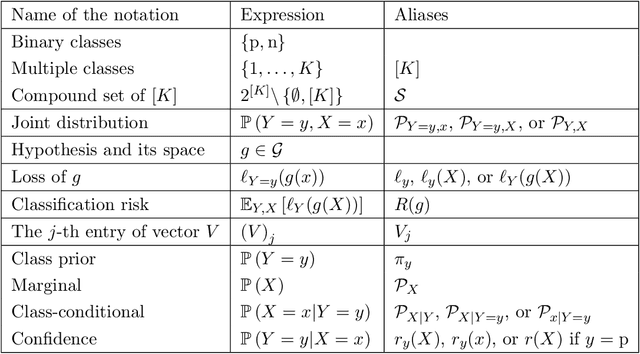
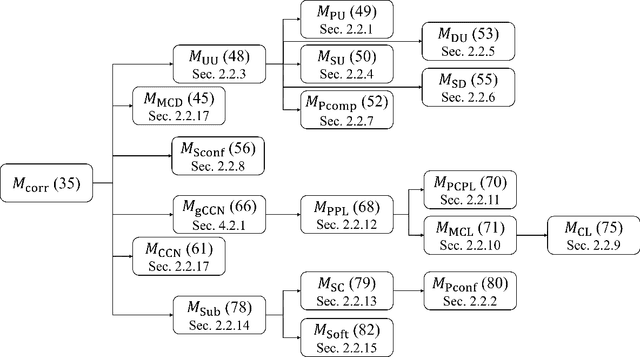
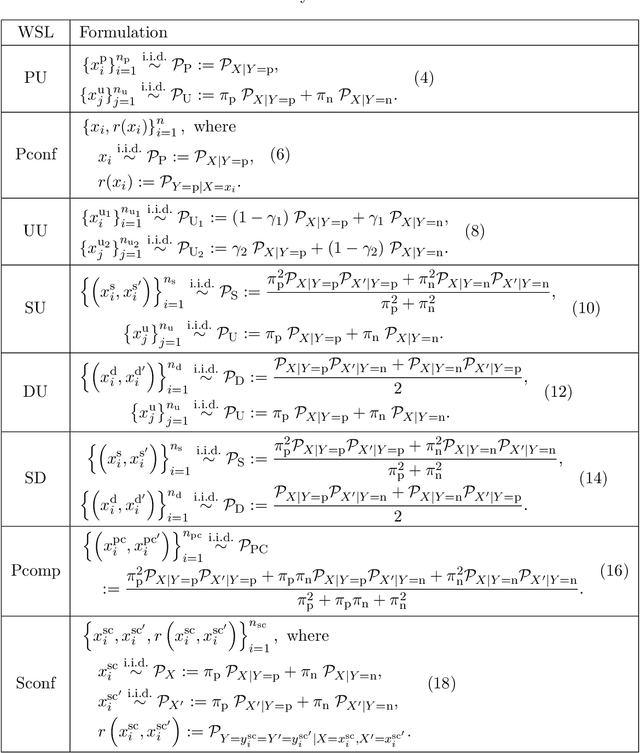
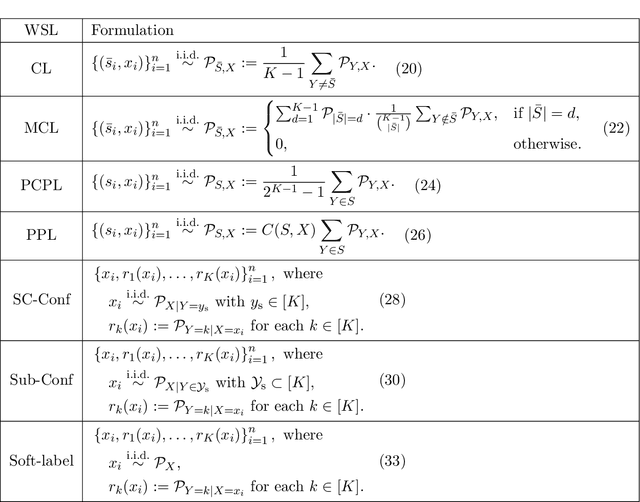
Among the flourishing research of weakly supervised learning (WSL), we recognize the lack of a unified interpretation of the mechanism behind the weakly supervised scenarios, let alone a systematic treatment of the risk rewrite problem, a crucial step in the empirical risk minimization approach. In this paper, we introduce a framework providing a comprehensive understanding and a unified methodology for WSL. The formulation component of the framework, leveraging a contamination perspective, provides a unified interpretation of how weak supervision is formed and subsumes fifteen existing WSL settings. The induced reduction graphs offer comprehensive connections over WSLs. The analysis component of the framework, viewed as a decontamination process, provides a systematic method of conducting risk rewrite. In addition to the conventional inverse matrix approach, we devise a novel strategy called marginal chain aiming to decontaminate distributions. We justify the feasibility of the proposed framework by recovering existing rewrites reported in the literature.
Thompson Sampling for Real-Valued Combinatorial Pure Exploration of Multi-Armed Bandit
Aug 20, 2023
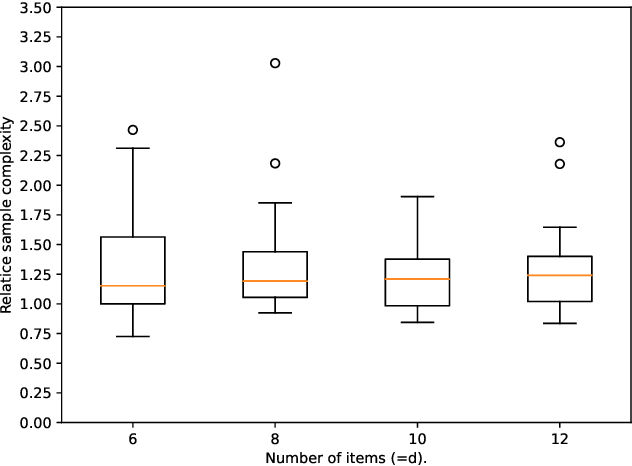
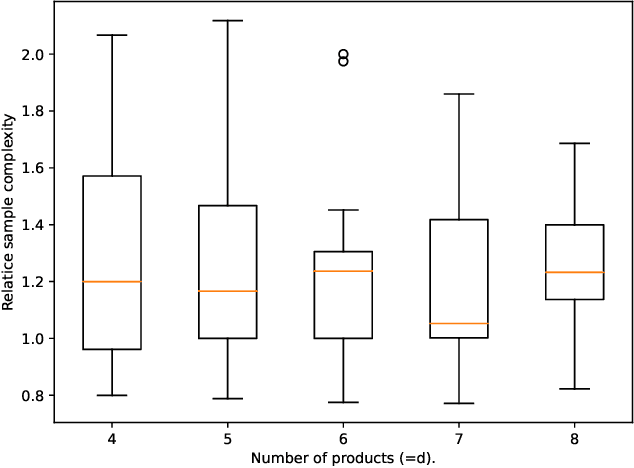
We study the real-valued combinatorial pure exploration of the multi-armed bandit (R-CPE-MAB) problem. In R-CPE-MAB, a player is given $d$ stochastic arms, and the reward of each arm $s\in\{1, \ldots, d\}$ follows an unknown distribution with mean $\mu_s$. In each time step, a player pulls a single arm and observes its reward. The player's goal is to identify the optimal \emph{action} $\boldsymbol{\pi}^{*} = \argmax_{\boldsymbol{\pi} \in \mathcal{A}} \boldsymbol{\mu}^{\top}\boldsymbol{\pi}$ from a finite-sized real-valued \emph{action set} $\mathcal{A}\subset \mathbb{R}^{d}$ with as few arm pulls as possible. Previous methods in the R-CPE-MAB assume that the size of the action set $\mathcal{A}$ is polynomial in $d$. We introduce an algorithm named the Generalized Thompson Sampling Explore (GenTS-Explore) algorithm, which is the first algorithm that can work even when the size of the action set is exponentially large in $d$. We also introduce a novel problem-dependent sample complexity lower bound of the R-CPE-MAB problem, and show that the GenTS-Explore algorithm achieves the optimal sample complexity up to a problem-dependent constant factor.
Multi-Label Knowledge Distillation
Aug 12, 2023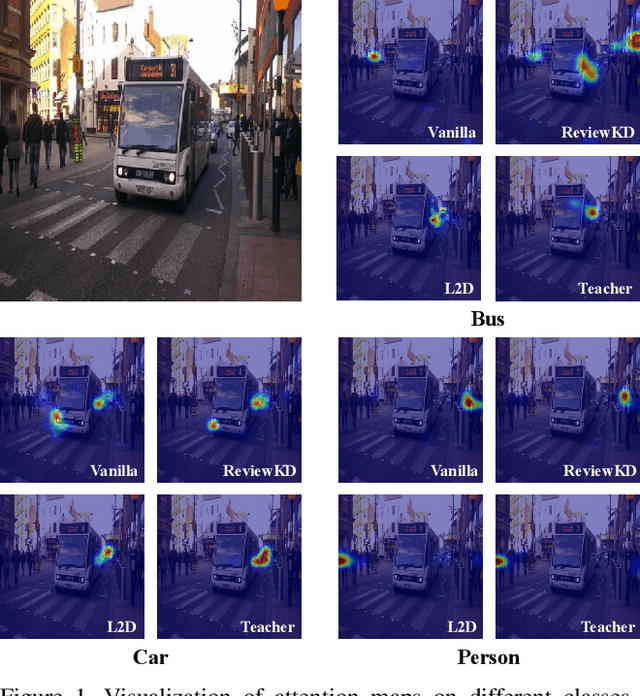
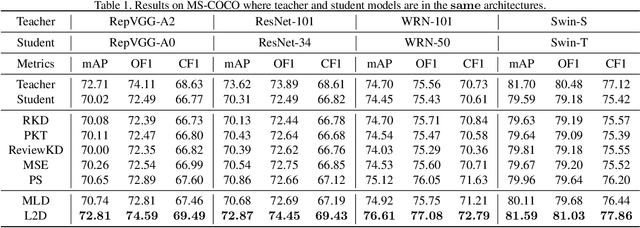
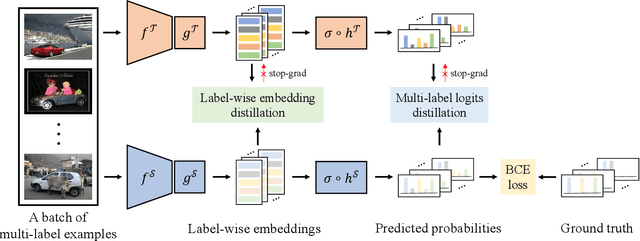
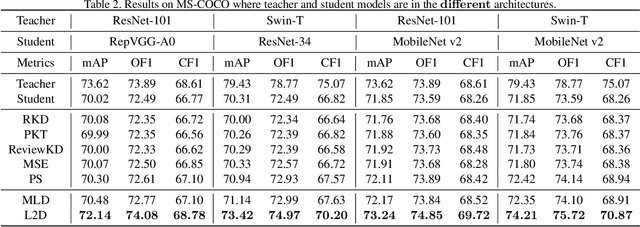
Existing knowledge distillation methods typically work by imparting the knowledge of output logits or intermediate feature maps from the teacher network to the student network, which is very successful in multi-class single-label learning. However, these methods can hardly be extended to the multi-label learning scenario, where each instance is associated with multiple semantic labels, because the prediction probabilities do not sum to one and feature maps of the whole example may ignore minor classes in such a scenario. In this paper, we propose a novel multi-label knowledge distillation method. On one hand, it exploits the informative semantic knowledge from the logits by dividing the multi-label learning problem into a set of binary classification problems; on the other hand, it enhances the distinctiveness of the learned feature representations by leveraging the structural information of label-wise embeddings. Experimental results on multiple benchmark datasets validate that the proposed method can avoid knowledge counteraction among labels, thus achieving superior performance against diverse comparing methods. Our code is available at: https://github.com/penghui-yang/L2D