 Add to Chrome
 Add to Firefox
 Add to Edge
Denoising-Enhanced Coarse-to-Fine Infrared Small Target Detection with Attention Prior-Guided Knowledge Distillation
Jun 20, 2026
Infrared small target detection (IRSTD) in high-resolution images is crucial for many practical applications, such as surveillance of unmanned aerial vehicles (UAVs) and UAV-based ground monitoring. However, IRSTD remains challenging due to the small size and weak features of targets, as well as significant interference from complex dynamic backgrounds. Existing detection methods often suffer from redundant computations on non-target background regions and insufficient exploitation of target context information, which limits their performance in complex backgrounds. To address these issues, we propose an efficient coarse-to-fine infrared small target detection framework with attention prior-guided knowledge distillation, termed ECFNet. In the coarse stage, we design a region binary classification network (RBCN) on grid-based multi-scale feature maps to efficiently recognize target-containing context region proposals while suppressing complex backgrounds. Moreover, we introduce a novel denoising-assisted training strategy that incorporates noisy ground-truth (GT) masks into the feature maps of RBCN and trains the network to reconstruct the GT masks through a denoising task, thereby enhancing its ability to distinguish target proposals from background regions and accelerating convergence. In the fine stage, we customize a lightweight target detector to the coarse stage's region proposals for balancing accuracy and efficiency. Furthermore, we propose a knowledge distillation strategy guided by the teacher-student cross-attention prior. This mechanism directs the student to focus on critical target regions, thereby enhancing the discriminative feature representation for infrared small targets. Extensive experiments on three real infrared datasets demonstrate that our method outperforms both existing single-stage and two-stage approaches while maintaining high real-time processing efficiency.

Spatio-Temporal Context Learning with Temporal Difference Convolution for Moving Infrared Small Target Detection
Nov 16, 2025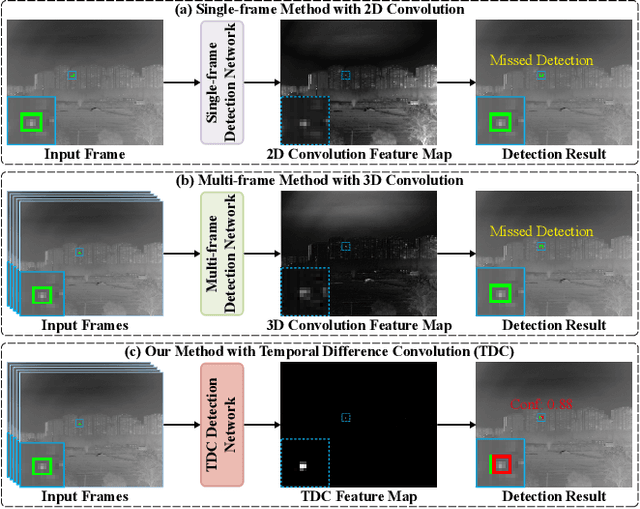
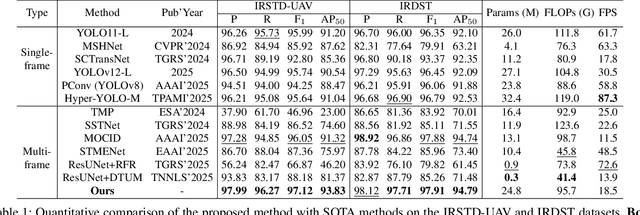
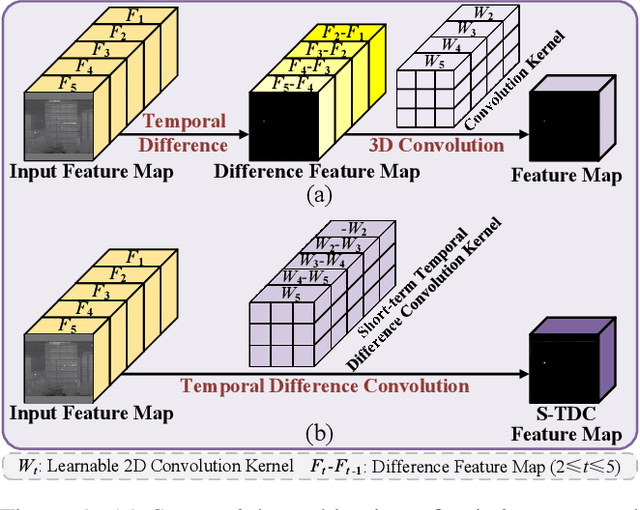

Moving infrared small target detection (IRSTD) plays a critical role in practical applications, such as surveillance of unmanned aerial vehicles (UAVs) and UAV-based search system. Moving IRSTD still remains highly challenging due to weak target features and complex background interference. Accurate spatio-temporal feature modeling is crucial for moving target detection, typically achieved through either temporal differences or spatio-temporal (3D) convolutions. Temporal difference can explicitly leverage motion cues but exhibits limited capability in extracting spatial features, whereas 3D convolution effectively represents spatio-temporal features yet lacks explicit awareness of motion dynamics along the temporal dimension. In this paper, we propose a novel moving IRSTD network (TDCNet), which effectively extracts and enhances spatio-temporal features for accurate target detection. Specifically, we introduce a novel temporal difference convolution (TDC) re-parameterization module that comprises three parallel TDC blocks designed to capture contextual dependencies across different temporal ranges. Each TDC block fuses temporal difference and 3D convolution into a unified spatio-temporal convolution representation. This re-parameterized module can effectively capture multi-scale motion contextual features while suppressing pseudo-motion clutter in complex backgrounds, significantly improving detection performance. Moreover, we propose a TDC-guided spatio-temporal attention mechanism that performs cross-attention between the spatio-temporal features from the TDC-based backbone and a parallel 3D backbone. This mechanism models their global semantic dependencies to refine the current frame's features. Extensive experiments on IRSTD-UAV and public infrared datasets demonstrate that our TDCNet achieves state-of-the-art detection performance in moving target detection.