 Add to Chrome
 Add to Firefox
 Add to Edge
ABot-M0.5: Unified Mobility-and-Manipulation World Action Model
Jul 01, 2026
Mobile manipulation is a key capability for general-purpose robots, yet remains challenging for current embodied learning methods. VLA policies are typically reactive and lack explicit world modeling, while existing World Action Models (WAMs) are still poorly aligned with the structure of mobile manipulation: they operate on coarse video chunks, model entangled navigation-manipulation actions, and train inverse dynamics under supervision that does not match autoregressive inference. As a result, they often miss fine-grained contact dynamics, suffer from action-distribution conflicts, and accumulate errors over long-horizon rollouts. We propose ABot-M0.5, a new WAM built on the insight that mobile manipulation requires alignment at three levels: temporal granularity, action space, and train-test consistency. To align temporal granularity, we introduce intermediate latent actions that capture local visual state transitions and serve as an bridging action space between video latents and embodiment-specific controls. To align action space, we design a dual-level Mixture-of-Transformers architecture that disentangles both modality representations and heterogeneous action subspaces such as base movement and arm manipulation. To align inference conditions, we propose the dream-forcing training strategy that progressively trains inverse dynamics on model-predicted videos, improving train-test alignment and robustness during autoregressive prediction. Experiments on challenging mobile and fine-grained manipulation benchmarks demonstrate that ABot-M0.5 achieves state-of-the-art performance in both long-horizon task success and finegrained control accuracy. These results highlight the critical importance of granularity-aligned, action-disentangled, and inference-consistent world-action modeling.

Multi-Stakeholder LLM Alignment: Decomposing Estimation from Aggregation
May 26, 2026Multi-stakeholder tasks require one output to satisfy users with conflicting preferences. Holistic LLM judges conflate utility estimation and utility aggregation, yielding unstable implicit weights. We show empirically and theoretically that this aggregation-specific \emph{weighting noise} can create large score shifts when stakeholder satisfaction is dispersed; in our experiments, these weight-induced shifts also increase with stakeholder count. We propose \textsc{DecompR}: counterfactual-calibrated weights are fixed from query structure before candidate scoring, while per-role utilities are estimated independently, removing candidate-dependent weight drift and reducing estimation noise.
GroupTravelBench: Benchmarking LLM Agents on Multi-Person Travel Planning
May 24, 2026Travel planning is a realistic task for evaluating the planning and tool-use abilities of LLM agents. However, existing benchmarks typically assume only a single user, thereby avoiding one of the most challenging aspects of real-world scenarios: an agent's ability to identify and resolve conflicts among multiple users. To address this gap, we introduce \textbf{GroupTravelBench}, the first benchmark for \textbf{multi-user, multi-turn} travel planning. Based on real user profiles, POI data, and ticket price data, we synthesize 650 tasks and divide them into three difficulty levels. Beyond standard abilities in single-user itinerary planning, such as multi-step reasoning and tool use, our benchmark further evaluates three key capabilities required for travel agents: \emph{(i) elicitation} -- proactively engaging in multi-turn dialogue to gather preferences from each user; \emph{(ii) coordination} -- resolving conflicts among users through compromise or subgrouping strategies; and \emph{(iii) planning} -- searching for travel plans that maximize overall group utility while maintaining fairness and feasibility. To simulate real-world conversational itinerary planning while enabling reliable tool use and offline evaluation, we build an interactive sandbox environment with cached real-world tool data. We evaluate a wide range of LLMs and find that even frontier models still show substantial weaknesses in preference coverage and group fairness. \textit{GroupTravelBench} provides a practical and reproducible benchmark for advancing research on LLM agents for real-world travel planning.
Episodic Multi-agent Reinforcement Learning with Curiosity-Driven Exploration
Nov 22, 2021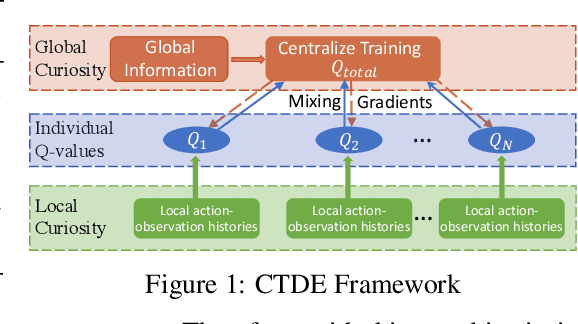
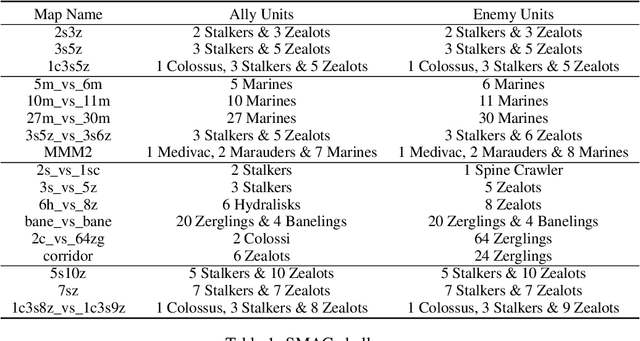
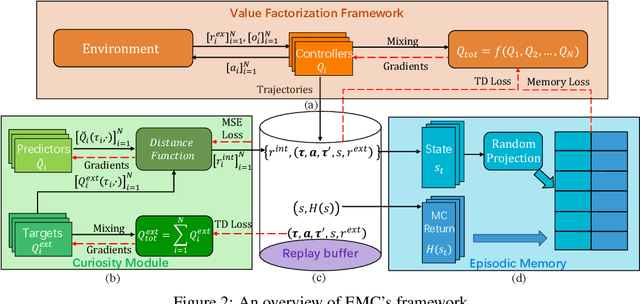
Efficient exploration in deep cooperative multi-agent reinforcement learning (MARL) still remains challenging in complex coordination problems. In this paper, we introduce a novel Episodic Multi-agent reinforcement learning with Curiosity-driven exploration, called EMC. We leverage an insight of popular factorized MARL algorithms that the "induced" individual Q-values, i.e., the individual utility functions used for local execution, are the embeddings of local action-observation histories, and can capture the interaction between agents due to reward backpropagation during centralized training. Therefore, we use prediction errors of individual Q-values as intrinsic rewards for coordinated exploration and utilize episodic memory to exploit explored informative experience to boost policy training. As the dynamics of an agent's individual Q-value function captures the novelty of states and the influence from other agents, our intrinsic reward can induce coordinated exploration to new or promising states. We illustrate the advantages of our method by didactic examples, and demonstrate its significant outperformance over state-of-the-art MARL baselines on challenging tasks in the StarCraft II micromanagement benchmark.