 Add to Chrome
 Add to Firefox
 Add to Edge
ABot-M0.5: Unified Mobility-and-Manipulation World Action Model
Jul 01, 2026
Mobile manipulation is a key capability for general-purpose robots, yet remains challenging for current embodied learning methods. VLA policies are typically reactive and lack explicit world modeling, while existing World Action Models (WAMs) are still poorly aligned with the structure of mobile manipulation: they operate on coarse video chunks, model entangled navigation-manipulation actions, and train inverse dynamics under supervision that does not match autoregressive inference. As a result, they often miss fine-grained contact dynamics, suffer from action-distribution conflicts, and accumulate errors over long-horizon rollouts. We propose ABot-M0.5, a new WAM built on the insight that mobile manipulation requires alignment at three levels: temporal granularity, action space, and train-test consistency. To align temporal granularity, we introduce intermediate latent actions that capture local visual state transitions and serve as an bridging action space between video latents and embodiment-specific controls. To align action space, we design a dual-level Mixture-of-Transformers architecture that disentangles both modality representations and heterogeneous action subspaces such as base movement and arm manipulation. To align inference conditions, we propose the dream-forcing training strategy that progressively trains inverse dynamics on model-predicted videos, improving train-test alignment and robustness during autoregressive prediction. Experiments on challenging mobile and fine-grained manipulation benchmarks demonstrate that ABot-M0.5 achieves state-of-the-art performance in both long-horizon task success and finegrained control accuracy. These results highlight the critical importance of granularity-aligned, action-disentangled, and inference-consistent world-action modeling.

ALAM: Algebraically Consistent Latent Transitions for Vision-Language-Action Models
May 11, 2026Vision-language-action (VLA) models remain constrained by the scarcity of action-labeled robot data, whereas action-free videos provide abundant evidence of how the physical world changes. Latent action models offer a promising way to extract such priors from videos, but reconstruction-trained latent codes are not necessarily suitable for policy generation: they may predict future observations while lacking the structure needed to be reused or generated coherently with robot actions. We introduce ALAM (Algebraic Latent Action Model), an Algebraically Consistent Latent Action Model that turns temporal relations in action-free video into structural supervision. Given frame triplets, ALAM learns latent transitions that are grounded by reconstruction while being regularized by composition and reversal consistency, encouraging a locally additive transition space. For downstream VLA learning, we freeze the pretrained encoder and use its latent transition sequences as auxiliary generative targets, co-generated with robot actions under a joint flow-matching objective. This couples structured latent transitions with flow-based policy generation, allowing the policy to exploit ALAM's locally consistent transition geometry without requiring latent-to-action decoding. Representation probes show that ALAM reduces additivity and reversibility errors by 25-85 times over unstructured latent-action baselines and improves long-horizon cumulative reconstruction. When transferred to VLA policies, ALAM raises the average success rate from 47.9% to 85.0% on MetaWorld MT50 and from 94.1% to 98.1% on LIBERO, with consistent gains on real-world manipulation tasks. Ablations further confirm that the strongest improvements arise from the synergy between algebraically structured latent transitions and joint flow matching.
ABot-Claw: A Foundation for Persistent, Cooperative, and Self-Evolving Robotic Agents
Apr 11, 2026Current embodied intelligent systems still face a substantial gap between high-level reasoning and low-level physical execution in open-world environments. Although Vision-Language-Action (VLA) models provide strong perception and intuitive responses, their open-loop nature limits long-horizon performance. Agents incorporating System 2 cognitive mechanisms improve planning, but usually operate in closed sandboxes with predefined toolkits and limited real-system control. OpenClaw provides a localized runtime with full system privileges, but lacks the embodied control architecture required for long-duration, multi-robot execution. We therefore propose ABot-Claw, an embodied extension of OpenClaw that integrates: 1) a unified embodiment interface with capability-driven scheduling for heterogeneous robot coordination; 2) a visual-centric cross-embodiment multimodal memory for persistent context retention and grounded retrieval; and 3) a critic-based closed-loop feedback mechanism with a generalist reward model for online progress evaluation, local correction, and replanning. With a decoupled architecture spanning the OpenClaw layer, shared service layer, and robot embodiment layer, ABot-Claw enables real-world interaction, closes the loop from natural language intent to physical action, and supports progressively self-evolving robotic agents in open, dynamic environments.
ABot-PhysWorld: Interactive World Foundation Model for Robotic Manipulation with Physics Alignment
Mar 24, 2026Video-based world models offer a powerful paradigm for embodied simulation and planning, yet state-of-the-art models often generate physically implausible manipulations - such as object penetration and anti-gravity motion - due to training on generic visual data and likelihood-based objectives that ignore physical laws. We present ABot-PhysWorld, a 14B Diffusion Transformer model that generates visually realistic, physically plausible, and action-controllable videos. Built on a curated dataset of three million manipulation clips with physics-aware annotation, it uses a novel DPO-based post-training framework with decoupled discriminators to suppress unphysical behaviors while preserving visual quality. A parallel context block enables precise spatial action injection for cross-embodiment control. To better evaluate generalization, we introduce EZSbench, the first training-independent embodied zero-shot benchmark combining real and synthetic unseen robot-task-scene combinations. It employs a decoupled protocol to separately assess physical realism and action alignment. ABot-PhysWorld achieves new state-of-the-art performance on PBench and EZSbench, surpassing Veo 3.1 and Sora v2 Pro in physical plausibility and trajectory consistency. We will release EZSbench to promote standardized evaluation in embodied video generation.
Neural Implicit Action Fields: From Discrete Waypoints to Continuous Functions for Vision-Language-Action Models
Mar 02, 2026Despite the rapid progress of Vision-Language-Action (VLA) models, the prevailing paradigm of predicting discrete waypoints remains fundamentally misaligned with the intrinsic continuity of physical motion. This discretization imposes rigid sampling rates, lacks high-order differentiability, and introduces quantization artifacts that hinder precise, compliant interaction. We propose Neural Implicit Action Fields (NIAF), a paradigm shift that reformulates action prediction from discrete waypoints to continuous action function regression. By utilizing an MLLM as a hierarchical spectral modulator over a learnable motion prior, NIAF synthesizes infinite-resolution trajectories as continuous-time manifolds. This formulation enables analytical differentiability, allowing for explicit supervision of velocity, acceleration, and jerk to ensure mathematical consistency and physical plausibility. Our approach achieves state-of-the-art results on CALVIN and LIBERO benchmarks across diverse backbones. Furthermore, real-world experiments demonstrate that NIAF enables stable impedance control, bridging the gap between high-level semantic understanding and low-level dynamic execution.
ABot-M0: VLA Foundation Model for Robotic Manipulation with Action Manifold Learning
Feb 11, 2026Building general-purpose embodied agents across diverse hardware remains a central challenge in robotics, often framed as the ''one-brain, many-forms'' paradigm. Progress is hindered by fragmented data, inconsistent representations, and misaligned training objectives. We present ABot-M0, a framework that builds a systematic data curation pipeline while jointly optimizing model architecture and training strategies, enabling end-to-end transformation of heterogeneous raw data into unified, efficient representations. From six public datasets, we clean, standardize, and balance samples to construct UniACT-dataset, a large-scale dataset with over 6 million trajectories and 9,500 hours of data, covering diverse robot morphologies and task scenarios. Unified pre-training improves knowledge transfer and generalization across platforms and tasks, supporting general-purpose embodied intelligence. To improve action prediction efficiency and stability, we propose the Action Manifold Hypothesis: effective robot actions lie not in the full high-dimensional space but on a low-dimensional, smooth manifold governed by physical laws and task constraints. Based on this, we introduce Action Manifold Learning (AML), which uses a DiT backbone to predict clean, continuous action sequences directly. This shifts learning from denoising to projection onto feasible manifolds, improving decoding speed and policy stability. ABot-M0 supports modular perception via a dual-stream mechanism that integrates VLM semantics with geometric priors and multi-view inputs from plug-and-play 3D modules such as VGGT and Qwen-Image-Edit, enhancing spatial understanding without modifying the backbone and mitigating standard VLM limitations in 3D reasoning. Experiments show components operate independently with additive benefits. We will release all code and pipelines for reproducibility and future research.
OpenBench: A New Benchmark and Baseline for Semantic Navigation in Smart Logistics
Feb 13, 2025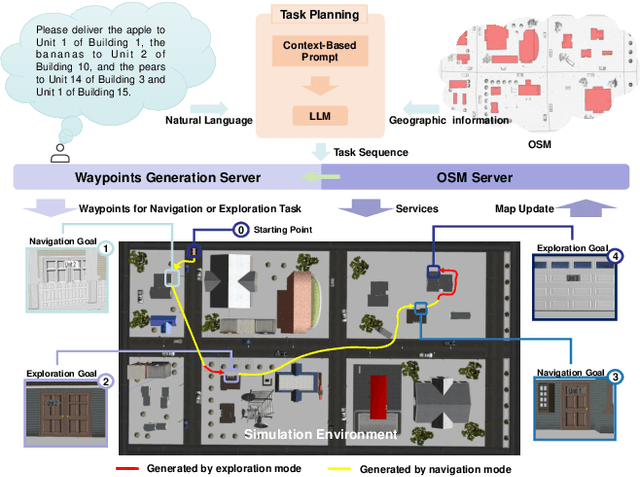
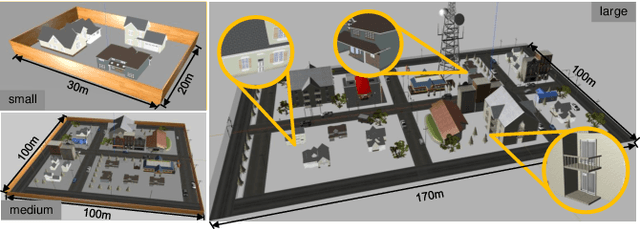
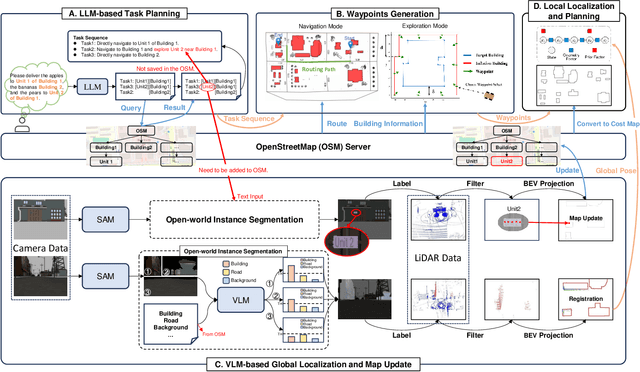
The increasing demand for efficient last-mile delivery in smart logistics underscores the role of autonomous robots in enhancing operational efficiency and reducing costs. Traditional navigation methods, which depend on high-precision maps, are resource-intensive, while learning-based approaches often struggle with generalization in real-world scenarios. To address these challenges, this work proposes the Openstreetmap-enhanced oPen-air sEmantic Navigation (OPEN) system that combines foundation models with classic algorithms for scalable outdoor navigation. The system uses off-the-shelf OpenStreetMap (OSM) for flexible map representation, thereby eliminating the need for extensive pre-mapping efforts. It also employs Large Language Models (LLMs) to comprehend delivery instructions and Vision-Language Models (VLMs) for global localization, map updates, and house number recognition. To compensate the limitations of existing benchmarks that are inadequate for assessing last-mile delivery, this work introduces a new benchmark specifically designed for outdoor navigation in residential areas, reflecting the real-world challenges faced by autonomous delivery systems. Extensive experiments in simulated and real-world environments demonstrate the proposed system's efficacy in enhancing navigation efficiency and reliability. To facilitate further research, our code and benchmark are publicly available.