 Add to Chrome
 Add to Firefox
 Add to Edge
Contrastive Learning for Multi-Object Tracking with Transformers
Nov 14, 2023
The DEtection TRansformer (DETR) opened new possibilities for object detection by modeling it as a translation task: converting image features into object-level representations. Previous works typically add expensive modules to DETR to perform Multi-Object Tracking (MOT), resulting in more complicated architectures. We instead show how DETR can be turned into a MOT model by employing an instance-level contrastive loss, a revised sampling strategy and a lightweight assignment method. Our training scheme learns object appearances while preserving detection capabilities and with little overhead. Its performance surpasses the previous state-of-the-art by +2.6 mMOTA on the challenging BDD100K dataset and is comparable to existing transformer-based methods on the MOT17 dataset.

Learning Robust Multi-Scale Representation for Neural Radiance Fields from Unposed Images
Nov 08, 2023We introduce an improved solution to the neural image-based rendering problem in computer vision. Given a set of images taken from a freely moving camera at train time, the proposed approach could synthesize a realistic image of the scene from a novel viewpoint at test time. The key ideas presented in this paper are (i) Recovering accurate camera parameters via a robust pipeline from unposed day-to-day images is equally crucial in neural novel view synthesis problem; (ii) It is rather more practical to model object's content at different resolutions since dramatic camera motion is highly likely in day-to-day unposed images. To incorporate the key ideas, we leverage the fundamentals of scene rigidity, multi-scale neural scene representation, and single-image depth prediction. Concretely, the proposed approach makes the camera parameters as learnable in a neural fields-based modeling framework. By assuming per view depth prediction is given up to scale, we constrain the relative pose between successive frames. From the relative poses, absolute camera pose estimation is modeled via a graph-neural network-based multiple motion averaging within the multi-scale neural-fields network, leading to a single loss function. Optimizing the introduced loss function provides camera intrinsic, extrinsic, and image rendering from unposed images. We demonstrate, with examples, that for a unified framework to accurately model multiscale neural scene representation from day-to-day acquired unposed multi-view images, it is equally essential to have precise camera-pose estimates within the scene representation framework. Without considering robustness measures in the camera pose estimation pipeline, modeling for multi-scale aliasing artifacts can be counterproductive. We present extensive experiments on several benchmark datasets to demonstrate the suitability of our approach.
Long-Term Invariant Local Features via Implicit Cross-Domain Correspondences
Nov 06, 2023


Modern learning-based visual feature extraction networks perform well in intra-domain localization, however, their performance significantly declines when image pairs are captured across long-term visual domain variations, such as different seasonal and daytime variations. In this paper, our first contribution is a benchmark to investigate the performance impact of long-term variations on visual localization. We conduct a thorough analysis of the performance of current state-of-the-art feature extraction networks under various domain changes and find a significant performance gap between intra- and cross-domain localization. We investigate different methods to close this gap by improving the supervision of modern feature extractor networks. We propose a novel data-centric method, Implicit Cross-Domain Correspondences (iCDC). iCDC represents the same environment with multiple Neural Radiance Fields, each fitting the scene under individual visual domains. It utilizes the underlying 3D representations to generate accurate correspondences across different long-term visual conditions. Our proposed method enhances cross-domain localization performance, significantly reducing the performance gap. When evaluated on popular long-term localization benchmarks, our trained networks consistently outperform existing methods. This work serves as a substantial stride toward more robust visual localization pipelines for long-term deployments, and opens up research avenues in the development of long-term invariant descriptors.
Towards High-quality HDR Deghosting with Conditional Diffusion Models
Nov 02, 2023High Dynamic Range (HDR) images can be recovered from several Low Dynamic Range (LDR) images by existing Deep Neural Networks (DNNs) techniques. Despite the remarkable progress, DNN-based methods still generate ghosting artifacts when LDR images have saturation and large motion, which hinders potential applications in real-world scenarios. To address this challenge, we formulate the HDR deghosting problem as an image generation that leverages LDR features as the diffusion model's condition, consisting of the feature condition generator and the noise predictor. Feature condition generator employs attention and Domain Feature Alignment (DFA) layer to transform the intermediate features to avoid ghosting artifacts. With the learned features as conditions, the noise predictor leverages a stochastic iterative denoising process for diffusion models to generate an HDR image by steering the sampling process. Furthermore, to mitigate semantic confusion caused by the saturation problem of LDR images, we design a sliding window noise estimator to sample smooth noise in a patch-based manner. In addition, an image space loss is proposed to avoid the color distortion of the estimated HDR results. We empirically evaluate our model on benchmark datasets for HDR imaging. The results demonstrate that our approach achieves state-of-the-art performances and well generalization to real-world images.
Revisiting Evaluation Metrics for Semantic Segmentation: Optimization and Evaluation of Fine-grained Intersection over Union
Oct 30, 2023Semantic segmentation datasets often exhibit two types of imbalance: \textit{class imbalance}, where some classes appear more frequently than others and \textit{size imbalance}, where some objects occupy more pixels than others. This causes traditional evaluation metrics to be biased towards \textit{majority classes} (e.g. overall pixel-wise accuracy) and \textit{large objects} (e.g. mean pixel-wise accuracy and per-dataset mean intersection over union). To address these shortcomings, we propose the use of fine-grained mIoUs along with corresponding worst-case metrics, thereby offering a more holistic evaluation of segmentation techniques. These fine-grained metrics offer less bias towards large objects, richer statistical information, and valuable insights into model and dataset auditing. Furthermore, we undertake an extensive benchmark study, where we train and evaluate 15 modern neural networks with the proposed metrics on 12 diverse natural and aerial segmentation datasets. Our benchmark study highlights the necessity of not basing evaluations on a single metric and confirms that fine-grained mIoUs reduce the bias towards large objects. Moreover, we identify the crucial role played by architecture designs and loss functions, which lead to best practices in optimizing fine-grained metrics. The code is available at \href{https://github.com/zifuwanggg/JDTLosses}{https://github.com/zifuwanggg/JDTLosses}.
SILC: Improving Vision Language Pretraining with Self-Distillation
Oct 20, 2023
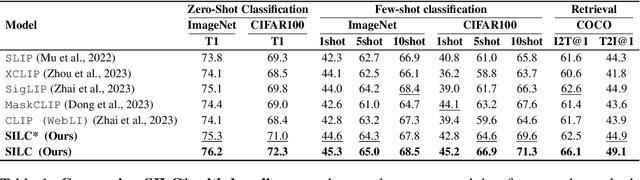
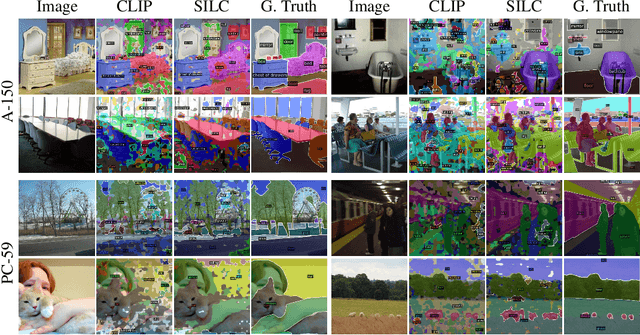
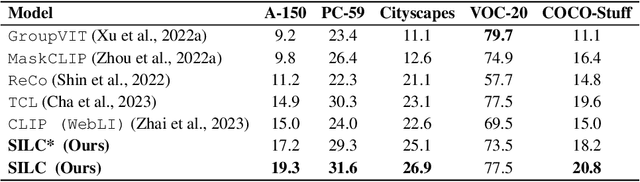
Image-Text pretraining on web-scale image caption dataset has become the default recipe for open vocabulary classification and retrieval models thanks to the success of CLIP and its variants. Several works have also used CLIP features for dense prediction tasks and have shown the emergence of open-set abilities. However, the contrastive objective only focuses on image-text alignment and does not incentivise image feature learning for dense prediction tasks. In this work, we propose the simple addition of local-to-global correspondence learning by self-distillation as an additional objective for contrastive pre-training to propose SILC. We show that distilling local image features from an exponential moving average (EMA) teacher model significantly improves model performance on several computer vision tasks including classification, retrieval, and especially segmentation. We further show that SILC scales better with the same training duration compared to the baselines. Our model SILC sets a new state of the art for zero-shot classification, few shot classification, image and text retrieval, zero-shot segmentation, and open vocabulary segmentation.
Real-Time Motion Prediction via Heterogeneous Polyline Transformer with Relative Pose Encoding
Oct 19, 2023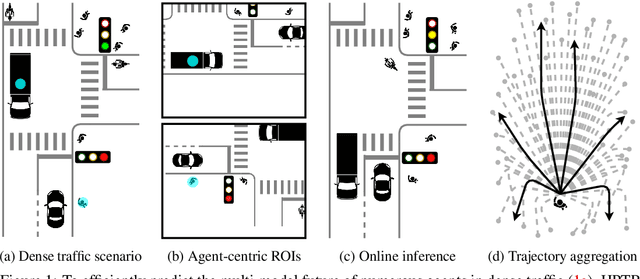
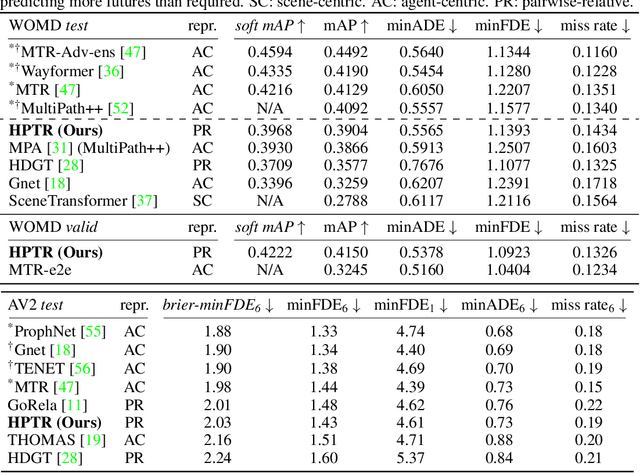
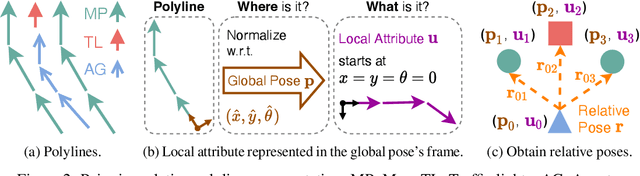
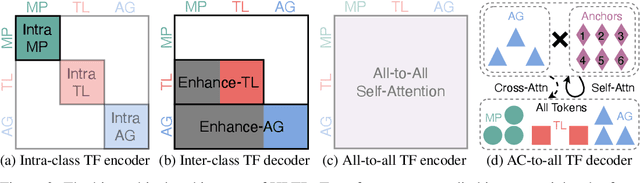
The real-world deployment of an autonomous driving system requires its components to run on-board and in real-time, including the motion prediction module that predicts the future trajectories of surrounding traffic participants. Existing agent-centric methods have demonstrated outstanding performance on public benchmarks. However, they suffer from high computational overhead and poor scalability as the number of agents to be predicted increases. To address this problem, we introduce the K-nearest neighbor attention with relative pose encoding (KNARPE), a novel attention mechanism allowing the pairwise-relative representation to be used by Transformers. Then, based on KNARPE we present the Heterogeneous Polyline Transformer with Relative pose encoding (HPTR), a hierarchical framework enabling asynchronous token update during the online inference. By sharing contexts among agents and reusing the unchanged contexts, our approach is as efficient as scene-centric methods, while performing on par with state-of-the-art agent-centric methods. Experiments on Waymo and Argoverse-2 datasets show that HPTR achieves superior performance among end-to-end methods that do not apply expensive post-processing or model ensembling. The code is available at https://github.com/zhejz/HPTR.
Probabilistic Sampling of Balanced K-Means using Adiabatic Quantum Computing
Oct 18, 2023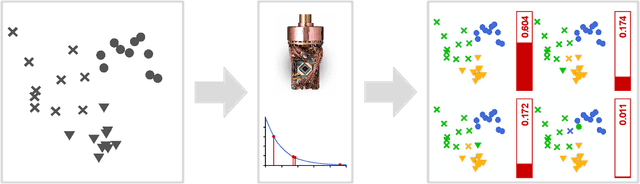
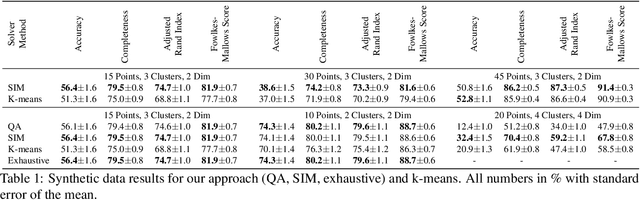
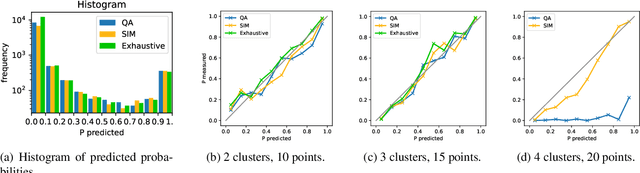

Adiabatic quantum computing (AQC) is a promising quantum computing approach for discrete and often NP-hard optimization problems. Current AQCs allow to implement problems of research interest, which has sparked the development of quantum representations for many machine learning and computer vision tasks. Despite requiring multiple measurements from the noisy AQC, current approaches only utilize the best measurement, discarding information contained in the remaining ones. In this work, we explore the potential of using this information for probabilistic balanced k-means clustering. Instead of discarding non-optimal solutions, we propose to use them to compute calibrated posterior probabilities with little additional compute cost. This allows us to identify ambiguous solutions and data points, which we demonstrate on a D-Wave AQC on synthetic and real data.
Deformable Neural Radiance Fields using RGB and Event Cameras
Sep 25, 2023Modeling Neural Radiance Fields for fast-moving deformable objects from visual data alone is a challenging problem. A major issue arises due to the high deformation and low acquisition rates. To address this problem, we propose to use event cameras that offer very fast acquisition of visual change in an asynchronous manner. In this work, we develop a novel method to model the deformable neural radiance fields using RGB and event cameras. The proposed method uses the asynchronous stream of events and calibrated sparse RGB frames. In our setup, the camera pose at the individual events required to integrate them into the radiance fields remains unknown. Our method jointly optimizes these poses and the radiance field. This happens efficiently by leveraging the collection of events at once and actively sampling the events during learning. Experiments conducted on both realistically rendered graphics and real-world datasets demonstrate a significant benefit of the proposed method over the state-of-the-art and the compared baseline. This shows a promising direction for modeling deformable neural radiance fields in real-world dynamic scenes.
Discwise Active Learning for LiDAR Semantic Segmentation
Sep 23, 2023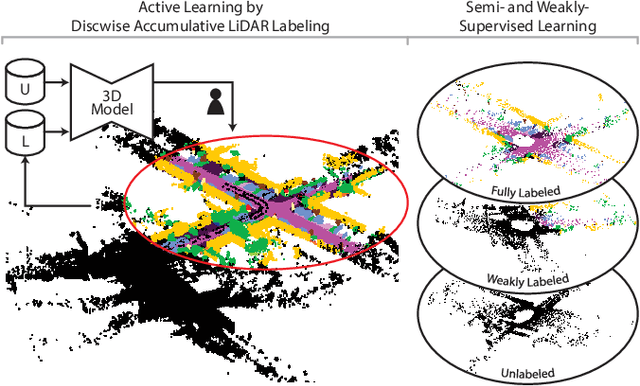
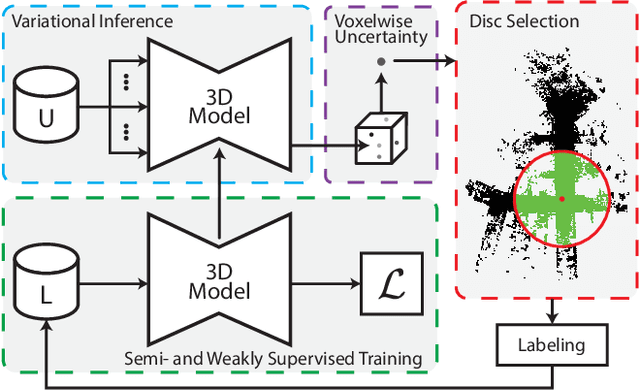
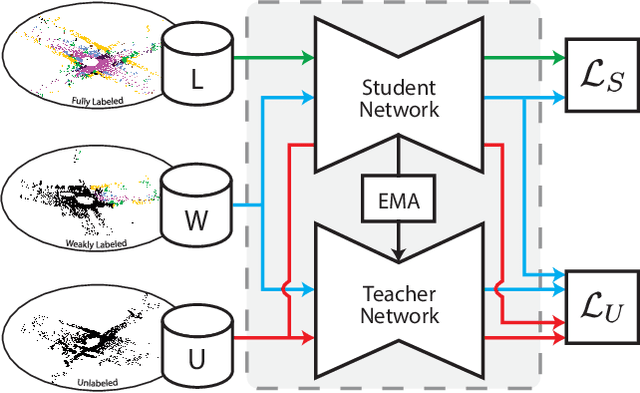
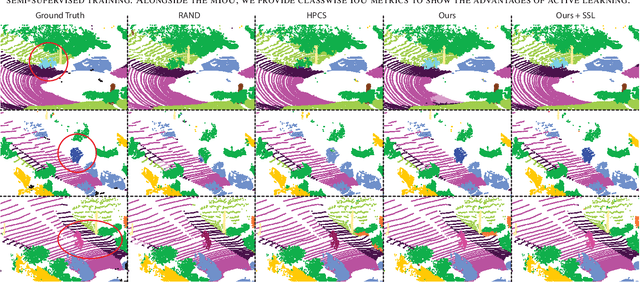
While LiDAR data acquisition is easy, labeling for semantic segmentation remains highly time consuming and must therefore be done selectively. Active learning (AL) provides a solution that can iteratively and intelligently label a dataset while retaining high performance and a low budget. In this work we explore AL for LiDAR semantic segmentation. As a human expert is a component of the pipeline, a practical framework must consider common labeling techniques such as sequential labeling that drastically improve annotation times. We therefore propose a discwise approach (DiAL), where in each iteration, we query the region a single frame covers on global coordinates, labeling all frames simultaneously. We then tackle the two major challenges that emerge with discwise AL. Firstly we devise a new acquisition function that takes 3D point density changes into consideration which arise due to location changes or ego-vehicle motion. Next we solve a mixed-integer linear program that provides a general solution to the selection of multiple frames while taking into consideration the possibilities of disc intersections. Finally we propose a semi-supervised learning approach to utilize all frames within our dataset and improve performance.