 Add to Chrome
 Add to Firefox
 Add to Edge
Multimodal Enhancement of Sequential Recommendation
Feb 06, 2026
We propose a novel recommender framework, MuSTRec (Multimodal and Sequential Transformer-based Recommendation), that unifies multimodal and sequential recommendation paradigms. MuSTRec captures cross-item similarities and collaborative filtering signals, by building item-item graphs from extracted text and visual features. A frequency-based self-attention module additionally captures the short- and long-term user preferences. Across multiple Amazon datasets, MuSTRec demonstrates superior performance (up to 33.5% improvement) over multimodal and sequential state-of-the-art baselines. Finally, we detail some interesting facets of this new recommendation paradigm. These include the need for a new data partitioning regime, and a demonstration of how integrating user embeddings into sequential recommendation leads to drastically increased short-term metrics (up to 200% improvement) on smaller datasets. Our code is availabe at https://anonymous.4open.science/r/MuSTRec-D32B/ and will be made publicly available.

Sequences as Nodes for Contrastive Multimodal Graph Recommendation
Feb 06, 2026To tackle cold-start and data sparsity issues in recommender systems, numerous multimodal, sequential, and contrastive techniques have been proposed. While these augmentations can boost recommendation performance, they tend to add noise and disrupt useful semantics. To address this, we propose MuSICRec (Multimodal Sequence-Item Contrastive Recommender), a multi-view graph-based recommender that combines collaborative, sequential, and multimodal signals. We build a sequence-item (SI) view by attention pooling over the user's interacted items to form sequence nodes. We propagate over the SI graph, obtaining a second view organically as an alternative to artificial data augmentation, while simultaneously injecting sequential context signals. Additionally, to mitigate modality noise and align the multimodal information, the contribution of text and visual features is modulated according to an ID-guided gate. We evaluate under a strict leave-two-out split against a broad range of sequential, multimodal, and contrastive baselines. On the Amazon Baby, Sports, and Electronics datasets, MuSICRec outperforms state-of-the-art baselines across all model types. We observe the largest gains for short-history users, mitigating sparsity and cold-start challenges. Our code is available at https://anonymous.4open.science/r/MuSICRec-3CEE/ and will be made publicly available.
DSL: Understanding and Improving Softmax Recommender Systems with Competition-Aware Scaling
Feb 06, 2026Softmax Loss (SL) is being increasingly adopted for recommender systems (RS) as it has demonstrated better performance, robustness and fairness. Yet in implicit-feedback, a single global temperature and equal treatment of uniformly sampled negatives can lead to brittle training, because sampled sets may contain varying degrees of relevant or informative competitors. The optimal loss sharpness for a user-item pair with a particular set of negatives, can be suboptimal or destabilising for another with different negatives. We introduce Dual-scale Softmax Loss (DSL), which infers effective sharpness from the sampled competition itself. DSL adds two complementary branches to the log-sum-exp backbone. Firstly it reweights negatives within each training instance using hardness and item--item similarity, secondly it adapts a per-example temperature from the competition intensity over a constructed competitor slate. Together, these components preserve the geometry of SL while reshaping the competition distribution across negatives and across examples. Over several representative benchmarks and backbones, DSL yields substantial gains over strong baselines, with improvements over SL exceeding $10%$ in several settings and averaging $6.22%$ across datasets, metrics, and backbones. Under out-of-distribution (OOD) popularity shift, the gains are larger, with an average of $9.31%$ improvement over SL. We further provide a theoretical, distributionally robust optimisation (DRO) analysis, which demonstrates how DSL reshapes the robust payoff and the KL deviation for ambiguous instances. This helps explain the empirically observed improvements in accuracy and robustness.
Melodia: Training-Free Music Editing Guided by Attention Probing in Diffusion Models
Nov 18, 2025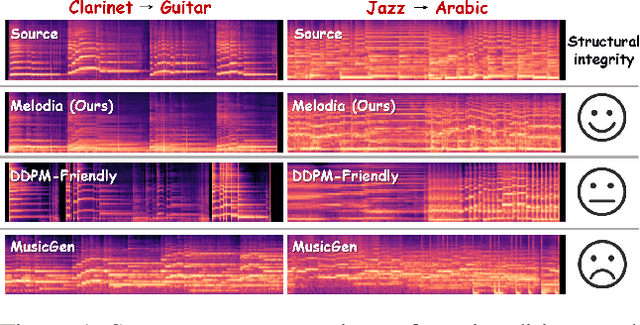
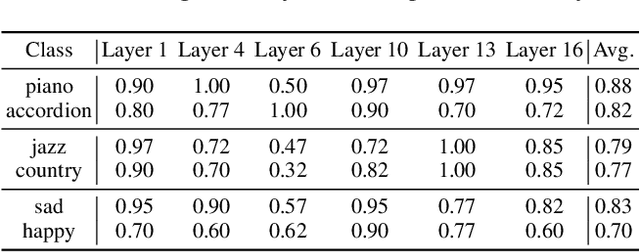
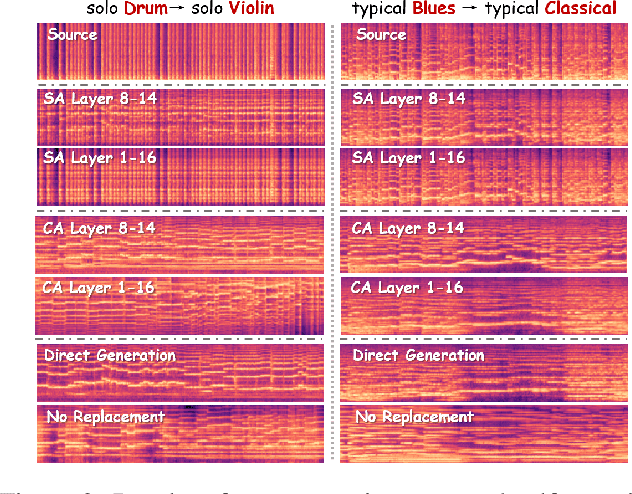
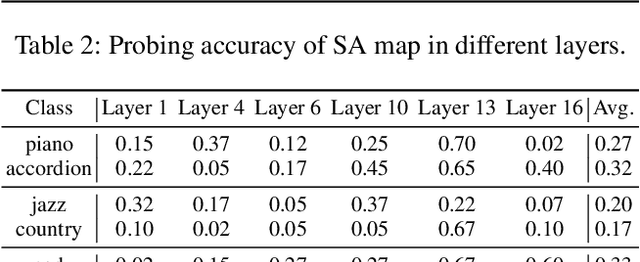
Text-to-music generation technology is progressing rapidly, creating new opportunities for musical composition and editing. However, existing music editing methods often fail to preserve the source music's temporal structure, including melody and rhythm, when altering particular attributes like instrument, genre, and mood. To address this challenge, this paper conducts an in-depth probing analysis on attention maps within AudioLDM 2, a diffusion-based model commonly used as the backbone for existing music editing methods. We reveal a key finding: cross-attention maps encompass details regarding distinct musical characteristics, and interventions on these maps frequently result in ineffective modifications. In contrast, self-attention maps are essential for preserving the temporal structure of the source music during its conversion into the target music. Building upon this understanding, we present Melodia, a training-free technique that selectively manipulates self-attention maps in particular layers during the denoising process and leverages an attention repository to store source music information, achieving accurate modification of musical characteristics while preserving the original structure without requiring textual descriptions of the source music. Additionally, we propose two novel metrics to better evaluate music editing methods. Both objective and subjective experiments demonstrate that our approach achieves superior results in terms of textual adherence and structural integrity across various datasets. This research enhances comprehension of internal mechanisms within music generation models and provides improved control for music creation.
A Physics-Informed Blur Learning Framework for Imaging Systems
Feb 17, 2025Accurate blur estimation is essential for high-performance imaging across various applications. Blur is typically represented by the point spread function (PSF). In this paper, we propose a physics-informed PSF learning framework for imaging systems, consisting of a simple calibration followed by a learning process. Our framework could achieve both high accuracy and universal applicability. Inspired by the Seidel PSF model for representing spatially varying PSF, we identify its limitations in optimization and introduce a novel wavefront-based PSF model accompanied by an optimization strategy, both reducing optimization complexity and improving estimation accuracy. Moreover, our wavefront-based PSF model is independent of lens parameters, eliminate the need for prior knowledge of the lens. To validate our approach, we compare it with recent PSF estimation methods (Degradation Transfer and Fast Two-step) through a deblurring task, where all the estimated PSFs are used to train state-of-the-art deblurring algorithms. Our approach demonstrates improvements in image quality in simulation and also showcases noticeable visual quality improvements on real captured images.
Tolerance-Aware Deep Optics
Feb 07, 2025Deep optics has emerged as a promising approach by co-designing optical elements with deep learning algorithms. However, current research typically overlooks the analysis and optimization of manufacturing and assembly tolerances. This oversight creates a significant performance gap between designed and fabricated optical systems. To address this challenge, we present the first end-to-end tolerance-aware optimization framework that incorporates multiple tolerance types into the deep optics design pipeline. Our method combines physics-informed modelling with data-driven training to enhance optical design by accounting for and compensating for structural deviations in manufacturing and assembly. We validate our approach through computational imaging applications, demonstrating results in both simulations and real-world experiments. We further examine how our proposed solution improves the robustness of optical systems and vision algorithms against tolerances through qualitative and quantitative analyses. Code and additional visual results are available at openimaginglab.github.io/LensTolerance.
DriveEditor: A Unified 3D Information-Guided Framework for Controllable Object Editing in Driving Scenes
Dec 27, 2024


Vision-centric autonomous driving systems require diverse data for robust training and evaluation, which can be augmented by manipulating object positions and appearances within existing scene captures. While recent advancements in diffusion models have shown promise in video editing, their application to object manipulation in driving scenarios remains challenging due to imprecise positional control and difficulties in preserving high-fidelity object appearances. To address these challenges in position and appearance control, we introduce DriveEditor, a diffusion-based framework for object editing in driving videos. DriveEditor offers a unified framework for comprehensive object editing operations, including repositioning, replacement, deletion, and insertion. These diverse manipulations are all achieved through a shared set of varying inputs, processed by identical position control and appearance maintenance modules. The position control module projects the given 3D bounding box while preserving depth information and hierarchically injects it into the diffusion process, enabling precise control over object position and orientation. The appearance maintenance module preserves consistent attributes with a single reference image by employing a three-tiered approach: low-level detail preservation, high-level semantic maintenance, and the integration of 3D priors from a novel view synthesis model. Extensive qualitative and quantitative evaluations on the nuScenes dataset demonstrate DriveEditor's exceptional fidelity and controllability in generating diverse driving scene edits, as well as its remarkable ability to facilitate downstream tasks.
Perceptual-Distortion Balanced Image Super-Resolution is a Multi-Objective Optimization Problem
Sep 05, 2024Training Single-Image Super-Resolution (SISR) models using pixel-based regression losses can achieve high distortion metrics scores (e.g., PSNR and SSIM), but often results in blurry images due to insufficient recovery of high-frequency details. Conversely, using GAN or perceptual losses can produce sharp images with high perceptual metric scores (e.g., LPIPS), but may introduce artifacts and incorrect textures. Balancing these two types of losses can help achieve a trade-off between distortion and perception, but the challenge lies in tuning the loss function weights. To address this issue, we propose a novel method that incorporates Multi-Objective Optimization (MOO) into the training process of SISR models to balance perceptual quality and distortion. We conceptualize the relationship between loss weights and image quality assessment (IQA) metrics as black-box objective functions to be optimized within our Multi-Objective Bayesian Optimization Super-Resolution (MOBOSR) framework. This approach automates the hyperparameter tuning process, reduces overall computational cost, and enables the use of numerous loss functions simultaneously. Extensive experiments demonstrate that MOBOSR outperforms state-of-the-art methods in terms of both perceptual quality and distortion, significantly advancing the perception-distortion Pareto frontier. Our work points towards a new direction for future research on balancing perceptual quality and fidelity in nearly all image restoration tasks. The source code and pretrained models are available at: https://github.com/ZhuKeven/MOBOSR.
Powerful Lossy Compression for Noisy Images
Mar 26, 2024Image compression and denoising represent fundamental challenges in image processing with many real-world applications. To address practical demands, current solutions can be categorized into two main strategies: 1) sequential method; and 2) joint method. However, sequential methods have the disadvantage of error accumulation as there is information loss between multiple individual models. Recently, the academic community began to make some attempts to tackle this problem through end-to-end joint methods. Most of them ignore that different regions of noisy images have different characteristics. To solve these problems, in this paper, our proposed signal-to-noise ratio~(SNR) aware joint solution exploits local and non-local features for image compression and denoising simultaneously. We design an end-to-end trainable network, which includes the main encoder branch, the guidance branch, and the signal-to-noise ratio~(SNR) aware branch. We conducted extensive experiments on both synthetic and real-world datasets, demonstrating that our joint solution outperforms existing state-of-the-art methods.
Jointly Optimizing Image Compression with Low-light Image Enhancement
May 24, 2023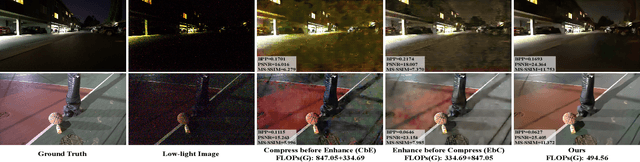
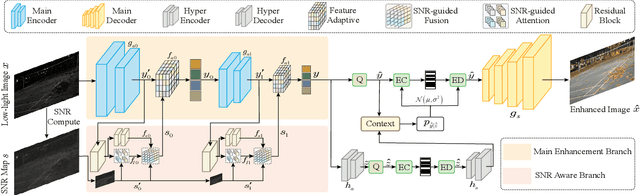
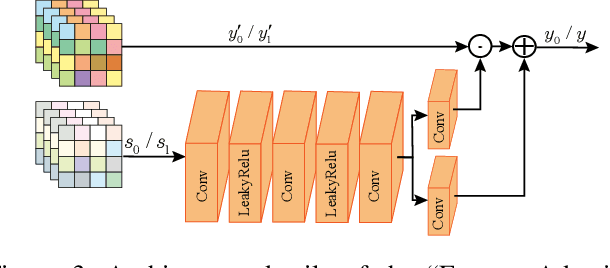
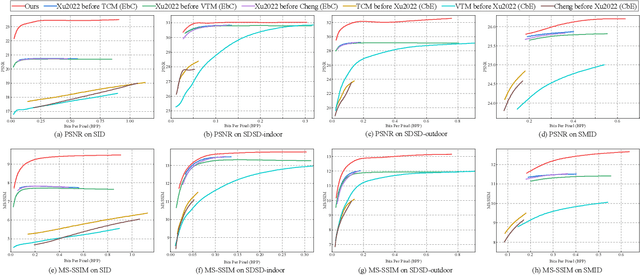
Learning-based image compression methods have made great progress. Most of them are designed for generic natural images. In fact, low-light images frequently occur due to unavoidable environmental influences or technical limitations, such as insufficient lighting or limited exposure time. %When general-purpose image compression algorithms compress low-light images, useful detail information is lost, resulting in a dramatic decrease in image enhancement. Once low-light images are compressed by existing general image compression approaches, useful information(e.g., texture details) would be lost resulting in a dramatic performance decrease in low-light image enhancement. To simultaneously achieve a higher compression rate and better enhancement performance for low-light images, we propose a novel image compression framework with joint optimization of low-light image enhancement. We design an end-to-end trainable two-branch architecture with lower computational cost, which includes the main enhancement branch and the signal-to-noise ratio~(SNR) aware branch. Experimental results show that our proposed joint optimization framework achieves a significant improvement over existing ``Compress before Enhance" or ``Enhance before Compress" sequential solutions for low-light images. Source codes are included in the supplementary material.