 Add to Chrome
 Add to Firefox
 Add to Edge
Voxtral TTS
Mar 26, 2026
We introduce Voxtral TTS, an expressive multilingual text-to-speech model that generates natural speech from as little as 3 seconds of reference audio. Voxtral TTS adopts a hybrid architecture that combines auto-regressive generation of semantic speech tokens with flow-matching for acoustic tokens. These tokens are encoded and decoded with Voxtral Codec, a speech tokenizer trained from scratch with a hybrid VQ-FSQ quantization scheme. In human evaluations conducted by native speakers, Voxtral TTS is preferred for multilingual voice cloning due to its naturalness and expressivity, achieving a 68.4\% win rate over ElevenLabs Flash v2.5. We release the model weights under a CC BY-NC license.

Voxtral Realtime
Feb 11, 2026We introduce Voxtral Realtime, a natively streaming automatic speech recognition model that matches offline transcription quality at sub-second latency. Unlike approaches that adapt offline models through chunking or sliding windows, Voxtral Realtime is trained end-to-end for streaming, with explicit alignment between audio and text streams. Our architecture builds on the Delayed Streams Modeling framework, introducing a new causal audio encoder and Ada RMS-Norm for improved delay conditioning. We scale pretraining to a large-scale dataset spanning 13 languages. At a delay of 480ms, Voxtral Realtime achieves performance on par with Whisper, the most widely deployed offline transcription system. We release the model weights under the Apache 2.0 license.
Ministral 3
Jan 13, 2026We introduce the Ministral 3 series, a family of parameter-efficient dense language models designed for compute and memory constrained applications, available in three model sizes: 3B, 8B, and 14B parameters. For each model size, we release three variants: a pretrained base model for general-purpose use, an instruction finetuned, and a reasoning model for complex problem-solving. In addition, we present our recipe to derive the Ministral 3 models through Cascade Distillation, an iterative pruning and continued training with distillation technique. Each model comes with image understanding capabilities, all under the Apache 2.0 license.
An Introduction to Discrete Variational Autoencoders
May 15, 2025Variational Autoencoders (VAEs) are well-established as a principled approach to probabilistic unsupervised learning with neural networks. Typically, an encoder network defines the parameters of a Gaussian distributed latent space from which we can sample and pass realizations to a decoder network. This model is trained to reconstruct its inputs and is optimized through the evidence lower bound. In recent years, discrete latent spaces have grown in popularity, suggesting that they may be a natural choice for many data modalities (e.g. text). In this tutorial, we provide a rigorous, yet practical, introduction to discrete variational autoencoders -- specifically, VAEs in which the latent space is made up of latent variables that follow a categorical distribution. We assume only a basic mathematical background with which we carefully derive each step from first principles. From there, we develop a concrete training recipe and provide an example implementation, hosted at https://github.com/alanjeffares/discreteVAE.
Deep Learning Through A Telescoping Lens: A Simple Model Provides Empirical Insights On Grokking, Gradient Boosting & Beyond
Oct 31, 2024


Deep learning sometimes appears to work in unexpected ways. In pursuit of a deeper understanding of its surprising behaviors, we investigate the utility of a simple yet accurate model of a trained neural network consisting of a sequence of first-order approximations telescoping out into a single empirically operational tool for practical analysis. Across three case studies, we illustrate how it can be applied to derive new empirical insights on a diverse range of prominent phenomena in the literature -- including double descent, grokking, linear mode connectivity, and the challenges of applying deep learning on tabular data -- highlighting that this model allows us to construct and extract metrics that help predict and understand the a priori unexpected performance of neural networks. We also demonstrate that this model presents a pedagogical formalism allowing us to isolate components of the training process even in complex contemporary settings, providing a lens to reason about the effects of design choices such as architecture & optimization strategy, and reveals surprising parallels between neural network learning and gradient boosting.
Relaxed Quantile Regression: Prediction Intervals for Asymmetric Noise
Jun 05, 2024Constructing valid prediction intervals rather than point estimates is a well-established approach for uncertainty quantification in the regression setting. Models equipped with this capacity output an interval of values in which the ground truth target will fall with some prespecified probability. This is an essential requirement in many real-world applications where simple point predictions' inability to convey the magnitude and frequency of errors renders them insufficient for high-stakes decisions. Quantile regression is a leading approach for obtaining such intervals via the empirical estimation of quantiles in the (non-parametric) distribution of outputs. This method is simple, computationally inexpensive, interpretable, assumption-free, and effective. However, it does require that the specific quantiles being learned are chosen a priori. This results in (a) intervals that are arbitrarily symmetric around the median which is sub-optimal for realistic skewed distributions, or (b) learning an excessive number of intervals. In this work, we propose Relaxed Quantile Regression (RQR), a direct alternative to quantile regression based interval construction that removes this arbitrary constraint whilst maintaining its strengths. We demonstrate that this added flexibility results in intervals with an improvement in desirable qualities (e.g. mean width) whilst retaining the essential coverage guarantees of quantile regression.
Why do Random Forests Work? Understanding Tree Ensembles as Self-Regularizing Adaptive Smoothers
Feb 02, 2024Despite their remarkable effectiveness and broad application, the drivers of success underlying ensembles of trees are still not fully understood. In this paper, we highlight how interpreting tree ensembles as adaptive and self-regularizing smoothers can provide new intuition and deeper insight to this topic. We use this perspective to show that, when studied as smoothers, randomized tree ensembles not only make predictions that are quantifiably more smooth than the predictions of the individual trees they consist of, but also further regulate their smoothness at test-time based on the dissimilarity between testing and training inputs. First, we use this insight to revisit, refine and reconcile two recent explanations of forest success by providing a new way of quantifying the conjectured behaviors of tree ensembles objectively by measuring the effective degree of smoothing they imply. Then, we move beyond existing explanations for the mechanisms by which tree ensembles improve upon individual trees and challenge the popular wisdom that the superior performance of forests should be understood as a consequence of variance reduction alone. We argue that the current high-level dichotomy into bias- and variance-reduction prevalent in statistics is insufficient to understand tree ensembles -- because the prevailing definition of bias does not capture differences in the expressivity of the hypothesis classes formed by trees and forests. Instead, we show that forests can improve upon trees by three distinct mechanisms that are usually implicitly entangled. In particular, we demonstrate that the smoothing effect of ensembling can reduce variance in predictions due to noise in outcome generation, reduce variability in the quality of the learned function given fixed input data and reduce potential bias in learnable functions by enriching the available hypothesis space.
A U-turn on Double Descent: Rethinking Parameter Counting in Statistical Learning
Oct 29, 2023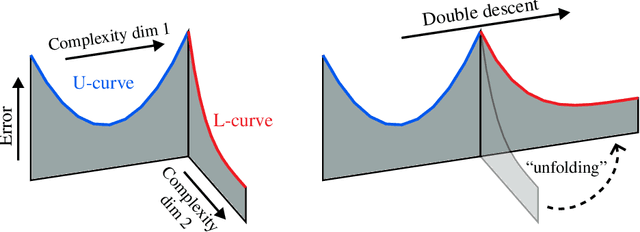
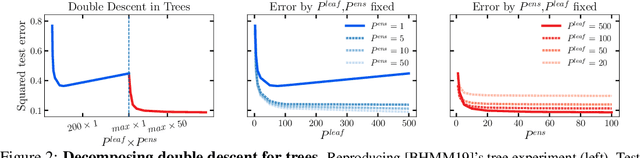
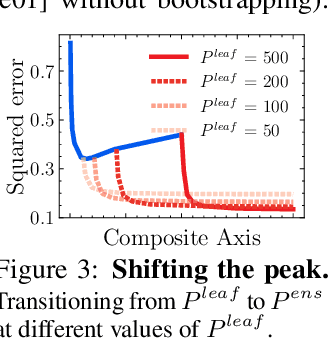
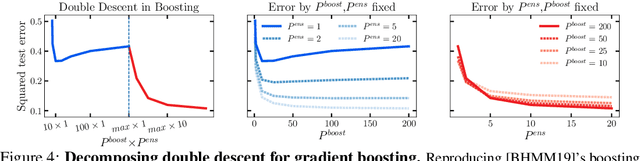
Conventional statistical wisdom established a well-understood relationship between model complexity and prediction error, typically presented as a U-shaped curve reflecting a transition between under- and overfitting regimes. However, motivated by the success of overparametrized neural networks, recent influential work has suggested this theory to be generally incomplete, introducing an additional regime that exhibits a second descent in test error as the parameter count p grows past sample size n - a phenomenon dubbed double descent. While most attention has naturally been given to the deep-learning setting, double descent was shown to emerge more generally across non-neural models: known cases include linear regression, trees, and boosting. In this work, we take a closer look at evidence surrounding these more classical statistical machine learning methods and challenge the claim that observed cases of double descent truly extend the limits of a traditional U-shaped complexity-generalization curve therein. We show that once careful consideration is given to what is being plotted on the x-axes of their double descent plots, it becomes apparent that there are implicitly multiple complexity axes along which the parameter count grows. We demonstrate that the second descent appears exactly (and only) when and where the transition between these underlying axes occurs, and that its location is thus not inherently tied to the interpolation threshold p=n. We then gain further insight by adopting a classical nonparametric statistics perspective. We interpret the investigated methods as smoothers and propose a generalized measure for the effective number of parameters they use on unseen examples, using which we find that their apparent double descent curves indeed fold back into more traditional convex shapes - providing a resolution to tensions between double descent and statistical intuition.
TANGOS: Regularizing Tabular Neural Networks through Gradient Orthogonalization and Specialization
Mar 09, 2023Despite their success with unstructured data, deep neural networks are not yet a panacea for structured tabular data. In the tabular domain, their efficiency crucially relies on various forms of regularization to prevent overfitting and provide strong generalization performance. Existing regularization techniques include broad modelling decisions such as choice of architecture, loss functions, and optimization methods. In this work, we introduce Tabular Neural Gradient Orthogonalization and Specialization (TANGOS), a novel framework for regularization in the tabular setting built on latent unit attributions. The gradient attribution of an activation with respect to a given input feature suggests how the neuron attends to that feature, and is often employed to interpret the predictions of deep networks. In TANGOS, we take a different approach and incorporate neuron attributions directly into training to encourage orthogonalization and specialization of latent attributions in a fully-connected network. Our regularizer encourages neurons to focus on sparse, non-overlapping input features and results in a set of diverse and specialized latent units. In the tabular domain, we demonstrate that our approach can lead to improved out-of-sample generalization performance, outperforming other popular regularization methods. We provide insight into why our regularizer is effective and demonstrate that TANGOS can be applied jointly with existing methods to achieve even greater generalization performance.
Improving Adaptive Conformal Prediction Using Self-Supervised Learning
Feb 23, 2023Conformal prediction is a powerful distribution-free tool for uncertainty quantification, establishing valid prediction intervals with finite-sample guarantees. To produce valid intervals which are also adaptive to the difficulty of each instance, a common approach is to compute normalized nonconformity scores on a separate calibration set. Self-supervised learning has been effectively utilized in many domains to learn general representations for downstream predictors. However, the use of self-supervision beyond model pretraining and representation learning has been largely unexplored. In this work, we investigate how self-supervised pretext tasks can improve the quality of the conformal regressors, specifically by improving the adaptability of conformal intervals. We train an auxiliary model with a self-supervised pretext task on top of an existing predictive model and use the self-supervised error as an additional feature to estimate nonconformity scores. We empirically demonstrate the benefit of the additional information using both synthetic and real data on the efficiency (width), deficit, and excess of conformal prediction intervals.