 Add to Chrome
 Add to Firefox
 Add to Edge
Rethinking the Pointer Loss in Table Structure Recognition: Geometry-Aware Pointer Loss for Spatial Locality
Jun 17, 2026
Table Structure Recognition (TSR) using a pointer network achieves impressive results by predicting HTML sequences while aligning tags to detected text (or cell) regions. However, our analysis reveals that when pointer networks fail, 79.6% of errors occur between spatially adjacent cells (Manhattan distance <= 2). Despite this, standard cross-entropy loss weights all negative candidates equally. In this work, we propose Geometry-Aware Pointer (GAP) Loss, which reweights the cross-entropy objective based on spatial proximity to ground truth. By applying inverse distance weighting, GAP focuses gradient flow where the model struggles most: immediate neighbors receive stronger gradients than distant cells. Our approach requires only a straightforward modification to the loss computation, maintaining the same model architecture with zero additional inference cost. Extensive experiments on PubTabNet and SynthTabNet demonstrate that GAP consistently reduces adjacent-cell errors, achieving new state-of-the-art performance. Our findings suggest that incorporating geometric inductive biases at the loss level provides a simple yet effective approach to robust TSR. Our code is available at https://github.com/teamreboott/GAP

Disentangling Visual and Factual Correctness in LVLMs' Visualization Literacy
Jun 02, 2026Large Vision-Language Models (LVLMs) show strong visualization interpretation, yet it is unclear whether their responses reflect genuine reasoning over visual evidence or factual priors learned during training. Current evaluations mix these two sources, obscuring when correct visual interpretation is overridden by memorized facts. We present a framework that isolates visual correctness from factual correctness, revealing validity limitations in existing visualization literacy assessments. Across three experiments with 15 state-of-the-art LVLMs: (1) several models reach human-level performance on standard tests (VLAT), but this may reflect factual recall rather than visual understanding, while randomized-data tests (reVLAT) underestimate literacy when correct visual interpretation is superseded by factual priors. (2) Using our Counterfactual Visualization Literacy Assessment Test (CVLAT) with capability-normalized arbitration metrics, we classify models by the sign of their visual-factual reliance index (VFRI), revealing a visualization-oriented majority and a factual knowledge-oriented minority, though several near-zero cases warrant caution. A human baseline (N=30) on the same counterfactual items confirms that people overwhelmingly follow the chart under conflict, providing a human reference point. (3) Prompt-based intervention can shift prioritization, but its effectiveness is highly model-dependent and direction-asymmetric, and high chart-reading capability does not predict prompt-controllability. Overall, high visualization accuracy is not sufficient evidence of faithful visual reasoning: reliable integration into visual analytics requires evaluating not only visualization literacy but also how models arbitrate between visual evidence and factual priors when the two diverge. Benchmark and code: https://github.com/JaeyoungKim-HCIL/CVLAT
Voxtral TTS
Mar 26, 2026We introduce Voxtral TTS, an expressive multilingual text-to-speech model that generates natural speech from as little as 3 seconds of reference audio. Voxtral TTS adopts a hybrid architecture that combines auto-regressive generation of semantic speech tokens with flow-matching for acoustic tokens. These tokens are encoded and decoded with Voxtral Codec, a speech tokenizer trained from scratch with a hybrid VQ-FSQ quantization scheme. In human evaluations conducted by native speakers, Voxtral TTS is preferred for multilingual voice cloning due to its naturalness and expressivity, achieving a 68.4\% win rate over ElevenLabs Flash v2.5. We release the model weights under a CC BY-NC license.
Voxtral Realtime
Feb 11, 2026We introduce Voxtral Realtime, a natively streaming automatic speech recognition model that matches offline transcription quality at sub-second latency. Unlike approaches that adapt offline models through chunking or sliding windows, Voxtral Realtime is trained end-to-end for streaming, with explicit alignment between audio and text streams. Our architecture builds on the Delayed Streams Modeling framework, introducing a new causal audio encoder and Ada RMS-Norm for improved delay conditioning. We scale pretraining to a large-scale dataset spanning 13 languages. At a delay of 480ms, Voxtral Realtime achieves performance on par with Whisper, the most widely deployed offline transcription system. We release the model weights under the Apache 2.0 license.
Adaptive Retrieval for Reasoning-Intensive Retrieval
Jan 08, 2026We study leveraging adaptive retrieval to ensure sufficient "bridge" documents are retrieved for reasoning-intensive retrieval. Bridge documents are those that contribute to the reasoning process yet are not directly relevant to the initial query. While existing reasoning-based reranker pipelines attempt to surface these documents in ranking, they suffer from bounded recall. Naive solution with adaptive retrieval into these pipelines often leads to planning error propagation. To address this, we propose REPAIR, a framework that bridges this gap by repurposing reasoning plans as dense feedback signals for adaptive retrieval. Our key distinction is enabling mid-course correction during reranking through selective adaptive retrieval, retrieving documents that support the pivotal plan. Experimental results on reasoning-intensive retrieval and complex QA tasks demonstrate that our method outperforms existing baselines by 5.6%pt.
Relevance to Utility: Process-Supervised Rewrite for RAG
Sep 19, 2025Retrieval-Augmented Generation systems often suffer from a gap between optimizing retrieval relevance and generative utility: retrieved documents may be topically relevant but still lack the content needed for effective reasoning during generation. While existing "bridge" modules attempt to rewrite the retrieved text for better generation, we show how they fail to capture true document utility. In this work, we propose R2U, with a key distinction of directly optimizing to maximize the probability of generating a correct answer through process supervision. As such direct observation is expensive, we also propose approximating an efficient distillation pipeline by scaling the supervision from LLMs, which helps the smaller rewriter model generalize better. We evaluate our method across multiple open-domain question-answering benchmarks. The empirical results demonstrate consistent improvements over strong bridging baselines.
Leveraging Multimodal LLM for Inspirational User Interface Search
Jan 30, 2025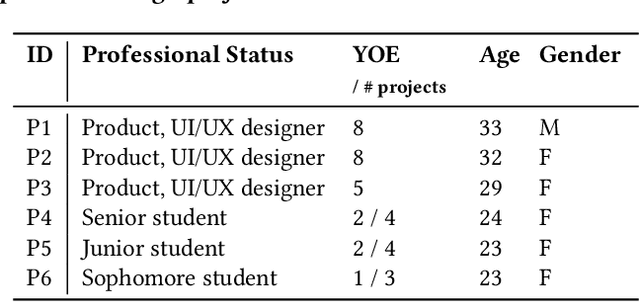
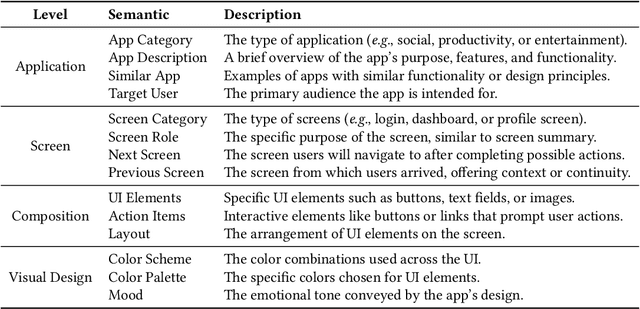
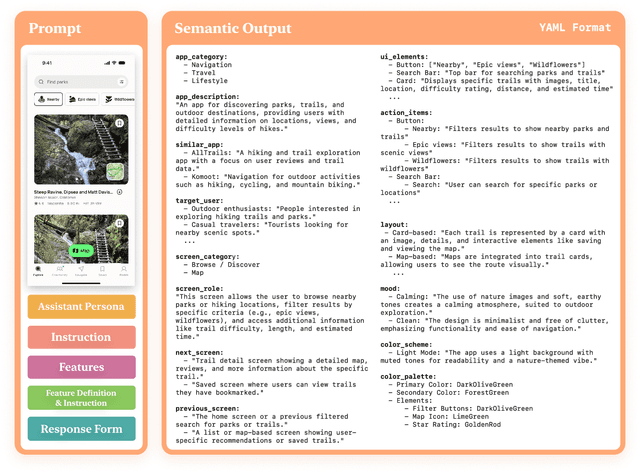

Inspirational search, the process of exploring designs to inform and inspire new creative work, is pivotal in mobile user interface (UI) design. However, exploring the vast space of UI references remains a challenge. Existing AI-based UI search methods often miss crucial semantics like target users or the mood of apps. Additionally, these models typically require metadata like view hierarchies, limiting their practical use. We used a multimodal large language model (MLLM) to extract and interpret semantics from mobile UI images. We identified key UI semantics through a formative study and developed a semantic-based UI search system. Through computational and human evaluations, we demonstrate that our approach significantly outperforms existing UI retrieval methods, offering UI designers a more enriched and contextually relevant search experience. We enhance the understanding of mobile UI design semantics and highlight MLLMs' potential in inspirational search, providing a rich dataset of UI semantics for future studies.
Multi-LLM Collaborative Caption Generation in Scientific Documents
Jan 05, 2025

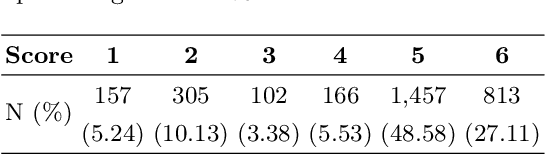

Scientific figure captioning is a complex task that requires generating contextually appropriate descriptions of visual content. However, existing methods often fall short by utilizing incomplete information, treating the task solely as either an image-to-text or text summarization problem. This limitation hinders the generation of high-quality captions that fully capture the necessary details. Moreover, existing data sourced from arXiv papers contain low-quality captions, posing significant challenges for training large language models (LLMs). In this paper, we introduce a framework called Multi-LLM Collaborative Figure Caption Generation (MLBCAP) to address these challenges by leveraging specialized LLMs for distinct sub-tasks. Our approach unfolds in three key modules: (Quality Assessment) We utilize multimodal LLMs to assess the quality of training data, enabling the filtration of low-quality captions. (Diverse Caption Generation) We then employ a strategy of fine-tuning/prompting multiple LLMs on the captioning task to generate candidate captions. (Judgment) Lastly, we prompt a prominent LLM to select the highest quality caption from the candidates, followed by refining any remaining inaccuracies. Human evaluations demonstrate that informative captions produced by our approach rank better than human-written captions, highlighting its effectiveness. Our code is available at https://github.com/teamreboott/MLBCAP
DALDA: Data Augmentation Leveraging Diffusion Model and LLM with Adaptive Guidance Scaling
Sep 25, 2024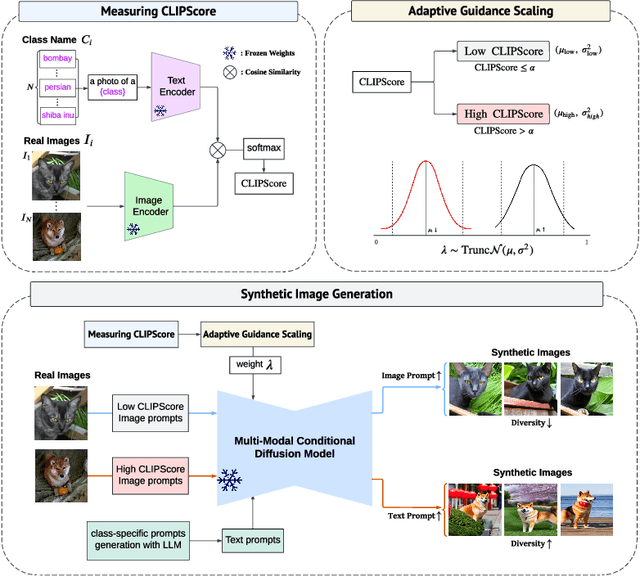


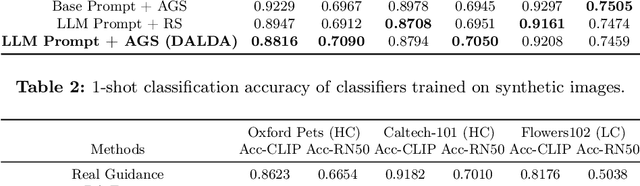
In this paper, we present an effective data augmentation framework leveraging the Large Language Model (LLM) and Diffusion Model (DM) to tackle the challenges inherent in data-scarce scenarios. Recently, DMs have opened up the possibility of generating synthetic images to complement a few training images. However, increasing the diversity of synthetic images also raises the risk of generating samples outside the target distribution. Our approach addresses this issue by embedding novel semantic information into text prompts via LLM and utilizing real images as visual prompts, thus generating semantically rich images. To ensure that the generated images remain within the target distribution, we dynamically adjust the guidance weight based on each image's CLIPScore to control the diversity. Experimental results show that our method produces synthetic images with enhanced diversity while maintaining adherence to the target distribution. Consequently, our approach proves to be more efficient in the few-shot setting on several benchmarks. Our code is available at https://github.com/kkyuhun94/dalda .
Clustering and Mining Accented Speech for Inclusive and Fair Speech Recognition
Aug 05, 2024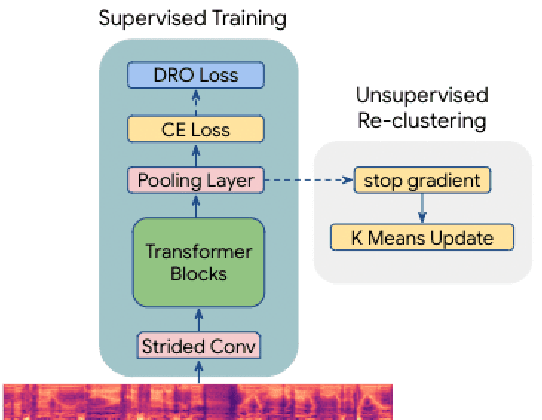
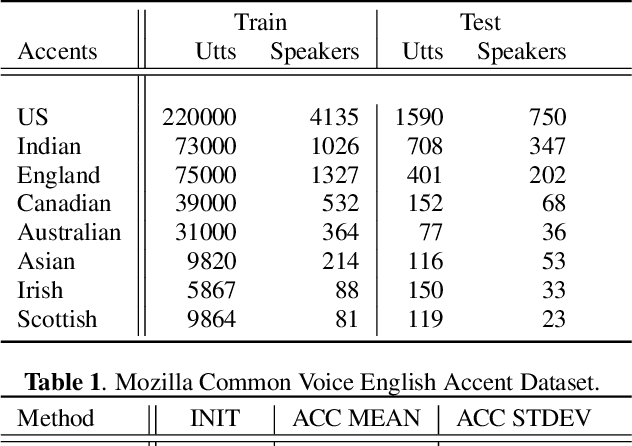
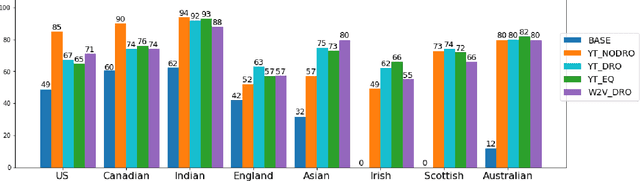
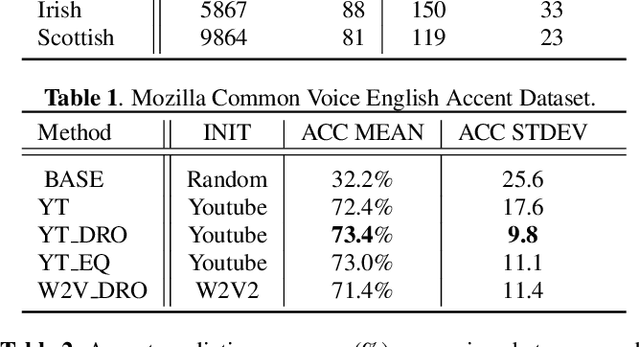
Modern automatic speech recognition (ASR) systems are typically trained on more than tens of thousands hours of speech data, which is one of the main factors for their great success. However, the distribution of such data is typically biased towards common accents or typical speech patterns. As a result, those systems often poorly perform on atypical accented speech. In this paper, we present accent clustering and mining schemes for fair speech recognition systems which can perform equally well on under-represented accented speech. For accent recognition, we applied three schemes to overcome limited size of supervised accent data: supervised or unsupervised pre-training, distributionally robust optimization (DRO) and unsupervised clustering. Three schemes can significantly improve the accent recognition model especially for unbalanced and small accented speech. Fine-tuning ASR on the mined Indian accent speech using the proposed supervised or unsupervised clustering schemes showed 10.0% and 5.3% relative improvements compared to fine-tuning on the randomly sampled speech, respectively.