 Add to Chrome
 Add to Firefox
 Add to Edge
Every Coin Has Two Sides: On the Dual Nature of Generalization in On-Policy Distillation of Large Language Models
Aug 17, 2026
On-policy distillation (OPD) transfers teacher capabilities by supervising trajectories sampled from the student's own policy, yet its generalization behavior remains poorly understood, as most studies evaluate OPD on a single domain and on benchmarks close to the training data. We present a controlled study that varies one generalization factor at a time, from in-domain distribution shifts to cross-domain transfer and the multi-teacher setting. We find that OPD transfers a teacher's reasoning behavior rather than its answers to particular problems: training difficulty barely matters, and even problems the teacher never solves are useful. Transfer depends strongly on the origin relationship between teacher and student: same-origin pairs bring the student close to the teacher across languages, reasoning horizons, and even other domains, whereas cross-origin pairs mostly fit the trained distribution. This broad reach is a double-edged sword: since routing prompts to domain experts cannot confine each teacher's influence, combining them yields a mixture-dependent seesaw among their capabilities. These results clarify when OPD generalizes and offer a useful perspective for diagnosing multi-teacher OPD.

ClawGym II: Exploring Black-Box RL on Agent Harness
Aug 17, 2026Agent harnesses have substantially improved performance on long-horizon tasks by coordinating agent interactions with the environment. However, reinforcement learning through complex harnesses remains largely unexplored, as scaling such training to long-horizon agent tasks introduces fundamental challenges. In this work, we present a unified black-box RL framework for stable and scalable optimization of general agents through complex harnesses. Concretely, we first build a sandbox-based execution infrastructure that isolates task environments and harnesses within temporary sandboxes for large-scale concurrent rollouts. We then decouple policy optimization from opaque harness execution and place a serving proxy at the model boundary to capture model calls. To reconstruct multi-turn trajectories and improve training efficiency, we organize the captured calls into prefix trees and further adapt both critic-based PPO and critic-free GRPO to optimize over the recovered tree structure. Meanwhile, we maintain training-inference consistency throughout the optimization process. Finally, we introduce mix-harness training, allowing a single model to be jointly optimized by heterogeneous harnesses. With Qwen3-30A3B, black-box RL improves Pass@1 on ClawGym-Bench by 9.98 and 14.81 points through OpenClaw and Claude Code, respectively, while remaining stable over 200-400 optimization steps. Moreover, the framework yields consistent gains on more challenging tasks such as JobBench and OfficeQA. Overall, our framework enables effective, stable, and scalable optimization of general agents through black-box harnesses, supporting unified training across heterogeneous execution systems.
LoopCoder-v2: Only Loop Once for Efficient Test-Time Computation Scaling
Jun 16, 2026Looped Transformers scale latent computation by repeatedly applying shared blocks, but sequential looping increases latency and KV-cache memory with the loop count. Parallel loop Transformers (PLT) alleviate this cost through cross-loop position offsets (CLP) and shared-KV gated sliding-window attention, making loop count a practical design choice. We therefore study PLT loop-count selection through a gain--cost view: an extra loop may refine representations, but CLP also introduces a positional mismatch at each loop boundary. We instantiate this study by training LoopCoder-v2, a family of 7B PLT coders with different loop counts, from scratch on 18T tokens, followed by matched instruction tuning and evaluation. Empirically, the two-loop variant delivers broad gains over the non-looped baseline across code generation, code reasoning, agentic software engineering, and tool-use benchmarks, improving SWE-bench Verified from 43.0 to 64.4 points and Multi-SWE from 14.0 to 31.0 points. In contrast, variants with three or more loops regress, revealing a strongly non-monotonic loop-count effect. Our diagnostics show that loop 2 provides the main productive refinement, while later loops yield diminishing, oscillatory updates and reduced representational diversity. Because the CLP-induced mismatch remains roughly fixed as refinement gains shrink, the offset cost increasingly dominates. This gain--cost trade-off explains PLT's saturation at two loops and provides diagnostics for loop-count selection.
FORT-Searcher: Synthesizing Shortcut-Resistant Search Tasks for Training Deep Search Agents
Jun 10, 2026Training deep search agents requires verifiable questions whose answers remain unavailable until sufficient evidence has been acquired through search. Existing synthesis methods often increase apparent difficulty by enriching graph structures, but structural complexity alone does not guarantee realized search difficulty: the intended search process can collapse through a cheaper identifying route. We formalize this gap with a shortcut-aware difficulty framework and identify four actionable shortcut risks: evidence co-coverage, single-clue selectivity, exposed constants, and prior-knowledge binding. To diagnose their realized effects, we use trajectory signatures including solving cost, answer hit time, and prior-shortcut rate. Guided by this framework, we introduce FORT, a Framework of Shortcut-Resistant Training-Data Synthesis. FORT constructs shortcut-resistant training data by controlling shortcut risks across entity selection, evidence graph construction, question formulation, and adversarial refinement. Experiments show that FORT induces longer pre-answer search and fewer shortcut patterns than existing open-source deep search datasets. Using the resulting trajectories, we train FORT-Searcher with supervised fine-tuning (SFT) only, and it achieves the best overall performance among comparable-size open-source search agents on challenging deep search benchmarks. Relevant resources will be made available at https://github.com/RUCAIBox/FORT-Searcher.
TMAS: Scaling Test-Time Compute via Multi-Agent Synergy
May 11, 2026Test-time scaling has become an effective paradigm for improving the reasoning ability of large language models by allocating additional computation during inference. Recent structured approaches have further advanced this paradigm by organizing inference across multiple trajectories, refinement rounds, and verification-based feedback. However, existing structured test-time scaling methods either weakly coordinate parallel reasoning trajectories or rely on noisy historical information without explicitly deciding what should be retained and reused, limiting their ability to balance exploration and exploitation. In this work, we propose TMAS, a framework for scaling test-time compute via multi-agent synergy. TMAS organizes inference as a collaborative process among specialized agents, enabling structured information flow across agents, trajectories, and refinement iterations. To support effective cross-trajectory collaboration, TMAS introduces hierarchical memories: the experience bank reuses low-level reliable intermediate conclusions and local feedback, while the guideline bank records previously explored high-level strategies to steer subsequent rollouts away from redundant reasoning patterns. Furthermore, we design a hybrid reward reinforcement learning scheme tailored to TMAS, which jointly preserves basic reasoning capability, enhances experience utilization, and encourages exploration beyond previously attempted solution strategies. Extensive experiments on challenging reasoning benchmarks demonstrate that TMAS achieves stronger iterative scaling than existing test-time scaling baselines, while hybrid reward training further improves scaling effectiveness and stability across iterations. Code and data are available at https://github.com/george-QF/TMAS-code.
InCoder-32B-Thinking: Industrial Code World Model for Thinking
Apr 03, 2026Industrial software development across chip design, GPU optimization, and embedded systems lacks expert reasoning traces showing how engineers reason about hardware constraints and timing semantics. In this work, we propose InCoder-32B-Thinking, trained on the data from the Error-driven Chain-of-Thought (ECoT) synthesis framework with an industrial code world model (ICWM) to generate reasoning traces. Specifically, ECoT generates reasoning chains by synthesizing the thinking content from multi-turn dialogue with environmental error feedback, explicitly modeling the error-correction process. ICWM is trained on domain-specific execution traces from Verilog simulation, GPU profiling, etc., learns the causal dynamics of how code affects hardware behavior, and enables self-verification by predicting execution outcomes before actual compilation. All synthesized reasoning traces are validated through domain toolchains, creating training data matching the natural reasoning depth distribution of industrial tasks. Evaluation on 14 general (81.3% on LiveCodeBench v5) and 9 industrial benchmarks (84.0% in CAD-Coder and 38.0% on KernelBench) shows InCoder-32B-Thinking achieves top-tier open-source results across all domains.GPU Optimization
Towards Effective Experiential Learning: Dual Guidance for Utilization and Internalization
Mar 25, 2026Recently, reinforcement learning~(RL) has become an important approach for improving the capabilities of large language models~(LLMs). In particular, reinforcement learning from verifiable rewards~(RLVR) has emerged as a promising paradigm for reasoning tasks. However, existing RL-based training still remains only a rough approximation to human learning. Human learners leverage both external and internal experience to guide exploration and gradually internalize useful trajectories into stable knowledge. Motivated by this gap, we ask: how can LLMs better utilize and internalize experience during RLVR training? To answer this question, we propose \textbf{D}ual \textbf{G}uidance \textbf{O}ptimization~(\textbf{DGO}), a unified framework that leverages \emph{external} and \emph{internal experience} to improve training effectiveness. Specifically, DGO first constructs an experience bank from previously explored trajectories. The policy then performs exploration under the joint guidance of the experience bank and the model's internal knowledge. The resulting trajectories are further used to refine the experience bank and optimize model parameters, forming a closed loop of experience utilization and internalization. Experiments show that DGO consistently outperforms baseline methods, suggesting that better utilization and internalization of experience lead to more effective reasoning.
IQuest-Coder-V1 Technical Report
Mar 17, 2026In this report, we introduce the IQuest-Coder-V1 series-(7B/14B/40B/40B-Loop), a new family of code large language models (LLMs). Moving beyond static code representations, we propose the code-flow multi-stage training paradigm, which captures the dynamic evolution of software logic through different phases of the pipeline. Our models are developed through the evolutionary pipeline, starting with the initial pre-training consisting of code facts, repository, and completion data. Following that, we implement a specialized mid-training stage that integrates reasoning and agentic trajectories in 32k-context and repository-scale in 128k-context to forge deep logical foundations. The models are then finalized with post-training of specialized coding capabilities, which is bifurcated into two specialized paths: the thinking path (utilizing reasoning-driven RL) and the instruct path (optimized for general assistance). IQuest-Coder-V1 achieves state-of-the-art performance among competitive models across critical dimensions of code intelligence: agentic software engineering, competitive programming, and complex tool use. To address deployment constraints, the IQuest-Coder-V1-Loop variant introduces a recurrent mechanism designed to optimize the trade-off between model capacity and deployment footprint, offering an architecturally enhanced path for efficacy-efficiency trade-off. We believe the release of the IQuest-Coder-V1 series, including the complete white-box chain of checkpoints from pre-training bases to the final thinking and instruction models, will advance research in autonomous code intelligence and real-world agentic systems.
InCoder-32B: Code Foundation Model for Industrial Scenarios
Mar 17, 2026Recent code large language models have achieved remarkable progress on general programming tasks. Nevertheless, their performance degrades significantly in industrial scenarios that require reasoning about hardware semantics, specialized language constructs, and strict resource constraints. To address these challenges, we introduce InCoder-32B (Industrial-Coder-32B), the first 32B-parameter code foundation model unifying code intelligence across chip design, GPU kernel optimization, embedded systems, compiler optimization, and 3D modeling. By adopting an efficient architecture, we train InCoder-32B from scratch with general code pre-training, curated industrial code annealing, mid-training that progressively extends context from 8K to 128K tokens with synthetic industrial reasoning data, and post-training with execution-grounded verification. We conduct extensive evaluation on 14 mainstream general code benchmarks and 9 industrial benchmarks spanning 4 specialized domains. Results show InCoder-32B achieves highly competitive performance on general tasks while establishing strong open-source baselines across industrial domains.
Scaling Laws for Code: Every Programming Language Matters
Dec 15, 2025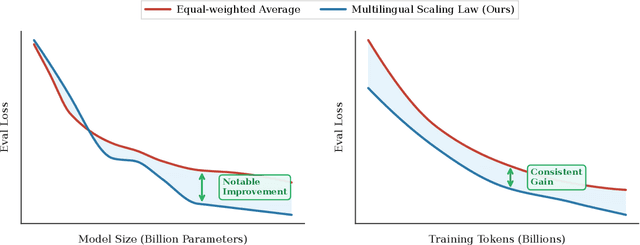
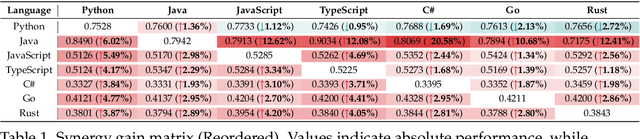
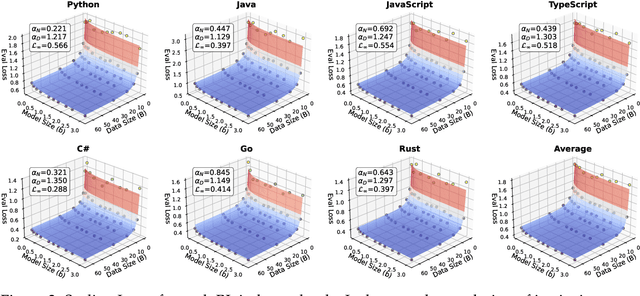

Code large language models (Code LLMs) are powerful but costly to train, with scaling laws predicting performance from model size, data, and compute. However, different programming languages (PLs) have varying impacts during pre-training that significantly affect base model performance, leading to inaccurate performance prediction. Besides, existing works focus on language-agnostic settings, neglecting the inherently multilingual nature of modern software development. Therefore, it is first necessary to investigate the scaling laws of different PLs, and then consider their mutual influences to arrive at the final multilingual scaling law. In this paper, we present the first systematic exploration of scaling laws for multilingual code pre-training, conducting over 1000+ experiments (Equivalent to 336,000+ H800 hours) across multiple PLs, model sizes (0.2B to 14B parameters), and dataset sizes (1T tokens). We establish comprehensive scaling laws for code LLMs across multiple PLs, revealing that interpreted languages (e.g., Python) benefit more from increased model size and data than compiled languages (e.g., Rust). The study demonstrates that multilingual pre-training provides synergistic benefits, particularly between syntactically similar PLs. Further, the pre-training strategy of the parallel pairing (concatenating code snippets with their translations) significantly enhances cross-lingual abilities with favorable scaling properties. Finally, a proportion-dependent multilingual scaling law is proposed to optimally allocate training tokens by prioritizing high-utility PLs (e.g., Python), balancing high-synergy pairs (e.g., JavaScript-TypeScript), and reducing allocation to fast-saturating languages (Rust), achieving superior average performance across all PLs compared to uniform distribution under the same compute budget.