 Add to Chrome
 Add to Firefox
 Add to Edge
R3D: Revisiting 3D Policy Learning
Apr 16, 2026
3D policy learning promises superior generalization and cross-embodiment transfer, but progress has been hindered by training instabilities and severe overfitting, precluding the adoption of powerful 3D perception models. In this work, we systematically diagnose these failures, identifying the omission of 3D data augmentation and the adverse effects of Batch Normalization as primary causes. We propose a new architecture coupling a scalable transformer-based 3D encoder with a diffusion decoder, engineered specifically for stability at scale and designed to leverage large-scale pre-training. Our approach significantly outperforms state-of-the-art 3D baselines on challenging manipulation benchmarks, establishing a new and robust foundation for scalable 3D imitation learning. Project Page: https://r3d-policy.github.io/

LAMP: Lift Image-Editing as General 3D Priors for Open-world Manipulation
Apr 09, 2026Human-like generalization in open-world remains a fundamental challenge for robotic manipulation. Existing learning-based methods, including reinforcement learning, imitation learning, and vision-language-action-models (VLAs), often struggle with novel tasks and unseen environments. Another promising direction is to explore generalizable representations that capture fine-grained spatial and geometric relations for open-world manipulation. While large-language-model (LLMs) and vision-language-model (VLMs) provide strong semantic reasoning based on language or annotated 2D representations, their limited 3D awareness restricts their applicability to fine-grained manipulation. To address this, we propose LAMP, which lifts image-editing as 3D priors to extract inter-object 3D transformations as continuous, geometry-aware representations. Our key insight is that image-editing inherently encodes rich 2D spatial cues, and lifting these implicit cues into 3D transformations provides fine-grained and accurate guidance for open-world manipulation. Extensive experiments demonstrate that \codename delivers precise 3D transformations and achieves strong zero-shot generalization in open-world manipulation. Project page: https://zju3dv.github.io/LAMP/.
Learning Adaptive Dexterous Grasping from Single Demonstrations
Mar 26, 2025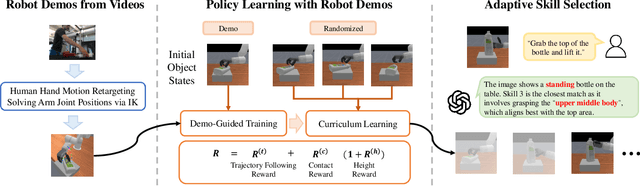
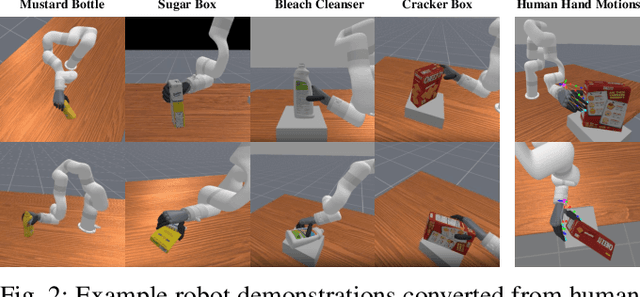
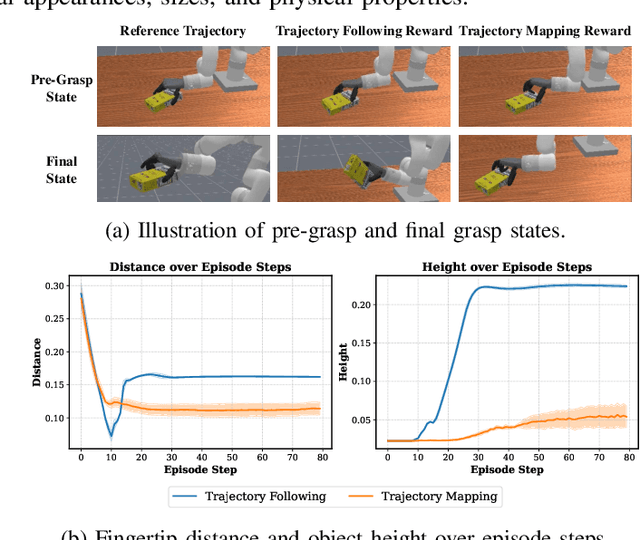
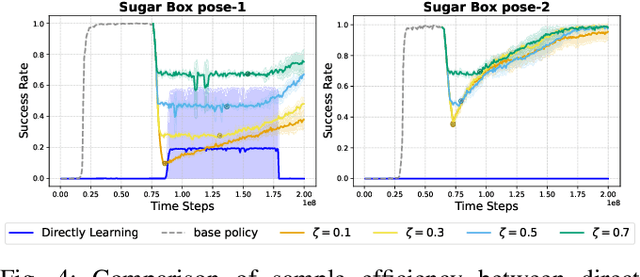
How can robots learn dexterous grasping skills efficiently and apply them adaptively based on user instructions? This work tackles two key challenges: efficient skill acquisition from limited human demonstrations and context-driven skill selection. We introduce AdaDexGrasp, a framework that learns a library of grasping skills from a single human demonstration per skill and selects the most suitable one using a vision-language model (VLM). To improve sample efficiency, we propose a trajectory following reward that guides reinforcement learning (RL) toward states close to a human demonstration while allowing flexibility in exploration. To learn beyond the single demonstration, we employ curriculum learning, progressively increasing object pose variations to enhance robustness. At deployment, a VLM retrieves the appropriate skill based on user instructions, bridging low-level learned skills with high-level intent. We evaluate AdaDexGrasp in both simulation and real-world settings, showing that our approach significantly improves RL efficiency and enables learning human-like grasp strategies across varied object configurations. Finally, we demonstrate zero-shot transfer of our learned policies to a real-world PSYONIC Ability Hand, with a 90% success rate across objects, significantly outperforming the baseline.
EasyHeC++: Fully Automatic Hand-Eye Calibration with Pretrained Image Models
Oct 11, 2024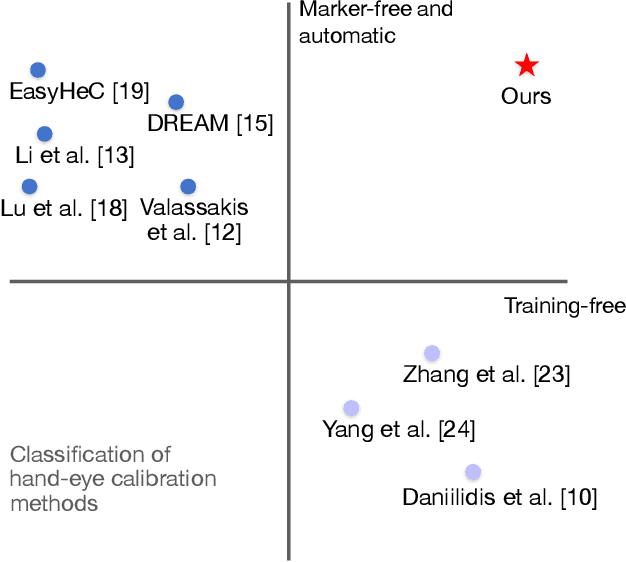

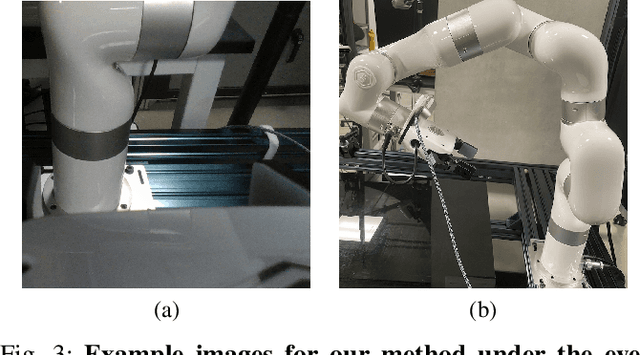
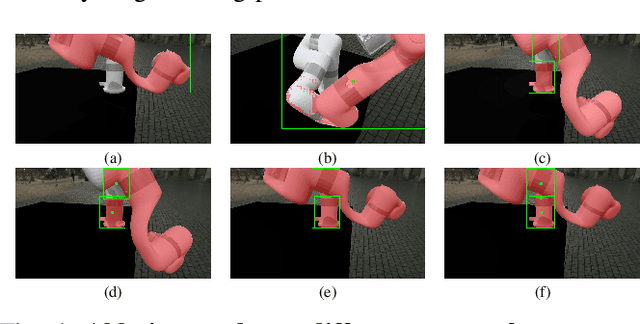
Hand-eye calibration plays a fundamental role in robotics by directly influencing the efficiency of critical operations such as manipulation and grasping. In this work, we present a novel framework, EasyHeC++, designed for fully automatic hand-eye calibration. In contrast to previous methods that necessitate manual calibration, specialized markers, or the training of arm-specific neural networks, our approach is the first system that enables accurate calibration of any robot arm in a marker-free, training-free, and fully automatic manner. Our approach employs a two-step process. First, we initialize the camera pose using a sampling or feature-matching-based method with the aid of pretrained image models. Subsequently, we perform pose optimization through differentiable rendering. Extensive experiments demonstrate the system's superior accuracy in both synthetic and real-world datasets across various robot arms and camera settings. Project page: https://ootts.github.io/easyhec_plus.